obiwanknabbe
-
Posts
444 -
Joined
-
Last visited
-
Days Won
4
Content Type
Profiles
Forums
Events
Store
Downloads
Gallery
Everything posted by obiwanknabbe
-
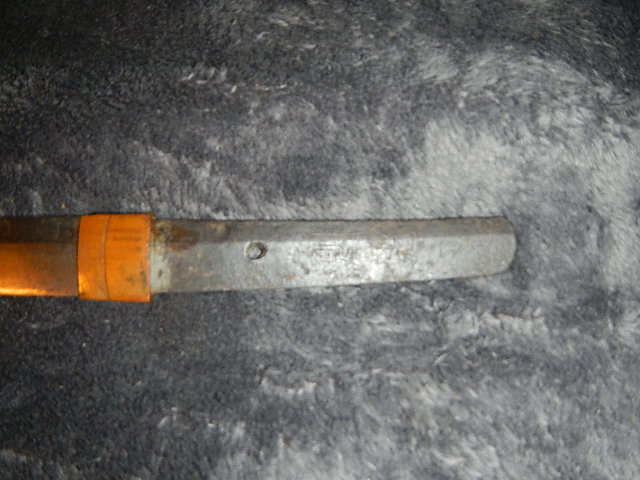
Can someone please tell me if this is an example of Kun-1399 (without totally giving it away to others who may be trying). I am using this as an opportunity to practice with my shiny new copy of Slaugh. Thanks Kurt.K If so...Is it just me or is the yasurimei different? Nakirishimei?
-
J. Reid, Thanks for that link. It seems the source of my information was dated (http://home.earthlink.net/~steinrl/gendai2.htm). The article in this database stated that the smiths were also allocated Mill Steel for their work (middle paragraph one). I was thinking that, perhaps, this is something that occurred towards the end of the war when tamahagane became scarce? Apparently not. Thanks for setting the record straight! Kurt.k
-
Brian, Respectfully, By "traditionally made" i was speaking about the entire process of production in the general Nihonto sense; That the blade be hand-made, folded, water quenched, and that it be comprised of Tamahagane. It is my understanding that many of the Rikugun Jumei Tosho also made many blades out of forged mill steel. These blades also would have had the star stamp on them. It is in that light that i suggested that there is a possibility that the blade in question may not be 100% traditionally made even though it has the star stamp. Unless I am mistaken, does not the star only indicate that the smith was a recognized member of the group, and not a testament as to what the blade was made of? Please correct me if i am wrong in thinking this. Is there a blurring of lines where "traditional" production is concerned between gendaito and nihonto? Kurt.k
-
Hi Jeff, I just thought you would like to know a little more about your smith. He was a member of the Rikugun Jumei Tosho (That is what the star stamp means). This was a group of "army approved" sword smiths that worked during the war. Here is a link to a site that explains the group in more detail http://home.earthlink.net/~steinrl/gendai2.htm Blades by this smith have been papered by the NTHK as Gendaito. Now just because other blades have been proven to be traditionally made, it does not automatically imply that yours is. BUT, it does not mean that yours is not either. Further study would be required to make such a determination. That star stamp is a good indicator though. Kurt.K
-
My question for my learned friends has to do with how certain variations of blades can reflect value. Specifically, in this case, nanban tetsu as a base material. Lets say I have two comparable swords from the same smith who is rated 40 pts , 2.5 million yen. Swords are pretty much the same quality and in a great state of polish. Does the fact that one is inscribed foreign steel have any effect on the value? Thanks Kurt.
-
Just out of curiosity, would this add to the value of a blade if it were, in fact, the blade that appears in Slough's book? Kurt.k
-

Helping a friend.. How did i do
obiwanknabbe replied to obiwanknabbe's topic in Translation Assistance
Thanks for the confirmation Moritia-san. This one took me a while to figure out. Just thought i would add, the indentation on the handle appears to be an old bullet strike. Its concave on both sides and actually a little sharp. It also shows groves that would correspond to the path and energy of a projectile. Thanks again! Kurt.k -
Question regarding Menuki selection.
obiwanknabbe replied to obiwanknabbe's topic in General Nihonto Related Discussion
Gentlemen, Its funny that the conversation has come to encompass Bamboo fittings, because that is a option i was considering for this particular project. The blade has sections of Sudare-ba Hamon. I thought Bamboo menuki would make an appropriate contribution to the overall aesthetics. Your right Guido. This is an interesting topic of discussion. Ikibana of the sword, so to speak! Kurt.k -
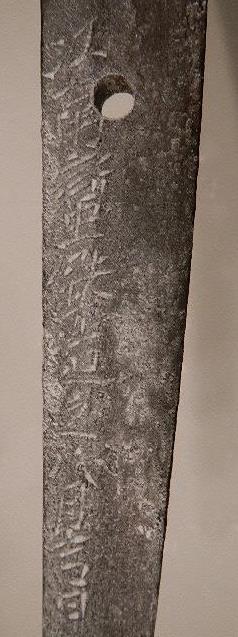
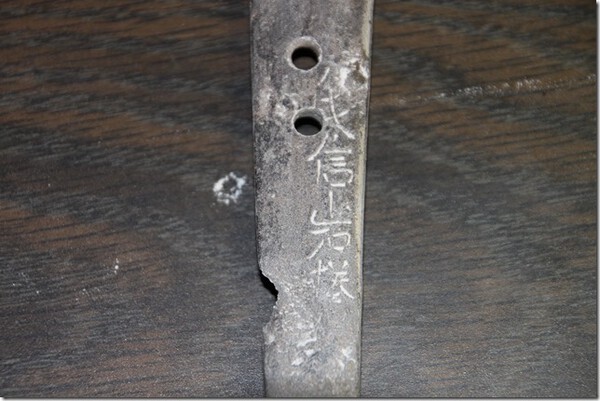
This is the Nagako of a very old looking wakizashi a friend of mine has. I have had a heck of a time trying to translate it but i think I finally got it. Does this read "ujinobu gammaku" 氏信岩捲 UJI104? The 3rd kanji looks a little off to be but this is the closest I could find. Any help from you folks would be greatly appreciated. Related, his blade seems to be in horrific, but moderately recent polish (perhaps early 1900's). Is there a reason that the geometry would be so bad on a Japanese polish. its wavy and the blade's thickness tapers drastically about half way up the blade.? Perhaps it was rushed into service, or something like that? It has a very nice copper tsuba that was clearly not made for the blade and the tsuka looks like it was off a small tachi but it has a hole for a sarute at the base. Thanks again for all you do Kurt.k
-
Hi everyone, I have a question regarding the selection of new menuki for a blade i have. When i purchased it, the ito was broken and the menuki were missing. The remaining fittings are all plain iron, with the exception of the tsuba, which has an Eggplant motif. My question is, what would a "proper" replacement be for the menuki? Is there a methodology or is it just a matter of taste. The blade was made circa 1675 +or -, it is a nanban-tetsu wakizashi, and it was made by Bushu ju Fujiwara Sukechika. The tsuka is also slightly longer than what i have normally seen (7.5 inches). I suspect the last owner was a merchant because when the sword is sheathed, it looks as if it were a katana. I seem to recall reading something about non-samurai doing things like that. Thanks in advance, Kurt.k
-
Funny Ebay Item Description
obiwanknabbe replied to hxv's topic in Auctions and Online Sales or Sellers
I am becoming a huge fan of all the AUTHENTIC, perfect condition, Gunto supposedly coming out of Japan... You know, the place where it is illegal to own or transfer them. Kurt.k -
Tsuba translation and authentication
obiwanknabbe replied to DGARBUTT's topic in Translation Assistance
Just a quick note from personal experience of restoring patina on various metals. Is that tsuba silver? if so, and you want to return a nice patina to it, put it in an empty cardboard shotgun shell box. Then put it over a radiator. In a few days it will develop a beautiful patina. The small traces of residual sulfur in the box will react with the silver, causing rather rapid, controlled, oxidation. The longer its in the box, the deeper the patina will be. If it is steel, it will still work, but take quite a bit longer. This is a good way to avoid harmful chemicals or acids that some people tend to use in this process. I will add that Brain's recommendation of professional repatination is always the best course of action. Kurt.k -
A little wakizashi with a LONG mei
obiwanknabbe replied to obiwanknabbe's topic in Translation Assistance
Thanks for the correction. I did not find much about this smith other than when he worked and that he was rated 15 points in Hawley (if its the same man). Can anyone shed some light on this mans work or what he is known best for? Regards, Kurt.K -
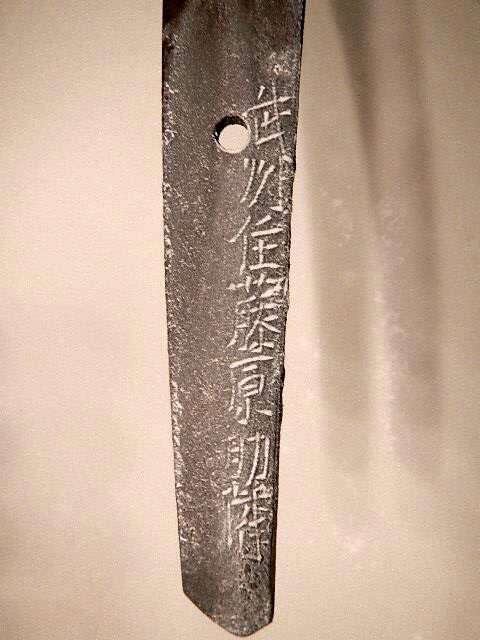
Hi everyone! I have come into possession of another nice little wakizashi in relatively fine order. When I took off the tsuka, I was pleased to find a rather long mei inscription on both sides. I THINK i have done pretty well with the first part of it, that being the makers name. Please correct me if I am wrong but I think it reads "Ishu ju fujiwara aki ???". I just cant make out the last kanji. Now the other side of the inscription has me stumped. I am pretty sure its the date as I can make out a few numbers and common kanji here and there. Is this a lucky day inscription or is that date zodiacal ? Kore ? ? (nen?) ? ? Kore 8th Month ? ? Thanks again for all your help Kurt.K

-
How does one determine value?
obiwanknabbe replied to obiwanknabbe's topic in General Nihonto Related Discussion
My thanks to everyone who responded! Indeed this is a very complicated field of study. That is likely one of the things that drew me in, aside from all the Samurai movies I grew up on. I believe specialization is an important tool in this game. Having started with Gunto blades, I have become familiar with the average going rates and the things to look for. Now that I am moving further back in history, I find myself gravitating towards late Shinto, early shinshinto period pieces. Looks like I have a whole new batch of things to learn before I break out the wallet again. Good thing I don't sleep much. Thanks again.. Kurt.K -
As a new collector, I am very curious about just how to determine the relative dollar value of a particular sword? In other areas of collecting, such as coins or stamps, there exist price guides like the Red book. Is there any such tool for Nihonto collectors. I know that Hawley has a point system, and that Fujishiro used a (sword="X" yen) approach to rating certain smiths, but how do we equate this into fair market value of a particular blade (or at least come close to ball-parking it), especially if it is an unrated smith or unsigned piece? In short, how does a professional, or anyone, determine that sword "X" is worth selling price "Y"? Is it a simple "its worth what your willing to pay" paradigm or is there a more scientific approach to making that call to avoid getting burned? Thanks to all Kurt.K
-
Just thought I would share this link with everyone who may be interested in working with Urushi. http://www.namikawa-ltd.co.jp/cgi/item_ ... te=14&no=1 They have several colors to choose from and for many applications. best regards. Kurt. K
-
The Chinese are faking showa-to now
obiwanknabbe replied to brannow's topic in Auctions and Online Sales or Sellers
I don't think you would have to worry about the fakes affecting the market too much, Gabriel. Look at the prices of CSA swords and the like. Yes, there are many fakes made to fool unwary collectors, but the real ones now garner a small fortune. Ultimately I think the future of the Militaria prices will be both market driven and inexorably tied to increasing age and rarity. That, and lets face it, Japanese swords are WAY cooler than most :D . Every time a new Samurai movie comes out, a new collector is born. As for a means to navigate the fakes, who knows? We may see some form of authentication papers being developed for such swords, much like NGC or PCGS for currency (million dollar idea anyone). That would only help maintain the value and integrity of real pieces. I recall EBAY instituting a rule that all coins sold with a grade attached to the listing had to be certified by one of the recognized grading companies. The same may become true for true antique blades. Wishful thinking? Perhaps, but it has happened in other arenas of collecting. For now, all I can recommend to new collectors is a lesson I have learned from all of you wonderful folk: ASK QUESTIONS BEFORE you fork over money. Kurt.K -
The Chinese are faking showa-to now
obiwanknabbe replied to brannow's topic in Auctions and Online Sales or Sellers
Better than most, but nah... No yasuri mei. Inscriptions look long stroked too, like it was done with large chisel. Just my 2 cents. Kurt. K -
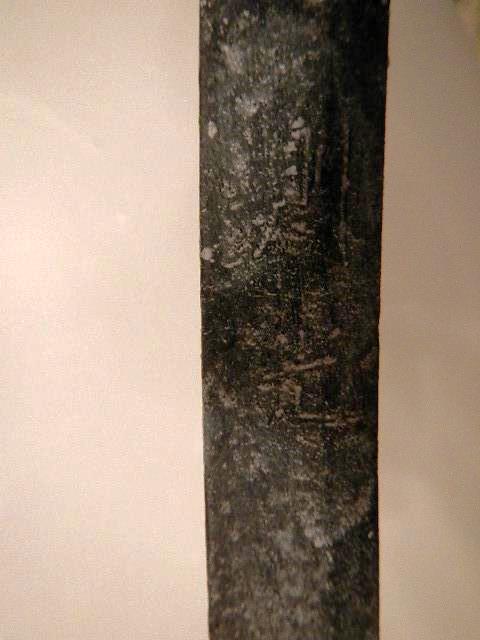
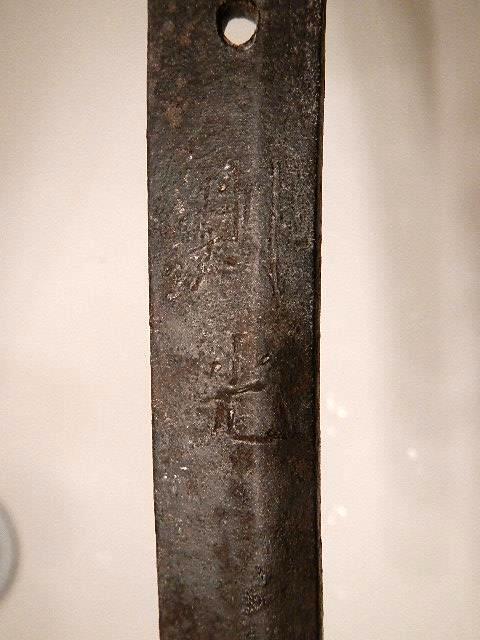
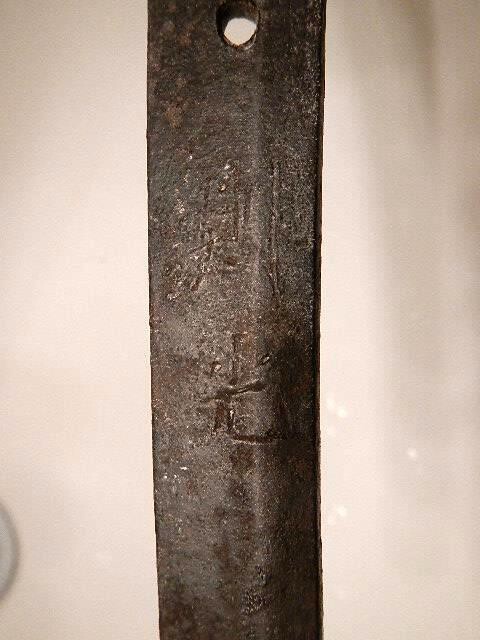
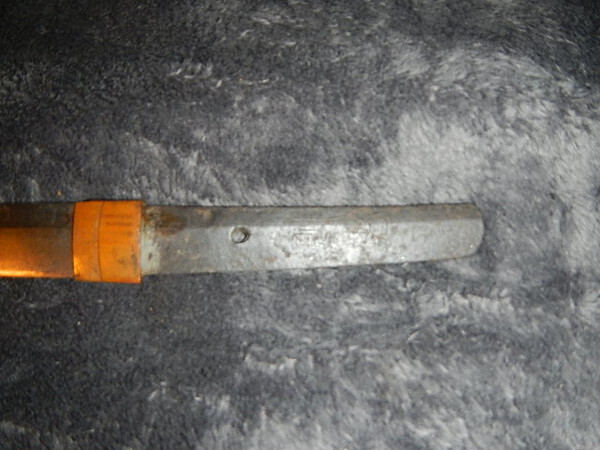
So i have found a few blades out there that have a very similar nagako and Mei. Those that were most similar were listed as being "Kazu uchi mono" or Bundle Swords. The Niji mei seems to be a constant as does the stubby nagako. What I didn't see was any other blades with a Kao on the Mune. Any of you guys want to weigh in on this? Kurt .k
-
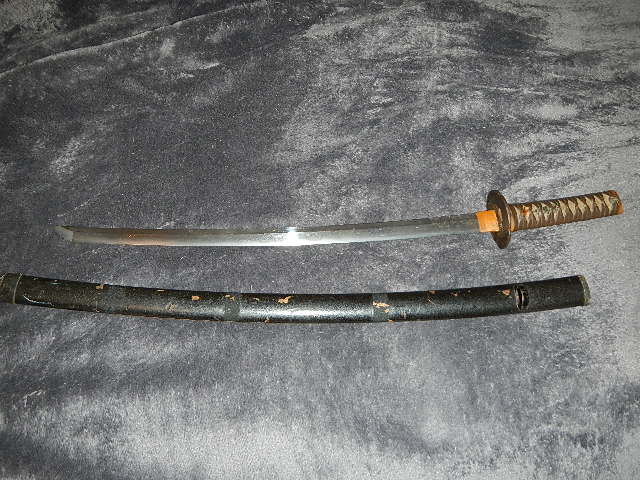
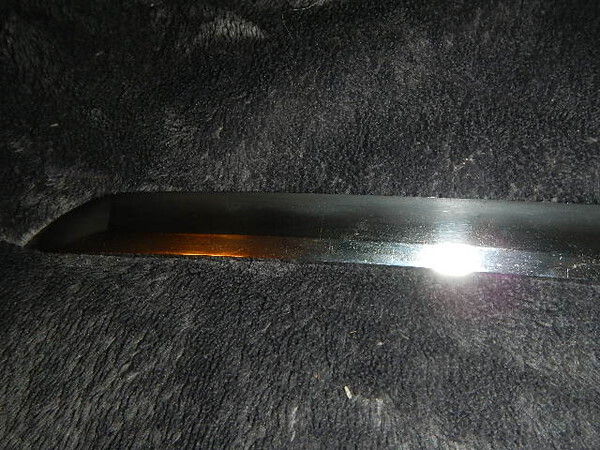
Hi everyone, Well, it looks like I got lucky again (does it seem to everyone else that swords are coming out of the woodwork lately?). It is a very nice little Wakizashi which is signed, abet VERY faintly, with some nice fittings (Rooster on the tsuba and ground hogs on the koshirae). I am guessing its late koto, going by the slender shape and the very dark rust on the nagako. It appears to have Mokume Hada and Gunome hamon. The nagako is short and on the stubby side. There is also a Kao on the mune side of the nagako. The 1st Kanji is very faded. It looks close to "Nori" 則 I think the 2nd Kanji is "Mitsu" 光 Any information on who this really is would be greatly appreciated. Thanks again for all you guys do, Kurt.K



-
Hi everyone.. I have a Tsuka that I need re-wrapped. I know about Mr Lohman's services, but he seems backlogged. Is there anyone else you folks can recommend? Thanks.. Kurt .K
-
Hi everyone, A while back i was fortunate enough to stumble across a Koa Isshin Mantetsu katana at a local antique shop ($100.usd . The original mounts had basically disintegrated from dry rot over the years so I embarked on a full mounting restoration using the original koshire and fittings. After weeks of work, I can say that It is coming our beautifully. As I "wrap things up" (bad tsukamaki pun) I was wondering, is there a correct tassel for the tsuka or would the officers rank have been the only consideration? Thanks in advance. Kurt.K
-
Thanks for the correction Steven, Learning is what I am here for. Kurt .K
-
Startrek (i dig the handle) It has been my experience that whenever there is a sword for sale and there are NO pictures of the Nagako, it sends up a red flag. Looking at the pictures, it looks as though some of the fittings may be real, but pieced together around a modern made blade. The Samegawa is identical on several of the blades... (and unless im wrong, black same was not typically used on army mounts) The Boshi looks short as well. I agree with the other guys here.. pass on it. Kurt. K