Steve Waszak
-
Posts
979 -
Joined
-
Last visited
-
Days Won
4
Content Type
Profiles
Forums
Events
Store
Downloads
Gallery
Everything posted by Steve Waszak
-
Hi Keith, I was trying to find my source material on the use of the kogai, but haven't been able to locate it in my library just yet. I'll keep looking... What you observe concerning the use of the kogai is partly what my understanding is based on. However, the main thrust has to do more with the use of the kogai as an implement by which the warrior of elevated rank would "make himself presentable" to his superiors (i.e. as a hair-"adjusting" tool). As I said, I am trying to find my sources for this understanding of the use of the kogai, so it's quite possible I'm mis-remembering/misunderstanding something here. However, I am pretty sure the kogai occupies a higher place in the ordering of tosogu than does the kozuka, and part of the reason for this is that its use was restricted to the more "noble" men in the buke. For the purposes of studying tsuba, though, the actual use of the kogai is perhaps a bit less important than simply knowing that it had a higher "rank" than the kozuka/ko-gatana, and that, therefore, early tsuba with kogai-ana (original kogai-ana, of course) had to have been meant not only for bushi (rather than other classes), but for higher-ranking bushi. Having said all of what I have here, though, I must confess that the whole matter is quite muddy to me in that I not infrequently see tsuba with TWO kogai-ana or two kozuka-ana. While the latter case I could sort of understand (the warrior in the field desiring yet one more blade on his person), why would two kogai ever be necessary or desired. I am assuming here that kogai-ana actually WERE meant for kogai, incidentally. If this is not the case, and in fact either implement could be used with either type of ana, then I frankly am not sure what to make of it all! lol... Cheers, Steve
-
Frankly, I'm not sure it matters all that much whether, by mid-Edo, a given tsuba was made for a person of samurai class versus one of the "lower" classes. By this time, the "samurai" were merely government bureaucrats; they certainly were not warriors. By the time of the "47 Ronin," more than a century had passed since Sekigahara. There was no one alive who had fought in a battle, no one for whom the term "warrior" meant anything beyond a fanciful and romantic imagined notion of himself. Come the turn of the 18th century, few knew even which end of the sword to hold. For most of them, a tsuba was akin to a gold watch---a precious bauble by which to impress their fellow bureaucrats. This is one big reason (along with the ascent of merchant class power [and taste]) for the dominance of kinko (soft metal) tsuba by the 18th century. A tsuba certainly no longer had to withstand the stress of any sort of actual fighting, and could function merely as the male jewelry it essentially was. While the decline of the buke was precipitous by this time, those of this class who could afford pricier tsuba seem to have been as enamored of the same relatively gaudy kinko stuff that those of the "lower" classes were. But as others in this thread have observed, it's hard to tell, exactly, who such tsuba were "for." After all, nothing would have prevented a sword-wearer to outfit his wakizashi with a larger-than-usual "wakizashi tsuba," unless I'm mistaken. I do believe that in times earlier than the mid-Edo, the kogai was reserved not only for bushi, but for higher-ranking bushi, so those tsuba from the early Edo Period and earlier whose kogai-ana were original may have been meant for/used by high-ranking warriors. I would imagine, however, that, even if this is an accurate understanding, by the 18th century, such divisions were no longer in play, so tsuba produced then which had kogai-ana may just as well have been meant for merchants as they were for the samurai. Then, too, many earlier tsuba could and likely did have kogai-ana added to the existing plate, again probably for a person of whatever class, as long as it could be afforded. The last vestiges of tsuba as functioning fighting tsuba and/or as possessing the first aesthetic principles as presented in Torigoye and Haynes' Tsuba: An Aesthetic Study, pretty much petered out with the end of the early Edo period (pre-Genroku), and in most cases, well before this. Of course, there are exceptions. But for the most part, I believe this to be the case. For me, therefore, post-Genroku tsuba are rarely of interest (again, there are a few exceptions), and honestly, very few even of post Kan-ei times. Few past this time are invested with excellence in the first aesthetic principles (see reference above), few possess or present the efforts to embody or express the more elevated aesthetic ideals that tsuba of the late Muromachi, Momoyama, and early-Edo periods did, and as just discussed, the "samurai" were no longer samurai, not, at any rate, as they had been for the years pre-Genroku. As for the years pre-Edo which were much "looser" as regards who may own/wear a sword, it is true that the restrictive measures put in place in the Momoyama Period had not yet materialized. As far as the way this impacts tsuba, however, much will depend on the individual guard. Certain types of tsuba were unquestionably made strictly for the more elevated members of Japanese society, and there would have been little chance (read NO chance) for any outside of this elevated level to own such a piece. Recall what I said above, too, regarding the use of kogai. Pre-Edo, unless I am mistaken, only those bushi of higher rank could use the kogai; so any tsuba commissioned/used by such persons were more likely, then, to include a kogai-ana (I'm assuming, here, that we're not discussing tachi, of course), while those tsuba meant for lower-ranked bushi would not have a kogai-ana, but perhaps just the kozuka-ana). As has been said in this thread, there is much to discuss, ponder, and research in this area. But I suppose I would want to ask these questions: of what particular interest is it to attempt to discern which mid-Edo tsuba may have been meant for those of the samurai class, and which may have been meant for those of other classes? What does one look to gain by discerning this distinction (assuming that there is one, and that, if so, such a difference can be ascertained)? I am quite genuinely curious to understand such a pursuit... ) Cheers, Steve
-
Hi Ford, Agreed, this seems VERY thin. John, any chance you could post photos of the mimi, maybe a side-on view, and/or a 3/4 shot? Cheers, Steve
-
Lee, Thanks for posting that link. Interesting. But notice how much thicker this piece is than the one originally posted in this thread. That is an important point, I believe. How many Edo Period tsuba do we know of that were 2mm (or less) in thickness? Even 3mm is rare in Edo times... Cheers, Steve
-
Yes, I did say I thought it possible that the zogan may have been added to an earlier ita plate... What you say here, Curran, is one reason that papers don't mean a whole lot to me. There have just been too many iffy calls made, as your example regarding the ko-tosho/"Shoami" illustrates. But then, given that so many of the "schools" that we find papers attributing tsuba to were convenient "taxonomic" inventions of various scholars and dealers of the Meiji Period, rather than existing as such when the tsuba in question were made, the notion that "correct" attributions can even exist in many cases is highly dubious. When one throws in all of the "cross-fertilization" in design and construction methods increasingly seen in the Edo period, it should invite us to be less concerned with identifying what "school" given mumei tsuba might be. We may want to ask ourselves why we are as focused as we are on the "identity" of tsuba, rather than (it would appear to me) on what makes a tsuba qualitatively excellent (or not). The fact that this latter would be seen as "too subjective" does not in the slightest invalidate this sort of inquiry, at least, not any more than such considerations would invalidate any form of critical examination and appreciation of art. Perhaps I am veering too far off topic... Apologies. Cheers, Steve
-
Higo? Hmmmm... I don't see this as Higo, I'm afraid. The plate is way too thin for Higo, the hitsuana do not speak of Higo sensibilities, and I don't see Shimizu steel here. The bori is too naively done to be Matashichi. If it is Higo, it's the thinnest plate I've ever heard of being attributed to a Higo artist... Cheers, Steve
-
Hi John, An appealing, intriguing tsuba here. My initial thought is that the zogan may be a later addition to an earlier ita plate. Your observations of the various features of the tsuba, including those that are "at odds," are good ones. As you say, while the Kunitomo employed the sawari inlay and forged quality steel for their tsuba, the overall design of this piece speaks to a pre-Edo sensibility, I would say. The thinness of the plate, in particular, has me thinking this tsuba can't be Edo, or at least, not the part of the Edo period in which Hazama tsuba are thought/known to have been made. Further, again as you have noted, the rendering of the motif is not done in a manner consistent with usual Hazama work. In fact, the only real strong indicator of anything having to do with Hazama, it seems, is the use of sawari inlay. I don't recall offhand if sawari was an invention of the Kunitomo, or if it had existed/been used well prior to their popularizing of it. In any case, the dimensions of this tsuba, together with its design (shape, engraving, large, elongated ryo-hitsu, and rendering of the motif) and metal quality, suggest a pre-Edo time of manufacture, specifically Momoyama. I would suppose ko-Shoami here. Whatever it is, it is a really strong, highly appealing tsuba, I think. I will look forward to others' comments... Thanks for presenting this, John... Cheers, Steve
-
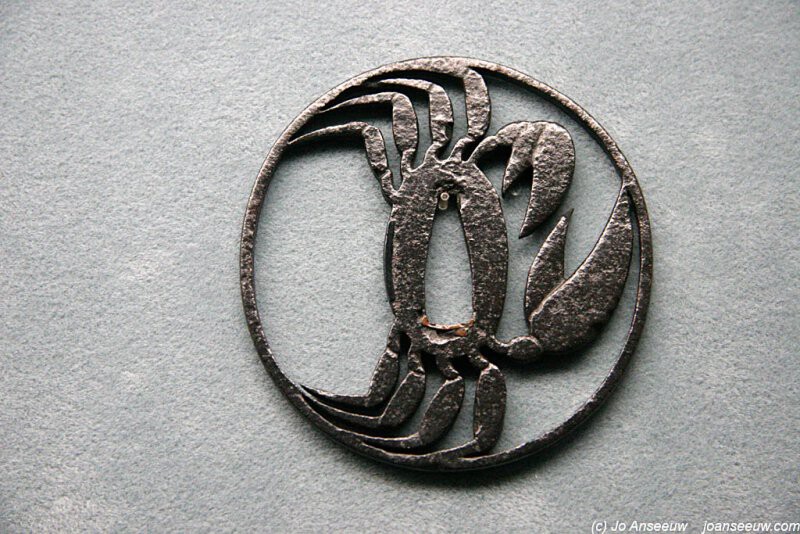
Interesting tsubs, Mariusz. I don't think I've seen one quite like this before. I wouldn't be able to locate this piece with confidence in a particular school, but I would agree with Ford: not cast and of the Edo Period (mid-to-late-Edo). Here is an image of the iconic Owari crab tsuba from the Tokyo National Museum. Obviously very different from yours there, but since you asked for crab tsuba... Cheers, Steve
-
Thanks for the explanation, Reinhard. Very interesting and thought-provoking. ;o) Cheers, Steve
-
Hi Reinhard, I'm just a little confused: when you say "this" in the above sentence, could you specify exactly what you're referring to? Thanks. Cheers, Steve
-
Ford, you allude here to one of the long-time "mysteries" concerning Myoju: how to explain his emergence when there is so little (if any) indication of where he could have learned his skills, found the inspiration for his motifs/designs, etc... There are exceedingly murky references to the "ko-Umetada," but even this group is not, as I understand it, to be seen as the foundation from which Myoju emerged, since the ko-Umetada are taken to be an un-related group working concurrently with Myoju, rather than earlier. So, as you say here, Ford, how to explain his skills and designs? The idea that there actually may have been two Myojus---one the father of Shinto blades, and the other a talented tsubako---is actually reminiscent of the debate about whether the katchushi Myochin Nobuiye was the same man as the tsubako Nobuiye (the thinking at the time of this debate being that there was only one tsubako Nobuiye). I believe this latter debate has now been "decided," with the conclusion drawn that the katchushi and (one of) the tsubako were not the same men. It is worth noting that, in no small way, it was close scrutiny of the respective mei involved that allowed for a reasonably confident determination to be made (in addition to observations made concerning techniques in forging, the likelihood that a famous armorer would have the time to develop the skills to make such superb tsuba and then also make so many of them, etc...). So, I go back to the matter of the mei on the blades' nagako and that on the tsuba: are these mei of the same hand, or not? It seems likely that it would require actually having the blades and the tsuba on a table together to have any chance of knowing for sure, but maybe not, I don't know... In any event, the "precedent" set by the Myochin Nobuiye example suggests the possibility, at least, that there were indeed two Myojus. This "precedent" is even more plausible given that the time periods involved (Nobuiye, Myoju) are not too distant from one another, and that the practice of signing tsuba was at those times still relatively novel (thus suggesting the lack of a firmly-established tradition prescribing the do's and don'ts of signing tsuba). Tangentially speaking, I think more research has to be done on Momoyama practices as regards the possible formation of ateliers in which small groups of talented artisans produced pieces under the supervision of "masters" and who, with the master's approval, "signed" their pieces with the workshop "mei." In such a scenario, we would have excellent tsuba being produced not by one great artist with a famous name, but by two or three, or even more, perhaps, all signing with the same mei. Likely? I don't know. But worth considering, I think... ;o) Cheers, Steve
-
Great discussion, guys... There is another Myoju tsuba whose photo really should be reproduced here: it is illustrated in the Haynes Catalogue, #7. I don't have a scanner at the moment. Could anyone who has this catalogue scan that image and post it here? Thanks... ;o) Cheers, Steve
-
Sorry, Paul... I selected the text and hit the "quote" button... Not sure what happened. Maybe Brian can get in there and correct it? It was Ford I was looking to quote, I believe... ;o) Cheers, Steve
-
Two more Myoju tsuba...


-
Fascinating discussion... I have a couple of thoughts/comments on the above... First, how do the mei on the tsuba and those on the nakago of his blades compare? I haven't examined the two in any comparative way before, but obviously, this would have been the subject of much scrutiny. For those who doubt that the Myoju who made the blades is the same man who made the tsuba, I would imagine that there may be a bit of doubt in your minds as to the similarity in the respective mei, no? As to the issue with Myoju's dates vs. Ogata's, if the blade Myoju was one man, and there was another Myoju who made the tsuba, it would be theoretically possible that the tsuba man came later (i.e. during Ogata's time)... However, Ford, when you say that the early Higo tsubako were "coming to the fore at the same time Ogata Korin was active," I'm a bit confused. According to my information, Hirata Hikozo died in the 1630s, Shimizu Jinbei died in the 1670s, and both Hayashi Matashichi and Nishigaki Kanshiro died in the 1690s. If Ogata Korin was born in 1658, he'd have been just over 30 years old by the time all of the four Higo masters were dead. So unless you're speaking of second-generation "early Higo masters" in your statement here, the dates would seem to pose a problem. Why is it not possible (it would seem) that, rather than it always being the painter who inspires the tsubako, it is the tsubako who inspires the painter? If Myoju did make the tsuba he is credited with, and if he made them when he is supposed to have, given his illustrious name, and given that his work would have been very well known among the upper class, why couldn't Ogata Korin (and for that matter, any of the four Higo masters) have been influenced by Myoju? If the mei on the nakago and the mei on the tsuba align (and if the experts who are anal about examining mei so closely assert that they do, in fact, align), then what seems at least as likely to me as any of the ideas expressed thus far in this thread is that Myoju did indeed make both the blades and the tsuba, and it was (one or more) of the Higo masters who borrowed from Myoju. The one guy to look at, especially, is Hirata Hikozo. He is the earliest of the Higo men. He was the teacher, I believe, of Shimizu and Nishigaki. He is the master of soft metal among the Higo men (as Myoju is a master of soft metal, also). I know that Hirata Hikozo came to Higo later in his life, but I can't recall off the top of my head where he migrated from. If it turned out that he and Myoju lived in the same area for a while earlier on, perhaps this may explain, in part, the resemblance of some Higo work to that of Myoju. As I say, a fascinating discussion. I'll look forward to further thoughts... Cheers, Steve
-
Cool tsuba, Grey. Thanks for posting. Any attribution? Cheers, Steve
-
Great images, Markus. Thanks for posting these... So hard to say without having the pieces in hand, and even then... Actually, if these were works of the mid-Muromachi, I'd be more confident of this loss of zogan actually being purely loss of zogan; but because Myoju was a Momoyama artist, the question becomes clouded, as the Tea aesthetic was so ascendent then. The power of the unfinished statement was a fairly major aesthetic ideal in those times... Thanks again for posting these images, Markus... ) Cheers, Steve
-
I would agree: more zogan, but not necessarily zogan everywhere we see the carving "to be inlaid." Steve
-
Hi Mark, Oh yes, this is not all that unusual, actually. To deliberately "leave out" inlay in spots is to pursue that wabi-sabi aesthetic, something akin to potters deliberately gouging the foot (or lip) of a tea bowl. Myoju was known as a master of inlay, at least on a par with the ko-Shoami. I find it unlikely, though not impossible, of course, that so much zogan would have "fallen out" of the tsuba... Just my opinion, of course... ;o) Cheers, Steve P.S. Ford, a piece's having attained "only" Hozon status doesn't mean that's all it merits; it simply means it hasn't been submitted for higher papers, no? Or am I wrong about that?
-
Agreed. Masterwork. The subtleties this tsuba exhibits are exceedingly impressive, from the nuances involving its overall shape to the various relational details concerning the placement of the sukashi, the dimensions of the sukashi, the finish of the metal (I don't think it's as degraded as it appears; I think much of this is deliberate), and the "unfinished" aspect of the zogan. The contrast between the rather formal, upper-class tastes expressed via the tsuba's shape, sukashi, and perimeter work near the mimi (note that this bori/design also extends onto the mimi itself), on the one hand, with the "weathered" metal of the surface and the "missing" inlay, on the other, allows this tsuba to achieve a loftiness of aesthetic expression achieved by few others. I will agree that the photos could be better, but its qualities still shine through even these less-than-ideal images. Incidentally, as Umetada Myoju was a celebrated artist/smith in his own time, working in Kyoto, and given that his reputation never sagged after his passing, it seems unlikely that any of his works would be allowed to rot away in some untended tansu. This consideration, then, lends credence to the reading of this tsuba, in its current state, as presenting the aesthetic it currently does (more or less). Thanks for presenting this, Eric... Cheers, Steve
-
Hi Roy, Would you happen to have photos of the tsuba? Cheers, Steve
-
 Koshoyama bookseller has a copy for 14,700 yen... There's a link to their site here at NMB... Cheers, Steve
 -
Bruce, Did you mean "state-of-presentation" or "state of preservation"? I was just a bit confused... Thanks, Steve
-
Hi kmark, What you'll want to pick up is the Tokyo National Museum's publication of Uchigatana Goshirae: The Art of Japanese Sword Mounting. There are a number of excellent late-Muromachi and Momoyama period koshirae illustrated in this coffee-table-sized book. Highly recommended. Cheers, Steve
-
Hi Rich, To my eye, yours is older and quite differently executed with regard to finish than the other. I would suppose the other is a "copy" of yours, meaning that it is a rather later rendering of the same design. Judging from photos here only, of course, but yours appears to be richer, with a deeper patina, and more carefully modeled sculpting of the details. In-hand may tell a different story, but that's what the photos suggest to me, anyway... ) I don't see these coming from the same workshop, as the metal and metal work appear too different... Cheers, Steve