Steve Waszak
-
Posts
998 -
Joined
-
Last visited
-
Days Won
4
Content Type
Profiles
Forums
Events
Store
Downloads
Gallery
Everything posted by Steve Waszak
-
A key component to all of this is recognizing a very human weakness we all (almost all?) share: our discomfort in remaining in a state of not knowing, or, as I like to call it, "living with the question." Many experience no small degree of anxiety in this state; the instability is too uncomfortable, perhaps even threatening in some way. But there is simply so much we do not know, and can never know with 100% certainty, about nihonto and tosogu, especially those made many centuries ago. Often, the best we can do is narrow down possibilities, recognize with clarity where the knowledge gaps are, and engage in the most informed speculation we can about plausible/likely answers. Not infrequently, the source of such speculation will arise not from the sword world itself, but out of related contexts (historical, cultural, political, social, economic, regional, etc...). Again, deepening our knowledge of these contexts is much less likely to concretely/objectively answer very specific questions we might have about a given blade or tsuba than it is to sharpen our speculation, so that certain probabilities are enhanced, vis-a-vis others. Living with the question is a discipline, and does take some conscious effort to reinforce, in my experience. Given the inherent esoteric and arcane nature of Nihonto and Tosogu (particularly as regards pieces made some centuries ago), even the most adept LLM will present with a multitude of information/knowledge gaps that cannot be bridged. As long as this can be recognized and accepted, LLMs could have great value, so long as they "begin at the beginning," as Glen and Curran and Thomas have emphasized.
-
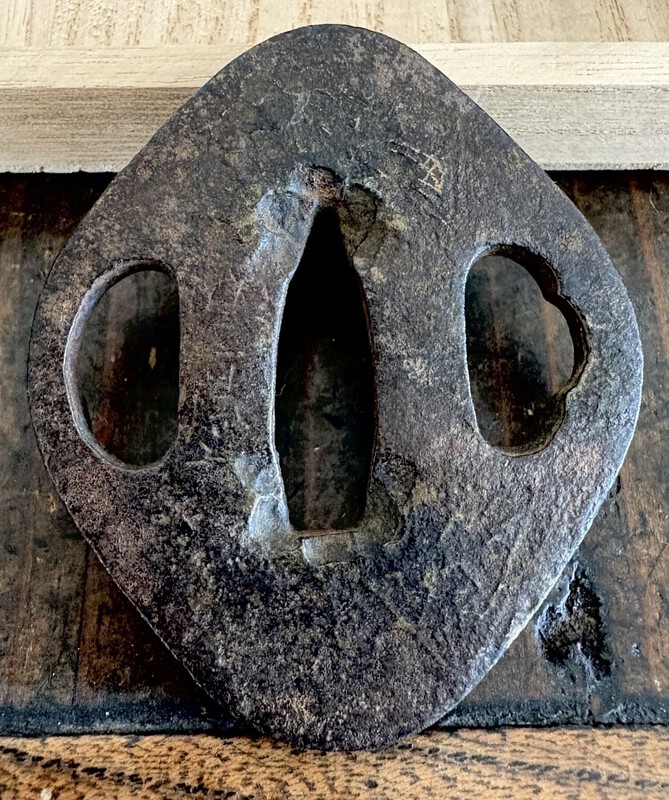
Yamakichibei has SOLD.
-
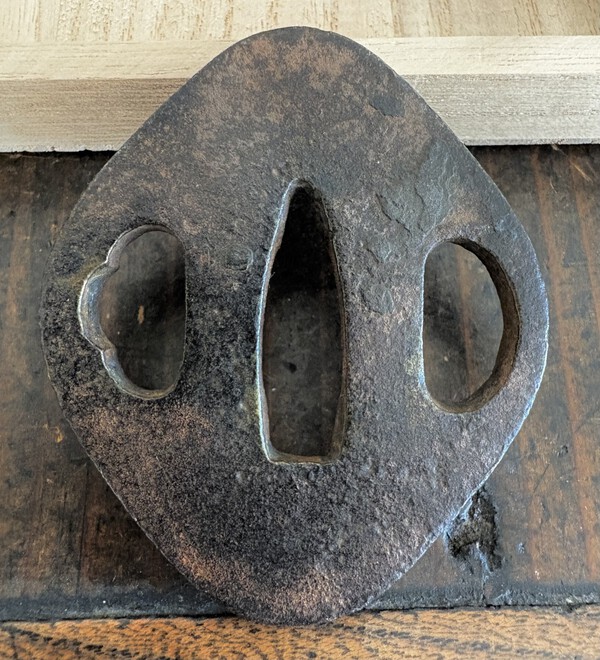
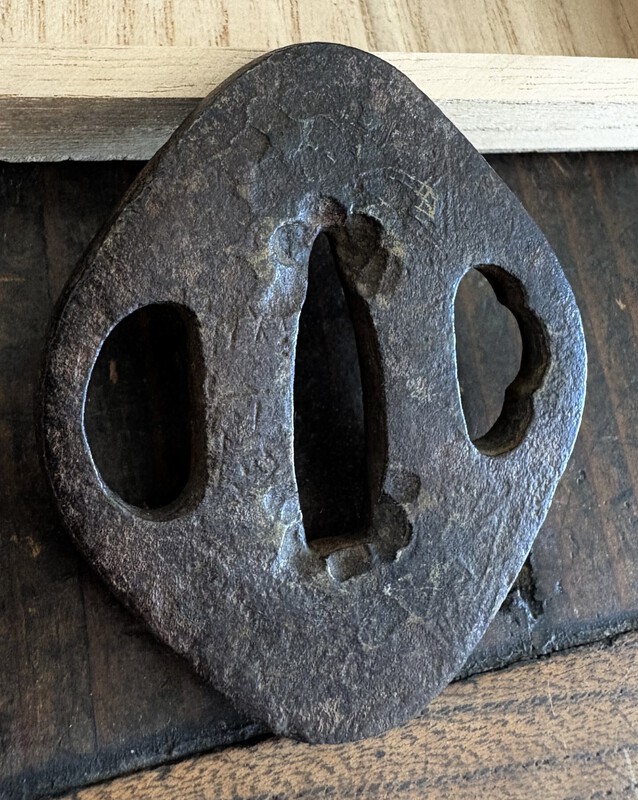
-
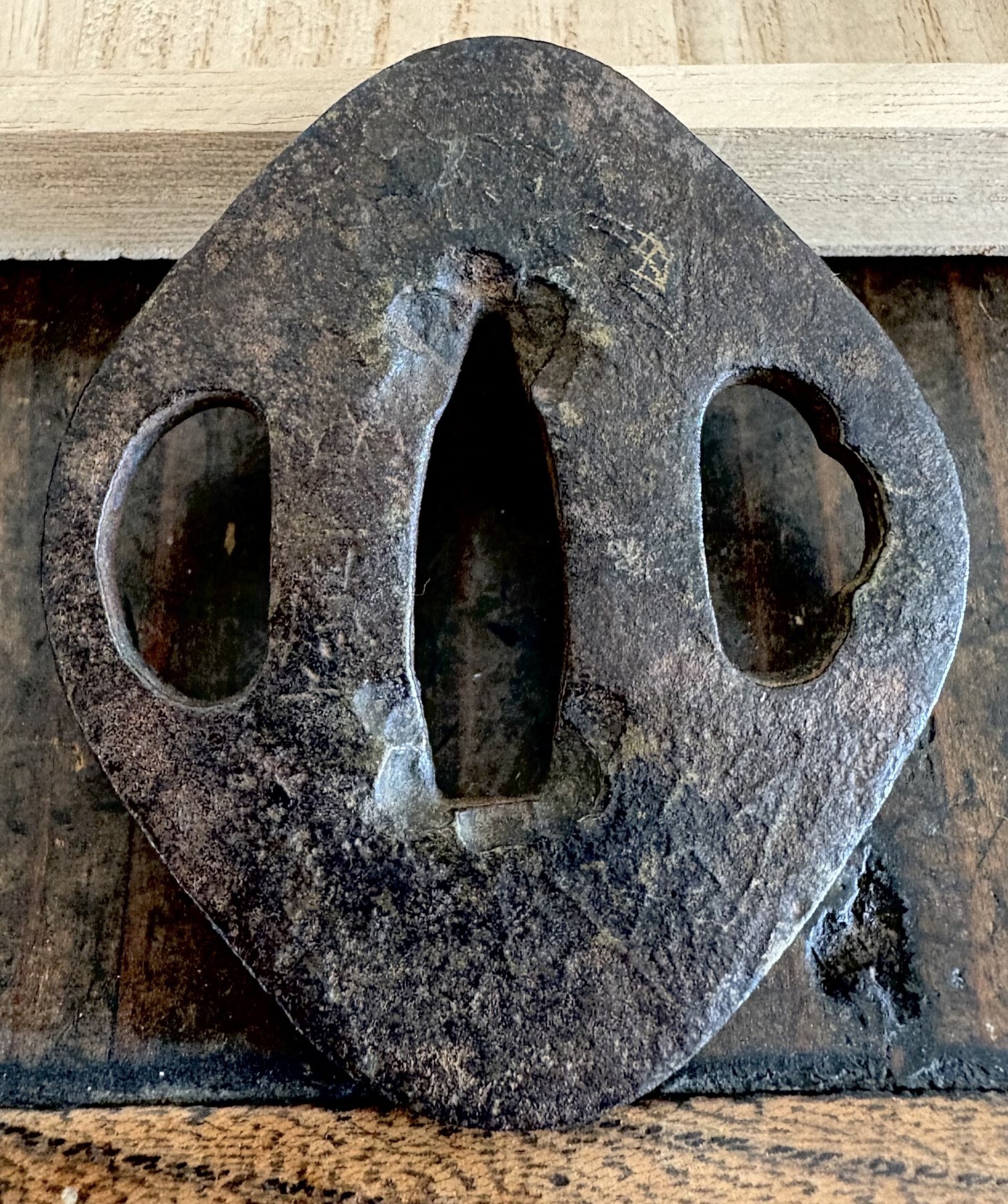
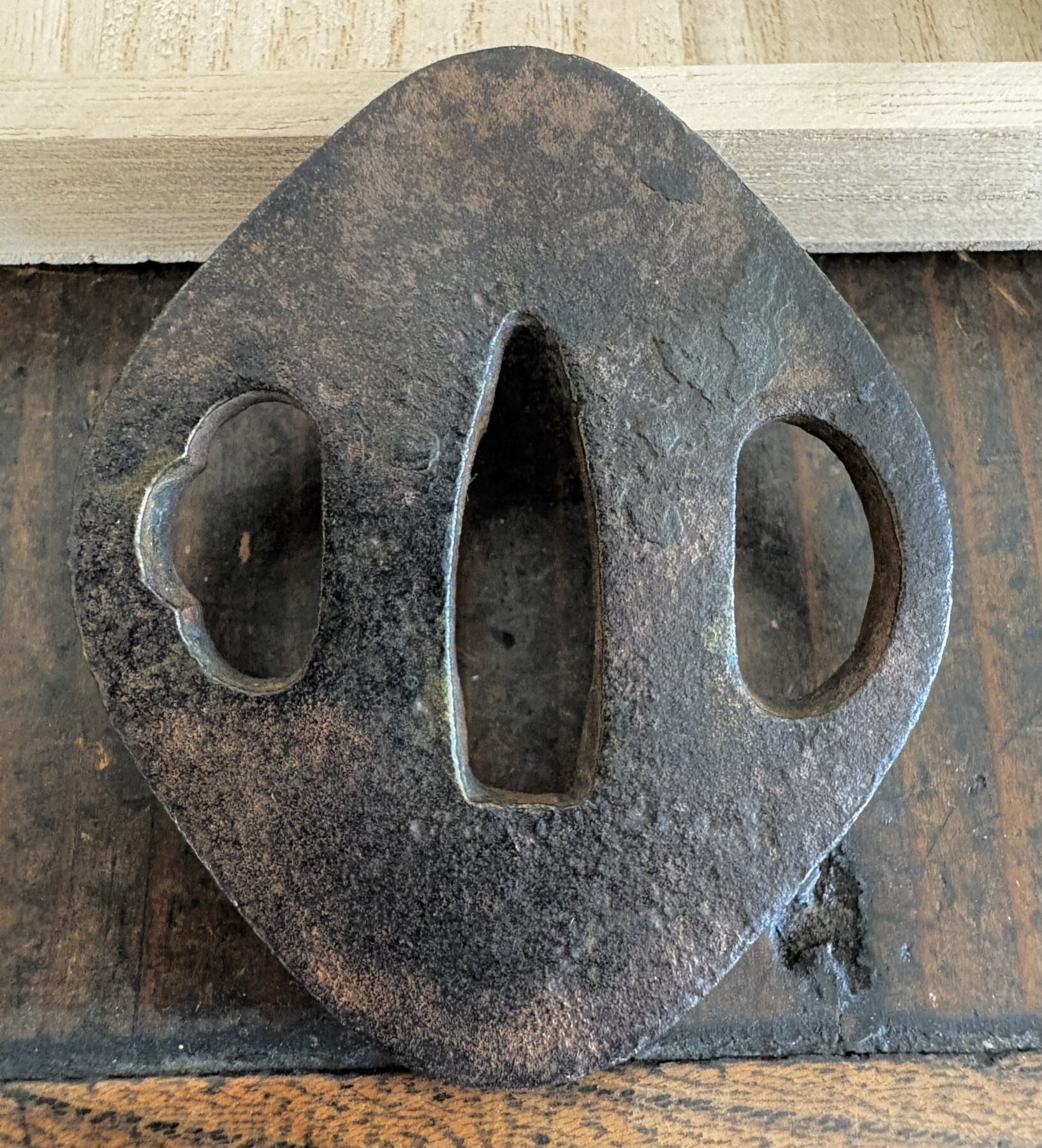
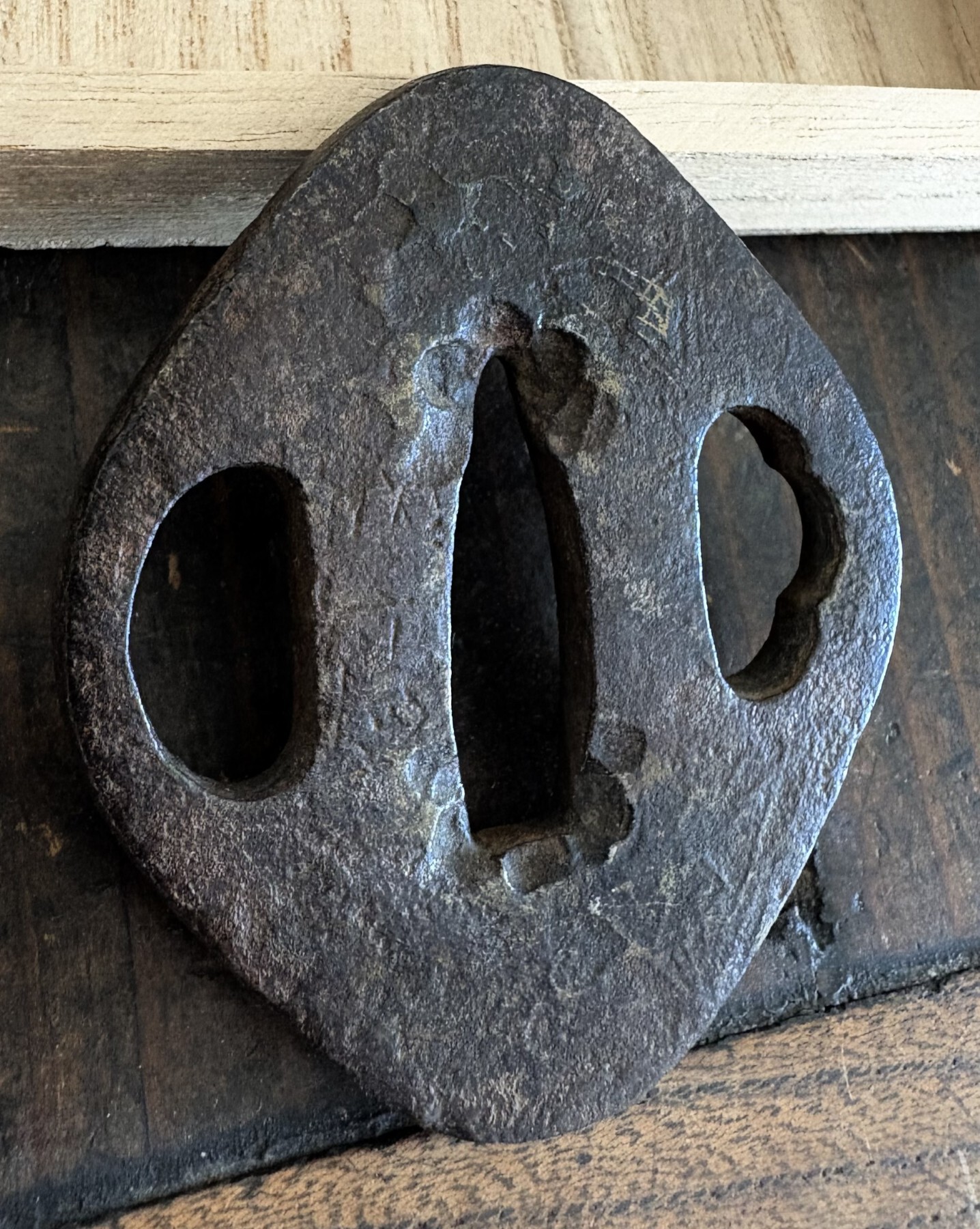
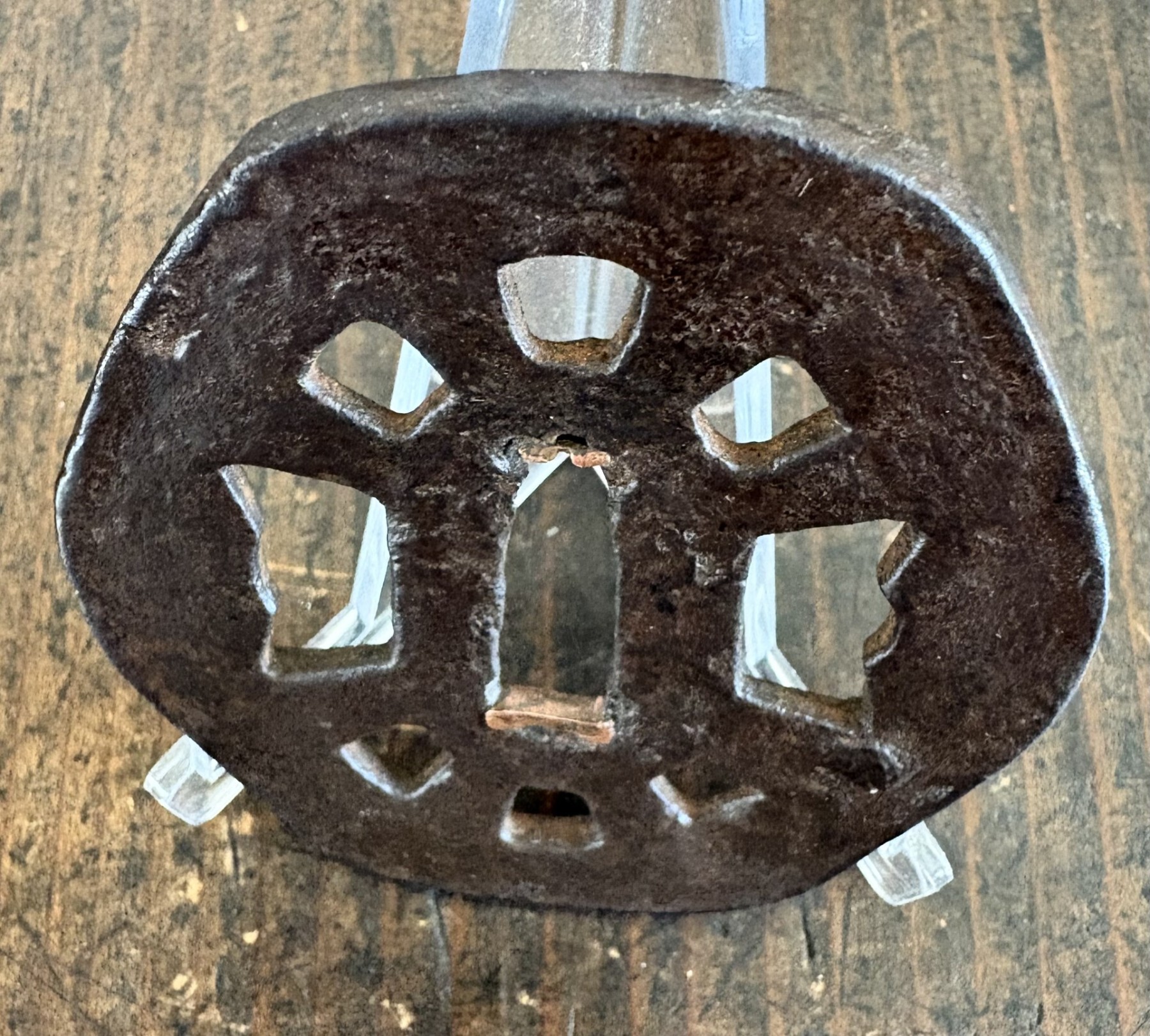
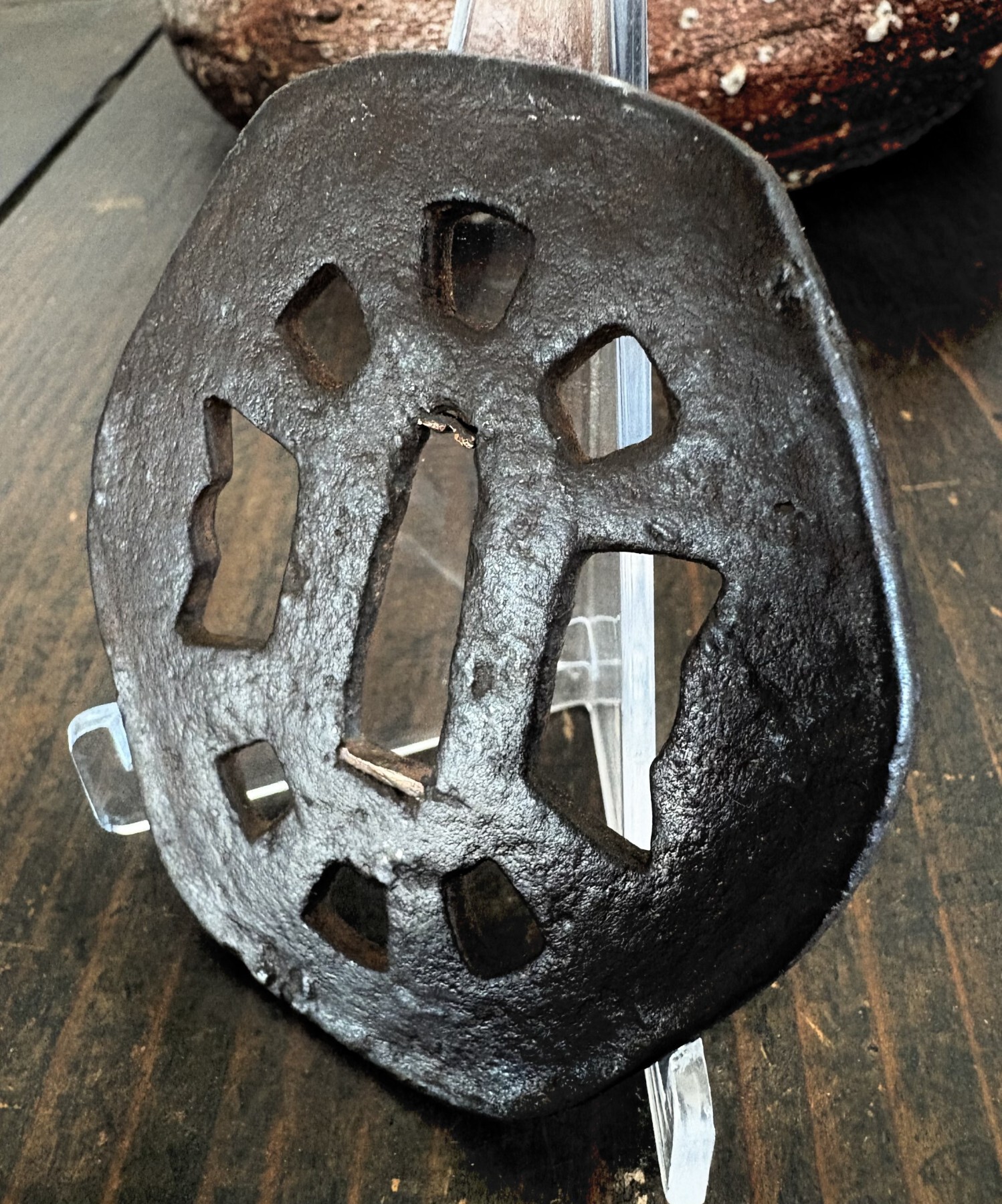
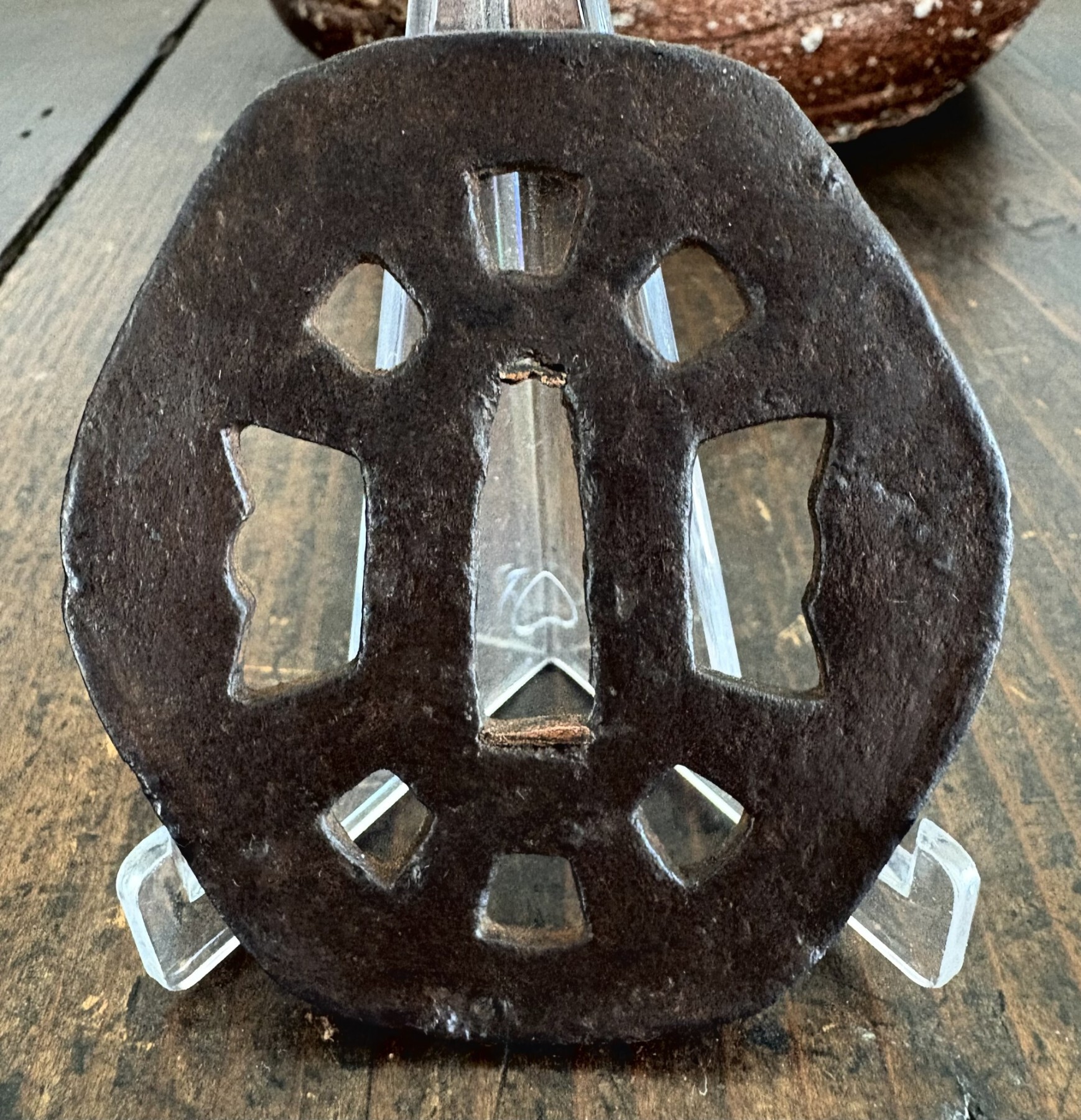
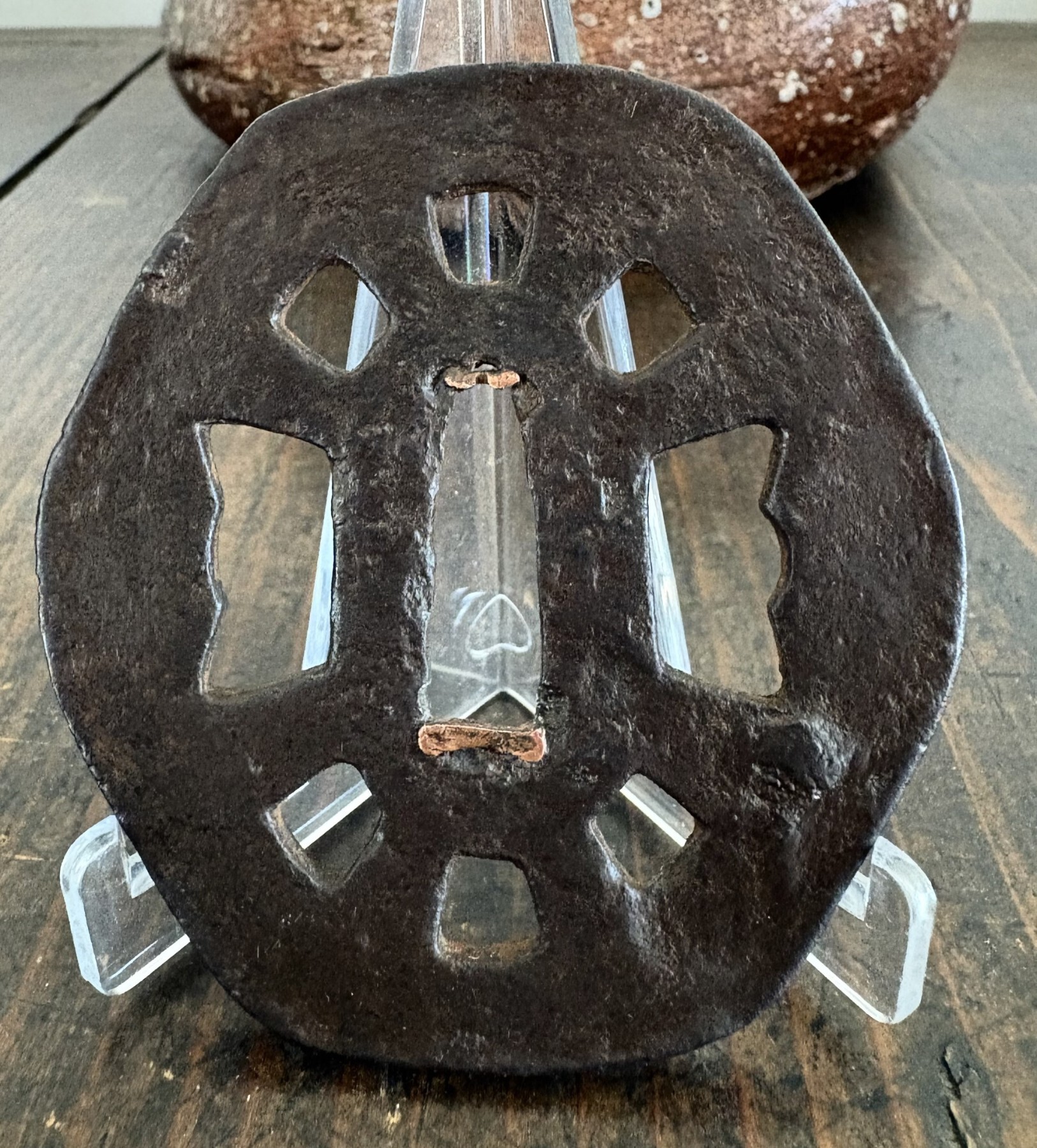
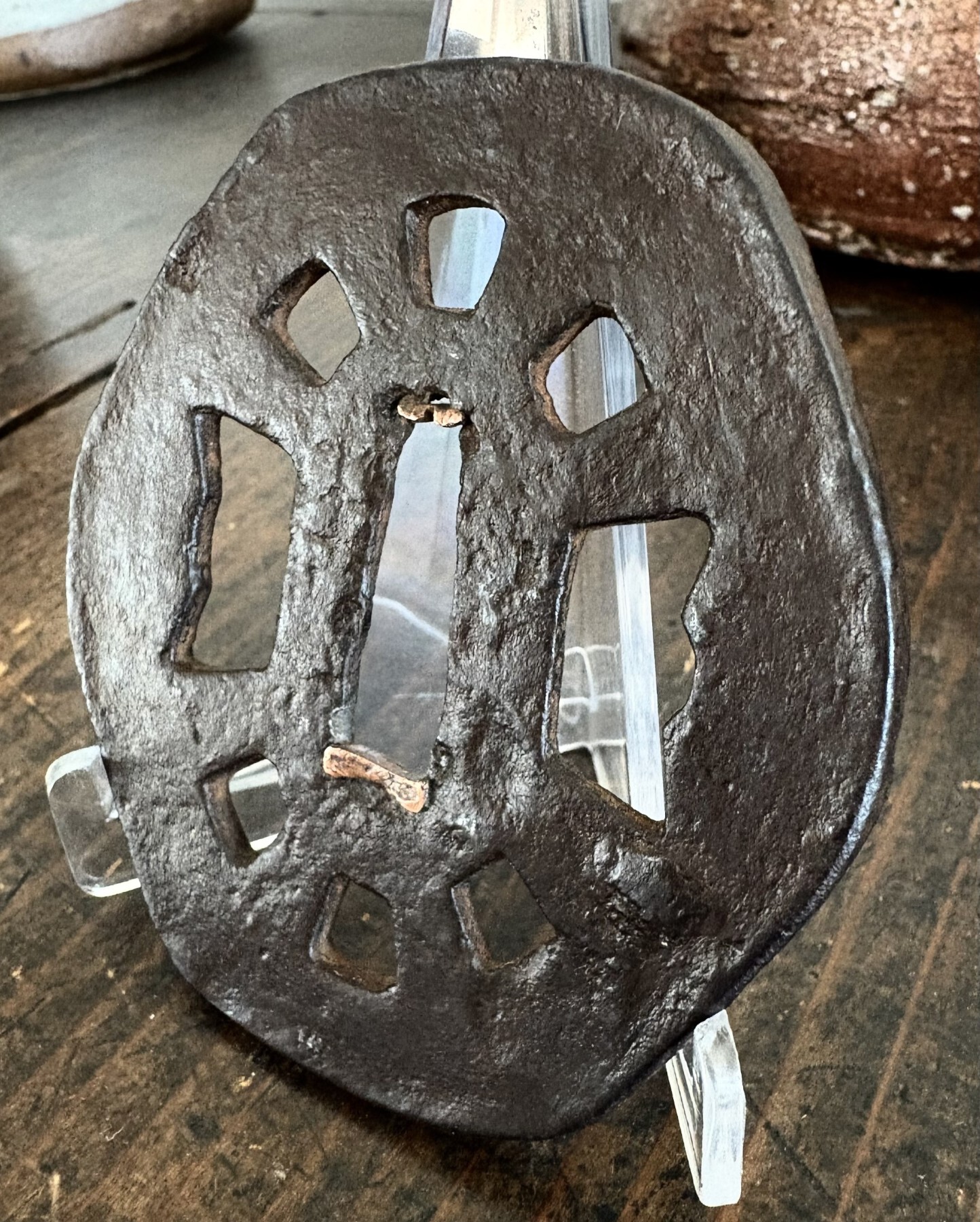
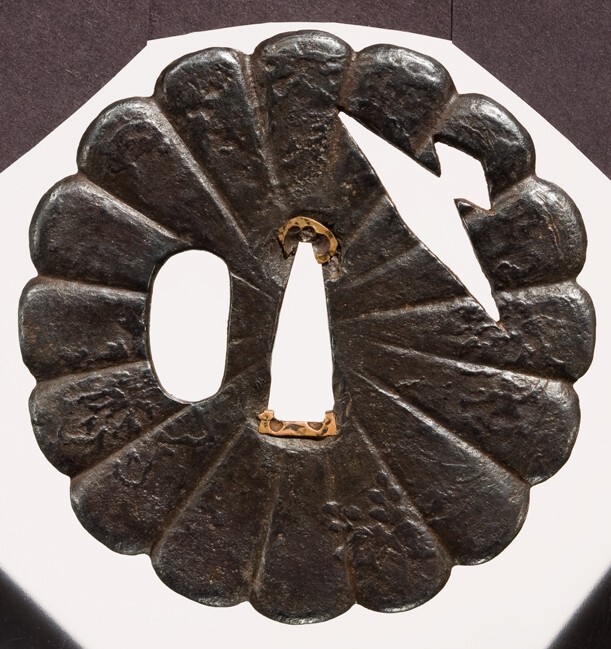
Offering today a couple of iron tsuba, both of which I would consider "project" pieces, at least to a degree. The first is a Yamakichibei work. I acquired this tsuba believing it to be early (early-Edo or Momoyama), and still believe it to be so. The mei, however, has been affected through the application of a yakite treatment after being chiseled onto the seppa-dai, plus the accumulation of rust on the surface of the iron. This makes it difficult for me to determine which Yamakichibei smith made this sword guard. There is also a wax coating applied in an effort (I suppose) to arrest any more rust activity. The form of the tsuba is a modified otafuku-gata (modified in that the upper and lower ends have been squared off, a treatment the Shodai is known to have used) featuring a guruma (wheel) sukashi design. There are tekkotsu here and there on both the plate and the rim. The tsuba measures 7.7cm x 7cm x 4mm at the rim (perhaps 2mm at the nakago-ana). This is a strong Yamakichibei design and a pleasing tsuba, but entails more work to ivory the plate and bring the tsuba up to the state it should be in than I am willing to engage in at this time. So, I am offering it here today. It is priced very reasonably owing to the fact that it does need some attention, as described above. $240.00, plus shipping. The second tsuba is a small (6.4cm x 5.4cm x 4mm) piece in iron, also of an otafuku-gata form. It is signed "Kunihiro," though as with the first tsuba, it is difficult to read the mei due to the condition of the surface. Another project piece. The plate features a sukidashibori treatment, possibly with a yakite finish. Spending time ivorying the tsuba would likely reveal the motif more definitely, but I believe it to be botanical in some way. Despite the small size of the guard, the dimensions of the nakago-ana (just short of 3cm top to bottom) suggest a large wakizashi or even a katana as the blade to be fitted to the tsuba. I am asking only $40.00 for this tsuba (plus shipping). Both tsuba together would be offered at $250.00, plus shipping. Also willing to entertain offers. For those who enjoy bringing neglected iron sword guards back to life, these could be interesting projects to tackle.
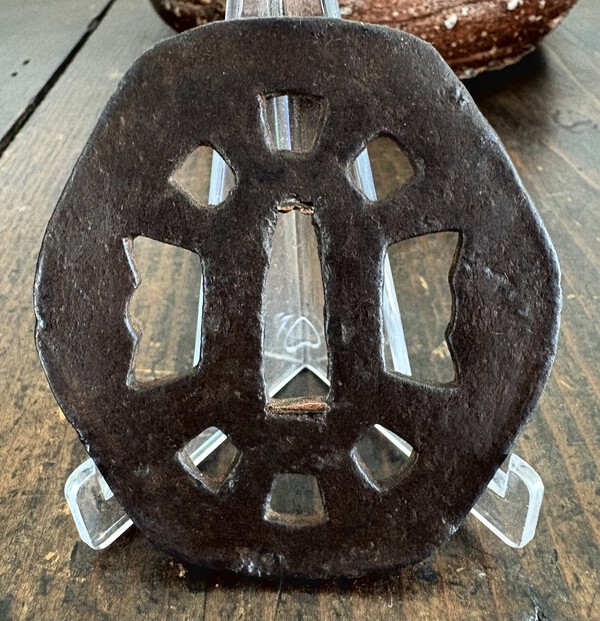

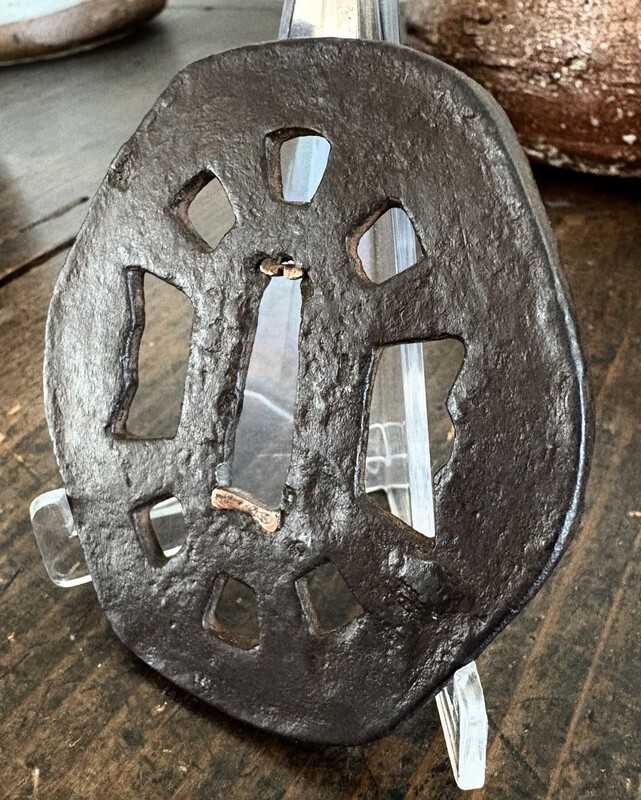
-
YES to all of the above. An interesting (and perhaps very productive) pursuit would be to work backwards in time in an effort to locate objectively factual information (e.g. unimpeachably reliable period documentation) about all tosogu artists, groups, and "schools." How far back could we go before running into the "it-is-said" abyss? Of course, the results of such an excursion would be quite ragged, with some traditions (e.g. the Higo smiths) likely having much more reliable information about them going back than, say, the early Akasaka group. or the early Umetada masters. Once the ends of reliable certitude are reached, and knowing that any artist or group of artists had to have had some sort of influencing agent(s) -- whether formal teachers or some other inspirational force -- then informed (we hope) speculation based on knowledge of cultural contexts of various kinds could be presented as further "time travel" is undertaken. I have long maintained that the problem being referred to regarding NBTHK (or other) papers is much less about such papers being issued than it is about those papers being seen by the community as factually correct and truthful. If it could be universally recognized that the NBTHK is simply providing an opinion (albeit a rather expensive one, in some cases), and that this opinion can be and has been incorrect on occasion, we would be in a better place with all this. A related issue here is that the NBTHK, to my knowledge, does not provide written explanations, reasoning, or strong references to support the conclusions they draw in delivering their judgments. Absent this, the opinions they offer lose a lot of weight (in my view), especially when we're talking about Hozon Paper-level tosogu submissions for mumei items. How much time are the shinsa teams really devoting to examining and analyzing such pieces? This dynamic, when combined with the entrenched iemoto-ism of always following what previous teachers and senior scholars determined, results in a morass of misinformation, contradiction, and undermined confidence in the capacity of such expert bodies to provide guidance and learning opportunities. This is why, in my opinion, it is so important to invest in our own studying and research (which may include NBTHK results, but not without a dose of healthy skepticism), not only of the objects themselves, but also of the various contexts (historical, cultural, political, etc...) that gave rise to these objects in various regions and in different periods. This last -- the deep consideration of multifarious contexts as they pertain to tosogu study -- is one that I do not see given sufficient focus and energy in many discussions and publications. However, I do not have access to (many?) Japanese sources that may indeed feature such an effort. If anyone does, and could recommend these, I would welcome knowing about them.
-
Joining the party late here... Just wanted to agree with Glen and Curran on that "Yamakichibei" Yagyu piece that Tim posted the image of. I really like the tsuba overall; too bad it's been marred by a "problematic" mei. Just a thought on the matter of whether Sakura Yamakichibei may have made tsuba for the Yagyu. Setting aside the published content stating that he did, there is at least some plausibility in the idea. He lived in the right place and at the right time to have done so, and it is known that "Yagyu" tsuba were commissioned to be made by various craftsmen in Owari in the latter 17th century. These "are thought/known" to include Sakura Yamakichibei, Ohno smiths, Hoan Kanenobu, Toda Hikozaemon, and Fukui Jizaemon. According to Jim Gilbert in his article on Yagyu (2005 publication for the Northern California Japanese Sword Club in coordination with the American branch of the NBTHK and an exhibition of Yagyu sword guards at the 2005 San Francisco Token Kai), "One version of the [Yagyu] design book mentions Akasaka makers," and the renowned swordsmith Kotetsu is speculated to have been commissioned to make tsuba for the Yagyu, among others. I have long observed the varied presentation of the construction and finish seen in Yagyu (even just early Yagyu) works, and have speculated that the reason for this is probably that many different smiths were commissioned to produce Yagyu tsuba over the years. For any who are especially interested in Yagyu tsuba, acquiring the aforementioned 2005 publication is a must. Some excellent photography here, too.
-
Need assistance with a publication covering a particular Juyo Session
Steve Waszak replied to Steve Waszak's topic in Nihonto
Thank you to those who PM'd me in response to my request. Your generosity is really appreciated. I received very useful information. Thanks again! -
I am not very familiar with the publications that present Juyo results from the various sessions. Are there such publications available in English? If so, I am seeking the publication from Juyo Session 54. If an English version is unavailable, I would still be interested in the Japanese. If someone has this, I would really appreciate being contacted by PM, as there is a particular item from this session I am researching. Thanks so much to anyone able to help.
-
Kudos, Dale, on the tidying up! Excellent work. You definitely didn't overspend. I believe this would be Echizen Nobuie. Nicely done.
-
Iida Koendo (interview)
Steve Waszak replied to Kanenaga's topic in Auctions and Online Sales or Sellers
Wonderful video. Thanks so much for sharing this, Les. I visited Iida Koendo in March of last year. Great experience. Iida-san and I had a very pleasant conversation. As I focus more on tsuba than blades, he was kind enough to show me some beautiful sword guards, and I was able to acquire a superb Nidai Yamakichibei tsuba. I very much look forward to visiting Iida-san again. -
I would be curious to know if there is a mei on this guard. Aspects of it remind me of the work of the Nidai Yamakichibei.
-
Ray is correct. This is a katabami (one of the Oxalis variations, or Wood Sorrel) motif. The katabami has strong associations with good fortune and prosperity, as well as with resilience and endurance. Easy to see why this would be a desirable motif on tsuba.
-
Sound approach, Curran. Not foolproof, unfortunately(!). This is a very appealing tsuba whose mei appears to have been carefully copied. I am not aware of any Myoju work whose whose aesthetic sense resembles that of this piece. Agreed: more appealing without the mei...
-
I would emphasize that the book "Uchigatana no Koshirae" -- which is the beautiful hardback and quite large catalogue of the exhibition Jussi mentions above -- is a must-have for anyone with even a passing interest in old (pre-Edo and [mostly[ intact) koshirae. Jussi's point about the social status of the owners of these koshirae is a good one, but seeing so many preserved koshirae at 400+ years of age collected in one publication is special. PM me if you'd be interested in obtaining a copy; I have an extra.
-
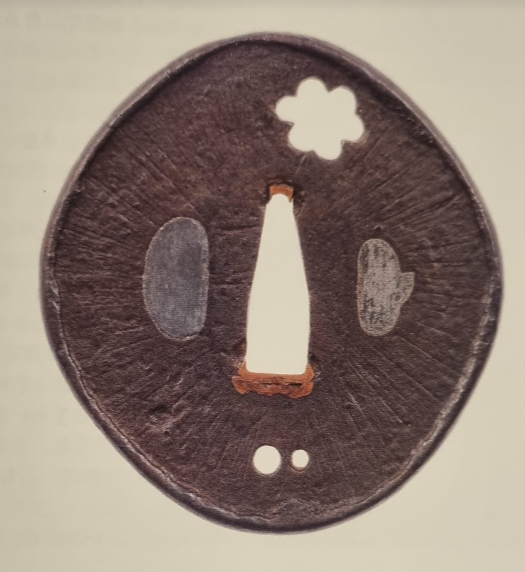
Here is Shodai Hoan tsuba with a yakite-kusarashi (or kusarakashi -- the term is often shortened in usage) finish. The recognizable motif of a kiri-mon may be seen in the lower-left quadrant, and others appear elsewhere on the plate. I believe the effects are achieved via the process I described in my earlier post. Florian, as far as I know, the creation of amida-yasurime was often accomplished by painstakingly careful application of the chisel onto the plate, at least in the tsuba I'm familiar seeing this presentation in (e.g. some of the Owari province artists and groups, such as Yamakichibei, Toda, Fukui). Attached is a Nidai Yamakichibei tsuba where the amida-yasurime was first chiseled into the plate, and then (perhaps?) there was some application of acid afterwards to soften the effect. This is how it appears to me, anyway.

-
Hi Florian, Interesting topic. My understanding with Hoan tsuba is that he would "paint" on the motif with urushi, and then place the guard in an acid bath so that the surface of the piece around the urushi-covered areas would be affected, leaving the motif raised above the surrounding plate surface. The term often used for his tsuba is "yakite kusarashi," which implies that there is also an application of heat in some manner. However, some argue that attempting to apply heat to the surface of a tsuba to achieve "melty" effects doesn't really work, and that the surfaces that present with melted-looking areas are achieved via the acid treatments, only. I do wonder how much there is in the old ways of metal working in Japan that we do not know about or have access to.
-
Agree with all: no worries here, John. There will (almost ) always be exceptions to the rule. Nice tsuba.
-
Matt and I have conversed on this piece, too. Beautiful work. I lean towards Nidai work, but I may very well be wrong, and it could be Shodai Hikozo. That plate is just killer. I'd love to see it in person some day. Congrats again, Matt, on acquiring this tsuba.
-
Glad it arrived safely, Matt. This tsuba perfectly exhibits the Tea aesthetics of Furuta Oribe, the leading Tea Master in Japan in the second half of the Momoyama Period. For such aesthetics, Yamakichibei sword guards (the genuine ones ) are at the top, IMHO. Remember, Matt: right of first refusal if you decide to part with this piece! Cheers
-
Incredible work, Hoshi, not just in execution, but in conception. Kudos is not a strong enough word. Thank you.
-
I had the privilege to speak with him on the phone on several occasions. Just a really good human being. Down to earth, earnest, non-judgmental, and always presented a positive energy and mindset. Gone far too soon. I will miss him. RIP, amigo.
-
This sword is now SOLD.
-


-