Steve Waszak
-
Posts
978 -
Joined
-
Last visited
-
Days Won
4
Content Type
Profiles
Forums
Events
Store
Downloads
Gallery
Everything posted by Steve Waszak
-
Keith, I believe you have just expressed your Zen side quite poignantly, actually. For exactly the reasons you gave, the making of a cast iron tsuba is about as closely aligned with Zen sensibilities as painting by numbers would be. It's hard to imagine anything less lifeless... Cheers, Steve
-
Just a couple of quick thoughts here in response... It seems doubtful to me that such low-quality guards would survive the 400+ years since then in any condition, much less a "presentable" one. I would think that, if such a guard did exist, and did survive till today, it would present as a rust-encrusted blob, rather than as a would-be collectable tsuba. Given the climate in Japan, anything made from iron/steel would need considerable care not to become rusted over. And if such a cast-iron tsuba were made then (assuming the technology was there), and if it did become heavily rusted (after all, why would someone care for such a low-quality piece over generations of time?), why would anyone bother to clean and collect such an item? It appears unlikely to me that this would be the case... Cheers, Steve
-
Hi Keith, Sorry to come back to the discussion a bit late here... I think Ford actually sums up quite well what I would say about tsuba as objects holding and expressing important cultural sensibilities, affiliations, beliefs, and so on. The semiotic function of tsuba is not something that can be dismissed nor ignored when seeking to appreciate what these objects "were." To do so is to say that semiotics has no place in academic/philosophical inquiry, and I don't think such a claim would hold up very well... I would add, too, that the artistic and aesthetic value you see present in tsuba is a cultural matter, and is so in a major way. Perhaps it is a matter of defining the word "culture"? Cheers, Steve
-
Thanks, Ford... A very interesting excerpt. Your posting it is much appreciated. The sentiments expressed there make perfect sense to me. Besides the technical aspects involved in the casting-of-iron-tsuba question, to me, the idea that a culture (or any prominent individual craftsmen thereof) as profoundly focused on the hand-made would toss aside the mastery achieved over centuries of iron/steel forging in favor of brittle, porous, "quick-and-easy" casting is one that is abundantly unconvincing. The Momoyama and early Edo periods are times in Japanese cultural history when exquisite quality in hand-made craftsmanship across a wide variety of media and objects was at its zenith. For something as culturally important as the tsuba of a bushi, it is inconceivable to me that cast-iron guards would ever have been acceptable. Cheers, Steve
-
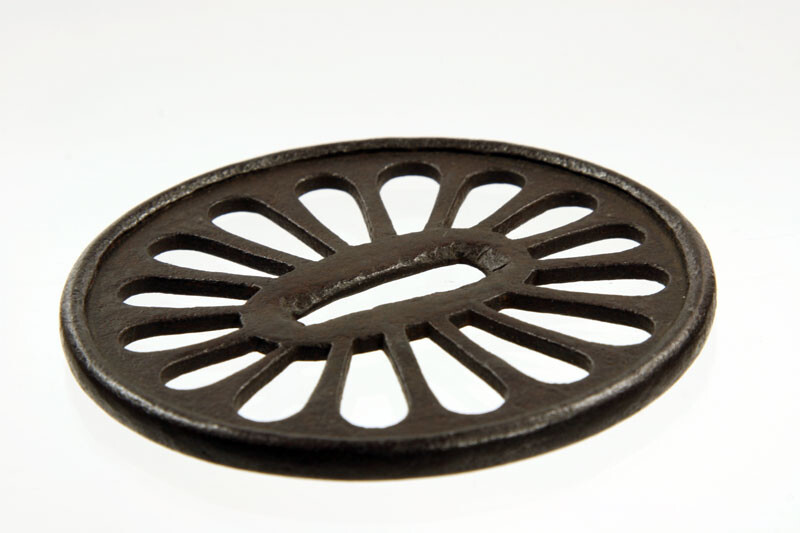
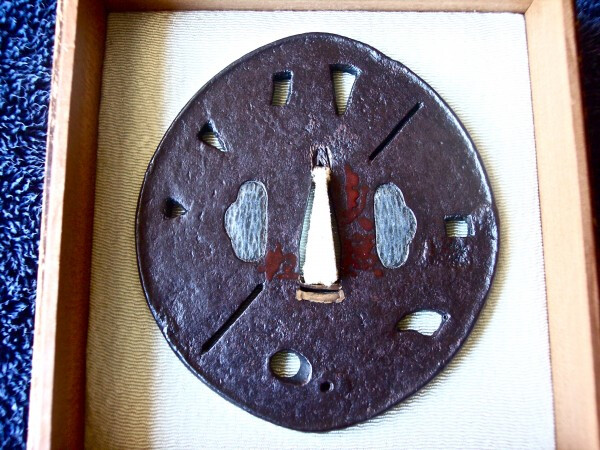
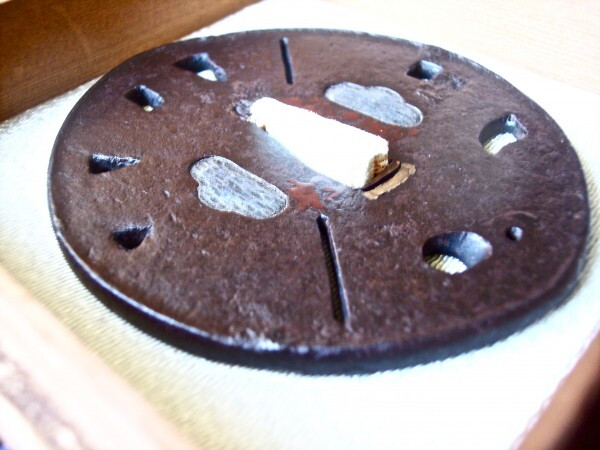
A few to add to the fire... 1. Late-Muromachi to early-Momoyama ko-katchushi (9.5 cm) 2. "Nidai" Yamakichibei 3. Shumei to (Owari) Sadahiro Cheers, Steve


-
Ko-sukashi tsuba with amida yasuri - what school?
Steve Waszak replied to andreYes's topic in Tosogu
John and Pete, While there can be little doubt of the growth and evolution of wabi Tea over the course of the late Muromachi period, as well as of its increasing influence on other aspects of Japanese culture, I do not believe that wabi Tea's expansion from the early to mid-1500s saw much if any direct (or maybe even indirect) influence on tsuba. Tea as practiced by the nobility and higher-ranking bushi during this time was decidedly Chinese in its aesthetic sensibility, from the utensils used to the design and atmosphere of the tea rooms the ceremony was held in. Chinese utensils commanded by far the most admiration, respect, and value: antique Chinese bowls, vases, paintings, etc... were highly sought after by the "high society" individuals we're discussing here. As you note, John, the emergence of wabi cha in the early 16th century began to break down the much more formal and "elegant" Chinese-inspired Shoin Tea dominant at the time. Korean wares began to find their way into Tea culture, wares which were more "earthy" in their expression. The shift from perfectly formed Chinese vessels to Korean pieces which may present with some irregularities and/or asymmetry is seen by many to be an example of wabi-cha sensibilities influencing the taste of tea aficionados, but this shift was quite gradual: over much if not all of the latter half of the 16th century, both Chinese and Korean utensils, as well as certain Japanese wares (Shino, Iga, Shigaraki, Bizen, and of course, Seto) were all employed in various interpretations/expressions of cha-no-yu. However, so far as tsuba are concerned, I really do not see tea culture, wabi or otherwise, affecting tsuba design/aesthetics until the Momoyama period. I would agree with Pete that the most likely source of this influence of tea aesthetics on tsuba is the Oda Nobunaga-Sen no Rikyu dynamic, but in my eyes the impact of the Tea aesthetic on tsuba design and expression reaches full flower with Furuta Oribe in the 25 years from 1591-1615. Even with Rikyu, I would say the influence of his taste and ideas as regards Tea aesthetics finds only rather tenuous manifestation in tsuba design. Pete, you mention the possibility of Rikyu's aesthetic sensibility manifesting in the work of Nobuiye. I can see some of this in certain Nobuiye guards, much less so in others. But to me, the aesthetic link between Rikyu and Nobuiye is significantly less pronounced than that between Oribe and Yamakichibei (especially the "nidai" Yamakichibei). I would be curious to see a few examples of Nobuiye tsuba that you would see as having close associations with Rikyu's aesthetic sensibility... I have to wonder, too, if Rikyu's class standing as a merchant (granted, social stratifications in Momoyama Japan were not close to as severe as we see in Tokugawa Japan, but merchants were nevertheless hardly seen as equals by the buke) may have limited his influence when it comes to how much his sensibilities affected tsuba design. After all, the drinking of tea, as popular as it was among the buke, was not limited to their class. Rikyu would have had less direct contact with tsubako, and with swords more broadly speaking, than he would have had with potters and pottery, I would think. Furuta Oribe, on the other hand, was a daimyo. I would be surprised if this difference did not matter to some degree here... Cheers, Steve -
Ko-sukashi tsuba with amida yasuri - what school?
Steve Waszak replied to andreYes's topic in Tosogu
Hi Pete, Most intriguing line of thought here. Certainly the kabuki you reference would have seen cross currents with Furuta Oribe at the helm of Tea Culture in Japan between 1592 and 1615; his designs for Tea ceramics would be a good example of the manifestation of this kabuki sensibility, I think. Interesting, too, to speculate on whether his "opening up" of the tea room itself (so famously dim under Rikyu's lead) by employing a number of windows might have had some influence on the "opening up" of more types of ji-sukashi tsuba. I have little doubt that there was an intimate association between Tea aesthetics and certain (Owari Province) tsuba aesthetics/design, particularly under Oribe. If such an association was indeed established and recognized among some tsubako, it isn't much of a stretch to see other forms of more expressive tsuba emerge under Oribe's influence. One further thought: the proliferation of ji-sukashi tsuba coincides with the ceasing of both warfare and dueling, I believe. If I remember correctly, the bakufu disapproved of dueling soon after the close of the Momoyama Period. With attack from a blade-armed opponent now greatly diminished, a less robust type of tsuba becomes less risky to use on one's koshirae... Cheers, Steve -
Ko-sukashi tsuba with amida yasuri - what school?
Steve Waszak replied to andreYes's topic in Tosogu
Yeah, probably, Pete... One comment/thought on your speculation that sukashi tsuba may not even have been made (largely) until the Edo Period: this then would mean that the tsubako whom we know lived in Momoyama times and who did make sukashi (including ji-sukashi) tsuba---Nobuiye, Yamakichibei, Hoan (shodai)---would be the first to employ (ji-)sukashi in their designs... Thought-provoking... Cheers, Steve -
Ko-sukashi tsuba with amida yasuri - what school?
Steve Waszak replied to andreYes's topic in Tosogu
Interesting discussion here... Just to add to the mix, here is a photo of a later-generation Hoan (Kanenobu? Kaneshige?). It features a similar amida-yasuri to the tsuba in question, as well as an even more pronounced go-stone shape. I wonder if this style wasn't simply a popular one for several schools to produce at a particular point in the early-Edo period... Cheers, Steve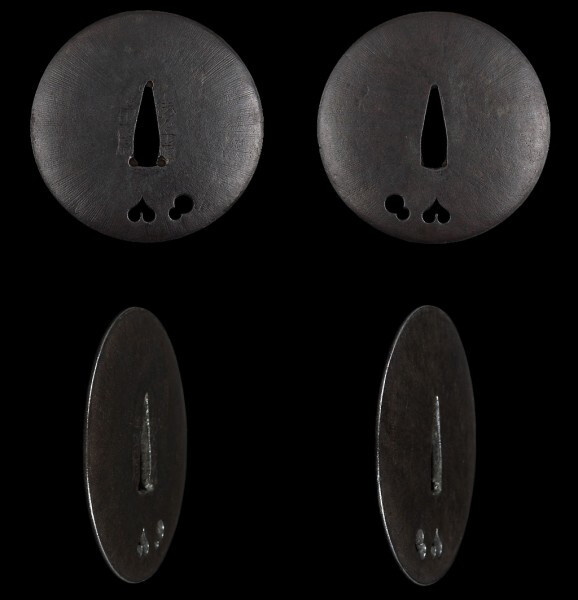
-
Yes, David, you're exactly right here. As I suggested in earlier posts, without being able to examine the tsuba in-hand, the speculation as to metal quality, workmanship, and condition is just that---speculation. From looking at the photos we have, it is the thickness of the guard, more than anything, that could substantiate locating it later than early-Edo. Zogan does not eliminate an early-Edo dating, especially the latter part of the early Edo period. And again, those hitsu-ana point away from later Edo period dating. I could see this guard being of Genroku times, perhaps, but I'm not sure about dating it much later than this... As we so often see in Edo period tsuba, this piece presents features which confound easy attribution to specific times within the Edo period. Cheers, Steve
-
Hi Hilik, Just to amend my previous post, in looking again at the metal of this guard, I'm thinking it's probably from the later part of the period I mentioned, so I'd say circa 1650 or so. It can be a bit challenging to locate Shoami work, especially without the piece in-hand. The Shoami artists were so prolific and wide-ranging, over so long a period, that dating their work precisely becomes quite the task... Cheers, Steve
-
Ah, I see. Okay, well the early Shoami artists didn't sign their work, so trying to figure out a specific maker for this piece likely isn't going to prove successful. As to its period, I would say late-Momoyama to early-Edo, circa 1600-1650. The iron appears to be of good quality, and there is no inlay. As a rule, the ko-Shoami craftsmen did not employ inlay as we would find later Shoami groups doing; additionally, the ko-Shoami are known for fine quality iron/steel, and I believe we can see that in this piece. As to the particular name of this pattern/design in Japanese, and the kanji for that, I'll leave that to others to tackle... Cheers, Steve
-
What specific information are you seeking? You ask for "any details" we might provide, but this is vague. What sort of information are you hoping to gain by posting these photos? Please elaborate... Cheers, Steve
-
The relation (?) between Nishigaki, Hayashi and Akasaka
Steve Waszak replied to Lorenzo's topic in Tosogu
Hi David, I see. I hadn't realized you were referencing only the Higo schools. In that case, yes, the ko-Shoami influence on some Higo artists would be there, I think, yes. However, remember, too, that the Kamiyoshi developed LONG after the Owari sukashi heyday was over (by the first few decades of the Edo Period). By 1700 if not considerably earlier, any "Owari" tsuba still being made were at best derivative copies of earlier Owari tsuba from a century earlier. So any real "influence" of Owari sukashi on Kamiyoshi was WELL removed by the time the latter group gets started, by some two hundred years, actually. It was really the Hayashi that influenced the Kamiyoshi, the Hayashi (perhaps) having had Owari connections. Cheers, Steve -
Nice tsuba... I believe this is a Shoami tsuba, perhaps ko-Shoami (but seeing it in hand would help here...). The openness of those hitsu-ana are said to be signs of Shoami work: unlike the hitsu-ana of other "schools," Shoami often tend toward the more rounded and wide-open expression seen in this tsuba. Also, in the KTK supplement book published in (I believe) 2005, there is a very similar, if not identical tsuba featured. It is categorized as (ko?) Shoami. Cheers, Steve
-
The relation (?) between Nishigaki, Hayashi and Akasaka
Steve Waszak replied to Lorenzo's topic in Tosogu
Actually, there is a rather interesting article by Matsumoto Seiji in Art and the Sword, Volume 3 (1990) which makes a rather convincing case, I think, for the Owari origins of (ko-)Akasaka tsuba. I personally doubt their having much in the way of Kyoto origins, as the early Akasaka work tends to be much less lyrical than it became (especially with the Higo influence... ) later in the 17th century. Early Akasaka work is more reminiscent to me of the boldness and vigor of Owari sukashi tsuba than it is of the filigree and "gentle" Kyo-sukashi work. As to the notion that the ko-Shoami influenced all the "schools" we're discussing here, I'm not sure I see this, especially as concerns Owari sukashi. I think it's more the other way around in this case, with the ko-Shoami becoming a bit more robust (moving away from the delicacy of Kyo-sukashi) due, perhaps, to the influence of Owari sukashi designs and production methods. Of course, our understanding---and our conjecture---is limited by the lack of certainty we have of the dates involved. It would be helpful if we knew exactly when these "schools" and traditions sprouted and flowered, how much interaction Owari Province had with Kyoto in the late 15th and early 16th centuries, etc... Given that ko-Shoami are seen by many as a "middle ground" between the strength of Owari sukashi and the gracefulness of Kyo-sukashi, however, it makes more sense to me to see ko-Shoami work as being more influenced by Owari than the reverse. Cheers, Steve -
The relation (?) between Nishigaki, Hayashi and Akasaka
Steve Waszak replied to Lorenzo's topic in Tosogu
Hi Lorenzo, I am inclined to agree with you here. I do feel that these particular designs are Higo in origin, and more specifically, Kanshiro or Hayashi. I'm still not sure if I see the creator as more likely Nishigaki (shodai) or Hayashi Matashichi, but on some gut level I find myself leaning toward Matashichi; somehow, I see these particular types of tsuba as coming out of the Matashichi sensibility of aesthetics and design a bit more than I do arising out of Nishigaki's. One other intriguing possibility to consider is whether or not the design is neither Nishigaki's nor Matashichi's, but is instead the brainchild of Hosokawa Sansai. As the Daimyo of Higo, he is famous for not only his deep involvement with the arts, but specifically for sponsoring the superb " four schools" of Higo tsubako: Hirata Hikozo, Shimizu Jinbei (shodai Jingo), Nishigaki Kanshiro, and Hayashi Matashichi. His sponsorship was quite "hands-on," which is to say that he had direct involvement with these tsubako. It is thought by some that Sansai even made a few tsuba himself, with the guidance of one or more of the four masters. In any case, I do not see the design in question to be an original Akasaka creation, nor am I aware of any other school, tradition, artist, or region that produced this design prior to the early Edo Period. Oh, and it should be said that the story of Karigane Hikobei is apocryphal. As others here have noted, the prevailing theory of Akasaka origins, I believe, is that the earliest Akasaka tsubako came to Edo from the Owari region... At least, this is my understanding... Cheers, Steve -
Fully agree with most of the sentiments expressed here. "The Last Samurai" is almost unwatchable, except for the scenes with Sanada... :D Ford, couldn't agree with you more: that scene where Ujio kicks the crap out of Algren is deeply satisfying...lol. Also agree on "The Twilight Samurai," probably my personal favorite in the genre of "samurai films." "The Hidden Blade" is also very good, thought not quite up to "Twilight." John, I SO agree with you, too, about the preposterousness of Algren learning enough kenjutsu in his winter in New Zealand to come anywhere CLOSE to touching Sanada or any of those he's combatting. Sheesh. Beyond silly. Truly. By the way, anyone here have any reviews on films made by the same writers/directors of "Twilight Samurai" and "Hidden Blade"? Cheers, Steve
-
The relation (?) between Nishigaki, Hayashi and Akasaka
Steve Waszak replied to Lorenzo's topic in Tosogu
Hi Lorenzo and Ford... I suppose it is possible that the explanation is as Ford describes. However, I frankly wonder if it is not the reverse: due to the sankinkotai requirement, Higo works were brought to Edo, where Akasaka tsubako were exposed to their designs. When we look at the earliest Akasaka guards (including "proto-Akasaka" Owari tsuba, as well as the earliest "ko-Akasaka" work), the sorts of designs and treatments we might confuse with Higo works are not common, if they're present at all. Only in somewhat later Akasaka tsuba do we frequently see the sorts of designs also seen in Nishigaki Kanshiro and Hayashi Matashichi work. These designs are rather significant departures from what is seen in the earliest Akasaka pieces, and if it is accurate (and I think it is) to see Akasaka tsuba originating out of an Owari tradition, such designs as we see rendered in even the later part of ko-Akasaka tsuba production would seem unlikely to be "sourced" back to Owari sensibilities. On the other hand, the fluid designs we see made by Nishigaki and Matashichi fit relatively seamlessly into their wider oeuvre, especially in the case of Matashichi. Both groups, though, were so original in their motifs and designs that it's hard (for me, at least) to be sure about which came first here, the chicken or the egg... Cheers, Steve -
Hi Craig, Thanks... I'll be very interested to hear what you find out from Bob on this... I really have no idea on the matter of which kao Dr. Torigoye used when. So this is all a good learning opportunity for me. Thanks again, Craig. Cheers, Steve
-
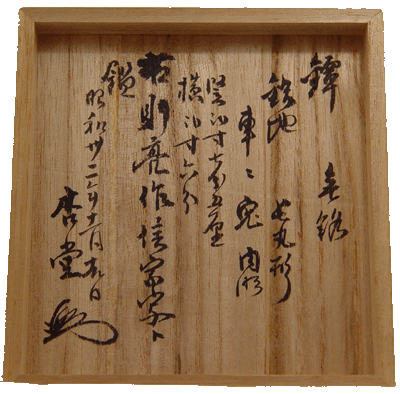
Many thanks, Moriyama-san, for your translation efforts. Very useful. Much appreciated... :D I was a little concerned that the box did not fit the tsuba, but it is quite clear that it does. Thanks again... Craig, Thanks to you, too, for your post here. Good thoughts. I have seen that "quality indicator" (one or two strokes on the kao) used with both the Kodo and the Sado kao. I have no idea how accurate the understanding is that these are reliable quality indicators, or that the Kodo kao was used for pre-Edo works, while the Sado kao was used for Edo pieces. Apparently, Bob Haynes has confirmed this understanding, but I don't know for sure... The tsuba in question here (and its hakogaki), though, would seem to contradict such an understanding... Thanks again to those who responded to this thread... Cheers, Steve
-
Hi Martin, Yes, Dr. Torigoye did apparently use a particular kao for his trips abroad, but the kao in question here is apparently one he used in Japan, but supposedly only for pre-Edo pieces. The oddity here is that his "pre-Edo kao" is used for a Norisuke tsuba, which means 19th-century... Cheers, Steve
-
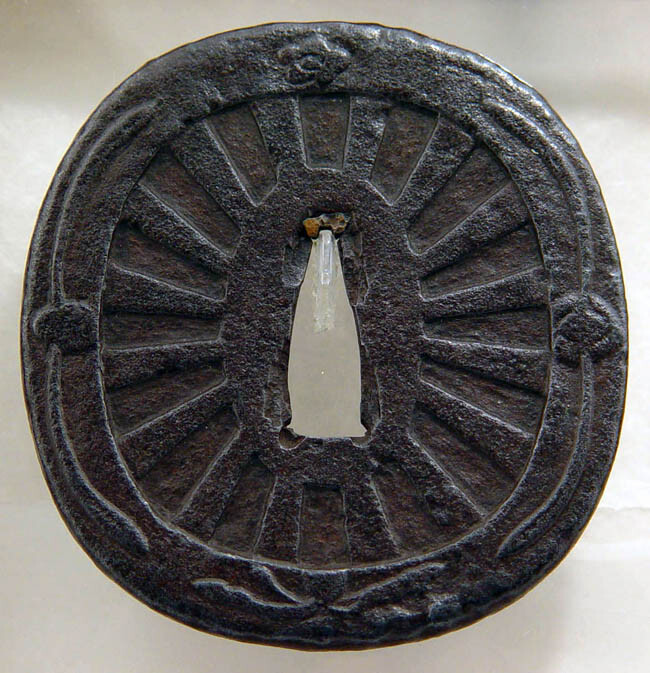
Nobody-san, Oh, yes, here is the tsuba! (see attached photos). Craig, Yes, I read through that excellent thread, and have consulted the Haynes #7. The oddity is that in that thread, it was said that Dr. Torigoye used the bird kao for pre-Edo pieces, and used the "round" kao for Edo-period work. In this case, though, he is using the bird kao for a tsuba that I'm pretty sure is mid-19th-century work. So I'm hoping to gain a little insight here... Cheers, Steve

-
Greetings, I am wondering if someone could aid me in the translation of this hakogaki... I believe it was done by Dr. Torigoye in the description of an Edo-period tsuba. Yet my understanding is that the kao he used here was one he reserved for pre-Edo pieces, so I'm a bit confused. I'm wondering if I'm missing something in the writing here... Any help is much appreciated... Cheers, Steve
-
Myochin Tsuba Mei Translation Help...
Steve Waszak replied to Soshin's topic in Translation Assistance
Hi David, Here are a couple of photos that may interest you. The first photo here is of an "Owari Nobuie" tsuba. These really are quite different in many ways from the two Momoyama Nobuiye masters... The second photo is of a small Nobuiye work; the mei is "hanare-mei," the signature recognized by most authorities as the "first generation" Nobuiye of the late-Muromachi and Momoyama periods. Cheers, Steve