Marius
-
Posts
3,200 -
Joined
-
Last visited
-
Days Won
26
Content Type
Profiles
Forums
Events
Store
Downloads
Gallery
Everything posted by Marius
-
Keith, there are always concessions to be made - what we have here is a discussion, a process in which we may learn and sometimes change our views thanks to the knowledge of other participants. I don't think either of us here is a fanboy of tetsu or irogane, respectively What we try to do is to put all arguments together (pro and contra) and come to some sort of conclusion. I am trying to learn a little bit about swordsmanship, hence my question to Jaques about the frequency of a full (not deflected) blow to a tsuba in actual sword fighting. I think we may be coming close to a point where we can agree that soft metal tsuba is not as functional as an iron tsuba, but still functional enough to be used in combat.
-
OK, as someone who hasn't practiced martial arts I have a question - do you expect your tsuba to take a full blow from your opponent, or would this be rare? This is a question, no statement, I have no idea but would like to know.
-
well... I have just made the assumption that ceremonial tsuba tend to be more ornate... An example of a tsuba which does not look very ceremonial, at least in my humble opinion...

-
Yes, I would consider this a good test. Soft metal tsuba are not as resistant as iron tsuba. A full blow on your tsuba would be probably a rare, if not impossible event. Since very simple, utilitarian tsuba have been made from soft metal as early as in the Kamakura and Muromachi periods, they hardly have been deemed non-functional. It is just that a tsuba's primary function is to prevent the hand of the swordsman to glide on the sharp blade, as already stated. Which is not to say that iron tsuba are not more robust and resistant. They are. Does that sound like a good compromise?
-
Since you have talked to them, I must assume that they were Japanese WWII veterans. In that case they would have used swords in gunto mounts. These mounts, as Ford has already stressed, had smallish, soft metal tsuba (brass). Or I am wrong here? On the other hand, they would not fight US soldiers armed with swords or sabres, so perhaps my argument is not valid at all. Correct me if I am wrong...
-
May I ask a stupid question? Has anyone seen tests where a yamagane or bronze or shinchu or katashirome or shakudo tsuba, mounted on a tsuka (or an equivalent) has been cut with a Japanese sword (or an equivalent)? I wonder if cutting through would indeed be so easy as many people assume...
-
@Ford I must say, Christian's unique wording makes his texts sometimes quite difficult to understand. :D @Chris Sorry old mate
-
Ford, I have removed the quote from my post. That should help us avoid misunderstandings BTW, I think it would be logical to assume that if the tsuba's combat functionality was (most of time) limited to preventing the hand from gliding down the blade, tsuba made from soft metal to be mounted on a combattant's uchigatana were fully functional in the eyes of their producers and users. A hint: It seems that Uesugi Kenshil wast fond of tsubaless koshirae. Since these koshirae were for uchigatana (ie. a sword designed mostly for slashing), would this not reinforce the above assumption? I know this is hair-splitting, in a way...
-
Chris, what do you say to early soft metal tsuba? They were worn on tachi (eg. aoi tsuba) on koshigatana and, last not least, on uchigatana. Some of the tachi kanagushi work, dating from the Muromachi period is so simple and made from rather inexpensive material (like katashirome or yamagane), that it is virtually unthinkable these tsuba were worn for splendor. The humble footsoldier would have had a tsuba mounted on his uchigatana. This tsuba was often made from yamagane or a yamagane alloy...
-
And enjoy the unique style of the site, the language, the sense of humour (very English, indeed), the atmosphere... I am a fan of the Kashima sisters for many years now. Good you have found it, it will serve you well for many years to come. Some great swords to be bought from time to time, as well... :D
-
I think we are making the error of categorizing a bit too much. What is a tanto? It is a relatively new name for a short sword. It used to be called koshigatana. What are the five schools (Gokaden) - a construct by Honami (or Fujishiro, I cannot recall who), in order to facilitate categorization. It is possible that in order to have a cut-off in this category, some scholar has taken 1 cm, but is it so important?
-
Ed, we have the sugata, which tels us something. We need the hamon, boshi, hada. That requires a lot of setting up work and good knowledge of photography, plus a decent camera. Not sure if it all that effort is worthwhile?
-
Ed, have you got better pictures? These scans are simply not enough to say something about the blade...
-
This tsuba has been sold to an NMB member @Henk-Jan You have the answer to your question now, as that was roughly what I paid.
-
Edward, bet we are interested
-
That is an often misused term, denoting a sturdy (thick), yet narrow tanto meant to penetrate armour in close combat. These tanto are usually around 20 cm in length (nagasa), but they have a rather longish nakago, which your sword does not seem to have. I bet yours is under 29 cm with a short nakago. Could be a kaiken, a short tanto - http://en.wikipedia.org/wiki/Kaiken_(dagger)
-
Thanks Barry, but it is not kuro urushi over yamagane. I wish it were, but there are only traces of lacquer. It might be shakudo with a low gold content... It might be... yamagane with great patina?
-
Sorry not to be helpful, but I guess both the menuki and the kozuka are pretty much ordinary, late Edo stuff. It will be hard to attribute them to a school or maker. WOuld you show us the saya as well?
-
I am interested in that tanto - can you take pics and post them in the nihonto section, please?
-
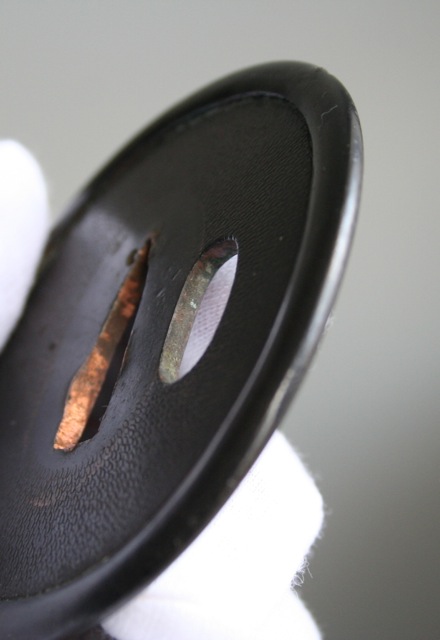
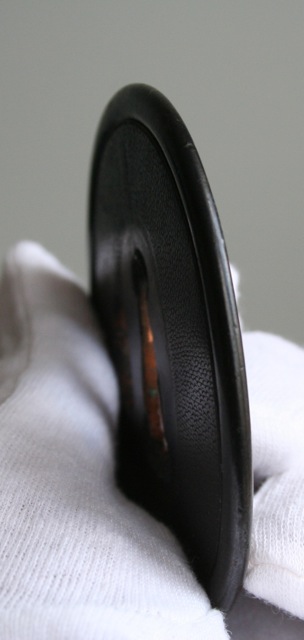
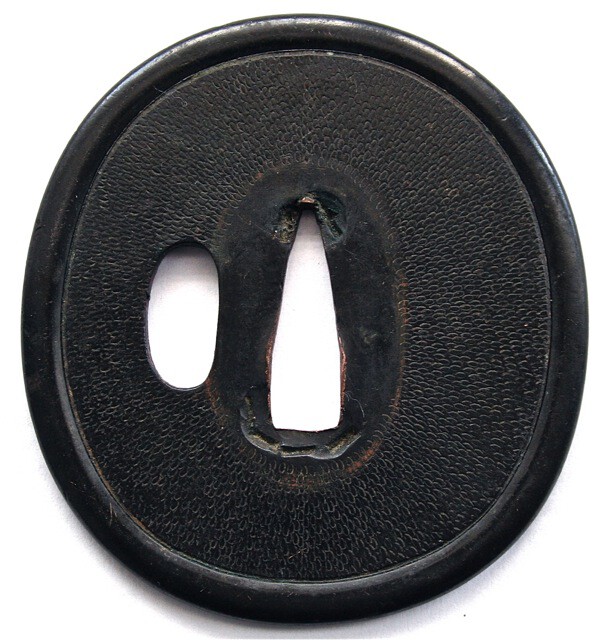
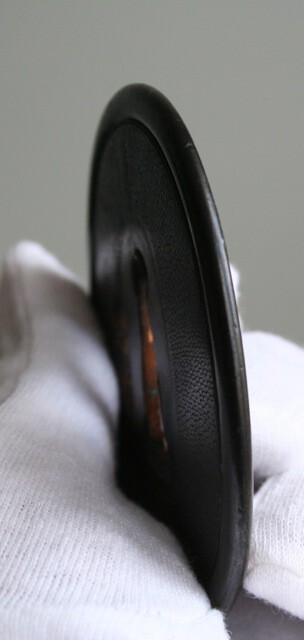
Hi, I have bought this one on eBay, got it today, I am quite puzzled what to make of it 7.2x7.7x0.25 cm. The colour is dark, blackish brown. The tsuba feels soft, waxy, yet heavy. The punch marks can be easily felt under the fingertips. Very pleasant to handle and hold. On the omote the rim stands out a bit more than on the ura. On the ura I see what seems like traces of kuro urushi, not much, but still. The plate tapers gently towards the rim, in which the seam is identifiable. I think that the rim may be of a slightly different material than the plate. It looks like shakudo, while the plate looks like low grade shakudo or katashirome. The kozuka hitsu ana has remainders of kuro urushi inside, but its walls are of reddish brown colour, like that of younger yamagane. More pics here: http://gallery.me.com/mariuszk#100704 Any thoughts?


-
Adam, honestly, what is the point of this? Would you shell out $2k for a sword whose current owner does not care to show decent pictures? It may have nioi-giri, it may have ha-giri, shinae, fukure, it may have all the flaws you can imagine - but you will never see it, at least not on pictures taken with 1998 vintage mobile phone. eBay can be cool, but only if you buy from reputable dealers, whom you can ask about the condition and form whom you can expect an honest answer. Otherwise, there is not much to be bought and nothing to be learned from those swords on eBay.
-
Yes, most of the time. There are exceptions though, eg. dealers who you can ask about the real condition of the item you want to buy. There are just a few, but they are there, like "komonjo" - Mike Yamaguchi. I have recently bought a very nice, papered Naminohira uchigatana from him. This was not a great bargain, but a reasonable price for a sword with NBTH origami in very good condition. There are some little bargains to be had, but your gain is more of a symbolic nature and they are rare. Nobody should expect to hit the jackpot on eBay, although I have the impression, that most people do. In a nutshell, with some exceptions, no sense to buy on eBay, I do agree.
-
This gentleman advertises his services on eBay. His site: http://www.takonomakurarestorations.com Anybody knows him? Any opinions, please?
-
I think that the "chawan" is reather a sumitori, a charcoal basket used in the tea ceremony. I recall, we have discussed a tsuba with a similar motif here, an Akasaka. Will try to find the thread later... Here it is: viewtopic.php?f=2&t=9429&hilit=Akao+akasaka
-
Dear All, what is your experience in storing urushi? I am acquiring an Edo koshirae in very good condition, and I would like to keep it according to the best practice. I live in a country where winters are cold and centra heating dries up the air a lot. How should I proceed ?