Davis
-
Posts
216 -
Joined
-
Last visited
Content Type
Profiles
Forums
Events
Store
Downloads
Gallery
Everything posted by Davis
-
I've just tried to post pictures of the full length, they were rejected due to size issues - I've substituted these. Mick
-
Hoah I've tried taking your advice but must admit the photon bit went way over my head. I had enough difficulty with a Box Brownie. Something I've learned from this is that I should have taken all the pictures I required first, then presented them. I can appreciate that posting piecemeal is not good for study purposes. These are my latest offerings and will probably be my last as I don't think I can improve upon them. Also, I've taken on board the points made concerning rust. Regards Mick
-
And another
-
Thank you all for your thoughts. The image is poor but if I'd waited to get a better shot it would probably never have been posted. I am constantly learning but will try to address some of the points made. Yes, haagari kurijiri. Yasurime, uniform "V" shape - feather like pointing towards habaki. Futasuji-hi extends full length of blade, well executed. An interesting feature of this blade which is 67.5cm long, is that it has mitsu-mune. I,ve had it now for about two years. When I first withdrew the sword from it's saya, the first thought that struck me was "good gendaito" this fleeting thought lasted seconds almost instantly changing to shinshinto. It was a struggle to remove the tsuka but when I did, I was of the opinion that shinshinto was correct. I was sure then, I'm not so sure now. I'll post more details as and when I get the opportunity, this might be a little while as other things are having to take priority at the moment. Many Thanks Mick
-
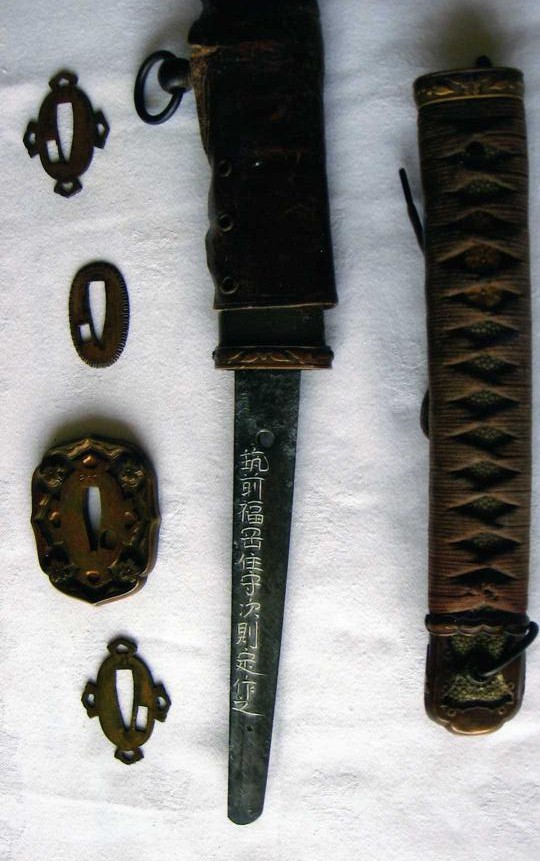
Good Afternoon I often marvel at the standard of photography exhibited on this board, as a good picture is enjoyable to view and easier to learn from. I'm aware also of the numerous articles that have been posted on this very subject. With this in mind, I've been trying to improve my limited photographic skills for the last couple of hours, choosing as a subject a military mounted sword. The nakago is much easier to capture than the blade so I'm posting this first. 2 mekugi-ana, yasurime pattern takanoha with futatsu -hi both sides. It is a signed blade and I will try to get a decent picture of that later. Does anyone have any thoughts on the age of this sword? difficult from just the one picture and I'm not even too sure myself. Mick
-
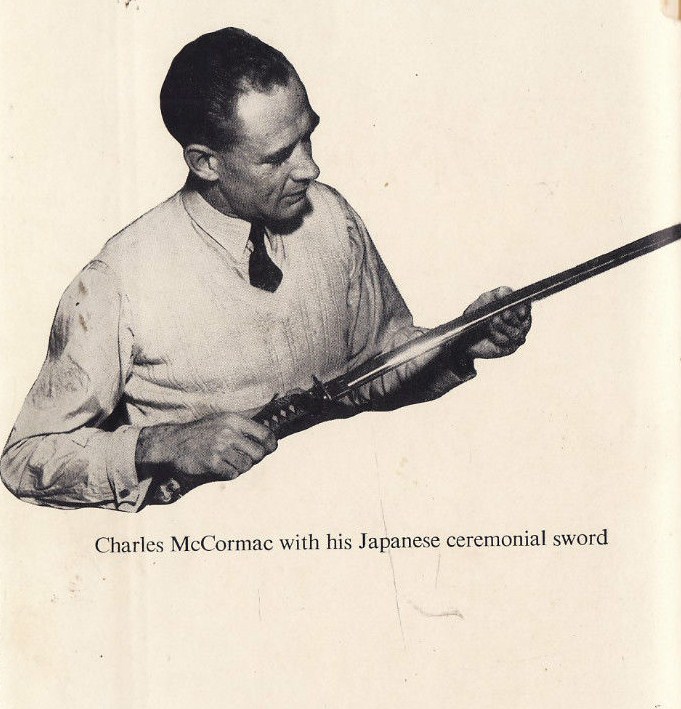
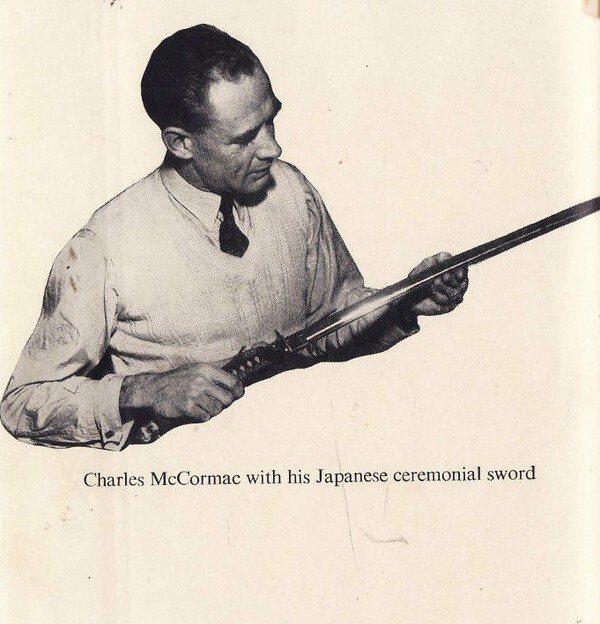
Squadron Leader Charles McCormac DCM (1915-85) was a married R.A.F. sergeant stationed with the Royal Air Force in Singapore. When the Island was attacked in 1942, he was able to get his young wife on one of the last evacuation ships but he decided to stay and fight. Eventually captured and interned, he along with other prisoners decided to break out from the camp where they were held. With only improvised weapons and their bare hands they overpowered the guards at the main gate and fled into the jungle. He and his comrades were mostly naked and barefoot, with very little food, they faced a 2,000 mile journey to reach Australia and freedom. It took McCormac 5 months to reach his goal, most of his fellow escapees were either killed or died from disease. His special qualities were recognised and he became involved with Intelligence Work and later served under Lord Mountbatten. It was Mountbatten who gave permission for McCormac to acquire Captain Teruchi's sword. It is obvious that this sword was a prized possession of both Captain Teruchi and the late Charles McCormac. I wonder where it is now? Does it still reside with his family? Did it go to auction or an antique shop. Perhaps it still lies hidden, forgotten in some corner cupboard, attic or basement - waiting to be re-discovered! Mick
-
Squadron Leader Charles McCormac c.1953
-
What could be the reason for this tsuba being plugged ?
Davis replied to kusunokimasahige's topic in Tosogu
Possibly used in a Meiji period cupboard/cabinet that was made for tourists/export, using redundant tsuba , menuki etc., Mick -
Bob Don't be disheartened.. Even with a background of experience and knowledge one can still come unstuck. For those interested in this topic, go to the To-ken Society of Great Britain website, click on "Home", then "Articles", scroll down, click on "see more". It's then worth reading about "A Sophisticated Forgery". Food for thought. Mick
-
Thanks George for that interesting snippet, Piers too. Those interested in the subject of surrender swords might wish to read the late Han Bing Siong's letter in programme No.37 on the To-Ken Society of Gt. Britain Website. He gives a good description of the sword at Windsor Castle and speculates as to which sword Lord Mountbatten returned to the Field Marshal's family in Japan. Also in programme No.81, Reminiscence - B.W Robinson, is in my opinion fascinating. Mick
-
Good Afternoon A gunto with a blade by Yasutsugu is on permanent display at the Commando Training Centre Officers' Mess and is presented annually. It is said to have belonged Field Marshal Count Terauchi Hisaichi. Those interested might wish to Google " The Mountbatten Sword " Yet another sword acquired by Lord Mountbatten is held by the Imperial War Museum, London. This one was given to Admiral Sir Geoffrey Layton in London 15th November 1946. A letter accompanies this sword. Mick
-
European Sword Fuller manufacture - it IS Nipponto related!
Davis replied to Peter Bleed's topic in Nihonto
Peter The To-Ken Society of Gt. Britain held an exhibition in 1968 at the Ashmolean in Oxford. Bon Dale edited a catalogue of these exhibits. One sword exhibited being a blade of European manufacture that had been polished and remounted in Japan. I'm pretty sure this sword later came up for auction in a London saleroom about six years ago. Unfortunately I no longer have this catalogue but I feel that someone, somewhere has a copy and can provide more details. Mick -
Yes Mark I agree, I have been told of many similar stories. However, whilst the surrenders in areas occupied by British, Americans and Australian forces are well documented, very little is known concerning surrenders to Russia and China. I know of only two individual sword surrenders to the Russian army and none at all to the Chinese. Some American and British soldiers did acquire large numbers of swords. Field Marshal Terauchi surrendered two swords to Lord Mountbatten. One he kept above his fireplace at Broadlands the other he presented to King George V1...this one is now on display at Windsor Castle. He also had many others, one of which is now in the Imperial War Museum. In a TV documentary in the 70's he mentions another he returned to Japan. A very interesting sword belonging to a Captain Teruchi was acquired by Squadron Leader Charles McCormac with Mountbatten's approval. Teruchi had actually attacked McCormack with this sword some years previous to the surrender. McCormac was later to write. "The sword is locked away in a cupboard now, safe from the inquisitive fingers of our three children; but sometimes when I am alone I will take it out and think of things that cannot be easily forgotten" From time to time over the years I have seen consigned to auction large batches of swords that have been stored by institutions and other establishments. I have also seen many others rusting away in some museum storerooms etc., As for Russia and China? I would be very interested in the full story of how the late dealer who imported the swords into Britain all those years ago managed to go about it. It certainly showed initiative! Mick
-
Thanks George for a very detailed response, what a great forum this is - ask a question and get an almost instant, quality answer. In the days before the internet it was almost impossible to obtain this sort of information. We had to depend writing long letters to one another which often took months. Incidentally, I recently googled Australian War Memorial, kept clicking and eventually ended up looking at well over 100 photos of sword surrenders. Some really interesting and again show the huge quantity that were involved. Obviously many of these ended up as trophies as the one given to your cousin but how many also ended up in storage and then forgotten? Mick
-
It does help George. I searched the forum and found your post "Akabane-To being restored" It puts flesh on the bones of the story. The UK is blessed with many fine local and regional museums. Most have massive reserve collections that they do not have the room to display. Some of these have fine collections of Japanese Swords that are just rusting away. Once they were cared for but with the passing of time and the moving on of those individuals who had the knowledge and expertise these treasures become overlooked, neglected... War wreaks havoc upon the cultural heritage of a nation....the treasures of the vanquished become the spoils of the victor but what do they do with them? Many years ago I spent a holiday in Russia, when it was the Soviet Empire. We were being guided around a government building when we were taken to a room, in the centre of which were piled several hundred German helmets. This got me thinking about the large number of Japanese swords that must have fallen into Russian hands in 1945. Consequently, on return from holiday I wrote to the Red Army Museum in Moscow to ask them what had happened to those swords. About six months later I received a reply. In the letter was enclosed a black and white photo of a N.C.O.'s sword, apparently this was the sum total of the collection. I also wonder what became of the Gustav Jacoby collection in Berlin, is it now in The Hermitage or perhaps piled up in some old cellar? Individuals too, in time of war are sometimes confronted with the opportunity to acquire massive art collections. The reclusive elderly son of a wartime Nazi art dealer springs to mind. By chance he was discovered to have an astonishing 1,500 works of confiscated art in his Munich flat...worth untold millions. The late Basil Robinson of the Victoria and Albert Museum, when an Army Captain, in Singapore in 1945 was given the task of sorting through 1,800 surrendered swords so that they could be graded and handed out to senior Britsh officers as trophies. Although he himself only brought back two. Others were more fortunate, perhaps because of their senior ranks. Field Marshal Festing and General Gracey spring also to mind. I believe Lord Mountbatten managed to obtain quite a haul. At an auction viewing once, I came across a box of old letters. one of them from Mountbatten was written to a London club thanking them for the hospitality that they had shown him the previous evening. He went on to say he was sending with the letter a Japanese sword for them to display at the club..he then went on to give a full description of the sword. He seemed to make a habit of presenting these sword to various people, including the then King George. I realise as I type I am making this overlong but suffice it to say that there are still many hidden treasures neglected, rusting away waiting to be discovered. Thanks Grey for the book title. Mick
-
Chris, thanks for that. Did any of the former owners or their families get their swords returned? I believe there were some high grade swords among them, do you have any more details? Brian, again very interesting, confirms what I've always thought. Purely from memory and without refering to references...the U.K. dealer was from Nottingham. Most of the swords were in poor condition having probably been used for agricultural work post 1945. All periods of sword were covered and some even had additional inscriptions added to nakago. So both Japanese and Chinese inscriptions could be found. These ones though seem to have been presented post capture/surrender as war trophies. I believe some of these are still in private collections in the U.K.......I'm still thumbing through Richard's book, very interesting. Mick
-
Good Afternoon I've recently received my copy of "Japanese Sword Surrender Tags" by Richard Fuller and very pleased with it too. On page 135 there is a picture of a card label which was stuck to the scabbard of a shingunto. The label reads "Japanese sword found in CT arms dump in S.Johore, Malaya in February 1958 by 1st Bn RSM Martell. This got me thinking about the many hidden treasures that still might one day be discovered. Stored away, forgotten, neglected in the most unusual of places. Watching the recent TV series "Combat Dealers" reinforced this thought. Does anyone remember the enterprising dealer (U.K.) in the 80's who sought out and imported a huge collection of Japanese swords, bayonets,ancient cannon etc from a military arsenal in China? What about the 5'000 swords found in a government warehouse in Japan. They had been confiscated in 1945 and then forgotten, I can recall reading about it a few years ago but nothing since. Does anyone have any thoughts or can add any additional information? Mick
-
Hi Thanks for posting the pictures. It certainly isn't a waste of time, I've studied them a number of times. My knowledge of the subject is rather weak and I too was hoping to learn from the comments of others. By the way what is the name of the museum and how did you get involved with them? Thanks for sharing. Mick
-
Brian I won't be able to obtain further pictures for a while - not that they would add much anyway. My sword too, exhibits the activity you refer to, although nowhere near as pronounced. During the last 25 years I have only handled one other sword by him and seen about eight references to others. Of these, most were special order blades. So, I have concluded that although not prolific his work was highly favoured.. All seemed to share the same flamboyant hamon and detailed activity. I should also imagine that whatever showed on his finished blades, was what he intended, otherwise he would not have put his name to them. I have owned a good number of gendaito, all now gone bar this Moritsugu Norisada. I believe the former Japanese owner of mine saw action in the field as the sword came with a battered n.c.o's leather knot and a bullet/shrapnel graze to it's saya. To me it is a privilege to be it's present custodian, a piece of military history yet a fine work of art too. Therefore I can share the enthusiasm that you obviously have for yours. Mick
-
Brian I managed to get a quick shot of my blade before returning it to storage. Unfortunately I didn't have the time to do better.Mine too has some corrosion, like yours a deep rich black not the normal red/brown colour that you would expect on a sword of this age. I'll get some more pictures/details when time allows. Mick

-
Brian From memory, it has a very flamboyant choji-midare mix. I have onley seen one other sword by this smith. He seemed to have concentrated on very high quality work and could not have made very many of this standard during the time that he was active. Look forward to seeing some more pictures. Mick
-
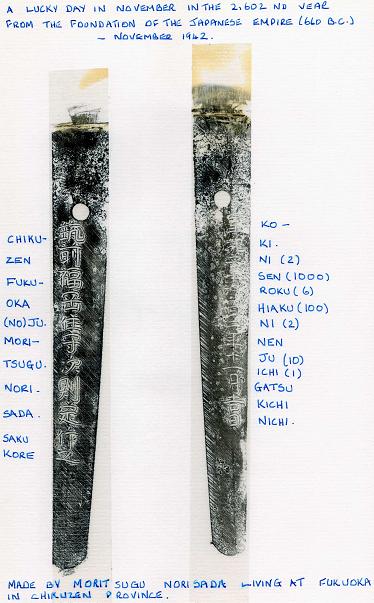
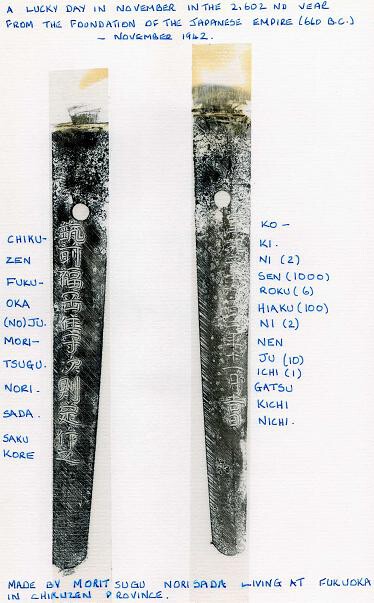
Evening Brian Digging through an old file I found some transalation notes I made when I acquired my sword. I might be a little wrong on the date though, looking at it again. I'.m still searching for other details. Mick
-
Hi Brian I'm not sure if this is of interest. It's an old photo of a sword that I have in storage. This one I believe reads "made by Moritsugu Norisada living at Fukuoka in Chikuzen Province". I'm busy with some building work at the moment but if you are interested I will give further details as and when. Regards Mick

-
Dear Ron, You have started a very interesting debate. I have tried to visualize how Samurai would have used your kaginawa. To climb a rope, the rope would have to have been strong enough to support a persons weight, it would also have to have a circumference that could be comftably gripped. Attaching such a rope to your kaginawa ( weight 1lb apprx.) would not allow it to be thrown very far vertically, the weight of the rope would act as a downward drag. Your kaginawa could however have been used with a combination of different sized ropes utilizing knots such as a double sheetbend and running bowline. The application of which would be too detailed to go into here. Many years ago in the course of my then employment I was trained in the use of hook and scaling ladders. The idea was that they could be used to gain access to buildings where conventional ladders could not be deployed - due to restricted space - rear of hotels, tenements etc. The hook ladder was of lightweight construction, 13' 6" long and had a 2' serrated hook. The person using it would also wear a "hookbelt" which attached to it were a large snaphook, axe and bobbing line. The boobing line was a 100' long and weighed about 2lb. An improvised grappling hook could be made using the line tied to the axe. It wasn't particularly effective as the bobbing line could never be climbed. A normal sized line (rope) had to be attached to it and pulled through. Many years ago I was shown a wartime documentary of British commandos training to scale cliffs. They were using grappling hooks fired from mortar like devices.. Schermuly rockets could no doubt be adapted to the same principle. Ron, your description of my Meiji period bronze is pretty accurate. However, the picture doesn't show the opening at the top which has been used to place incense in the past. A Japanese specialist at a London museum also thought that it was a koro. I believe Christies sold a pair of them similiar to mine at a sale in London during 2012, describing them as koro. You were also right to pick up on the patination. A previous owner has almost ruined it in the past by cleaning it with abrasive metal polish. but time is again allowing it to mellow. A very interesting subject, thanks again Ron. Regards MIck
-
Ron Thanks for the very interesting links. I once read that in Old Japan, firemen attending a blaze would have a standard bearer, who would plant his banner into the ground and stand alongside it whatever happened, even if the fire advanced upon him. Whether this is true or not I don't know. Also read that firemen together with yakusa were very keen on full body tattoos. Getting back to the main subject, I'm posting a picture of a koro that I have, hope it's of interest. Mick