Davis
-
Posts
213 -
Joined
-
Last visited
Content Type
Profiles
Forums
Events
Store
Downloads
Gallery
Everything posted by Davis
-
Rick Some adopt that principle and it can work but it won't exclude the wealthy buyer, who on a whim can buy and then discard anything they choose, without any appreciation for what they have acquired. Very interesting Mark. Nothing is forever and everything on earth has an expiry date. Yes, at some stage we will no longer care but while we still can, we do. Sometimes, I have stared at paintings in a gallery and wondered, for how long, something so fragile can exist, before it too succumbs to the ravages of time. Decay, fire, warfare or thrown away with the rubbish. Dark thoughts? Perhaps. Many swords I have encountered have been damaged or neglected in some way. Most of which has happened, probably over the last 70-100 years. Every so often though a treasure emerges from somewhere and presents itself in perfect condition, apart maybe from some surface dirt and grime, which is itself a form of patination. How could it have survived, intact and undamaged for so long? Generation upon generation of careful custodians, identities unknown. Mick
-
Some years ago I donated a couple of items to a museum. They never did appear on display and were probably stored away and forgotten. The museum eventually closed. I would never donate to a museum again. In the UK, the Museums Association recently conducted a survey of museums. It revealed that 1 in 10 are considering selling off items from their collections. Also 53% of museums responding to the survey reported cuts to full time staff. Almost a third (32%) reported an increase in the number of volunteers and interns. 36% said the number of school visits had decreased. The pace of selling off artifacts has also speeded up. Northampton Museum sold off a 2400BC Sekhemka Egyptian statue for over £14 million. Croydon Council disposed of 24 Chinese ceramics for over £8 million. A number of other museums are lining up to do likewise. Some with very good Japanese collections. Getting back to the original post - we will of course, all make our own minds up on what we intend to do. A good inventory, photos, descriptions, contact addresses etc., will all no doubt help. Thanks all for sharing your thoughts on this interesting subject. Mick
-
Marius I hadn't realised that Chris had covered this before. Thanks. Peter I agree with every point. I might also add that a museum repository will tell you more about that museum than it's public display ever will. Scholarship has waned............ I remember the first keeper/curator I met during the 1960's. It was at a London museum and I had taken along a sword seeking information. It was early morning and I hadn't made an appointment. An elderly gent greeted me like a long lost friend, he was at least fifty years older than me. Full of enthusiasm and free with his knowledge, we spent the entire day together touring the building. Very enjoyable. My most recent encounter was with a young woman giving a talk on the "Edo Period". She held handwritten notes and read straight from them without looking up. We were then showed a shingunto which she told us was typical of the swords worn by samurai at that time..... With regards to disposal. Auctions are an option but the right auctioneer, right sale and timing are crucial. Some examples of past sales:- The first example was a sale held many years ago and from memory the vendor was alive at the time. He was a WW2 veteran, collector and author. His collection was split between two auctioneers, one in London and the other in Sussex. The best of the collection - ancestral blades in military mounts went to London and the remainder, gendaitos etc., went to the specialist in Sussex. Nice catalogues, good lot descriptions and well advertised in advance etc., This collection sold well. The second example was a collection held in more recent times. This sale took place a considerable time after the owners death, the 30 plus swords had been in storage many years before coming to market. They were good swords but in poor condition. The lot description for each was virtually identical and incorrect. The sale was poorly advertised. This collection was given away. Final example was not a collection but a single sword that appeared in a general sale. Described as a " Japanese Officers sword est £150 - £200". No doubt consigned by an elderly veteran or his relatives. What the auctioneer failed to mention was that the blade was 600 years old and was very well preserved. Fortunately it was spotted and a good price had to be paid for it. A dealer later had it on offer for just under £5,000. Mick
-
Ian It was the Museum of Childhood in London's East End that inspired me to collect. Despite the name it housed a magnificent collection of Japanese swords and fittings - nicely displayed. Hundreds of tsuba were contained in cabinets that had pull out drawers for closer inspection. Around that time I used to write to Basil Robinson asking for his help in reading signatures. He usually replied with a beautifully handwritten note with the calligraphy highlighted in red ink. Museums were a joy in those days. Your valuable insight into the workings of the RA is very reassuring. This should be the gold standard other museums aspire to. Your witty description of the museum that replaced it's ethnographic collection with looms and spindles I feel, is the standard though these days. I once offered the Imperial War Museum a small collection of rare items - they were not interested. This lead me to read up on the acquisition/disposal of collections by museums. As you say very bureaucratic. You also mention the financial restraints local authorities and museums face. This has lead in some museums to staff cuts and reduced opening times to the public. I have also heard whispers of some museums wishing to sell off parts of their collections. This has happened in the past. Do you remember, many years ago The Tower of London selling off a huge stock of ex East India Company muskets/pistols? I know also that the trustees sold off a considerable number of swords from the Bower's collection at Chiddingstone. I vaguely remember something similar at Warwick castle? I think that last year Thomas Del Mar also sold arms and armour from an institution in the U.S.A. I don't have the references in front of me but I will try to find them. Ian, thanks for your comments. Brian A very practical solution. I like the idea that the price we pay is really the "rental fee". Thanks Mick
-
Thank you for your positive replies. Peter, "collections are numerous as clouds....." Sums it up perfectly. Ken, my late father had a collection of boxing memorabilia. My younger brother was a boxer but wasn't interested in it, neither was I. I inherited it anyway. knowing what it had meant to him I spent a year breaking it up. I carefully selected various items and passed them to his old friends and associates. The rest I trickled through auction. Hopefully, all his treasures are now safe and appreciated. Unfortunately, no member of my family is remotely interested in Japanese swords Regarding keeping regular up to date values. We know what we paid, we might think we "know" what our treasures are worth and we "know" that there is someone out there eager to buy. That's the easy bit. It's another thing in reality. So how can we expect our family or executors to handle things better than we can? Steve, you mention museums! Grey and Brian have answered as I would have. I've seen inside the storerooms of some museums. Water damage, rust, swords forcefully jammed into wrong saya etc., etc. Some museums have had dedicated, professional staff with an absolute passion for the subject. Names like the late Commander Newman and Basil Robinson and in more recent times Victor Harris and Ian Bottomley, spring to mind. People move on though. Continuing expertise cannot always be guaranteed. Regarding "Museum Collapse Syndrome" - it's already with us. I know one museum albeit small and specialised that was closed for financial reasons but in reality the reason was political correctness. I've also seen auctions where museums have consigned arms and armour following a clearout. The reason usually given is that money has to be raised for building maintenance or some trendy new project. The other Peter, reducing a collection to a few choice items, I believe, is the way to go and taking on the disposal of the rest ourselves. The burden shouldn't fall to others. They just won't have the enthusiasm. Mick
-
I have observed over the last few years the increasing frequency of Japanese collections coming onto the market - mainly at auction. No doubt in many cases this is due to the death of the former owners. Viewing these collections can be very interesting and can give clues to the tastes, knowledge and pocket of the collector. The size of these collections can vary from a handful of pieces to many hundreds of items. Conditions can range from the badly distressed and almost beyond redemption to pristine verging on the immaculate. Quality/condition usually achieves a high price but generally most things sell well below what they are worth and probably what was originally paid. It also seems the larger the collection on offer the lower the prices realised. Auction houses, certainly here in the UK, vary considerably. Some are well run, with efficient and pleasant staff, research their consignments, provide good catalogue descriptions and supply excellent pictures. Some don't! So the older collector, as the years advance, should maybe start to think about the disposal of his collection. Should it be cherished to the end and then left to others ( not qualified/interested ) to carry out your wishes. Or, while you still have the mental/physical capacity and perhaps some knowledge of the market, start to break it up yourself? We are the present custodians and should endeavour to pass on our "treasures", intact, into the safe hands of the next generation but what's the best way? Any thoughts? Mick
-
Ian, Completely agree with you - you raised some very good points. I do think though, that this will be put to parliament sooner rather than later. There are too many high profile public figures who wish to court popularity. They are on record as saying that they wish that our major collections of ivory should be destroyed. New trendy thinking? Recently Helen Ghosh, Director of the National Trust said that their properties have too much "stuff" in them. Her solution, pack it all away and just have a few exhibits on display. You can imagine the future, say at Snowshill Manor. A collector makes the journey there to view the Japanese Arms and Armour and is disappointed to find almost empty rooms. Instead on display is perhaps a single vase to stare at but you would have a bean bag to sit on! Mick
-
Some politicians did receive a good kicking. However, the Conservatives are now the Government and have pledged to ban the sale of ivory. They also intend to campaign for a complete international ban. Mick
-
Good evening all Here in the UK, the Conservative Party has pledged in it's manifesto that they will ban all sales of ivory. It has since been confirmed by Conservative Central Office that the ban would be total and include antique items predating 1947. When this eventually happens, what will become of antiques made from ivory or including ivory? Will they cease to have a value or will their blackmarket value skyrocket? Source - Antiques Trade Gazette 27th April 2015. Mick
-
I don't know what happened there, I'll try again.
-
Not so commonly found are those made from stag antler. This one is from a collection formed pre WW1. Quite heavy too. Mick
-
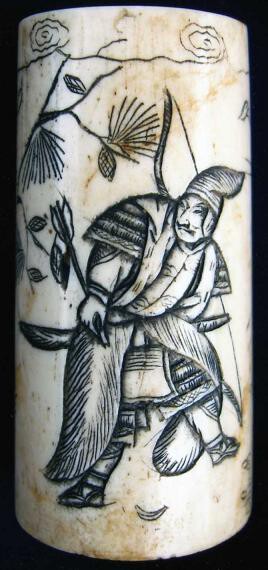
I bought this 7cm x 3cm section of bone at an antique fair. I asked a Chinese couple (antique dealers) browsing at the same stall whether it could be Chinese. The answer was no. The picture is not very good, the detail is much better viewed in hand. My opinion is that this is Japanese. Mick
-
Some thoughts on the original question. The appearance of a fire damaged tsuba might depend on a number of varying factors. Was the tsuba placed in a fire intentionally under controlled conditions? Was it involved in a fire accidentally? What was the duration/intensity and maximum temperatures reached? Where was the tsuba located within the fire and how was it positioned? How do different metals behave in a fire, what are their expansion rates/melting points? Did the tsuba anneal slowly or was it quenched rapidly? Was there corrosion/rust present before the involvement with fire? Was it allowed to rust after the fire? Was it re-patinated? What were the mediums used? Was re-patination done well/badly? Etc., etc., Re sekigane. Omote side, it has more exposed surface area and seems to stand proud - so easily buffed. Ura - less surface area and appears recessed - difficult to buff - patination or discolouration remains. Sometimes it's seems clear cut, sometimes not. Mick
-
I also picked up on the points made by Brian and Pete. My initial thoughts were rust+oil+buffing. Are there any hairline cracks in the iron adjacent to the copper? Mick
-
Whereabouts unknown. Authenticity? It would have been acquired at a time of great upheaval in Japan and anything is possible...Liverpool, in the past was a great place to collect swords. A large port, large number of very wealthy Victorian collectors whose collections were disposed of locally when they died...... Mick
-
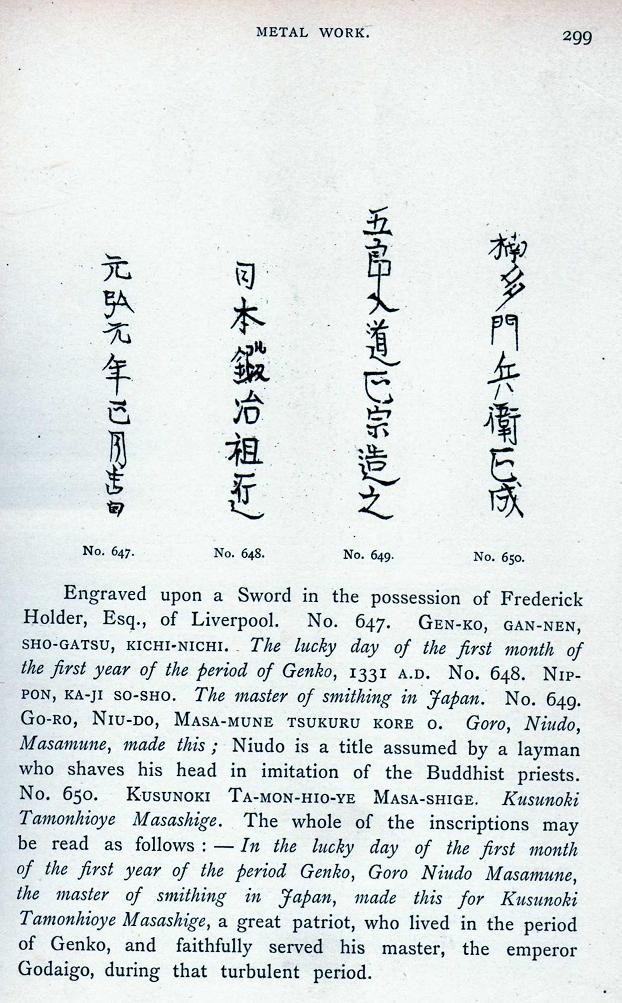
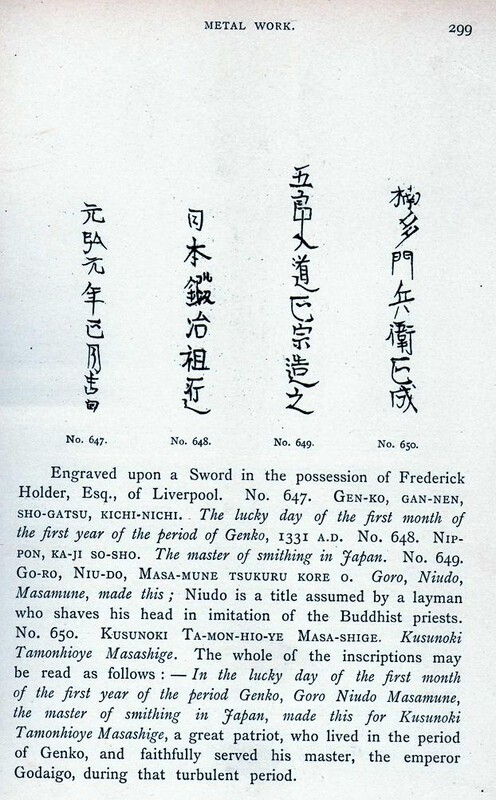
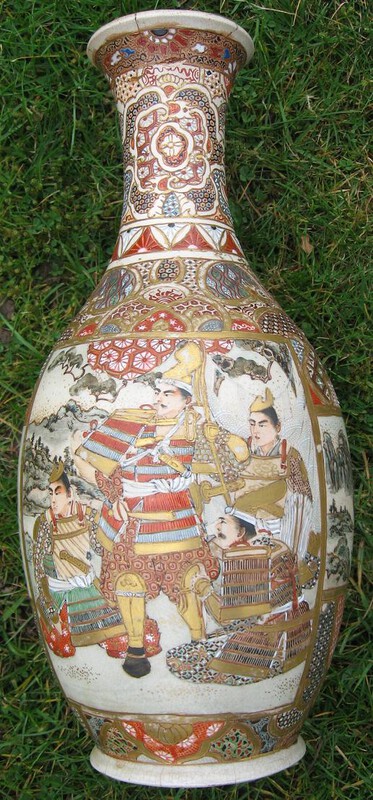
Nicely summed up Pete. The page is copied from a book published in 1882, the vase was purchased at a flea market for a couple of pounds. They perhaps illustrate the range of "art" that came to the UK in the Victorian/Edwardian eras. In the UK "export" art can still be found in abundance and cheap too. Mick
-
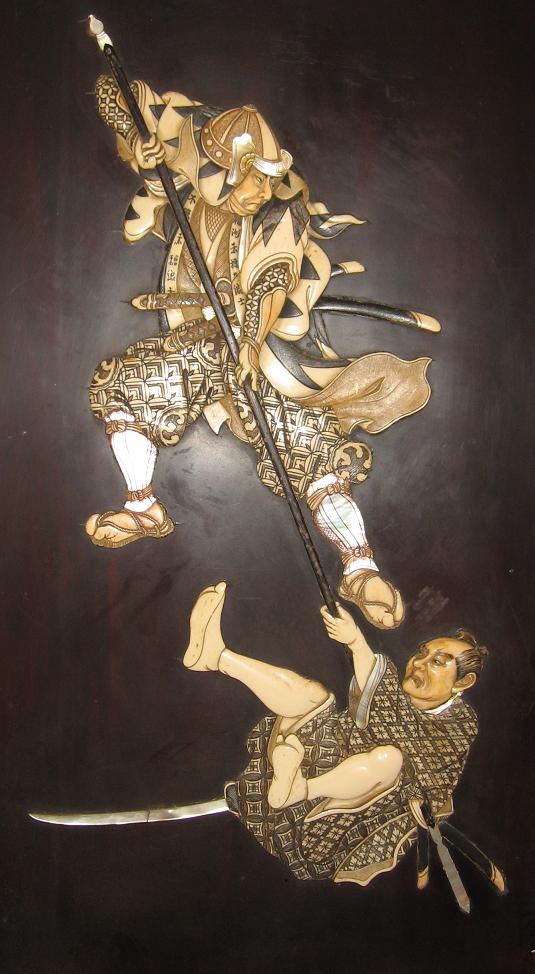
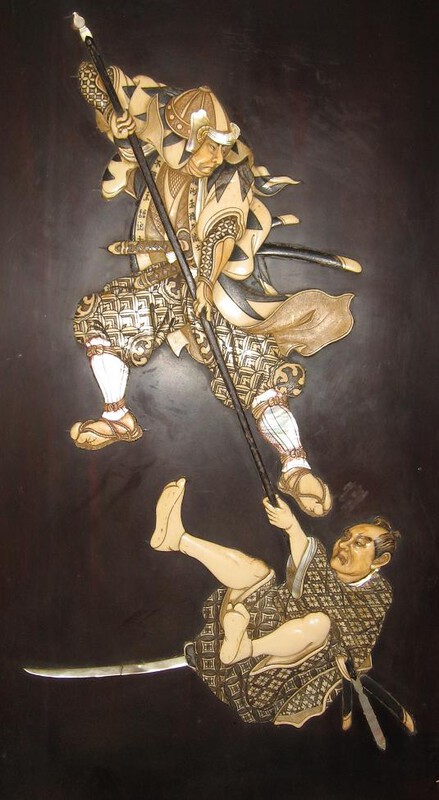
Thanks Steve for your interesting and thought provoking comments. Victorian England was fascinated with Japan. Writers such as Mitford and Satow wrote of their experiences and captured the public's imagination. Collecting Japanese "art" was very popular with those that could afford to do so. The late 19th and early 20th century saw huge quantities of this "art" arriving in the UK. Some of this was indeed treasure such as arms and armour once prized but now discarded. Much more though was "art" created specifically for the western market. This panel falls into the later category. The politically correct of this world might also view it as just a display of random violence from a bygone age. To me though it is much more than that. It's creator has used some remains of once living things and brought them to life again albeit in a different form. It reveals a hidden tale of honour, loyalty and self sacrifice. It might be just another tourist piece but I would still regard it as art. It's pleasing that some of you would agree. Thanks for your responses. Mick
-
Thank you Morita san for identifying the subject. The panel is housed in a wooden frame and measures 82cms x 47cms. The materials used are ivory, bone and shell. As said, art as in beauty is in the eye of the beholder. Although I'm not sure Pete how this piece can be enhanced by velvet? Mick
-
Good Morning all Brian, it's a great idea to create this separate section. I'm looking forward to using it and improving my very limited knowledge in this field. I'm posting a picture of a decorative panel that was made for the tourist/export market, probably during the Meiji period. To me it conveys movement and momentum but can it be considered as art? Does anyone have any thoughts? Mick
-
Hi Eric For what it's worth. The brass habaki was on a very good sword that I once owned. It was acquired by an American Colonel in Japan c.1945. The Colonel was subsequently based in England and passed the sword to a friend of mine in the 1960's. The friend passed the sword to me 27 years ago. It wasn't Chinese. Unfortunately, the only photos I now have don't show the quality of this fine blade. This picture though might give you some idea. Mick
-
Here they are!
-
Hi Eric Getting back to your original post "materials used for habaki through the ages." I've often marvelled at the workmanship that goes into the making of habaki and would like to learn more on the subject myself. The majority of swords I have encountered have had habaki made from copper. I have also handled and owned swords with solid silver habaki but they have been few and far between. Usually they have been mounted on very good shinshinto blades. I'm posting pictures of two solid silver habaki, one solid brass and one double habaki, silver wrapped over copper. Perhaps other members could post pictures of habaki on swords they have and give details as to materials used, design and classification. Regards Mick
-
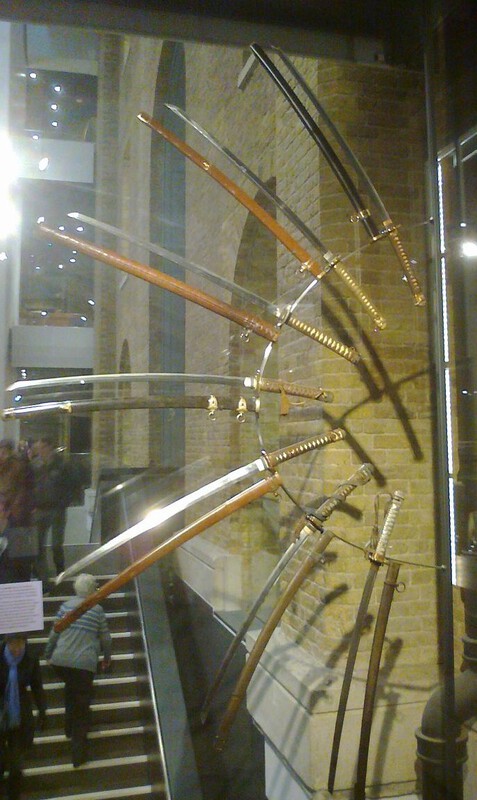
The Imperial War Museum, London, had in it's reserve collection at one time over 100 Japanese swords. I'm not sure how many they have now but on a recent visit there I found just eight on show. Seven of these were displayed as shown in the attached picture. If anyone wishes to find more on the Nobuo Fujita story they might wish to google Offbeat Oregon. The article of 13th May 2013 "The flying Samurai who attacked Oregon" has an excellent picture of Nobuo Fujita presenting his sword. Mick
-
Thanks to your assistance I believe I've been able to locate a reference to this artist. I think he is Naito Akimatsu who was registered in the Tokyo Sculptor's Society:List of Ivory Carvers working 1904 - 22. What I describe in my post as a plaque is actually a lacquer panel depicting samurai made from ivory and shell. Thanks again for you help. Mick
-
Thank you both for that information. Armed with that I can go through my reference books again. Mick