ROKUJURO
-
Posts
6,806 -
Joined
-
Last visited
-
Days Won
32
Content Type
Profiles
Forums
Events
Store
Downloads
Gallery
Everything posted by ROKUJURO
-
Calabrese, did I say the WABI concept has to be applied always without exception? I hope not. But there are many examples. See the YATSU HASHI below. https://tsubashi.com/product/yatsuhashi-bridge-with-irises-tsuba/ We could possibly discuss without result if there is an unfinished bridge depicted or just the idea of one. You can also read about René Magritte (Ceci n'est pas une pipe https://www.planet-schule.de/mm/nie-wieder-keine-ahnung/malerei/epochen/surrealismus ). Even detailed "finished" works of art may just give you an idea, an imagination of the real thing! Only bad work and laziness would need an excuse.
-
Calabrese, of course the ZEN painting is not related to casting techniques! I just referred to the idea of "unfinished". This is possibly only a different concept in our Western brains and does not necessarily correspond to Japanese aesthetics in arts. Leaving things out can make room for thoughts and emotions, while we in the West fill in every corner of an art-work so there remains no space for your own interpretation and imagination (very generally speaking). It is just a different way of seeing and feeling(s), I think. In addition to that, I find it very unreasonable to believe that an 'unfinished' TSUBA was sold/released from a workshop, with clear signs of hammer-work on the SEPPA-DAI (which is a proof that it is not cast!), with mounted SEKI-GANE as a proof of use, would be embellished with a silver FUKURIN. This part of the whole discussion is redundant in my opinion.
-
No Dominique, this does not apply to Japanese swords! They are very special and sophisticated, and without the necessary knowledge and experience, all "cleaning" will lead to damage, as you see.
-
Dominique, a problem is that the sword and metal parts seem to have been 'cleaned'. Besides many other factors, patina is important for an age guess. Even good photos do not allow a precise judgement, so all comments will have to remain a bit vague. The best way would be to find an expert - de préférence an NMB member - and show him your sword in hand.
-
Geoff, tempering is not hardening, While closely connected in the heat-treatment of blades, they are two different processes.
-
Molds were not cut as it is possible nowadays in die casting. In former times (and in Japan) you needed a model first which was then copied in a mold made from a mixture of clay and fine sand. In a different casting process, a 'positive' wax model was made that remained in a mold. It evaporated as soon as the molten metal was poured into the mold. BELOW: Is this an unfinished painting then?
-
MEI is NOBUHIDE SAKU.. On these later photos, it looks indeed handmade. Perhaps for a special purpose in crafts?
-
 Hi dear members, as time progresses, I would like to remind you of my TSUBA forging workshop. If you would like to participate (max. 3 persons) and need accommodation for this event, please plan ahead as we have tourist season! I can help with finding guestrooms, so please let me know! TSUBA forging workshop 2025.pdf
 -
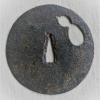
The oval part is the SEPPA-DAI. MIMI is the outer rim.
-
Steve, I was referring to the difference between methods and materials.
-
Steve, I don't think so. If they wanted to underline that it was "made with traditional material", TAMAHAGANE could have been ONE possibility. But traditional methods might just imply it was forged or differentially hardened or ground on bench stones.
-
FUJIWARA MASAHIRO. For better photos, please remove TSUBA and HABAKI, and use a dark, non-reflective background. Edited. Of course Ray!
-
SAME is hide, not leather. That is why it expands when soaked in water and shrinks while drying. But there is also SAME leather available for decorative purposes. I have seen SAME repaired by Japanese craftsmen. They did their very best, but In my opinion, it is always obvious and never nice.
-
Mike, nothing rough or coarse in this nice TSUBA! It is just the style! What are the dimensions?
-
Is this an original ww2 one?
ROKUJURO replied to aftakas's topic in Auctions and Online Sales or Sellers
Jelle, you understood well that no blades are included? -
Parts like SAYA, TSUKA-ITO and TSUKA were often repaired, renewed or replaced in SAMURAI times, so if it were mine, I would consider having it redone with good material by a professional (if I had the means, that is...). Of course I would keep the same style and not choose neon-green TSUKA ITO and pink SAME.
-
If you look at the patina, it is gone after OSA.... There has been worked on it, I believe.
-
....and the white background reduces the contrast! Better use a dark, non-reflective one. Otherwise, nice blade!
-
My kai-gunto: some photos & questions.
ROKUJURO replied to Nazar's topic in Military Swords of Japan
Nazar, you may be an expert in sandblasting. But what about Japanese sword blades? Do you see something like HABUCHI, NIOI, or NIE on your blade? I do not know what you have there, but I miss HATARAKI or any other typical signs of what you could expect on a Japanese sword blade, even if it was a SHOWA TO. -
Excuse me MORIYAMA-SAN, I am very sorry!
-
I can't see anything wrong on these images. Looks fine for me. I don't think this design would be cheap and easy to copy.
-
Frank, that blade is probably not Japanese. The signature(s) (= TACHI MEI) make no sense to me. What remains of the Japanese TSUBA cannot be sold on the market. It may not be very old (how old is old?), but very corroded. The FUCHI is not genuine, but the TSUKA looks to be a repurposed original one. As it is a gift, there were certainly good intentions involved. Don't kill the spender!
-
Mike, the blade itself does not look dangerously corroded, but someone has obviously sandpapered it, taking off material and rounding the SHINOGI down. Any metal removal on an old blade is a damage and a loss of possible "lifespan"! What is visible of the HAMON does indeed look spectacular! May I ask who the polisher is you will send it to? If he is traditionally trained, he will certainly take care of any corrosion issues.
-
The second is a TOROKUSHO, a government registration paper. Would be easier to read if oriented correctly, not lying on the side.
-
Mike, it is WAKIZASHI, not Wakazashi. Signature reads BIZEN KUNI no JU OSAFUNE.....Do not try to "restore" the blade, do not "clean" the NAKAGO! More photos of the complete blade without HABAKI - made on a dark, non-reflective background and presented as cut-outs, tip always vertically upwards - will help the experts to tell you more.