


Grey Doffin
-
Posts
4,174 -
Joined
-
Last visited
-
Days Won
31
Content Type
Profiles
Forums
Events
Store
Downloads
Gallery
Everything posted by Grey Doffin
-
Be very careful with this blade. Without the tsuka and mekugi to lock it in place, the blade bottoms out inside the saya and the kissaki is easily broken. 2 blocks of wood with holes bored in the right places, and a dowel through those holes and the mekugi-ana in the nakago, the whole held together with a stout rubber band, will limit the travel of the blade into the saya. Grey
-

Stupid question time
Grey Doffin replied to SwordGuyJoe's topic in General Nihonto Related Discussion
Joe, Rather than spend what would be necessary to fit your shira-saya mounted blade with new koshirae, for about the same cost you could buy a sword mounted in koshirae you like. Then, rather than having one sword in koshirae and a useless shira-saya, you would have 2 swords. The purchase of tsuba, F & K, and menuki, and paying to have a saya and tsuka made and wrapped, adds up. Grey -
Chicago show
Grey Doffin replied to Rich S's topic in Sword Shows, Events, Community News and Legislation Issues
Hi Keith, I had about 6 or 7 attendees at my care and etiquette talk, and another 3 or 4 who showed up at the end got a truncated version. The lack of a notice board in the lobby with show schedule hurt; no one knew it was going to happen until I made an announcement just before. Grey -
Chicago show
Grey Doffin replied to Rich S's topic in Sword Shows, Events, Community News and Legislation Issues
The show wasn't slow for everyone; I was busy. The American Branch of the NBTHK presented 2 sessions: how to do kantei, and later a chance to try your newly learned skills with a kantei on 4 blades. The latter session also had about 6 very nice blades that weren't for formal kantei; just to enjoy. The highlight of the session was a Tokubetsu Juyo tachi by Rai Kunimitsu. Grey -
Your pictures show 3 Kanji. The last 2 are Yasuyoshi. I'm wondering if there is a 4th Kanji (1st actually) before the one above Yasuyoshi. It might be mostly obliterated by corrosion and the 2 mekugi-ana (holes). Take a close look and let us know what you can see. Grey
-
Hi Rob, Definitely an older blade, shortened more than once, and mounted for WWII. No one will be able to tell you much from the pix; it needs to be seen by someone who knows Nihonto. In the mean time, make sure you're up on sword care and etiquette (look to links above) so it doesn't suffer damage. Grey
-
Chinese. Grey
-
Fujiwara Kunitsuna Katana
Grey Doffin replied to YukouYukimura's topic in Auctions and Online Sales or Sellers
Tyler, you're providing tremendous use to the forum already. Without beginners like you us old farts wouldn't get to act like we know something. Grey -
Fujiwara Kunitsuna Katana
Grey Doffin replied to YukouYukimura's topic in Auctions and Online Sales or Sellers
I agree with all above and one more thing sticks out to me. In the 9th & 10th pictures it looks like the habaki sits crooked on the blade (it actually makes the blade look crooked at the machi but I'm sure it's just the habaki). A habaki that doesn't fit properly probably wasn't made for the blade. Possibly a bunch of parts put together to make a salable package. Grey -
Henry, I can recommend Sasano: Japanese Sword Guards Masterpieces From the Sasano Collection by Sasano Masayuki. Part one was the only volume published in English (don't know about a Japanese edition) before Mr. Sasano's death. Bob Benson at Bushido (see links) sold and maybe still sells these. Beautiful and informative book on early iron sukashi tsuba. Grey
-
This looks to me to be a sword cut (kiri komi I believe?). These aren't considered defects when they are in the mune, as the mune is the proper surface of the blade to use to block an attack. I think you have nothing to be concerned over. Grey
-
Removing hardened oil?
Grey Doffin replied to SwordGuyJoe's topic in General Nihonto Related Discussion
Hi Joe, I've always used sword (clove) oil to soften old cosmoline on swords; maybe it would work on old oil as well. If not, you could try some alcohol, but make sure to thoroughly clean up the alcohol after use because it usually has picked up water from humid air. If neither of these solutions work you might need professional (polisher) help. Whatever you do, don't use anything the least bit abrasive. Grey -
Hi folks, The Japanese Sword Society of the US is ready to take on our next publishing project and we are considering proposals. Our last 2 efforts were Sue Koto: Japanese Swords of the 15th & 16th Centuries and Kyomono no Ko-Meisaku, both by Yoshikawa Koen. Our next could be a similar translation from Japanese to English, a different translation (kodogu related perhaps), or even original research. The translator/author will be paid for his or her time. Rather than go into detail here, if you want more information please email me (or call if in the US) and I'll get back to you. Grey Doffin, JSS/US Publications. gdoffin@cpinternet.com 218-726-0395 central time
-
Two Swords - Good, or no?
Grey Doffin replied to Brett's topic in Auctions and Online Sales or Sellers
Hi Brett, While it is possible to buy a true Nihonto on ebay and not pay way too much, and it's even possible to buy one and pay way too little, it is highly unlikely that either will happen if the seller is someone who sells Japanese swords regularly on ebay. The bargains tend to be from sellers who don't understand what they have and list their swords with a $300. buy it now. If the seller knows what he has and the auction runs the whole 7 days the final value is usually at least full retail, if not way too high. Buyers with more money than knowledge tend to bid recklessly. Better deals will be had from some of the dealers with websites and some of us who don't have sites, and from dealers at sword shows. Ask around, attend shows, do some homework (books, books, books), and then you're more likely to end up with something you'll be proud to own. What I'm getting at: while either of these 2 swords may be worth owning, something of equal or higher value likely can be bought for less elsewhere. Grey -
If I'm remembering properly, I've seen the notches near the bottom of the nakago of gunto, WWII swords, not earlier blades remounted as gunto. I could be mistaken, though. Grey
-
Warm water and a gentle toothbrushing, followed by a thorough drying, should do no damage. Beyond that, if more is necessary, I'd leave to someone who knows more about the subject than I do. Anyone have a better idea? Grey
-
I can remember seeing these on Gunto; not sure I've seen them on earlier blades. If they are a Gunto thing it likely has to do with inventory in some way. Guess I don't know. I also have a faint memory of a thread from a year or so ago on the same subject. A search through NMB archives might bring it up. Grey
-
Hi Gary, On your sword, the answer is no. No possible way to know for whom the sword was made. What's more, most likely the sword wasn't made for any specific customer. It was made and sold/given/whatever to whoever happened by. "Kin Saku" (respectfully made), as written on your sword, is something you see from time to time. It doesn't necessarily mean anything is special about the blade. Sometimes, on older, traditional Samurai swords there is an inscription stating who the customer/patron was. This is fairly uncommon. Can't remember ever seeing a WWII era sword with this kind of inscription. Grey
-
Thanks; now I don't feel so bad about not being able to make sense of the mei. And thanks to all who helped. Grey
-
That's Ko-Bizen Masamune, not Soshu Masamune. Grey
-
Hi guys, I'm indexing a book with some very obscure smiths. Would someone be so kind as to translate this mei so I know who to index? Thanks, Grey
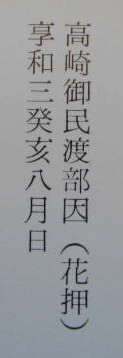
-
Gary, Gimei means fake signature. Guys, I've had some correspondence with Gary about his blade. Just to make clear what he's asking about: his sword is signed "Toto Ju Nin Ikkansai Kunimori Kin Saku". My understanding is that Kunimori is a signature Yasukuni Yasuhiro used when he wasn't working at the shrine and also after the war. Gary is trying to learn the value of his sword. Anyone know what they go for without the Yasukuni mei? Grey
-
This person who has sharpened Japanese swords before, who will remove the grinder marks from your sword, is he a properly trained polisher or something else? This sword may be salvageable and it might be worth the expense of the salvage, but if the work is attempted by anyone other than a properly trained polisher you'll be wasting your money and possibly destroying the blade. Grey
-
WWII Mounts/Fittings
Grey Doffin replied to SwordGuyJoe's topic in Auctions and Online Sales or Sellers
And it's not a sure thing that the saya will fit either. Like Todd said, almost impossible to find a rig to fit your blade even if you can try it on. Online by way of photos and measurements, no chance. Grey -
The blade is much older than WWII; no doubt about that. I was commenting on the hand writing, nothing more. Grey
