Geraint
-
Posts
3,086 -
Joined
-
Last visited
-
Days Won
9
Content Type
Profiles
Forums
Events
Store
Downloads
Gallery
Everything posted by Geraint
-
C'mon Piers, stop teasing and show us the polished yari! All the best.
-
Alternative tsukamaki wrapping (leather)?
Geraint replied to Mikaveli's topic in General Nihonto Related Discussion
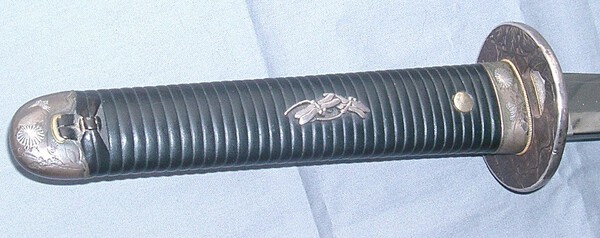
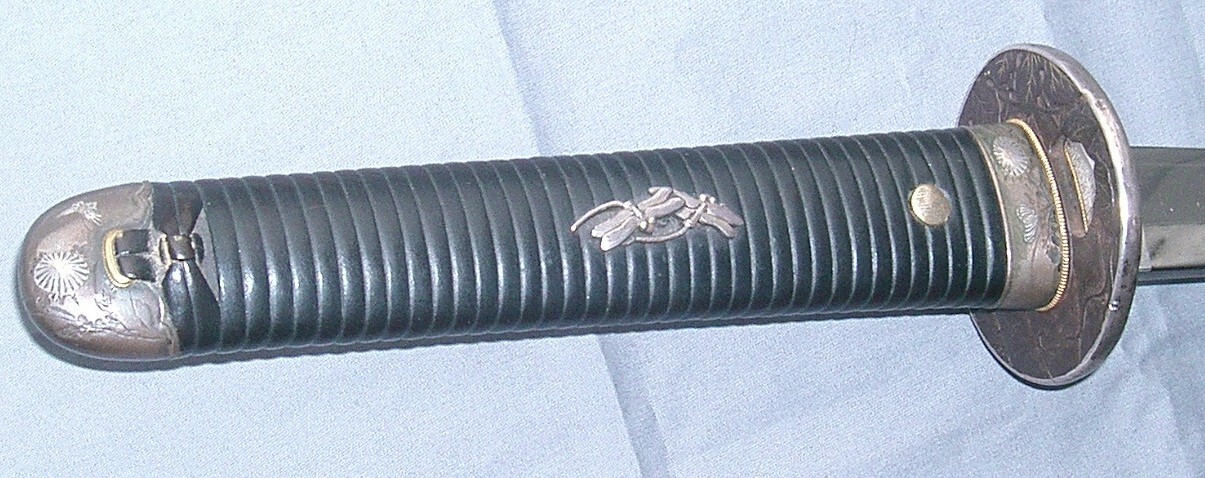
Dea Michael The first exmple is lacquered leather to match the saya colour. @Charles I don't think baleen, that presents as thin, slightly shiny strands, often found on tanto koshirae. Looks almost like a plastic. @Adam, I really like your tsuka, certainly looks like leather. I have two wakizashi mounted in rather similar ways, the one I posted I am fairly sure is leather, but lacquered. The other is more of a puzzle as on close inspection I think I can see a grid pattern under the surface so perhaps a thin leather wrapped around a woven tape for greater strength. Enjoying this thread guys, keep them coming!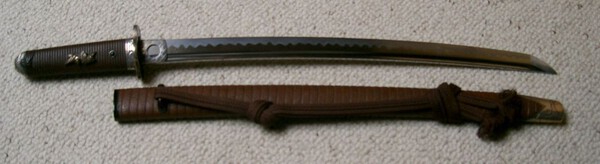
-
Alternative tsukamaki wrapping (leather)?
Geraint replied to Mikaveli's topic in General Nihonto Related Discussion
Dear Michael. There are a huge range of styles and materials used for this, just when you think you have seen them all another pops up. I'm quite partial to this style. From your desvciption it sounds as though what you are seeing is plainer than this, as Mark suggests a scren shot will help. All the best.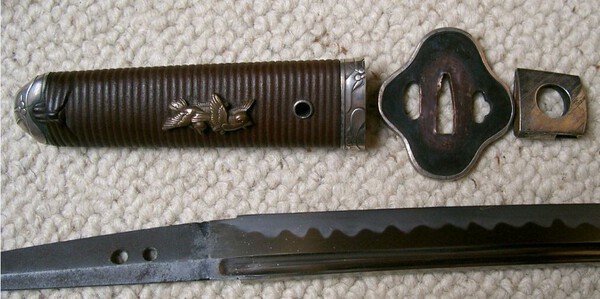
-
Dear George. As you know opinions based on images are not likely to be consitent here but for what it's worth I think the first one is probably right based on workmanship and the koshirae is/will be nice. The second is also interesting with orikaeshi mei though I can't see enough to be convinced about the mei. The rustic koshirae I also find interesting. The last one, as Domink suggests, is the big question and if rght worth full restoration without a doubt. If you look up Inami Hakusui you wil find out all about him but thought eh paper work is nice to have and should stay with the items it is not regarded as conclusive. Love to know how this story ends, you sure have a knack for finding interesting stuff! All the best.
-
Thanks again Dale. I had thought Akasaka but when it arrived there are quite a few tekottsu on the mimi and no sign of layers in the sukashi, a bit too large for Owari? Perhaps Shoami it is then? All the best.
-
Oh, well spotted Dale, thank you. I'd never have come across that. Needless to say that's not where it came from to me. What do we think of the Shoami attribution? All the best.
-
This tsuba has just joined the collection and I wondered if anyone would care to comment on it. I have seen a similar design somewhere but having scoured the memory palace, well more of a memory ruin these days, I have failed to come up with it. 77mms x77mms, Uniform thickness of 6mms. Thanks one and all. All the best.
.thumb.JPG.aa8f27aeb1fd10c1010870418ce397a5.JPG)
.thumb.JPG.05ea2540c1963c34a14acc06eeffcae6.JPG)
.thumb.JPG.eea5ee2c8dc41592a1f3a1980733f888.JPG)
-
Hi Jody. Welcome to NMB. Not sure how much you know so forgive me if I over simplify. This is not a military sword but an earlier civilian mounted or Samurai sword. It looks to have been slightly shortened at the nakago/tang. I appreciate that you are wroking with your phone but an overall shot of the bare blade and another of the whole of the nakago would be helpful. Don't do anything more than wipe the blade with some light oil and avoid touching it with your fingers. Looking forward to some others jumping in here. All the best.
-
Dear Mike. Forgive me if you know this alredy but don't clean anything! Wipe the blade with some light oil and cloth but nothing more. When you look up Tanba no kami Terukado you will find lots of information. He was working in the 1600s. However there is always the possibility of this being an incorrect signature so don't get too excited just yet. Give us some more pictures and we will see where this goes. Welcome to the complex world of Japanese swords! ALl the best.
-
Kevin, not very much value for the smaller bits and pieces I'm afraid. Sorry I can't make out the signature on the smaller tsuba. Do we have a photograph of the other side of the larger tsuba? I would guess around$100 to $150 for that one if the back is in the same sort of condition Others will add to this later on. Just one question, are there two of the little ornaments on the hilt? They are menuki and if so and they are OK then maybe a bit in them, can't tell from these photos. All the best.
-
Hi Kevin, welcome to NMB! So the smaller copper washer like objects are called seppa, they fit on either side of the tsuba or handguard. The broken leather washer would have been on a military sword and the tab would have had a press stud on it so that it could pass through one of the slots on the tsuba and clipped to the scabbard. The broken bit with the cloth tape is the pommel end of a tsuka or hilt. It has an iron kashira or pomel cap. The other bit is a tsuka but it looks like one that someone was attempting to make up. The metal collar with the flowers is the fuchi. The two larger items are tsuba or guards, the smaller one is for a tanto or dagger, the larger one is the most interesting of the lot. If that's not clear then please do ask. ALl the best.
-
Dear Piers. From what I can see I think I would label your tsuba as Nagoya mono; the colour of the alloy, the nanako and the tagane marks around the nakago ana would support this. I imagine that the soaking in hot water would have removed some of the accumulated dirt and the fact that it softened the adhesive is a trick worth remembering. All the best.
-
Dear Piers. Result! Was it Superglue or epoxy do you think? I note that you have called it a kenjo tsuba, what makes you apply that label to it, I wonder? Alll the best
-
Nice find! All the best.
-
Identifying an old sword left to me
Geraint replied to titantinker's topic in General Nihonto Related Discussion
Dear Jacob. Just in case this all means very little to you. The kiku mon is the chrysanthemum carved on the tang. This is used by several smiths in the Edo period r around 1600 to 1700 and others. It is usually carved at the top of the tang followed by the name of the smith, the position of yours suggests that the tang has been shortened, removing the signature. This is not uncommon though less desireable. The tang appears also to have hade the edges modified making the kiku mon look crowded. Fumbari is a term that means a narrowing of the blades wifdth just above the end of the tang. It shouldn't be visible at this point if the tang has been shortened, hence Colin's suggestion that the blade maY have had some metal removed from the edge about half way up. All OK so far? More pictures please. All the best. -
In fairness to the curator all that they actually are reported to have said was that it was a mumei blade from the 1600s, the rest is sales hyperbole. I am pretty sure that the idea that the MFA sends it's swords to anyone other than accredited Japanese experts is a nonsense. What we have here is a well written sales pitch from someone who may have done a walk in at the MFA and asked for an opinion from someone who has been sent down from the department to keep the punters happy at the front desk. All the best.
-
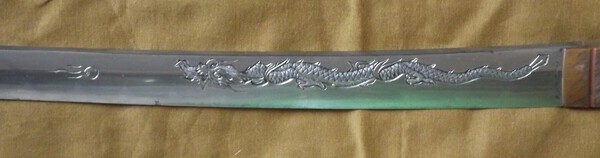
Dear Neil. Here's one by Mishina Yoshiaki. All the best.
-
And by comparing yours to the Ebay example you can see that yours is much better, as Jean suggests. Go slow and keep looking. All the best.
-
Hi Jonathan. Thank you for the images, it's a nice habaki. Don't be too quick to dismiss the tsuba, it might, as you suggest, just be a cheap casting, it's hard to tell underneath all the crud. However it is in the Namban style and might be more interesting. Soft metal Namban are rare. Perhaps some hot soapy water and a soft brush might help to reveal detail. If you don't already know it see ere for some more information, https://www.shibuiswords.com/Asian Sword Guards.html Whatever it turns out to be enjoy your sword. All the best.
-
Dear Phil. Well if that is your first sword you did well. Personally I rather like the severe koshirae, the mounts. Kirill's description of it as a stick references the very straight blade with pronounced taper and rather small kissaki or tip. This does tend to indicate a Kanbun Shinto blade, one that was made around 1660. The shape also recurs during the Shinshinto period as Jeremy suggested, the nakago patination and the presence of two mekugi holes tends to add to the Kanbun Shinto call. A lot of collectors would pass this by because it's unsigned Shinto but I think you did well with this one. Enjoy! Welcome to the endlessly complicated world of Japanese swords! All the best.
-
Dear Jonathan. I would be very interested to see some more photographs of the tsuba and the habaki if you have them. All the best.
-
“Server Not Found”
Geraint replied to Bruce Pennington's topic in Forum Technical Details and Maintenance
Been having the same issue intermittently, just now, 10.43 BST with the subtext nginx/1.18.0 Did a search for the Nihonto messageboard link and got a file not found then when I clicked on Sales we got there. Keep up the good work. All the best. -
Dear Yves. Assuming, as Barry suggest, that the sekigane are not part of the original tsuba then they were added to make it fit a specific blade. Usually they would suffice so it seems probable that this tsuba has seen ervice on at least three blades, the original, the one where sekigane have been fitted and finally the one whch required the punching to make it fit. As you know some tsuba makers used decorative punch marks as identifiers but I have never come across evidence of this applied to those who later modified the tsuba. The use of decorative punches is unusul but I have seen it before. All the best.
-
Just to add to the information about the jumonji yari, I thought I had seen the feature somewhere and find that, of course, the Knutsens book illustrates several naming them Uekama jumonji yari. All the best.
-
Dear Bjorn. Interesting assembly. You are right, the first wakizashi is in the best condition though it doesn't look to be in great polish. The two naginata are, in my opinion, clearly wakizashi blades re mounted, not much to g on but the signed one might be interesting. The jumonji yari is interesting becasue it didn't start life as a jumonji, the tip is a sasaho yari and the lower bars appear to be an addition, in other words a separate component through which the tang of the yari passes. The Higo mounted sword is attractive but they don't illustrate the nakago so who knows what you will find but you are certainly going to have to add the cost of a polish to that one. The sankaku yari seems OK but again it's going to need a polish and if you are not within driving distance to collect posting them can be a real problem! Do let us know how this works out for you. All the best.





.JPG.3cf627dd51ca999d2ebfdeca8dfe6c0e.JPG)
.JPG.3cbaedfe0c347cb844ed48f53fca3a5b.JPG)
.JPG.6a99c6b1869a266ddc0b904e6745edd8.JPG)