Bruce Pennington Posted June 11 Report Posted June 11 Ok, right. He is just describing the wooden saya covered with leather. The translation system he used for that site was pretty antiquated and not real good. I would like to see some shots of your saya. Sounds unique. 1 Quote
Justin Grant Posted June 11 Report Posted June 11 Not much to see. It’s not in the best condition. Blade signed Yoshida Yoshitsugu Quote
Bruce Pennington Posted June 11 Report Posted June 11 Ah, I see! It's not removable. I thought you were saying that it was "one" with the saya, like an all-leather saya, or cemented to a wooden saya. Can you tell if the material is actually leather? They were making some artificial leathers, like pressed paper and pressed fabrics. Quote
Justin Grant Posted June 11 Report Posted June 11 It’s leather. I used a consolidator on it to stop it from powdering. I took it to a leather “dealer” who sells and produces leather goods and he recommended the stabilizer. Appreciate your help, as always. 1 Quote
Bruce Pennington Posted June 12 Report Posted June 12 Not in as good of condition as John's, but another kaigunto with black leather cover. For sale on this St. Croix Blades page. Quote
Bruce Pennington Posted July 6 Report Posted July 6 7 hours ago, Scottykarate said: Here's my example. John, That's a unique one! Can you post closer, clear shots of the belt hanger, and one of the koiguchi (metal cap at opening of the saya)? 1 Quote
Scottykarate Posted July 6 Report Posted July 6 I'll take some more pictures, hopefully this week. My mom will pass it down someday, but I don't want to take it right now, so I have to go there to take more pictures. I've been meaning to forever anyway. I have a couple of other pictures but they're too large to upload. It doesn't have any metal in/on the saya other than the hanger. Bruce, I had this on the firearms of the rising sun message board ages ago and I worked on figuring out what the sword is with various posters (you, Edokko?) back then. I think we had decided that it isn't a forged blade and likely machine made. I just want/ed to be able to have the details a little more dialed in on it anyway. I'm never able to get good pictures of the blade, but I believe we decided that what we had going on is grain opening up or cracks were likely from polishing. We tried to decipher what looked to be kanji inside the saya, but I couldn't get a good shot of that, either. Lol. I know it is original insofar that my grandfather brought it back after WW2 along with my T99 and T30 bayonet. Do you have any advice on getting good pictures of the blade without reflections and the inner saya? 1 Quote
Bruce Pennington Posted July 6 Report Posted July 6 The writing inside the saya are usually just production instructions, type of wood, sometimes a worker's name, so other than pure curiosity, there's no need to work that out. There are plenty of in-depth discussions about photography, but the essence is - dark/black background; dark room with single, bright light above or behind you; take shot so the glare of the light is just off the side of the spot you want to show. 2 1 Quote
Conway Posted July 29 Report Posted July 29 Thought I would share this Type 32 Otsu with leather cover. I wonder if covers on NCO swords were issued by the unit or personal additions. I’ve seen a few examples in photographs and will share one below. 4 Quote
Bruce Pennington Posted July 29 Report Posted July 29 Good question Conway! Sword was issued, but who paid for the cover? I had always assumed it was the NCO's doing. Quote
BANGBANGSAN Posted July 29 Report Posted July 29 There are a few of these leather-covered Type 32 examples exist. 1 2 Quote
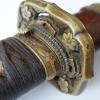
Tcat Posted July 29 Report Posted July 29 Gentlemen, I thought I would share in a little more detail an unusual leather-covered officer’s guntō saya that may be of interest to followers of this thread. These fittings were part of an eBay purchase years back when I was new to the hobby and attempting to find a decent koto blade at a bargain price (haha). WWII era is outside of my main field of study, but what first caught my attention was the unusual two-hanger suspension arrangement, indicating that the sword was probably intended to be worn tachi style. The maker’s stamp, (清松製 / Kiyomatsu-sei?), is oriented so that it is visible when the sword hangs this way. I presume this maker to be a smaller local outfitter contracted to do this kind of work during the war. If I had to guess, perhaps they were originally a saddle and horse tack maker. The leather has been closely formed around the wooden core, giving the scabbard a slimmer than average profile and quite graceful taper. The stitching is pretty straight and evenly executed along the seam. The suspension bands appear to have been individually made and fitted from heavier leather to better withstand wear. Each band also incorporates a small brass tube through which the brass suspension ring passes, preventing direct contact with the leather. The brass koiguchi is a smooth push fit and with a little wiggling can be removed; the wooden core can then be easily extracted from the leather outer shell for cleaning. Seems like an excellent design for practical field use. I would be very interested to know whether anyone else has encountered another example of this style of leather saya, particularly one bearing the 清松製 stamp, or has any further information regarding the maker. For anyone curious, the blade housed in these mounts is an ō-suriage Nanbokuchō blade which, after many years of research and examination, was recently attributed to Yamato Shizu. 2 3 Quote

Recommended Posts
Join the conversation
You can post now and register later. If you have an account, sign in now to post with your account.