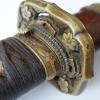
EdWolf Posted December 25, 2016 Report Posted December 25, 2016 Hello to all,Let me first introduce myself. My name is Ed, living in the Netherlands. Sorry but my English writing skills are not very good but I hope this is not a real problem. Recently I became interested in Japanese swords. I have purchased an old Wahizashi sword. The tang is signed but I need help how to read the signature. Hope one of you can help me. Thanks, in advance.Best regards,Ed Quote
Stephen Posted December 25, 2016 Report Posted December 25, 2016 only two kanji why not give it a go edit please post nakago pix blade up it helps in translation Quote
EdWolf Posted December 25, 2016 Author Report Posted December 25, 2016 Hi Stephen, The last kanji looked like the kanji in G9 but i don't know what this means. Regards, Ed Quote
Stephen Posted December 25, 2016 Report Posted December 25, 2016 Very good...its the last part of his name...???.tsugu Quote
Stephen Posted December 25, 2016 Report Posted December 25, 2016 tell you the truth i have not found what i think the first kanji is, ill let someone else make final call Quote
Ray Singer Posted December 25, 2016 Report Posted December 25, 2016 Certainly looks like Ietsugu to my eyes. Quote
EdWolf Posted December 25, 2016 Author Report Posted December 25, 2016 Hi Ray, Thanks for your input. Ietstugu looks good. For me all the kanji's looked the same regards, Ed 1 Quote
Stephen Posted December 25, 2016 Report Posted December 25, 2016 ive never seen le tsugu live and learn IETSUGU (家次), Eishō (永正, 1504-1521), Bizen – “Bizen no Kuni-jū Ietsugu” (備前国住家次), he moved later to Izumo province IETSUGU (家次), Jōkyū (承久, 1219-1222), Bitchū – “Ietsugu” (家次), Ko-Aoe school, son of Moritsugu (守次), student of Sadatsugu (貞次), suguha mixed with ko-midare IETSUGU (家次), 1st gen., Ōan (応安, 1368-1375), Bitchū – “Ietsugu” (家次), “Bitchū no Kuni-jū Ietsugu saku” (備中国住家次作), “Bitchū no Kuni-jū Ietsugu” (備中国住家次), “Bitchū no Kuni-jūnin Ietsugu” (備中国住人家次), Aoe school, we know blades from the Jōji (貞治, 1362-1368) to the Ōan era, saka-chōji that tends somewhat to koshi-no-hiraita, also a suguha with ashi, compact nioiguchi, ō-wazamono, jō-saku ◎ IETSUGU (家次), 2nd gen., Shitoku (至徳, 1384-1387), Bitchū – “Bitchū no Kuni-jū Ietsugu saku” (備中国住家次作), “Bitchū no Kuni Ietsugu saku” (備中国家次作), “Ietsugu saku” (家次作), Aoe school IETSUGU (家次), 3rd gen., Meitoku (明徳, 1390-1394), Bitchū – “Bitchū no Kuni-jū Ietsugu saku” (備中国住家次作), Aoe school, later Ietsugu smiths were active until about Daiei (大永, 1521-1528), there exists a date signature of Daiei six (1526) of such a later Sue-Aoe Ietsugu smith IETSUGU (家次), Ōei (応永, 1394-1428), Bizen – “Bizen no Kuni-jū Ietsugu” (備前国住家次), “Bizen no Kuni-jūnin Ietsugu” (備前国住人家次), student of Yukiyoshi (行吉), suguha, gunome-chōji IETSUGU (家次), Eishō (永正, 1504-1521), Wakasa – “Obama-jū Heishichirō Ietsugu” (小浜住平七郎家次) IETSUGU (家次), Eiroku (永禄, 1558-1570), Mino – “Nōshū Seki-jū Ietsugu” (濃州関住家次) IETSUGU (家次), Tenbun (天文, 1532-1555), Hizen – “Hizen no Kuni-jū Ietsugu” (肥前国住家次) IETSUGU (家次), 1st gen., Ōei (応永, 1394-1428), Bingo – “Bishū Tomo-jū Ietsugu saku” (備州鞆家次作), “Bishu no Kuni-jū Ietsugu saku” (備州国住家次作), Tomo-Mihara group, he lived in Tomo (鞆) in Bingo province, younger brother of Bingo Iesada (家貞), itame with masame towards the ha, suguha mixed with ko-midare IETSUGU (家次), 2nd gen., Chōroku (長禄, 1457-1460), Bingo IETSUGU (家次), 3rd gen., Meiō (明応, 1492-1501), Bingo – “Bishū Tomo-jū Ietsugu” (備州鞆住家次), “Bishū Tomo-jū Ietsugu saku” (備州鞆家次作), there exists a date signature of the sixth year of Meiō (1497), chū-jō-saku IETSUGU (家次),4th gen., Daiei (大永, 1521-1528), Bingo – “Bishū Mihara-jū Ietsugu” (備州三原住家次) IETSUGU (家次), Ōei (応永, 1394-1428), Kaga – “Kashū-jū Fujiwara Ietsugu” (加州住藤原家次), “Ietsugu” (家次), “Kashū Fujiwara Ietsugu” (加州藤原家次), Fujishima school, we know blades from the ninth year of Ōei (1402) to the third year of Eikyō (永享, 1431), itame mixed with masame, suguha, ko-midare IETSUGU (家次), 1st gen., Bunmei (文明, 1469-1487), Kaga – “Ietsugu” (家次), “Ietsugu saku” (家次作), “Kashū-hū Fujiwara Ason Ietsugu” (加州住藤原朝臣家次), Hashizume school, because of the similarities in workmanship to the Aoe school, this lineage is also referred to as Kaga-Aoe, it is said that he also worked in Wakasa and Echizen, the exact succession of generations after this 1st gen. Ietsugu is unclear, suguha, gunome-midare, wazamono IETSUGU (家次), Daiei (大永, 1521-1528), Kaga – “Kashū Nomi-gun-jū Shōgen Ietsugu” (加州能美郡住将監 家次), “Kashū Nomi-gun-jū Ietsugu saku” (加州能美郡住家次作), “Shōgen Ietsugu” (将監家次), Kaga-Aoe school IETSUGU (家次), Kōji (弘治, 1555-1558), Kaga – “Ietsugu” (家次), “Kashū-jū Fujiwara Ason Ietsugu saku” (加州住藤原朝臣家次作), “Kashū Fujiwara Ietsugu saku” (加州藤原家次作), Hashizume school, Kaga-Aoe, we know blades from the Tenbun (天文, 1532-1555) to the Eiroku era (永禄, 1558-1570), suguha mixed with chōji, gunome-midare, wazamono, chū-jō-saku IETSUGU (家次), Kan´ei (寛永, 1624-1644), Kaga – “Gashū-jū Fujiwara Ietsugu saku” (賀州住藤原家次作), “Ietsugu” (家次), real name Kondō Ri´emon (近藤利右衛門), shintō-era successor of the Ietsugu line, he lived in Kanazawa (金沢) IETSUGU (家次), Kanbun (寛文, 1661-1673), Kaga – “Kashū-jū Fujiwara Shirōbei no Jō Ietsugu kore o saku” (加州住藤原四郎兵衛尉家次作之), “Kinpu-jū Fujiwara Ietsugu” (金府住藤原家次), “Kashū-jū Fujiwara Ietsugu” (加州住藤原家次), he lived in Kanazawa (金沢) IETSUGU (家次), Kanbun (寛文, 1661-1673), Owari – “Bishū-jū Ietsugu” (尾州住家次), even more but you get the idea 1 Quote
EdWolf Posted December 25, 2016 Author Report Posted December 25, 2016 Hi Stephen, thanks for all the information and your help. Next step, finding the right ietsugu :-) regards, Ed 1 Quote

Recommended Posts
Join the conversation
You can post now and register later. If you have an account, sign in now to post with your account.