watsonmil
-
Posts
1,406 -
Joined
-
Last visited
-
Days Won
4
Content Type
Profiles
Forums
Events
Store
Downloads
Gallery
Everything posted by watsonmil
-
Perhaps my eyes deceive me, but the yasurime looks V shaped ( taka-no-ha ) to me which might well point to Yamato. Perhaps Chris could advise. Whether Koto or Shinto, .... Chris it is a very lovely blade. ... Ron Watson
-
Hello Chris, A very lovely old ( koto ) blade. Very quiet and dignified. The jigane is indeed lovely and evenly forged. The flaw ( opening ) in the shinogi-ji is really not interfering with the appreciation of the overall beauty of the blade, and from speaking to others far more knowledable than I, .. and having seen highly rated blades ( papered ) with similar flaws in the shinogi-ji it would be my opinion that although noted it would not affect the overall rating of a very beautiful specimen. The flaw will and is bothering you more than others who will admire your aquisition. Any collector here who would turn down owning such a specimen is in my opinion a foolish man. Congratulations. Kind regards, ... Ron Watson
-
Dear Reinhard, .... in my short article I managed to refer to you as Heinrich. I am sorry for this. I was interrupted in my typing by a customer by the name of Heinrich, ... and example learned DO NOT TYPE when talking on the phone, My sincere apology for my error. Regards, ... Ron Watson
-
I can see both sides of this argument/discussion. The comming of Commodore Perry's Black Ships had an immense influence on the Ploitical and Social climate of the formerly insulated Japanese Culture. It was the beginning of the end of the Feudal System in Japan and consequently the demise and eventual disbandment of the Samurai Class. It should not go un-noticed of course that subtle changes from the times of the unification of Japan under the Tokogawa were already in place. The Samurai sword and it's fittings gradually moved from the very simple yet effective weapons of war to a quiet reserved sword and fittings as peace and stability came to Japan. As the era of peace continued we see a slow but steady trend towards more flamboyant sword style, and more expressive fittings until by the end of the Shin Shinto period the swords and fittings are somewhat overly influenced by louder and louder ( for the Japanese at least ) expressions of ART over utilitarianism. It continued this established trend into the Meiji era. It seems to me at least this was a natural internal transition rather than one immensly influenced by European likes and dislikes. There is no doubt that the Europeans bringing there culture to bear upon the Japanese would have some influence. To think otherwise would be to say that foreign immigration to Canada or the Uk has not had cultural influence on those nations. I have not yet seen Heinrich present a piece that demonstrates that the Japanese artisan deliberately changed the aestetics of his work to western influence ( although some may exhist ), I do not see that the Japanese were doing anything that the Japanese themselves were not already demanding in their fittings due to internal stagnation in the militarism of the country. The samurai turned more and more towards the visual stimulation that comes from Art rather than the physical stimulation that comes from Warfare. The Europeans certainly influenced all aspects of Japanese culture with that I agree, ... but I think ART was one of the least influenced. Art generally is a CULTURAL manifestation and not subject to the same forces of influence as are the scientific, medical, inventions and politics of other counties intrusions. Just my observations, ... Ron Watson
-
Hi Eric, The only other eample I have seen is pictured in " Stone's ... Glossary of the Construction Decoration and Use of Arms and Armor ", page 325. For anyone who does not have this fine old book, ... you are missing out on an excellent general reference bible of arms and armor. It would seem Mr. Stone had a particular passion of Japanese Arms and Armor as virtually every page has some Japanese references. Regards, ... Ron Watson
-
Hello Klause, You are not stupid, ... you have a desire to learn and boy you'd better enjoy learning ! To elaborate a wee bit further on the groves or " yose-tagane ", ... they often help anchor the small copper fillers that are hammered into place and then filed to fit a specific blade. See the illustrated tuba that Barry shows on the left. You will note the copper fitted into and somewhat anchored by the yose-tagane. Katana, Wakizashi, and Tanto tsuba are always pictured cutting edge up, while the older Tachi type sword tsuba are pictured cutting edge down. The side groves or punch marks simply served to narrow the opening of the tang hole ( Nakago-ana ). Kind regardsm, ... Ron Watson
-
I think it's high time I made another contribution to the NMB. My God, ... the knowledge shared with me, ... the camaraderie. I sincerely hope you all realize that in this day and age to find such a wealth of assistance without strings attached in itself deserves a JUYO rating. I too have shared some expertise in my specialized fields over the years simply because I feel that knowledge is a gift to be shared. I more often than not have been ridiculed by my peers as having been stupid enough to give away knowledge that is marketable. This site is a most refreshing vindication of what I and you people obviously believe in, .... Sharing. Hopefully I can get better closeups of the last two kanji, if I may indulge your patience. ...... Ron Watson
-
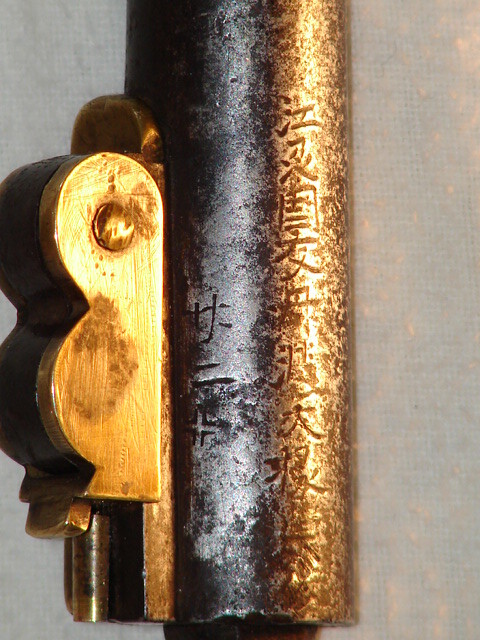
Dear Bazza, Here's a slightly different angle of the signature. I do not do digital photography, ... I rely on my son's expertise and I won't see him again for a couple of weeks. The last kanji appears poorly engraved, ... or more likely has suffered a slight ding. I appreciate your help and above all patience. Regards, ... Ron Watson
-
Jacques, ... Firstly I respect your opinions on the subject of swords about as high as anyone. You may be correct that this is a ghost work by the Nidai, ... but having looked at oshigata of known examples of the Nidai ghost signatures, ... the mei on this naginata is to my eyes quite different from the way the Nidai signed for his father, whereas once again I refer to the same reference book only this time to page 88 and 89 wherein the same sword is again pictured . Paragraph 7 states .... " Each of the signatures was signed by each of these two smiths ( including the mon )." I do not have your knowledge and I most certainly respect your opinion, ... but on the basis of my studies I must disagree with you on this one. ... Amicalement, ... Ron Watson
-
Thanks Bazza, ... I was able to make out the Kunitomo kanji, as I own a couple of other Kunitomo guns. I hope the guys don't think me lazy when it comes to kanji translations, .... but for whatever reason try as I might it just doesn't click with me. I've tried Harry Watson's counting strokes and catagorizing, and various sword kanji books, ... but all I ever come up with is jibberish. When I finish the restoration I'll post a couple of photos. I wouldn' t even mind showing the step by step procedure in their restoration, ... but I'm afraid the moderators or some members might not approve, ... this being primarily a blade and fittings site. Again thanks, ... Ron Watson
-
Hello Dan, ......... and welcome. I am an old time collector, but also new to the forum. It can be a most humbling but learning experience. There are many knowledgeable people on this site. It can and still is to me at least a bit intimidating. Regards, ... Ron Watson
-
Hello James, The mon you picture is quite close, but not really close enough. I too spotted that one in an older book ( your reference # 2164 ). My understanding is that " mon " are quite specific in detail, and although very similar just too much different. Hello John, The article on Christian symbols was an excellent read. I once had a wonderful Christian theme tsuba which I foolishly sold without realizing the story relating to such tsuba. I fully agree, ... this is much more a likely a Ju character. To have openly displayed a Christian symbol as blatanly as this would have been an invitation for trouble. Thank you all, ... Ron Watson
-
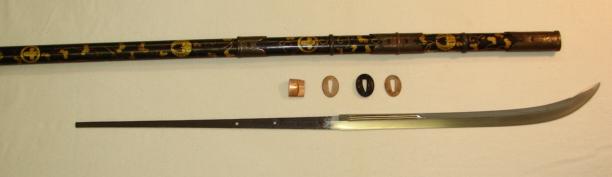
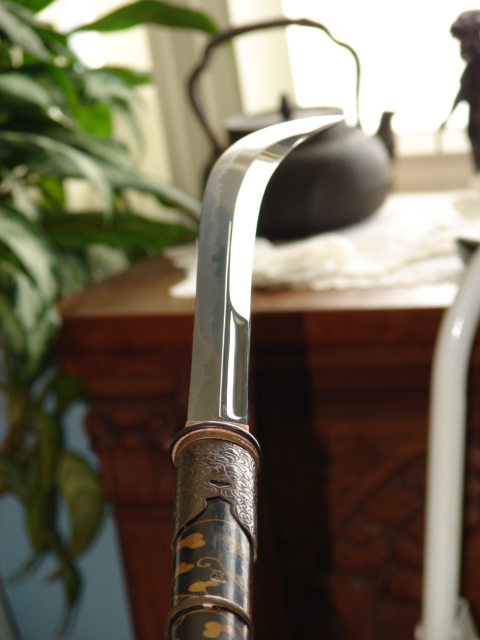
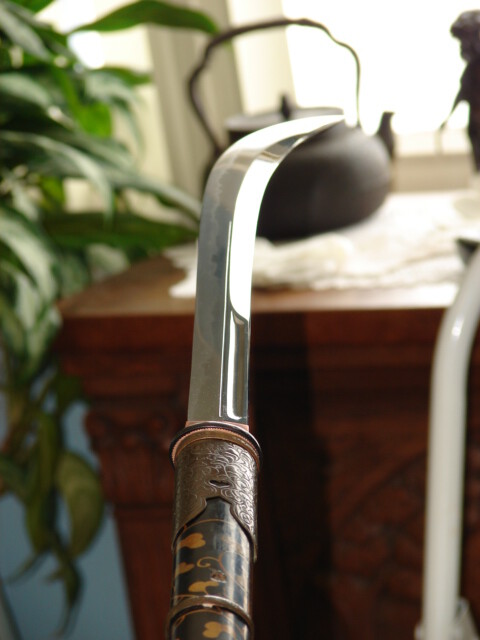
To answer a few queries : The Overall length of the Nagina including the nakago is 36 3/16 inches. The Nagasa is 18 1/2 inches. The Nakago is ubu ( 2 ) mekugi ana, ... the yasuri is o-sujika. The Kitae is Ko-itame. To answer Jacques, ... the mei is a carbon copy of Shodai Hisamichi ....... page 56, figure 27 .. Art and the Sword volume seven. All of the workings, the boldness and confidence of the signature, plus examination by what few other collectors who have examined the signature lead me to believe it is OK. Of course that is only opinions. The mountings are original to the Naginata as are all fittings except for the pole tip which is a replacement, .... now having said this the naginata was obviously previously mounted at some time as there is only one mekugi ana on the pole, but two on the nakago. There is no doubt that the pole currently with the naginata was made for this naginata however as everything lines up perfectly. Anyways I thought I would share it with other members. By the way I am open to critizism ( signatures or whatever ) so long as they are constructive and reasonable. It has not been presented to shinsa as of yet, .... and no doubt the Japanese would find the style of polish not to their taste, .... which is yet another arguable choice that I made and for which I have no regrets. Kind regards, ... Ron Watson
-
Usually if I post something it will be in relation to some unusual item, or a Tanegashima that I am working on. So I thought just in case you guys think I am on the wrong forum, ... here's a very nice Naginata from my collection for everyone's enjoyment. It is I believe a First Generation ..... Kikumon Omi no kami Minamoto Hisamichi. It would appear from examination of his signatures to be a later work circ. 1695 - 1705. I particularily enjoy the Mishina School Smiths and if opportunity presents itself I try to aquire examples. I am not an expert in photograhing blades, but I think at least some of the many workings in the blade will present themselves. Anyway it is a shown here for your study and enjoyment. If someone knows the family name for the styalized cross in a circle mon, I would appreciate identification, as I have come up empty in my reference book on " Mon ". Kind regards, ... Ron Watson


-
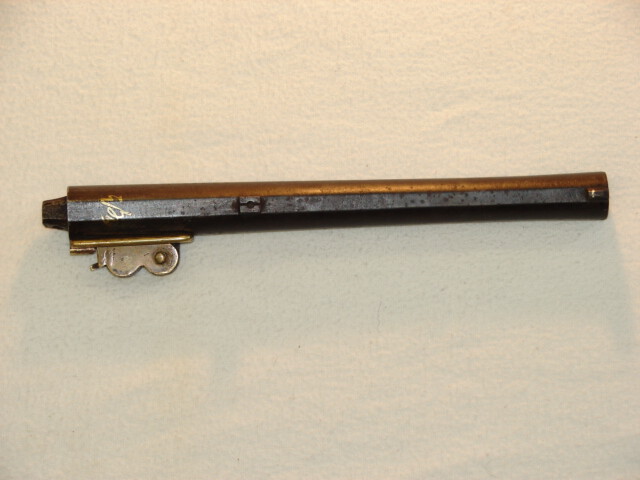
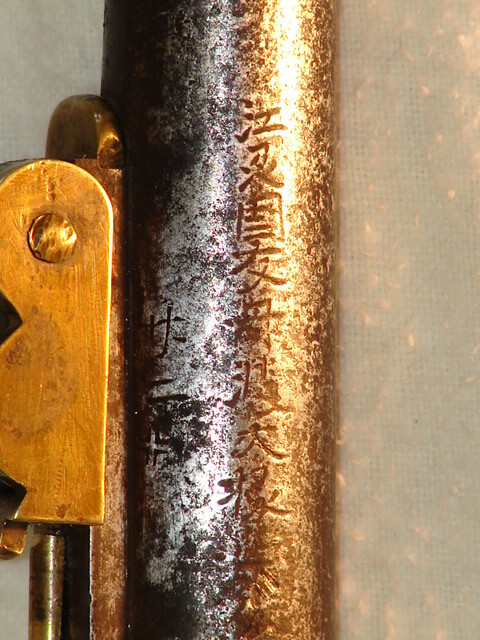
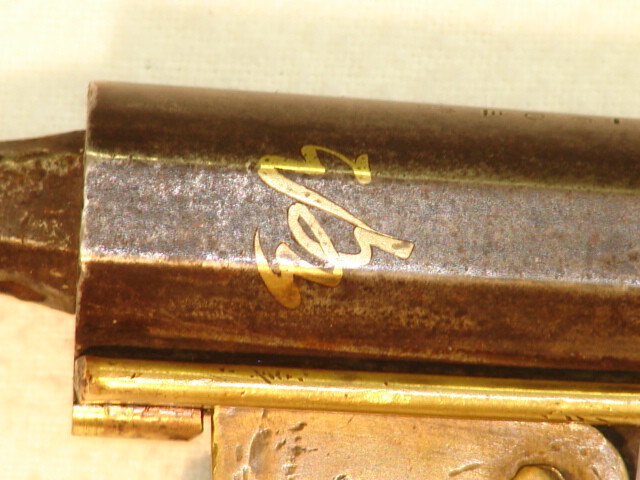
Could I prevail upon our Kanji experts to translate the signature on a Tanegashima barrel. There is also an interesting Mon or possibly script saying on the top of the barrel. I can not find it in my book on Mon, so I assume it is a saying. Anyway in a couple of weeks once the pistol is restored I shall post photos of the completed project. It is a beauty ! Thank you, ... Ron Watson
-
Bienvenue Mathieu, ... votre anglais est tres bonne en comparaison de ma francais ! Enjoy the Message Board, ... there's plenty to learn ! ... Ron Watson
-
Well Barry, ... If the third Fuchi posted pictures an " owl ", ... which I take it to be, ... it is certainly a rarity. Of all birds of Japan the owl is considered most unlucky, ... and an omen of death. It is my understanding that if portrayed at all it is usually shown with eyes closed or more often with it's back towards the viewer. The above information courtesy of " Japanese Animal Art " ... auithor Lea Baten. Nice find, .... Ron Watson
-
I don't think it's hostility as much as indignation at the " gall " of those who are in this forum strickly for free appraisal services. The really sad thing is many of the members are allowing themselves to be used, ... and I also note an element of a feeding frenzie amoung some members. The vultures are circling, and that is equally as distasteful. My opinion, .... Ron Watson
-
Having difficulty identifying the school and design.
watsonmil replied to Ford Hallam's topic in Tosogu
Definitely not Momoyama period, .... definitely Momamia period ! Ron Watson -
What is this? Found it in dresser draw in wooden box>
watsonmil replied to goinlower6969's topic in Tosogu
A buyer who's great when he pay's ????? Hmmm. ... Ron Watson -
New Kantei Nyusatsu Handbook
watsonmil replied to Clive Sinclaire's topic in General Nihonto Related Discussion
Thanks for the " Heads Up " Clive. Always interested in keeping the old brain active. ... Ron Watson -
Hello Ron, I can understand your frustration with eBay. I would think you might be even MORE frustrated with the Facist attitude of the UK government. You live in a " control everything but immigration country ". By the way the UK is not the only country that has / is going this route. My family originally came from the UK, and my wife and I used to pay annual visits. I would no sooner visit the UK today as I would have visited Germany in the 1930's. It wouldn't surprise me to be chastied or even expelled from the Nihonto Forum, ... but it needed to be said even if this is a Forum for the study of Nihonto rather than a Political Forum. Unless people speak up there will be no Nihonto Forum anyway as it will eventually become impossible to collect ...... BY GOVERNMENT BAN. Kind regards, ... Ron Watson
-
Questions about a tanegashima matchlock.
watsonmil replied to Dmitry's topic in Tanegashima / Teppo / Hinawajū
Piers noticed the amaooi missing ( a more or less rectangular brass plate ) that fits between the priming pan and the barrel. This is one of the reasons for the heavy barrel corrosion in this area. This brass plate acted as a shield protecting the barrel from the flash and searing action of the black powder on ignition. Black powder is highly corrosive to iron especially when ignited. Thr residue is highly acidic and if left on iron for even a relatively short period will cause the rusting you see on that area of the barrel. The 12.5 mm caliber means this is a 3 monme gun ( ball weight ) or about .50 inch caliber. The " monme " is simply the Japanese way of measuring caliber by projectile weight. As with the Japanese samurai swords, these interesting firearms need to be maintained and where possible restored to as close to their original beauty as possible. Many are true works of art. ... Ron Watson -
Questions about a tanegashima matchlock.
watsonmil replied to Dmitry's topic in Tanegashima / Teppo / Hinawajū
Hello again, The mark across the barrel is a puzzle, ... It is too wide for a sword, and the lead projectiles of the time this gun was in use would never cut a grouve like that in iron. A modern high velocity projectile would do this but the mark does not look fresh enough. I have restored numerous Matchlocks ( among many other antique firearms ). Be liberal with the oil and elbow grease. The stock too once the barrel is removed should be washed with a mild soap and water ( outside ONLY ). Dry with a clean rag, and apply several coatings of a good quality lemon oil. That old wood will love you for it. You can also apply a liberal amount of lemon oil to the bedding of the stock. Do not however apply oil directly onto any ink signature that may show up. The ramrod too should be removed and cleaned, and oiled with lemon oil. It is always a good idea before cleaning the inside of the barrel to take a measurement of depth using the ramrod. Check and see that it goes slightly deeper than where the flashhole enters the barrel. Putting a mark on the ramrod and then comparing depth on the outside of the barrel answers this question. If the ramrod depth indicates it stops above the flashhole, ... well then let me know and I'll run you through the procedure for removing the ball and powder. Two of the matchlocks I own were still loaded after 150 - 200 years ! It is NOT wise at this stage to remove the breach plug for further cleaning, as they are usually so tightly rusted into place that twisting on the square breach plug body with a wrench will at the very least cause unnecessary damage. A matchlock or ANY muzzle loading firearm can be cleaned quite nicely without EVER removing the breach plug. It takes more time, but it is less likely to cause the gun damage. Write me before doing this step, and I'll talk you thru it if you're not familiar with cleaning muzzle loaders. Same with removing and cleaning the INSIDE of the lock, ... it is easy to remove once you know how. If you do not know how ASK. Anyways enough for tonight. I look forward to seeing what is under that barrel ! Kind regards, ...Ron Watson -
Questions about a tanegashima matchlock.
watsonmil replied to Dmitry's topic in Tanegashima / Teppo / Hinawajū
It would appear to be a mid 19th century Saki Gun of Shibatuji style. These later matckocks tended to be somewhat over decorated as compared to those of an earlier period. You will most likely find some kanji on the bottom of the barrel usually giving the province of manufacture and the name of the smith. In order to have a look, cock the Serpentine ( hammer ), then if you push out and remove the 4 bamboo ( sometimes brass ) pins from left side out the right side, the barrel should come off by firmly holding the top of the stock while the barrel is upright, and gently pulling the barrel away from the stock at a slight angle. Once free of the stock at the muzzle end lift the barrel out of the stock. Turning the barrel over should allow you to see if the barrel is signed. Quite often the bedding of the stock will also have writing in ink which will be the stock maker's signature. There are members here who can translate the characters provided you post decent photographs. If like most Taganishima a layer of rust will have formed along the sides of the barrel. This is caused by the iron barrel coming into contact with the oak stock which is high in acid. The barrel should be carefully wiped down with a good grade gun oil and allowed to stand. Much of the rust will wipe off with a cloth. Repeating the process will remove even more. The pitting on top of the barrel is unfortunate, ... and not common on even moderately maintained guns. Anyways, I'm sure you will have other advice as your post is read. .... Ron Watson