watsonmil
-
Posts
1,406 -
Joined
-
Last visited
-
Days Won
4
Content Type
Profiles
Forums
Events
Store
Downloads
Gallery
Everything posted by watsonmil
-
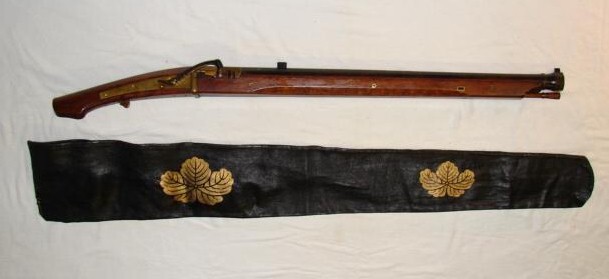
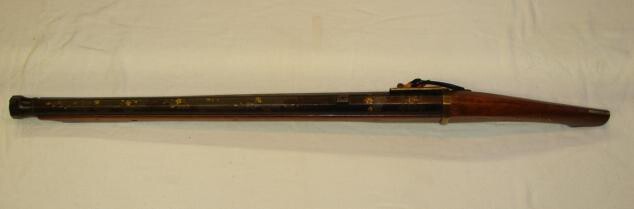
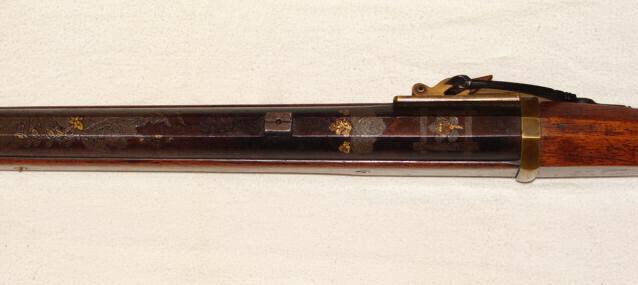
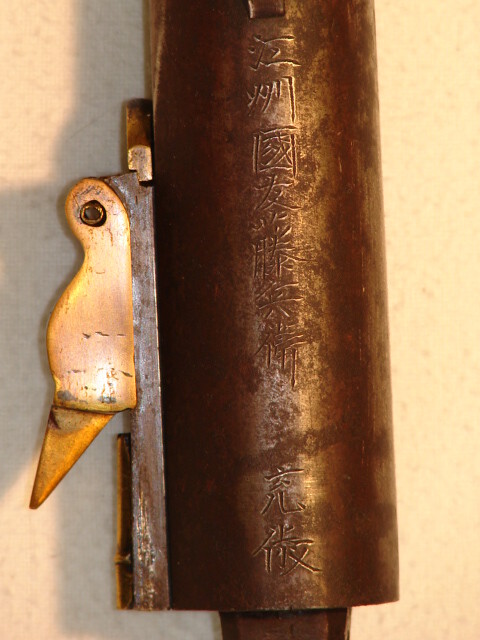
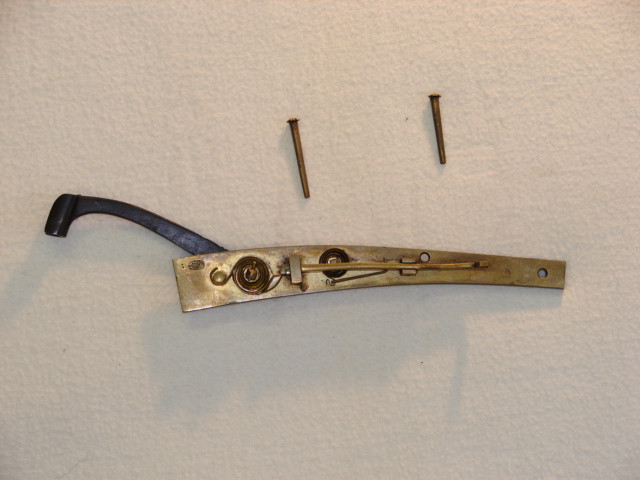
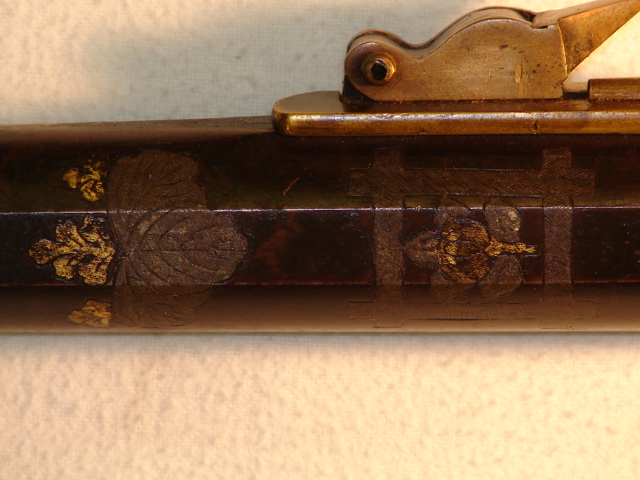
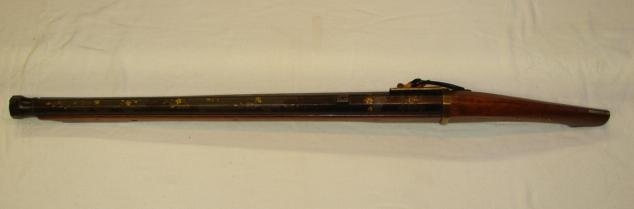
Sakai is a city on Honshu Island near the larger city of Osaka. Sakai like Kunitomo was famous for producing great quantities of firearms during the Edo Period. Guns produced by the Sakai were famous throughout Japan for their very high quality. Where the Kunitomo smiths excelled in well made practical guns, ... most devoid of all but minor decoration, the Sakai gunsmiths seemed to have revelled in embellishing their guns with fine barrel inlay, and applications of brass decorations to the stocks. Often seen on Sakai guns are large decorative escutcheons covering the again rather large pin holes which take the pegs to fasten the barrel to the wooden stock. The guns are generally elegant in shape, if somewhat ( at times ) over embellished with ornamentation. The stocks are of the finest oak utilizing the natural grain to its best visual appeal. It has been written that Daimyo would often commission Sakai gunsmiths for their personal weapons due to the beauty and quality of their workmanship. The gun I illustrate today is certainly a text book example. This gun is signed made by Kuniyasu, and is dated 9th year of Bunsei, ( 1825 ) a lucky day in August. Overall length is 51 1/2 inches. The caliber is 11.5 mm ( .46 inch ) or in Japanese measurement 2 monme. Barrel is octagon tapering towards the muzzle which is bulbous. The front sight has an inlaid silver bead to aid in sighting. The top of the barrel is inlaid in brass, silver, and copper with a depiction of KWANYU ( a celebrated Chinese General of the 2nd century, diefied in 1594 as the God of War ). He is depicted carrying his large spear. The depiction is flawlessly inletted into the steel barrel. The brass lock is of the outside spring type, but the inside has a small coil release on the sear re-lease arm. There are no less than 5 adjustments fot trigger pull. In order to prevent the corrosion and burning associated with the ignition of black powder, the flash pan is lined with gold. The entire lock mechanism works like a fine tuned clock. The stock is of fine grained burl oak, and the escutcheons over the pin holes are large and ornamental. In addition a single brass band ( not counting the large breach band which are always present on Tanegashima ) helps anchor the barrel to the stock. The floorplate of the stock has a well executed brass dragon entwined around a silver ken sword. The inletting of this huge piece of metal must have taxed the stockmaker. A circular mon in silver of the Abe family is also inlaid. Near the forend another brass plate depicting a dragon helps strengthen this vunerable area of the stock. The offside of the stock butt has a Chrysanthemum in alternating rings of brass and silver, the hole in the center is meant to accomodate the excess of match cord, and keep it firmly secured to the stock. The condition of this firearm is excellent, and would be quite safe to fire. This short article, and accompanying photos are respectfully submitted for the study and enjoyment of the NMB membership ..... Ron Watson
-
Dear Rich, Grey is probably right, .... of course it could also be the hidden treasure map to the WWII Japanese Gold hidden by Yamashita somewhere in the Phillipines :D ! .... Ron Watson
-
Hmm, ... it also resembles my wife when I told her I was thinking about a Tanto I'd kind of like. ... Ron Watson
-
Dear Barry, I only have a few, ... but I would love to participate, ... and of course view other collections. Kind regards, ... Ron Watson
-
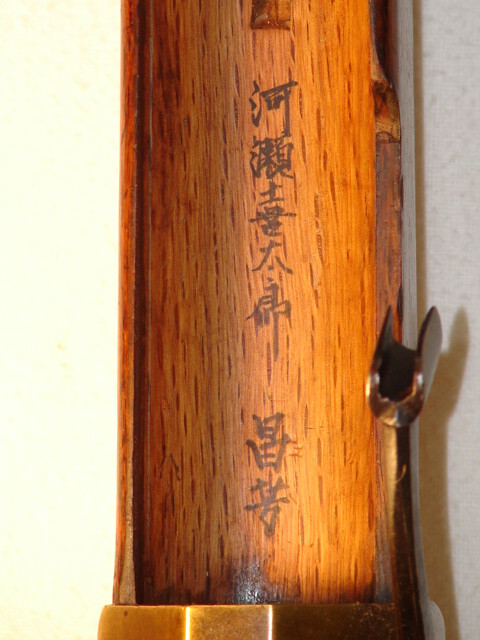
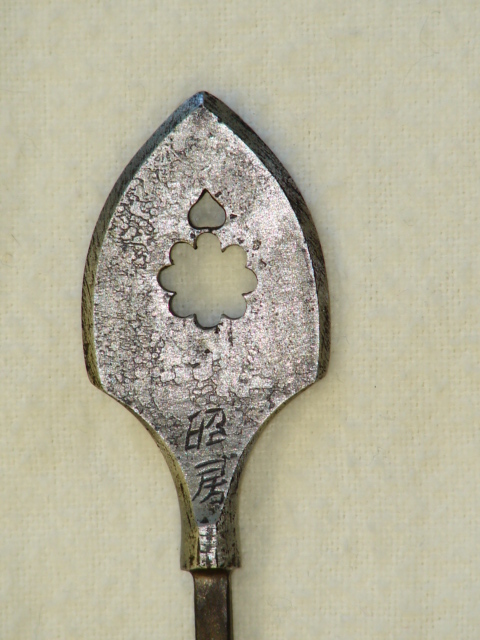
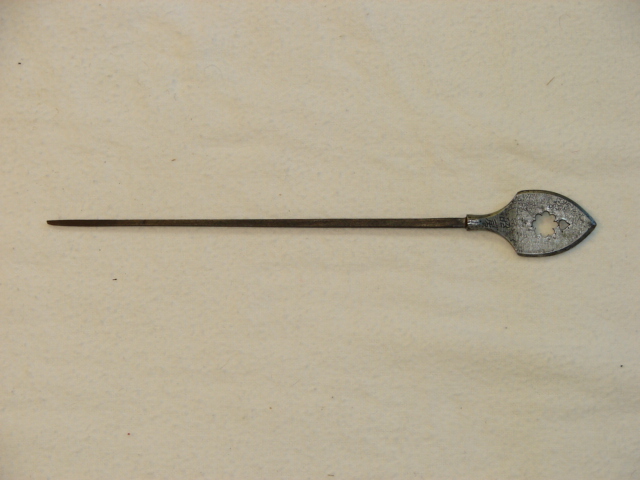
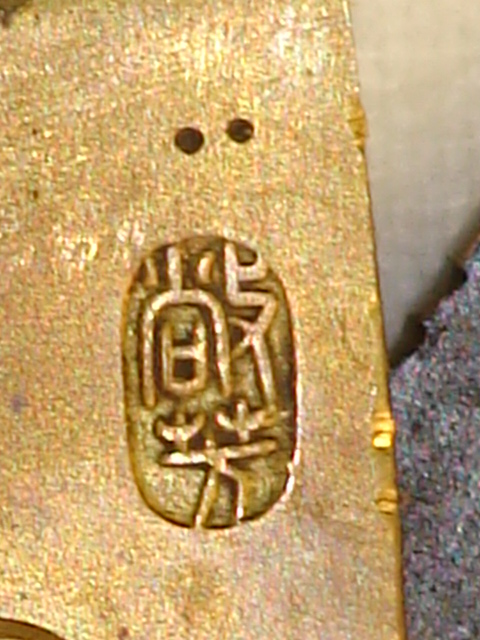
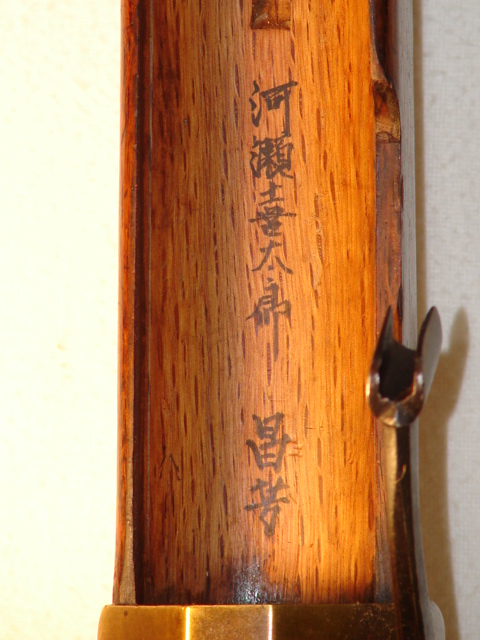
The recent article posted on yanone, ... got me looking at some of my examples. Here's one I could use a little help translating the mei. I take it the last kanji is .... fusa .... but what is the first ?? A couple of photos attached. Thanks, ... Ron Watson


-
Dear Mariuszk, Thank you for the interesting article. I have a half dozen or so yanone, .... different styles. It is interesting to see as in all things Japanese, .... " arrowhead " will not suffice, ... has to be more specific, .... eg: Intestinal ripper : . Anyways off to label my yanone :D . .............. Ron Watson
-
Dear Fred, I concur with Stephen, .... I too am not an expert on fittings. But I know what I like. I like to see people post their collections whether spectacular or humble. This IS NOT an elitist club. The moment it becomes one, I will be gone. Anyways you, and others should be encouraged to post, ... this is how we ALL learn. In this case I particularily like the Owari Tsuba. I like the piercing work, and the feel of old iron. May your collection grow. Kind regards, ... Ron Watson
-
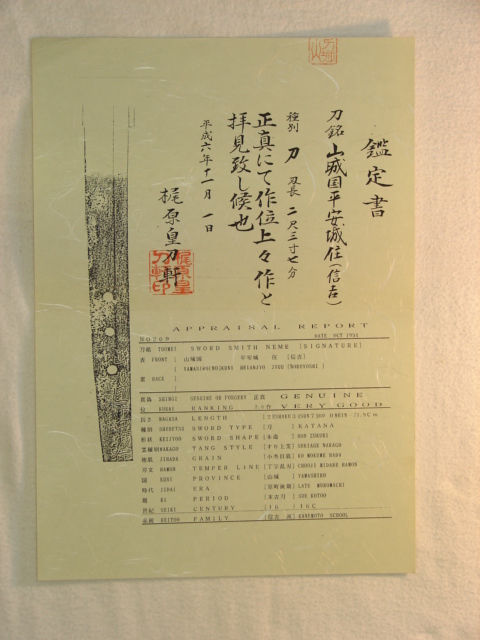
Dear John & Franco, When I got the papers from Kajihara, .... He had taken the Oshigata back to Japan along with all details and that is from where he mailed the papers to me. He had said at the Shinsa to me ( I showed him a letter I had received from NBTHK indicating the missing part of the signature might well be Nobuyoshi ) that he wanted to get a couple of opinions from collegues back in Japan. He seemed quite surprised that the NBTHK had offered an opinion by letter. I have always assumed that the Nobuyoshi he assigned the blade to was Hawley's NOB 116. I have no idea why he assigned Kanemoto School, ... but that is what it says on the paper. Just for interest sake, ... you can find an absolute twin to my blade ( as far as visual appearance ) in Harry Watson's translation Nihon To Koza Volume IV, page 119 by Ryohaku. I am not so an advanced student of Nihonto as to question Mr. Kajihara's judgement. I simply cannot answer your question. I do know that he would write me every so often to enquire about polishing that blade. .......... Ron Watson
-
Dear John, The appraisal was done by Kotken Kajihara. I attended a Shinsa in Toronto 1n 1984, and had the pleasure of having breakfast with him and a translator. He also examined a Mishina wakizashi that was in full ploish that I presented. He gave a Jo Jo Saku rating which he said was as high as he could go outside of it going to Japan for Shinsa. It is a sword by Kikumon Izu no Kami Fujiwara Kinmichi ... son of the first generation, and brother to Iga no Kami ( more famous ). He did say that the Izu no Kami was rare, ... and not only that but in this case superior in workmanship to his more famous brother. He said there is often one masterpiece to be seen in virtually all good swordsmith's work, and he advised I have seen one today ! I think he wanted me to buy breakfast ( which I did ) I must say however that the Japanese do have style, ... when it was time to return home, ... I was planning on taking the Hotel Courteousy Van. To my surprise someone had ordered me a strech limosine ( and I do mean big ) to drive me to the Airport. I enjoyed it, I must say ( a country bumbkin riding alone in a limo ), ... but I was a bit embarressed. He stayed in contact with me for a couple of years, ... always saying he would like to polish the Nobuyoshi. His prices were high, and I was afraid to lose the blade, ... paranoia. Unknown to him I had already had the blade polished by another gentleman. Never the less, .... I being a nobody in the Nihonto world, ... he still treated me with great respect. It's nearly become extinct this .... kindness, honesty and respect. The " old timers " had class, ... but the new up comers are strictly in it for the money, ... and display no class whatsoever. I once had a team of Japanese buyers wine, dine, ... and offer me the services of a lovely and very young Japanese lady just to improve their chances of buying a sword from me. I did enjoy the food, I did enjoy the wine, ... but I did not dare partake in the enjoyment of the young lady ( I certainly am no saint ), but was leary that they would use that indescretion to get their way with the dealing ! Kind regards, ... Ron Watson
-
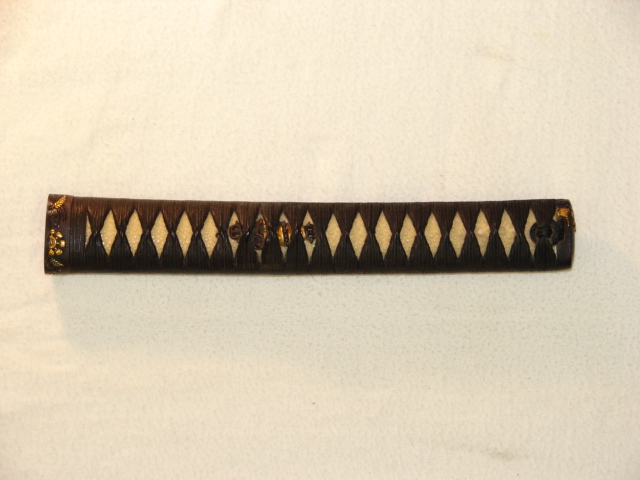
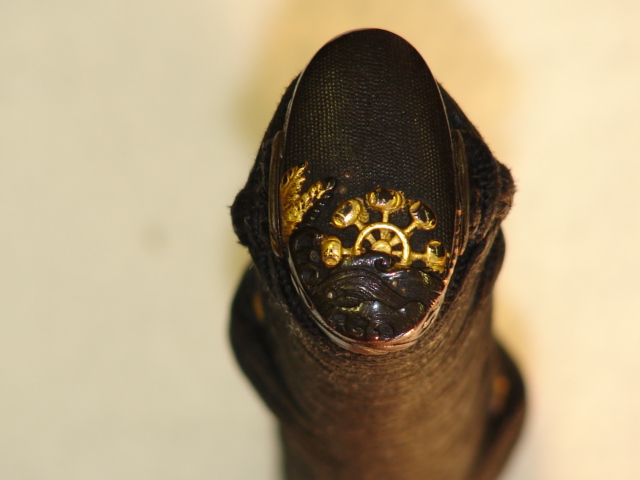
SWORD KOSHIRA

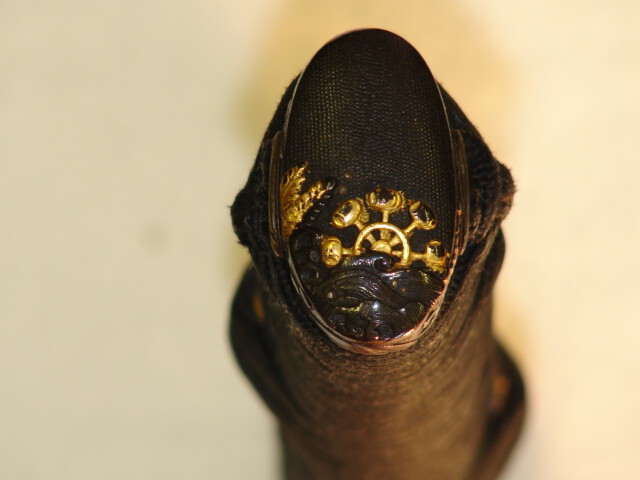
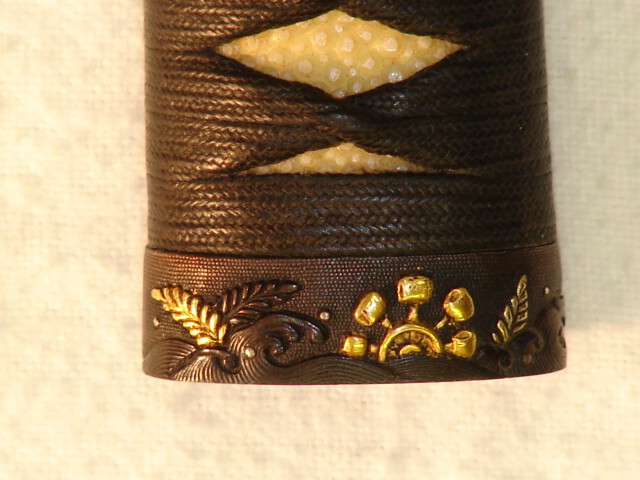
-
MORE PHOTOS


-
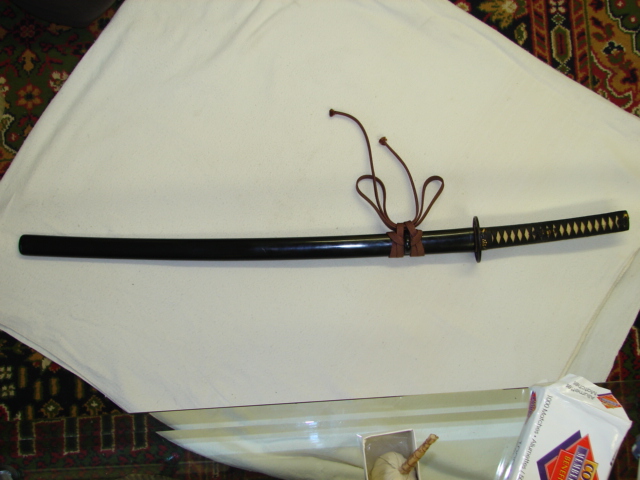
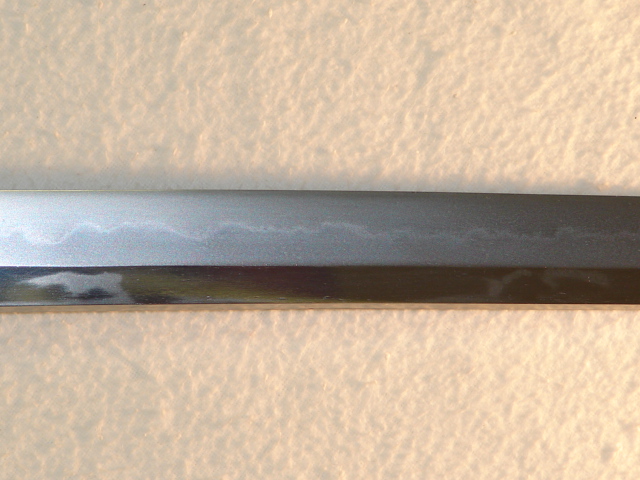
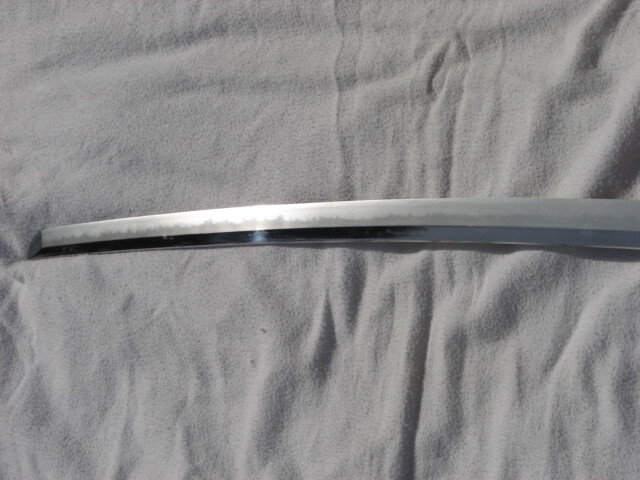
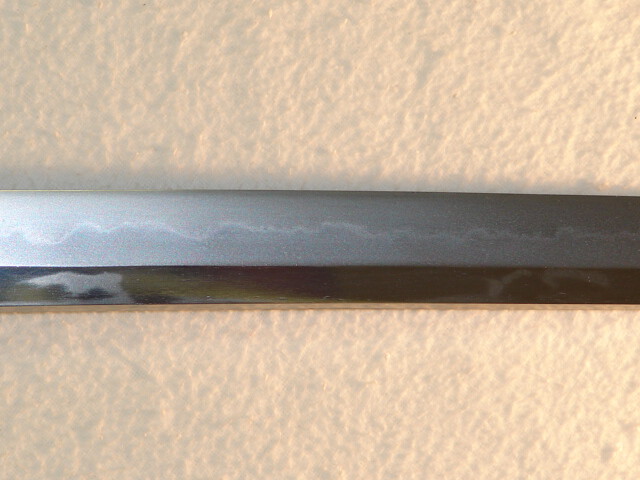
Photographs attached:



-
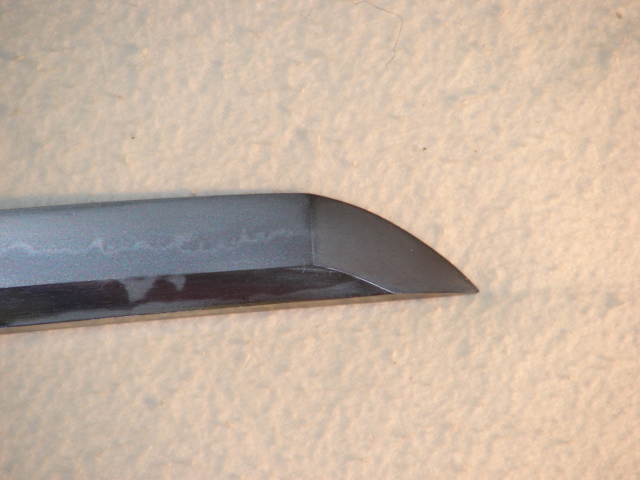
I'd like to relate a story about a Katana I own. It is a story with an important moral. Being an Antique Arms Dealer ( now semi-retired ), I used to attend many Gun Shows, or Arms Fairs as they are known in Europe. Back in 1983 I was attending a show in the USA. Being Canadian I was not allowed under American Law to sell ( at least not without a good deal of Bureaucratic Red Tape ), but I was allowed to buy. The US Gun Shows were and still are a good deal larger than our Canadian Shows, and consequently one could always find a few bargains. I used to rent two tables and display some high quality firearms and accessories as well as a nice selection of Nihonto and Matchlocks. In this way I often attracted people to my display and more often than not someone would show me an item they wanted to sell, or if not sell would ask for identification which I would always give if it were in my area of expertise. It never failed that I would be asked to look at a few WWII Japanese Swords ( veteran souvenirs of WWII ). At that time most of the veterans were in their 60's or early 70's. Probably 90 % of the times I was asked to examine a sword , it would turn out to be a mass produced arsenal sword of no real value. I would do my best to explain that the sword was not handmade, and although it looked like a Samurai Sword it was not. The clincher that would convince them was when they would ask if I wanted to purchase the sword .... sort of a layman's test to see if I were a crook. I would invariably say politely ... " no, I think it has more value to you as a keepsake, and perhaps something you might want to pass down to your children or grand children to remind them of your involvement in WWII, and the sacrifices you and your comrades made as young men ". They would usually say yes, thank you that really is what I was planning on doing. Occassionally someone would bring me a real Nihonto to examine, or an ancestorial blade mounted in military mounts. Usually they would be in awful condition, and after advising them that .. yes you do have a genuine samurai sword, and do my best to place the sword by shape into a time frame. Once again explaining that what they had was of no great value considering the costs of polish even though the blade was 200 - 300 years old. Asked if I were interested in buying, I would always decline and advise them to pass the blade down to a family member. After having done many of these two day shows over a period of several years, I was beginning to think I'd never see a really good blade for sale. I always came home with American and European antique firearms and accessories so the shows were always good to me. Anyways on the first day of this particular two day show with about 1/2 hour left before the show was to close for the day, a veteran approached me and complimented me on my display. He asked if I would have time to look at his sword. The only problem being that he lived 40 miles out of town, and I would have to drive out to see it. Being tired, hungry, and not feeling like looking at yet one more vet souvenir, I politely declined, but told him if he cared to attend the show the next day, I would be more than happy to examine and give an opinion on his sword. He thanked me and said if he could get away, he'd bring the sword the next day. To make a long story a little shorter, it was exactly one hour before the show was to end, ... a time for me to make my rounds thanking those who put on the show, and saying my goodbyes to dealer friends, ... when my wife came running up to me to say a gentleman had a Japanese sword for me to look at. I wasn't running, but I was walking very fast, ... until I saw the gentleman from the day before holding what appeared to be a typical WWII Japanese sword in a combat leather scabbard. My fast walk was now just a slow tired shuffle. Never the less I was going to give my best assessment. As I slowly withdrew the blade, ... I nearly fainted. Slowly what was appearing was as nice an ancestoral blade as you could imagine. Although in need of a polish, it had not been abused. I could clearly see the Choji Midare hamon, the Ko Mokume grain, and oh yes the boshi looked just fine. Removing the tsuka, I could see it had been shortened a long time ago. " Well what do you think ? " .... I told him this is not WWII, but quite possibly 16th century, and that it was by far one of the most beautiful Samurai Swords that I had ever laid eyes on. " Go ahead tell me what ever you can " .... I pointed out the features that I could see, and especially noted the hitasura in the shinogi-ji area. " Well do you want to buy it ? " ..... I'm sorry, but to be honest I cannot afford this blade. I believe it to be worth several thousands of dollars. It really should be polished by a sword polisher to bring out it's full beauty. " Tell me what would you do if you did buy it, ... would you sell it ? " No .. I would have it restored to its former beauty, and re-mount it in the best fittings I could afford. I would have a new saya made to fit, but I would keep the WWII fittings to prove that it had seen action as long ago as possibly 500 years, and as late as only 50 years ago. " Well ... you see that son of a bitch over there ( indicating another dealer ) .... he told me it was a nice WWII sword worth maybe $ 300.00 tops. " " Young man if you promise to restore the sword and keep it rather than just sell it, pull out your wallet and give me $ 300.00. " " I don't have a lot of time left in this world, and I'd like someone to treasure it after I'm gone. " " Money I have, someone to look after my sword I do not have. " " Now give me the $ 300.00 before I change my mind. " But I don't have $ 300.00 in cash. " Well you do have a cheque ... don't you ? " I promptly wrote him a Royal Bank of Canada cheque writing in big letters US behind the 300. " I must be a bloody fool taking a Canadian cheque made out in US dollars. " " You promise me one other thing, .... I'd like to see it one more time when it's restored. " Sadly by the time the sword was polished, and new tuska, saya and fine antique fittings gathered, ... I learned upon trying to make contact that he had passed on by several months. As promised I will keep and treasure the sword to the day I die. Here are the details of the sword. I apologize for the photography. The photos do not do this sword credit. Sword signed : Yamashiro ( no ) Kuni Heianjo Ju ( Nobuyoshi ) Nagasa : 71.9 cm Sword Shape : Hon Zukuri Jihada : Ko Mokume Hamon : Choji Midare Era : Late Muromachi Period : Sue Koto School : Kanemoto School Upon completion of polish the sword exhibits in addition : A boshi of Kaeri-Fukashi, with Mune-Yaki extending back over the mune for about 14 cm. Sunagashi is prevelent, ... as is the occasional line of Kinsuji. The Shinogi-ji has patches of hitasura spaced along it's entite length. Respectfully submitted for the study and enjoyment of our NMB members, ..... Ron Watson
-
This Week's Edo Period Corner
watsonmil replied to Bugyotsuji's topic in General Nihonto Related Discussion
Eric, ............. Remember to give credit where credit is due, .... .......... Ron Watson -
Paul Chen perfectly legal???
watsonmil replied to Bugyotsuji's topic in General Nihonto Related Discussion
Don't you just love this " Political Correct " world the simplistic individuals and nanny governments have created. Oh don't offend anyone, .... Oh please don't put this or that in our history books, .... we might offend. Circumvent the truth to be politically correct so we all live happily ever after. Yeah right, .... notice I refrained from using : Lord don't , ... or My God don't offend .... and substituted " Oh " instead. Even the word " God " is now considered Politically incorrect. Hopefully the pendulum of human intellect swings back from this arc of stupidity before we are afraid to freely speak our minds, and be responsible for our own actions but rather rely on governments to make our moral and intellectual decisions for us. OH who will help us then ? .... Ron Watson -
An Interesting 8 Monme Tanegashima
watsonmil replied to watsonmil's topic in Tanegashima / Teppo / Hinawajū
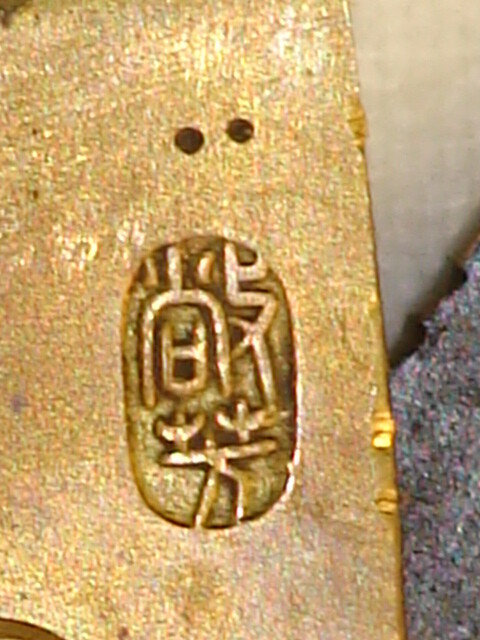
Dear Mr. Jones, Piers has answered your query as to the two major types of Japanese firearm " locks ". Basically these constitute the whole with only minor internal variations ( speaking of Matchlocks only ). Other types of locks, ... percussion for example show up at the end of the Edo Period. With respect to the European Matchlock, ... the problem of having the match extinquished by falling too hard against the priming pan was solved by having the priming pan crisscrossed with grouves or sometimes punch marks. This compensated for the possible mis-fires that would be encountered by the match hitting upon a flat surface. The Japanese defeated the problem in a slightly different fashion by having the serpentine spring made of brass .... only strong enough to actually allow the serpentine to little more than free fall upon the priming pan. This assured the match did not strike hard enough to extinquish the coal. The brass coil spring is actually quite easy to manufacture, as when you wrap the thin flat piece of brass around a wheel ( tumbler ), ... the slight stress you creat by wrapping produces a very weak spring. Thus no hardening or tempering is required as would be for a steel spring. The picture you refer to in Wikipedia is actually an example of the outside spring that Piers refers to, ... and was common to the end of the Japanese Matchlock period. Although much thicker than the brass used for a coil spring, the amount of spring is really no greater. It simply took more brass to creat the same amount of spring when using brass in a V type spring. It is interesting yes, ... that the Japanese would place a rear sight on a Musket ( smoothbore ), .... when most Euriopean Smoothbores of the time .... even well into the flint era did not have a rear sight. I feel it is simply the Japanese penchant for even the slightest improvement in design. The Japanese have always been very adept at improving upon a mechanical design. The Japanese in some cases put sights on barrels so short that they would have been competely impractical to use, .... and even mortars which you sight by range rather than by direct aim invariably have sights. They seemed to have put sights on these barrels simply because of aestetics. The slight advantage of putting rear sights on ANY smoothbore musket are outweighed by the cost and labour involved especially when you could not expect to hit anything aimed at much past 50 yards, .... and pure bloody luck to hit a man sized target at 100 yards ... with or without sights period. Only when rifling ( which the Japanese never did employ ) came forth did stability of projectiles improve to where sights front and rear mean great accuracy in firearms. I hope between Piers and I we have answered your query satisfactorily. ..... Ron Watson -
This Week's Edo Period Corner
watsonmil replied to Bugyotsuji's topic in General Nihonto Related Discussion
Dear Eric, The missile fitted into a large Teppo , .... just the base portion. They were called " bohiya ". The central area just back of the nose cap down to the fins was wrapped with rope soaked in a flamable substance. The idea was that firing one of these missiles into a Castle roof as an example would set the building on fire. Piers posted a photo in this section , .... I think page 67 The samurai is carrying it over his shoulder in the photo # Rimgo598.jpg . ..... Ron Watson -
An Interesting 8 Monme Tanegashima
watsonmil replied to watsonmil's topic in Tanegashima / Teppo / Hinawajū
To all the members who took the time to post a translation, .... A BIG THANK YOU ! I finally got my system to do a translation ( GOOGLE ). I wish I were as adept at running these computers as you guys. Hell even my 8 year old grandson is better than I, which is just a bit embarassing ! ... Ron Watson -
An Interesting 8 Monme Tanegashima
watsonmil replied to watsonmil's topic in Tanegashima / Teppo / Hinawajū
Dear Members, If someone could PM me a translation of the following article. I would be most appreciative. When I try all I get is illegible code. You can e-mail me at : watsonr@mts.net http://www.harimaya.com/kamon/column/igeta.html I apologize for the inconvenience, ... but I would really like to be able to read this article. Thank you, ... Ron Watson -
An Interesting 8 Monme Tanegashima
watsonmil replied to watsonmil's topic in Tanegashima / Teppo / Hinawajū
Dear Ian, I finally found the article pertinent to my statement that the Ii Family suffered after his assassination, ... " After Ii Naosuke's death the Ii family was disgraced for many years, recently however Ii's actions have been looked at in a more favourable light and Ii Naosuke has taken his place as one of the most important political figures of Japanese history. On October 7, 2009, Naotake Ii, a family descendant of Naosuke attended a memorial ceremony with the people of Fukui to reconcile the execution of Hashimoto Sanai ". ...... Kyodo News, " Fukui, Hikone `reconcile` over 1859 beheading ", Japan Times, October 8, 2009. .... Ron Watson -
An Interesting 8 Monme Tanegashima
watsonmil replied to watsonmil's topic in Tanegashima / Teppo / Hinawajū
Dear Ian, Between the assassination of Ii Naosuke in March 1860, and the Tokugawa's final capitulation in 1869, the Ii family were somewhat shielded from the forces supporting the Meiji restoration. Remembering that most Daimyo had favoured the continual isolation of Japan, and it being the Tairo ( Ii Naosuke ) who had signed on the dotted line so to speak, .... the family was indeed shunned. In the confusion that followed with the eventual restoration of the Meiji and the end of the Tokugawa, ... it was only through the benevolence of the new Restoration Government that the Tokugawa and those like the Ii family survived at all. It was remarakable that many of these disidents eventually became part of the government. It is my understanding that for awhile at least in the interval of all this upheavel that the Ii family were made to suffer a great deal. The whole of Japanese Politics at this time is most confusing, ... as I'm sure you would agree. ..... Ron Watson -
An Interesting 8 Monme Tanegashima
watsonmil replied to watsonmil's topic in Tanegashima / Teppo / Hinawajū
Morita san, I am indebted to you for the Kakihan translation and kind words. Both are very much appreciated. .... Ron Watson -
An Interesting 8 Monme Tanegashima
watsonmil replied to watsonmil's topic in Tanegashima / Teppo / Hinawajū
Dear Justin, The Kunitomo were by far the largest suppliers of firearms during the Edo period. Generally they made exceptional firearms. When faced with a huge order for supplying cheap guns for equipping Ashigaru ( untrained foot soldiers ), .... they supposedly turned out some very poor quality firearms, .... sometimes refered to as " noodle guns ". These are not often encountered as they were soon discarded and few survive today. .... Ron Watson -
An Interesting 8 Monme Tanegashima
watsonmil replied to watsonmil's topic in Tanegashima / Teppo / Hinawajū
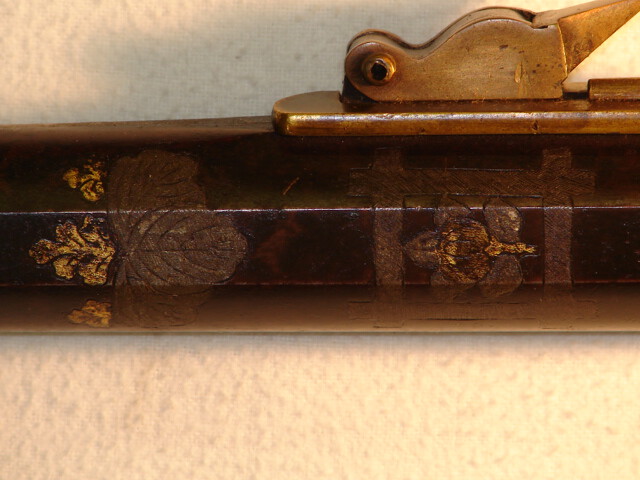
A few more photos. ... Ron Watson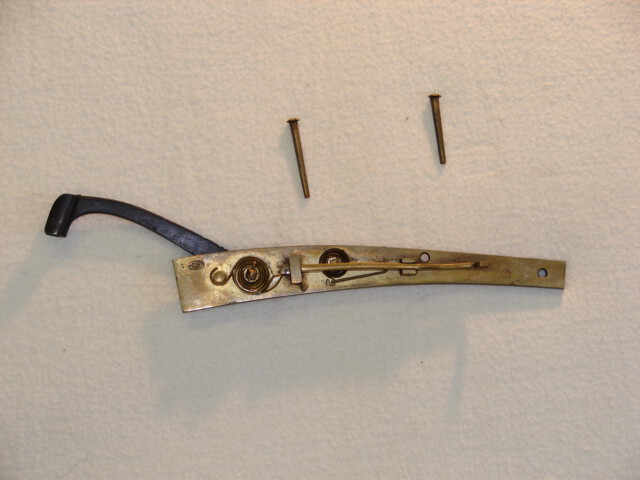
-
An Interesting 8 Monme Tanegashima
watsonmil replied to watsonmil's topic in Tanegashima / Teppo / Hinawajū
Here are a few photos of the Tanegashima. ... Ron Watson