watsonmil
-
Posts
1,406 -
Joined
-
Last visited
-
Days Won
4
Content Type
Profiles
Forums
Events
Store
Downloads
Gallery
Everything posted by watsonmil
-
Black lacquer gold Mon Tazuke School Tanegashima
watsonmil replied to Bugyotsuji's topic in Tanegashima / Teppo / Hinawajū
Dear Piers, I must say, .... what a great example. Two things I note, ... the breach plug is round ended instead of square, .... was this a later feature or earlier feature. Is this a particular feature that helps identify this school. Also it is the first that I have seen that punch marks were used in making decorative patterns. Again is this a particular feature of this school. Jealous plays no part, .... I am only too pleased to see it published for us all to learn from. Congratulations on aquiring what I am quite sure is a rarity even among the already rare Samurai Matchlocks. 20 monme and larger caliber guns are not easy to come by. I'm glad you found the time to share with the rest of us interested in this specialized field. Well done ! ... Ron Watson -
This Week's Edo Period Corner
watsonmil replied to Bugyotsuji's topic in General Nihonto Related Discussion
Ian, Gives a whole lot more meaning to : " Praise the Lord and pass the ammunition ". I guess that quote is a little too late in history to be attributable however. Kind regards, ... Ron -
This Week's Edo Period Corner
watsonmil replied to Bugyotsuji's topic in General Nihonto Related Discussion
Hi Ian, I too enjoyed the Arch Bishop story, ... I wonder if his faith was somewhat shaken to find the Cruxifix carved onto a bullet actually caused a greater deviation than the un-carved bullet ??? Of course he could always argue that the Cruxifix kept the demons fom riding the bullet at all, and therefore accuracy was reduced. It's interesting how the clergy could never lose an argument ! ..... and still can't ! Piers, .... Some lovely items, .... you must have a ball rumaging about in the land of the Samurai. Good for you, ... I for one am filled with envy, .... but none-the-less delighted for you. Keep posting your wonderful finds. They are both enlightening and educational. ... Ron Watson -
POSSIBLE BIZEN TANEGASHIMA with Sakai influence
watsonmil replied to watsonmil's topic in Tanegashima / Teppo / Hinawajū
Dear Piers, Now there's a TANEGASHIMA ! How about an article on that beauty some day as time permits. I am certain I am not alone in wanting to see and hear more . ... Ron Watson -
POSSIBLE BIZEN TANEGASHIMA with Sakai influence
watsonmil replied to watsonmil's topic in Tanegashima / Teppo / Hinawajū
Dear Bazza, I should have mentioned that where their is any signature on the stock bed ( usually in Ink ), ... this area MUST be avoided when applying oil. I have never found the application of oil ( lemon oil ) to be detrimemtal in any way to the wood inside or out. Barry, ... even in the best of climates, .... wood that is 200 years old will have lost much of it's normal moisture ( oils ). It was once a living organism, .... and as with all things dead, ... decomposition begins. With wood it takes longer depending upon climate, ... but the cell structure eventually collapses. It would be difficult to see without the aid of a microscope, but never the less it is happening. My 8 monme gun had a perfectly dry, free of cracks stock bed. It still is free of cracks, and looks no different in a few days after a treatment with lemon oil. I would however never recommend applying oil where wood has a lacquer coat. The oil may well damage the lacquer. Getting back to the stock beds, ... I have guns that do have some cracking and although these had not gone thu to the outside of the stock, ... they eventually would over the next 100 years or less. The oil replacing the naturally lost oils in the wood will and has stopped the deteriorating process. I own not only several Tanegashima, ... but have owned many fine English rifles such as a " RIGBY", ... and " Holland & Holland ". If it were not for the careful maintenace of the woods on these rifles using oils, ... the perfect wood to metal fit would soon show seperation as the wood shrinks from slow decay ( shrinkage ). A gun stock is no different from a fine piece of OAK or WALNUT furniture, ... without being wiped down with a good quality furniture oil, ... the wood will eventually crack. It will also lose it's luster the very same as the gun that was pictured has lost it's wood luster. It looks dry and lifeless. The oil is meant to bring that back, ... and give it beauty while at the same time preserving it for the enjoyment of the future generations. I just noticed you also said the outside of your stocks have been clear lacquered, ... this I doubt to be lacquer, but rather some type of other finish such as the original stain combined with the natural oil found in human hands after countless thousands of handlings. I assure you that NONE I own or have handled to the best of my knowledge have a clear lacquer finish. A lacquer finish on the outside of your guns would have yellowed, cracked or otherwise deteriorated from sunlight alone after 200 years. If someone purposely lacquered the outside of a gun stock with a clear lacquer this was not done by the gun maker. A few stocks were black lacquered, ... but this was not common on most tanegashima but with the exception of one school, .... and of these black lacquered guns, .... unless refurbished they tend to be dull and damaged. ... Ron Watson PS> I have pictured on this forum, ... at least 7 tanegashima, .... do you see even one that is not in prestine condition ? All have been oiled, ........ I rest my case. -
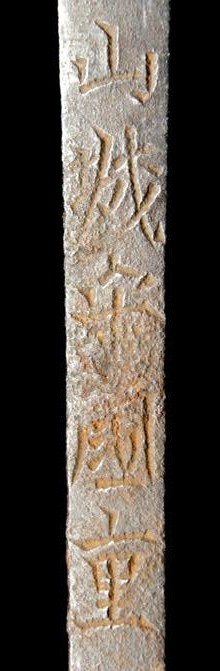
Dear Members, I recently aquired a rather nice Su-yari. It is signed : Yamashiro no Kami Kunishige. The seller states Monju School ( Yamato Den ) The blade has Masame Hada, Hamon is Suguha, Nie-deki. Blade length is just shy of 20 cm. OA length is 55 cm. Nakago has two mekugi-ana. Blade is very nicely forged with no flaws, but in need of a fresh polish. I can find in Hawley's at least 4 possibilities Kun 1119, Kun 1120, Kun1155, Kun 1157. I'm wondering if anyone may have oshigata that can narrow down the probable smith ?? ..... Thank you ...Ron Watson


-
Dear Ben, Gimei refers to a false signature. It does not mean that the sword bearing a Gimei is fake, ... but rather the signature is fake. Some swordsmiths or dealers in order to increase the saleability and value of a sword would have the signature of a well respected ( famous maker ) swordsmith inscribed on the tang. This has been going on for a few hundred years. The known original signatures of the smiths are recorded in books, and a comparison of how a given smith signed his name is compared to authenticate. Other factor also enter play here, such as is the sword of the correct time period of the signed smith, .... is the style of work the same as is known for the smith. I hope this assists you in understanding the meaning of Gimei. ... Ron Watson
-
This Week's Edo Period Corner
watsonmil replied to Bugyotsuji's topic in General Nihonto Related Discussion
Dear Ian, Having been the Canadian Senior ( meaning adult ) 3 position Small Bore ( .22 ) rifle champion of Manitoba at the tender age of 14, and again at 15 years of age ( at 16 my interest took a turn towards girls ), and having participated in the Canadian National Matches those years and having placed very well, .... I also was invited by the Canadian Army Reserve at age 17 ( as a private contractor ) to teach long range marksmanship out to 900 yards ( full bore .303 ), .... and having spent the balance of my working career as both an explosives demolition contractor, and Antique Arms Dealer. During the past 40 + years I have fired everything from full size 9 pounders ML Cannon thru Machine guns, thru the very finest Target Rifles, ... and also no end of Muzzle Loading Firearms. I can assure you that the Japanese penchant for accurate long range shooting with the Smooth Bore Tanegashima was nothing more than wishful thinking. The English Brown Bess was a smooth bore Service Musket of reasonable military quality, ... certainly the equal of any Japanese Tanegashima of the period, given the poor design of the Tanegashima stock for accurate shooting .... and I assure everyone reading this that to hit a single standing man at the short distance of 100 yards would be pure luck. You may well hit a man at 100 yards, ... but it will NOT be the man aimed at with exception of luck. The Japanese seem to love to improve upon an idea. In the case of leaf sights, ... they would most certainly be an aid in getting the APPROXIMATE elevation for a given distance, but the idea of long range target shooting with ANY smoothbore musket would require targets as big as the side of a very large barn as a target at anything approaching say 200 yards. ... Ron Watson -
POSSIBLE BIZEN TANEGASHIMA with Sakai influence
watsonmil replied to watsonmil's topic in Tanegashima / Teppo / Hinawajū
Dear Eric K, Most good furniture stores will carry lemon oil, ... I use a brand called " Old English ". It is funny to say but manufactered in the USA. Any quality furniture store should be able to provide you with a furniture oil which will PENETRATE ( be absorbed into ) the wood. Wax will only SEAL the wood, ... this is NOT what you want. That wood is old, dry, and in need of some oil to preserve and fill the empty pores. You'll be amazed at how the oil will disappear into the wood for awhile. YES, .... by all means the stock bed needs a good amount as well. Here I literally pour on oil, and wipe off the excess with a clean cloth. As does the wood under the lock inletting. After several treatments over a period of 2-3 months, you will see a big difference ... the life and beauty will be restored, ... and as a bonus you will be preserving the gun for the next generation of collector. ...Ron Watson -
This Week's Edo Period Corner
watsonmil replied to Bugyotsuji's topic in General Nihonto Related Discussion
Dear Mr. Jones, The reason for the bulbous muzzle is to allow for a higher mounting of the front sight, .... without the bulbous muzzle the front sight would have looked like the CN tower. The height at which the REAR sight had to be fixed to the barrel to allow for the unusual stance of the Japanese gunner, ... required a correspondingly higher FRONT sight. Where the bulbous muzzle is not seen, ... one will notice the barrel " swamped " ......... a term meaning the muzzle swells in diameter near the muzzle to accomplish the same solution, but without the bulbous appearance. Sighting a matchlock is much different from sighting a western type gun with a shoulder stock to take up the recoil. No one wants to rest their face up against and slightly over what is essentially a VERY long barreled pistol. The recoil is being taken up by the wrist and arms ... not the shoulder, ... so aiming ( sighting ) requires a somehat different position of the face. It must be kept higher and out of the way, ... otherwise you'd at the very least have a bruised and bloody cheek. ... Ron Watson -
This Week's Edo Period Corner
watsonmil replied to Bugyotsuji's topic in General Nihonto Related Discussion
Dear Ian et al, I have a reasonable collection of old articles on the Japanese Matchlock. I wish now I'd have kept e-mail photos of various Japanese Tanegashima that I have been offered over the years, ... but alas since " conversions " were of little or no interest to me I did not. I know I was offered one that was bolt action, and definitely a conversion of a regular matchlock barrel to accept a bolt action ... this only a couple of years ago. Two other photos ( part of old magazine articles ) that I did save show what is definitely a model 1880 Murata action and barrel fitted to what had to be a customer ordered matchlock style stock. The other photo, ... again although I do not recognize the particular bolt action and barrel, most definitely also has a stock in matchlock style which was a custom order and not a conversion ( neither of the stocks show any indication of ever having had been inletted for a side lock ). It would appear to be simply a case of the original Japanese owners not likeing the shoulder type stocks of the more modern firearms, ... but preferring the old style of stock with the simple pistol type grip. Both of these " custom " rifles have to have been built post 1880. ... Ron Watson -
This Week's Edo Period Corner
watsonmil replied to Bugyotsuji's topic in General Nihonto Related Discussion
Dear David, Although these tiny guns could ( and quite likely some ) are considered eprovettes ( powder tester ), ... the example you picture is more than likely a Netsuke ( a toggle fastened by a cord to an inro or tobacco pouch ) and hung from the Obi ( Japanese waist belt ). Note the suspension loop, ... and tiny size. If used as an eprovette it would little more than tell you if the powder would ignite. Trying to hang onto the little barrel and touching it off with a red hot wire would probably have given you little more than a severe powder burn. The other possibilities for this tiny a barrel, ... is that it may have served some wealthy gunner as a priming powder dribbler ( very fine black powder used for priming the flash pan ). In this case it would have had a tiny stopper which is now long gone. Another possibility is that it is simply a toy or novelty item. In any event, ... it is a most interesting little artifact. ... Ron Watson -
POSSIBLE BIZEN TANEGASHIMA with Sakai influence
watsonmil replied to watsonmil's topic in Tanegashima / Teppo / Hinawajū
Dear Mr. Jones & EricK, Firstly, ... Mr. Jones .... Once you have as much rust ( corrosion ) removed from the inside of the barrel as possible, ... a coating of a light machine oil such as 3 in 1 or a good quality gun oil inside and outside the barrel once or twice a year should suffice to preserve and protect the barrel. A good cleaning with a brass brush ( inside of barrel ) and afterwards a swab with oil soaked rag twice a year will suffice. The military used to use a product called " cosmoline ", ... still available from a retailer in the USA named Brownell's. It is messy with the consistency of vasoline, ... but it would protect the inside of the barrel practically forever. It is a pain to clean out however. Eric, .... I concur with Piers, ... but for a very few variations ... typically a Bizen Tanegashima. It is very nice. Give that barrel and lock some oiling, ... and the stock some lemon oil ! Regarding the " dimples ", .... I have not seen this before, and I really do not know the answer. Regarding the conversions of Matchlock to Bolt Action, ... any I have seen were converted using a Murta action of 1880. This was Japan's first indigenous service rifle and fired a black pwder cartidge of 11 mm. As Piers says a nightmare conversion, ........ and really of no benefit. Thank you for posting the photos, ... and congratulations on aquiring a very nice example of a rare Samurai weapon. ... Ron Watson -
POSSIBLE BIZEN TANEGASHIMA with Sakai influence
watsonmil replied to watsonmil's topic in Tanegashima / Teppo / Hinawajū
Dear Eric, At least half the pleasure in owning something is to share. Whether we own a bit of unique knowledge, ... or an interesting artifact. Sharing with others of the same interest is what the study of Nihonto and related items is all about. I always find something new, .. unusual, .. educational, .. or derive just plain pleasure in seeing other collections. Please do post a few photos when you are ready. Kind regards, ... Ron Watson -
POSSIBLE BIZEN TANEGASHIMA with Sakai influence
watsonmil replied to watsonmil's topic in Tanegashima / Teppo / Hinawajū
Dear Thomas, Christ, .... I live in Canada, .... ... I've been chased by a moose, ... I've shot a moose, ... I've eated a moose, ... I've even been love sick like a moose ( sorry guys who are trying to translate - Hope your translation is not mechanical ), but I'll be damned if I'd milk a moose ! By all means Eric, ... post a picture. Kind regards, ... Ron Watson PS> The receipe sounds exactly the same as what many of our locals drink by the way. -
Alternative to ebay
watsonmil replied to Grey Doffin's topic in Auctions and Online Sales or Sellers
Dear Brian, You make a most valued point, .... It would be indeed nice to see our members offer their goods here before using the eBay facility. Grey also is quite correct when he points to the GREED that eBay exhibits. In fact in the future I would not be surprised to see Webster's Dictionary giving " ebay " as a synonom for " greed ". Why is it whenever someone comes up with a winner like eBay was, ... within a few months or at the most a few years, .... it becomes so corrupted that it is barely recognizable. It reminds me of my father ( RIP ), ... if something was working well, ... he could not resist fixing it until it was completely screwed ! eBay has this problem with selling weapons ( antique or otherwise ), ... but absolutely no problem selling " skin movies ". Mind you, ... I haven't checked out their skin movies since I turned 60, ... a couple of years past now ! ....... I better have a look, as there sure as hell aren't any decent Nihonto there ! ... Ron Watson -
POSSIBLE BIZEN TANEGASHIMA with Sakai influence
watsonmil replied to watsonmil's topic in Tanegashima / Teppo / Hinawajū
Dear Eric K, The only book I know of in English is: THE Japanese MATCHLOCK - A Story of the Tanegashima by Shigeo Sugawa There is no ISBN number shown in my book. First edition April, 1991. The book is hardcover well illustrated but only 61 pages printed on high quality paper. I recently saw one listed at $ 150.00 . You might be wise to do a Google search of Used Book Sellers, ... or perhaps one of our members may have a copy available ( Bridge of Dreams member ). Regards, ... Ron Watson -
POSSIBLE BIZEN TANEGASHIMA with Sakai influence
watsonmil replied to watsonmil's topic in Tanegashima / Teppo / Hinawajū
Dear Eric, I've never heard that oil of clove is bad for swords, ... I think quite the opposite is true in moderation. Whale oil would work, as would any number of natural oils. You might remember a gun is not a sword. I would not use a petroleum based oil on my swords, ... but on/in a gun barrel I use it all the time, as I'm sure Piers does as well. On the wood I prefer to use lemon oil, .... but in/on the barrel I use 3-1 light machine oil. ...... Ron Watson -
POSSIBLE BIZEN TANEGASHIMA with Sakai influence
watsonmil replied to watsonmil's topic in Tanegashima / Teppo / Hinawajū
Dear Eric, I should think the oil of choice was clove oil. It has much the same rust preventative properties as the petroleum based oils of today. ..... Ron Watson -
POSSIBLE BIZEN TANEGASHIMA with Sakai influence
watsonmil replied to watsonmil's topic in Tanegashima / Teppo / Hinawajū
Dear Eric, When the gun was new, ... the ideal was to remove the barrel from the stock, ... un-screw the threaded breach plug leaving a barrel open at both ends. Since black powder residue is soluble in water, a funnel was placed in the muzzle and hot water ( the hotter the better ) was poured thru the barrel. This removed the bulk of the fouling. Next a cloth soaked in hot water was pushed thru the barrel using the ramrod or other suitable rod. After repeating this procedure a few times, .... if the barrel still looked dirty, ... a brass brush would have been pushed thru to loosen any stubborn residue. This was then followed by the wet cloth yet again. If the barrel appeared to be clean, a dry cloth was then pushed thru to remove any moisture. The breach plug was then cleaned and replaced. If the gun were not to be used for a while ( a week or so ), ... an oily rag would have been passed thru barrel to prevent any rust from forming. When the gun was next to be used, a dry cloth would be passed thru to remove any oil before loading. In reality few Samurai went to all this trouble. One reason being that the breach plugs were of notorious poor fit, and the threads were often wrapped in a very thin lead sheet to aid in getting a gas tight fit between the threads of the breach plug and the threads of the inside of the barrel breach. In fact allowing for some residue in the very bottom of the barrel allowed for a better gas tight seal in this vunerable area. What was normally done to clean, ( and by the way even today with western type muzzle loaders ) is that all the steps I outlined are followed EXCEPT for the removal of the beach plug. Hot water is poured down, but instead of running all the way thru, .... the barrel is tipped down for the water to run back out the muzzle. In fact this NOT removing the breach plug and adding a little pressure from the cloth tipped rag forces water out the touch hole, and thereby aids in cleaning residue out of it. Once the barrel cloth comes out clean upon withdrawl of the cleaning rod, ... a dry cloth is used on the cleaning rod to dry the barrel, and once again if the gun is not to be used for sometime, a little oil on the cleaning rod cloth pushed down and withdrawn will help prevent rust. Just remember as before, .... before using the gun a dry cloth must be used to remove the oil from inside the barrel. The outside of the barrel and lock are also cleaned with warm water, and oiled as black powder residue is highly corrosive. You can count on spending at least an hour to properly clean a Black Powder Muzzle Loading gun. ........ Ron Watson -
POSSIBLE BIZEN TANEGASHIMA with Sakai influence
watsonmil replied to watsonmil's topic in Tanegashima / Teppo / Hinawajū
Dear Piers, Interesting you mention the " silver headed pins ", ..... on this particular gun, ... the only restoration I needed to attend to was the Serpentine Pin. It was cracked thru where the round section turns to a flat section. I still have the broken pin, ... and it does have a silver head. I built a new Serpentine Pin, .... but should have silver plated the head. When doing any restoration, ... one must always adhere to the original, .... and at the time I never thought of this small detail or of it's being that important. A good lesson learned. I shall attend to it. Since you have access to knowledge about this line of " smiths " , .... did you by chance note if there were dates given for this man's era of work. His dates may be shown on the paper you posted, ... but if so I cannot read it . It would be nice to add an approximate date to the gun. ..... Ron Watson -
POSSIBLE BIZEN TANEGASHIMA with Sakai influence
watsonmil replied to watsonmil's topic in Tanegashima / Teppo / Hinawajū
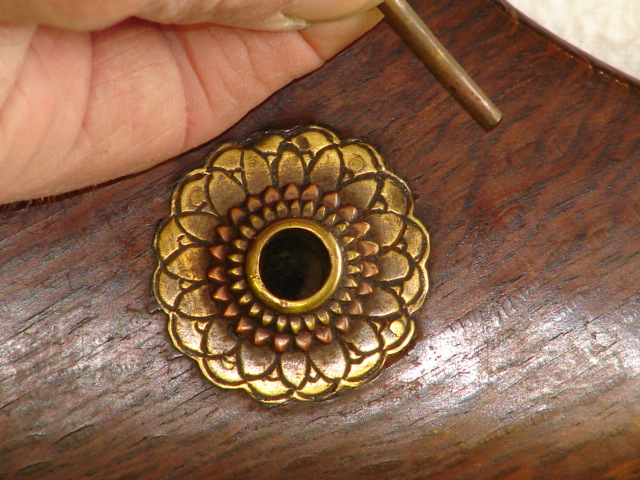
ADDITIONAL PHOTOGRAHS ... Ron Watson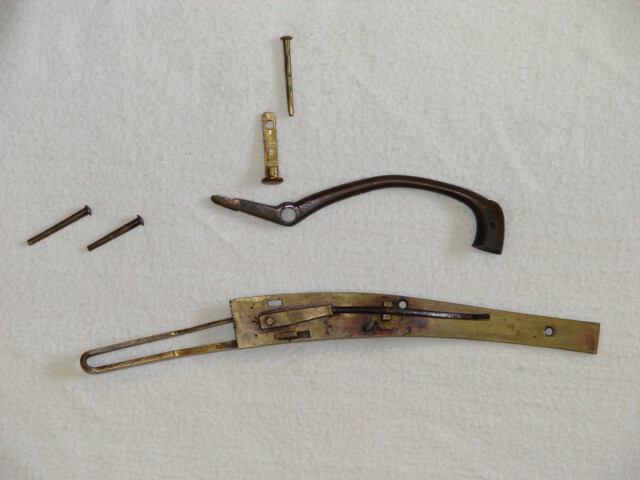
-
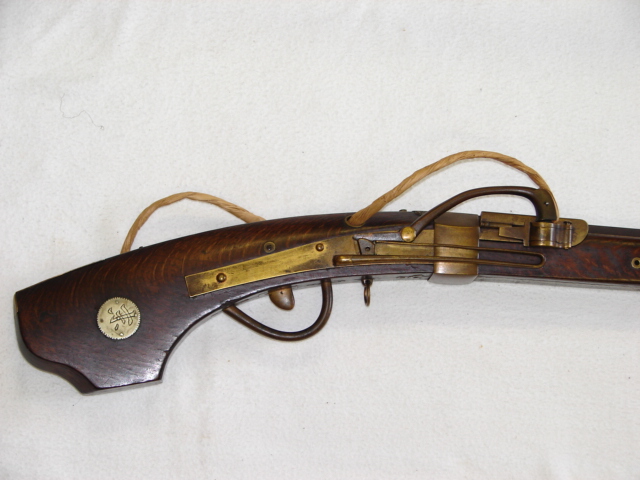
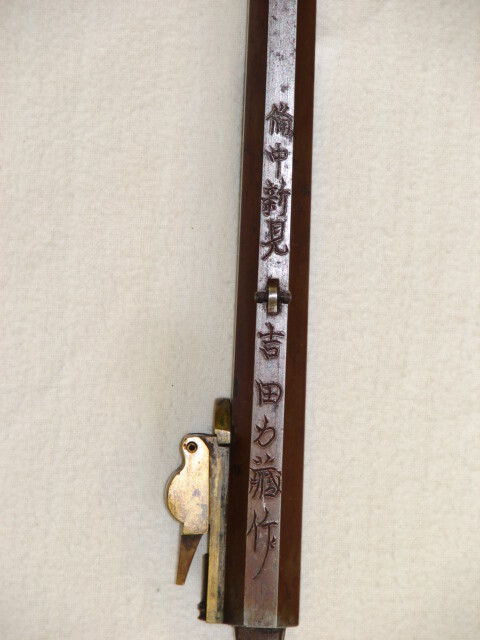
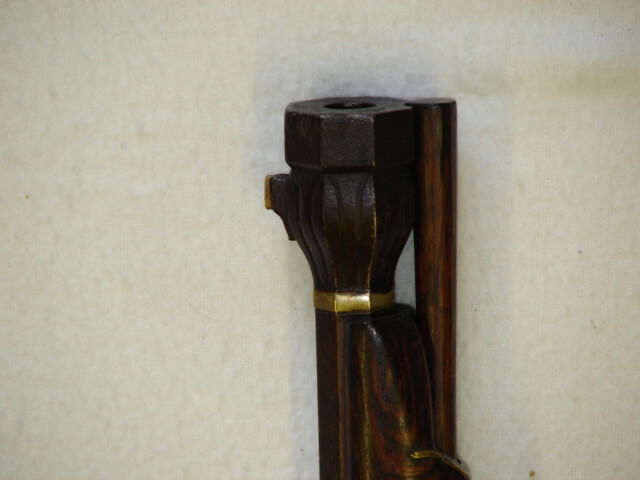
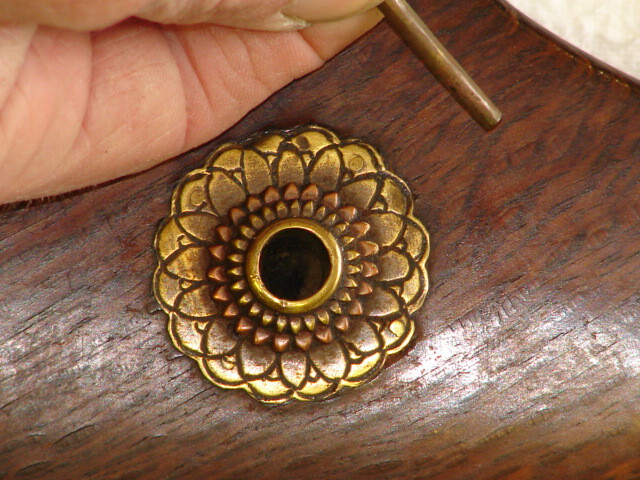
This was my first Tanegashima, .... purchased many years ago. At the time very little research material was available for study, ... and although this has somewhat improved over the last few years, much work is yet to be done. Unfortunately due to the limited space ( pixels ), I will be unable to post a photo of the overall gun. I will however post what is allowable from my picture files. The stock is of high quality oak with beautiful stripping grain running the length of the stock. The floorplate has a well carved brass dragon skilfully inlaid. The pin holes for securing the barrel to the stock are stengthened by plain round brass escutcheons. The off side of the stock has a Chrysanthemum Match Holder/Match extinquisher. In this case more likely a match holder as it is a full 1 inch deep. In addition the stock has an angled brass lined transverse hole to carry the match from the serpentine to the Match holder. The stock also bears a silver medallion, probably added by the original owner of the gun. The barrel is tapered octagon ending in a bubulous poppy shaped muzzle that I usually associate with the Sakai Gun makers. The front sight has a gold bead for aid in sighting. The barrel is otherwise free of decoration. Caliber of this gun is .43 inch ( 2 monme ). OA length of the gun is 53 1/2 inches. The Lock has a top pinned serpentine, and is of the outside spring variety. The lock is of high quality and carefully inlaid into the stock. The trigger appears to be Bizen in style although the Awa makers cannot be ruled out. The barrel is signed : Bitchu Nimi Yoshida Rikizo made. The fact that Bitchu borders with Bizen would give reason to assign this gun to the Bizen Gun Makers, ... but with Sakai influence. Photographs are attached. Respectfully submitted for the enjoyment and study of the NMB members. ... Ron Watson

-
Dear Keith, I would never have guessed it was Katana size ( which it is obviously ). I too think the removal of wax or old oil film brings out the best in the end. The cutting/carving appear sharp, and the quality appears excellent. I will be interested to see what our experts have to say, ... my guess is mid Edo. Although tastes will vary, ... it is one of the nicest I've seen posted in sometime. ... Ron Watson PS> There we go I was just about to post when Steve stepped in to clarify, explain, and attribute.
-
Dear Keith, I'd have to agree with Mark, .... very nice. It would be of interest to know it's dimentions. It appears to be wakizashi size. Personally I think it is a very elegant looking tsuba. I would add it to my modest collection any day ! Thank you for posting. .... Ron Watson