watsonmil
-
Posts
1,406 -
Joined
-
Last visited
-
Days Won
4
Content Type
Profiles
Forums
Events
Store
Downloads
Gallery
Everything posted by watsonmil
-
Dear Alf S, Specifically, ... eBay is a dangerous venue for the novice collector, ... When it comes to item discription, category, the seller has absolute rein over what the description is, and what category to place his item. Given this type of free for all, .... eBay ( VIRTUALLY ALL- ONLINE Auction sites are the same, eBay is simply the largest ) are a magnet for the dishonest, the faker, and the make a quick buck crowd who know nothing of what they sell. eBay and comparible on-line sites have sporned an industry in China as an example in the manufacturing of fake Japanese Swords, Koshira, yanone, yari, and this is ONLY one field of antique/collectible. You speak of : if you throw peanuts you attract monkeys, ... well my friend that is rapidly fading into the past. I have personally see yanone coming out of China that are so good that they would fool at least 90 % of the collectors, At least a couple are being offered on eBay RIGHT NOW and not for peanuts. This even though PayPal ( an eBay subsiduary ) was offered proof of them being forgeries. I have and will continue to buy objects off eBay, ... BUT I also have over 40 years of experience in the field. There are damndable few of us, but a whole mess of gulible novices out there. There are a FEW honest seller's on eBay. It is much like the story of Lawyers however, ... 99 % of Lawyers give the other 1 % a bad name. I was going to use the analogy of Politicians rather than Lawyers, ... but as I see it there are NO honest Politicians period ! By the way there are damn few honest Sword dealers were the truth be told. It is always best to run any anticipated purchase by the members of the NMB, ... that way you get the benifit of a non-biased opinion from some of the world's leading experts. ... Ron Watson
-
Dear Brian, I once asked my old dentist ( now deceased ), ... if by chance he knew of a Simon Wiesenthal, .... he snapped back ... " if you mean Joseph Mengele, ... he vas mine teacher ". The dental assistant stood there completely blank. She was kinda cute . ... Ron Watson
-
Dear Josh, Hmmm a DMD, .... by the way its .... " trauma ", .... not .... " trema ". ... Ron Watson
-
This Week's Edo Period Corner
watsonmil replied to Bugyotsuji's topic in General Nihonto Related Discussion
Hello Piers, A Japanese " pepper grinder ", .... hope all is well in Scotland. .... Ron Watson -
Dear Malcolm, The article was written with the intent of showing an interesting trade/presentation item of the late 19th century, and how the Western world modified at least some of the many thousands of Vases both Porcelain and Bronze that were imported, into utilitarian objects for the Victorian hosehold but still retaining the beauty of the original Japanese workmanship/art. I apologize to the membership if I have gotten the various Pawlownia crests ( mon ) attributed incorrectly. Perhaps someone will offer the correct attribution. I feel bad if I have somehow disseminated poor research with respect to the MON. I should have been more careful in my research in identification before putting pen to paper. ... Ron Watson
-
Dear Chris, You are correct or to be more correct the Government of Japan vis-a-vis ( The Office of the Prime Minister ), ... my error. ... Ron Watson
-
MORE PHOTOS of VASE converted to LAMP



-
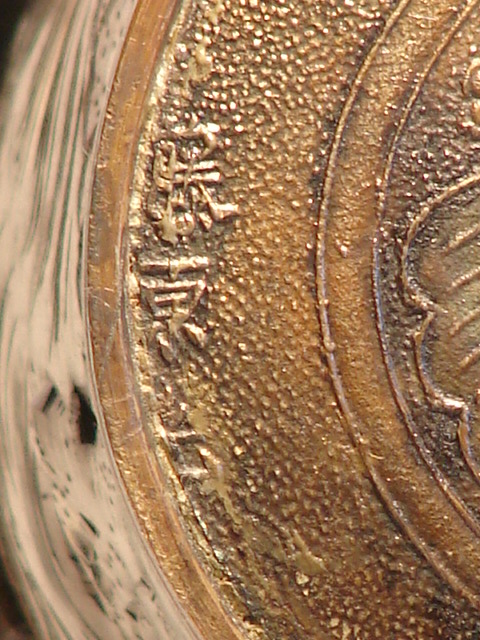
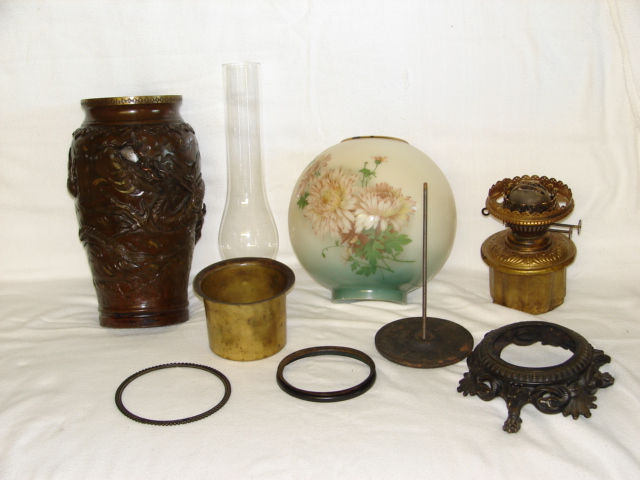
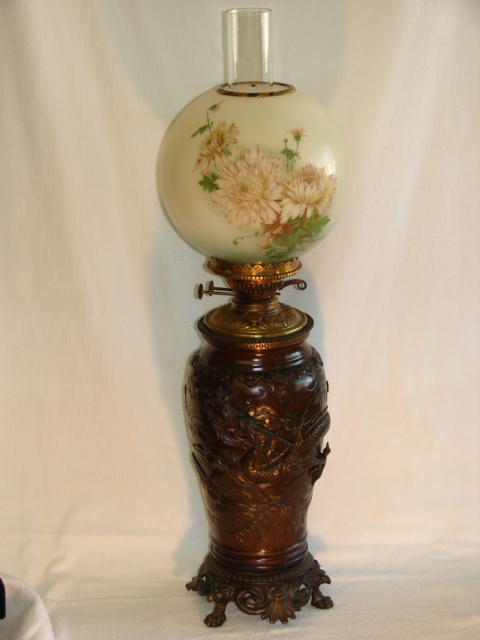
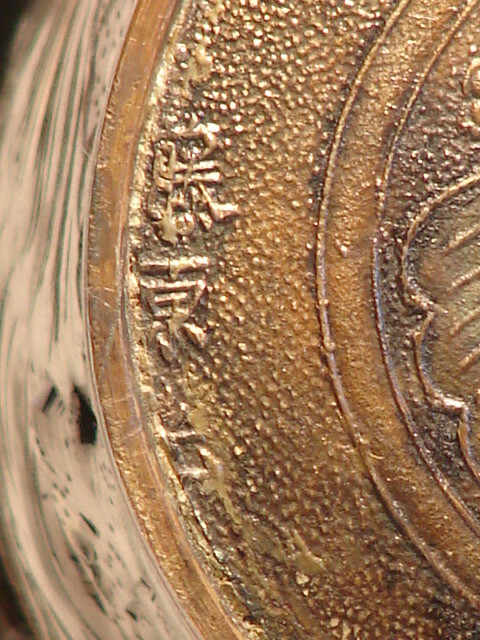
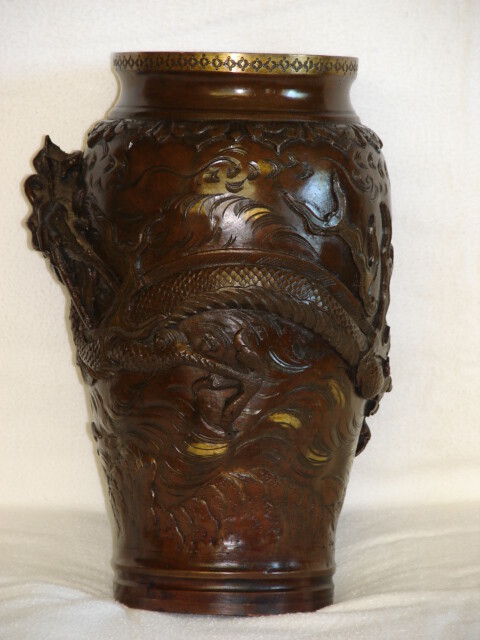
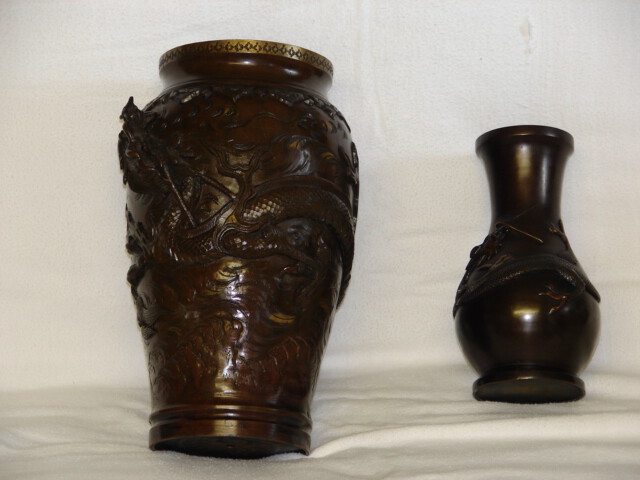
During the period following the Restoration ( post Edo ), ... Japan finally opened her doors to the Western World. All through the period of the 1870's thru the 1880's many trade missions, scientific missions, and diplomatic missions entered Japan. It was a period of learning for both the Japanese and the Europeans. Trade in particular was flourishing with the advent of the industrial revolution in Europe, ( the people had disposable cash for luxuries and the exotic ). The Japanese for there part were anxious to adopt all things European/Western. The Europeans had a penchant for Japanese Lacquer wares, and also fell in love with Japanese metal work. One of the very popular items given as gifts to visiting diplomats, ... but equally popular as an export item were the very beautiful Japanese Vases done in porcelain, but especially those done in bronze. So many vases were imported into Europe, ... that the problem of marketing them became somewhat of a problem for the merchants. Some enterprising individual decided to modify some of the vases into something not only decorative, ... but also useful from a practical point. Thus a cottage industry sprung up in Europe, .... converting many Japanese vases into Oil Lamps. Metal bases were made in brass or bronze to accept the base of the Japanese Vases to give them more stability when converted to Lamps. I have noted where these bases were made with several concentric diameters stacked so to speak on top of one another, ... so that the rings could be cut off until the appropriate diameter was reached to fit any vase. Rings to fit the mouth of the vases were made the same way either to fit a particular lamp, or for the less expensive, stacked rings were cast of varying diameters and the workman simply cut the ring from the stack at the correct circumference. A pot to hold the lamp font ( oil reservoir ) was inserted and fastened to the base of the lamp by a long rod inserted from the base of the lamp. This base rod often had a heavy metal weight to add stability to the finished product. Once the font complete with burner was inserted, ... chimney, and globe added, .... the merchant had a most beautiful AND utilitarian item to offer his customer. In my collection are a couple of these export bronze vases. The one has never been modified for a lamp, while the other has been modified, .... and the modifications are of excellent workmanship, ... and result in a VERY beautiful lamp indeed. The size and massive relief carving on this particular vase/lamp as well as the Pawlonia Crest on the bottom make me wonder if this particular vase was a Japanese Shogunal gift to some visiting diplomatic mission personnel of lower rank. Perhaps one of our members might have a view. There is a signature cast into the base plate, ... but the last kanji is not clear. If someone can read this, ... that too would be most welcome. Anyways here are the particulars and dimensions : Material : Bronze heavily carved in relief and deeply cut as a Dragon. In some areas the carving is deeply engraved rather than relief. Some areas are highlighted in gold. Height : The vase before being modified is 12 inches high Diameter : Not counting the high relief dragon is 6 1/2 inches, ... counting the dragon highest point diameter then is 7 3/4 inches. As a lamp the whole stands : 29 1/2 inches from the base to the chimney top. In closing, .... I would just like to add that this is the type of large lamp that would have been found in the home of some European family of means. This was obviously not the type of lamp to be found in a Middle Class Victorian home of the 1860 - 1880 period. Submitted for the enjoyment and study of the NMB membership. ... Ron Watson

-
Dear Bob, A great deal of metal would have to be removed, ... with a reshaping of the blade to eliminate that deep of a chip. I should think it possible, ... but I don't know if it would be practical. ... Ron Watson
-
This Week's Edo Period Corner
watsonmil replied to Bugyotsuji's topic in General Nihonto Related Discussion
Dear Piers, They look like Chop Stick " rests " to me. ... Ron Watson -
............... NO DOUBT ................ ! ... Ron Watson
-
I agree with Peter, ... just another of daimyo54eb fakes or as I prefer to call him " damnyou54bs ". This guy is one step below a Lawyer in intergrity, .... and just a tiny bit above that of a Politician. He has done the collecting community great dis-service with his an antique here ( usually poor ), ... and fake there ( sometimes pretty good but never-the-less fake ). A pox on his wallies ! ... Ron Watson
-
This Week's Edo Period Corner
watsonmil replied to Bugyotsuji's topic in General Nihonto Related Discussion
Dear Piers, Portugal, ... now that will creat some logistical fun ! Hope all turns out for your troop. No one invites me . Hope the Portugese are footing the bill ! It would be an excellent promotion for the historical interest it will/would kindle. ... Ron Watson -
AN UNUSUAL BALL CARRIER FOR A TANEGASHIMA
watsonmil replied to watsonmil's topic in Tanegashima / Teppo / Hinawajū
Dear Piers, It dispenses the balls only in that they run down to the narrow end .. to then be picked out one at a time. There is no automatic mechanism for dispensing the balls. It all works rather well, ... In the second picture the outside of the lid is showing. Note the wear to the finish from rubbing against the hip of the user. ... Ron Watson -
AN UNUSUAL BALL CARRIER FOR A TANEGASHIMA
watsonmil replied to watsonmil's topic in Tanegashima / Teppo / Hinawajū
Dear Piers, The depth with the lid in place would accomodate 5 monme balls. The balls I have in situ are 2 monme balls, ... which are a little loose, ... but still fit well enough. The inside of the lid and lining of the box is just dark wood with a very old black stain or just dark patina. I would say the box would be fairly weather proof. I doubt it was designed to hold a powder flask, ... as one would have to remove the string to remove the box contents. It really makes more sense to have been for carrying balls, as they are easily dispensed from the narrow end. I regret I do not for now have a photo of the inside showing the mechanism. The mechanism is not complicated, ... but rather simple in its ingenuity and quite effective. ... Ron Watson -
AN UNUSUAL BALL CARRIER FOR A TANEGASHIMA
watsonmil replied to watsonmil's topic in Tanegashima / Teppo / Hinawajū
Dear Piers, Length is 3 3/4 inches, ... Width is 2 1/2 inches, ... Thickness is 1 inch. ... Ron Watson -
AN UNUSUAL BALL CARRIER FOR A TANEGASHIMA
watsonmil posted a topic in Tanegashima / Teppo / Hinawajū
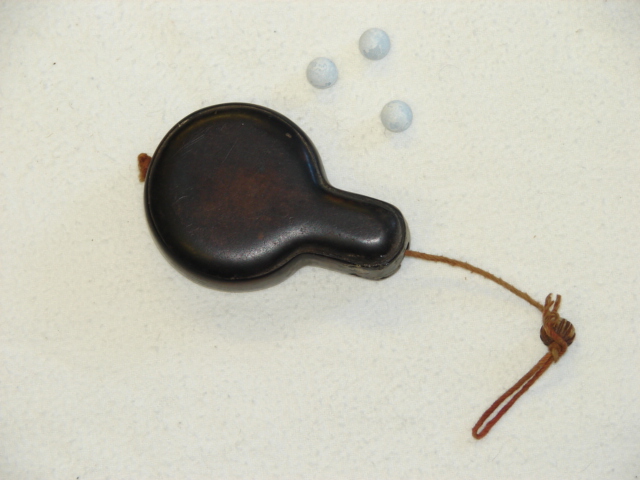
Dear Members, For those interested in the Tanegashima ( Japanese Matchlock ), ... and their accessories, ... I thought I might picture a rather unusual accoutrement. I don't know whether to call it a Doran ( ammunition case ), ... or a Tama-iri ( ball bag ). It is made of wood, and is lacquer covered. The ojime helps keeps the box closed while attached to the obi. The netsuke is missing but was probably quite simple in design as this was certainly a heavily used item. The side ( back side ) has much of the laquer worn away from rubbing on the hip of the gunner. The cord is tied/anchored at a small opening at the back of the main body of the container. The cord then passes thru two U shaped iron staples one at the very back of the lid and one at the narrow front end of the lid, thence through a small opening at the front ( narrow section ) of the main body, ... then through a bead ( ojime ). The weight of the box and contents keep the lid tightly ( closed ) secured to the main body of the box. It took me awhile to figure out what the box was made for, ... until it dawned upon me to put a few musket balls inside. Voila, ... puzzle solved. A most ingenious and handy way of carrying musket balls. It is the only example I have seen, ... Simple but very well made. Sorry I do not have photos of the inside showing how the mechanism works, ... but my explanation should provide a pretty accurate picture. Submitted for the enjoyment and study of the NMB members ... Ron Watson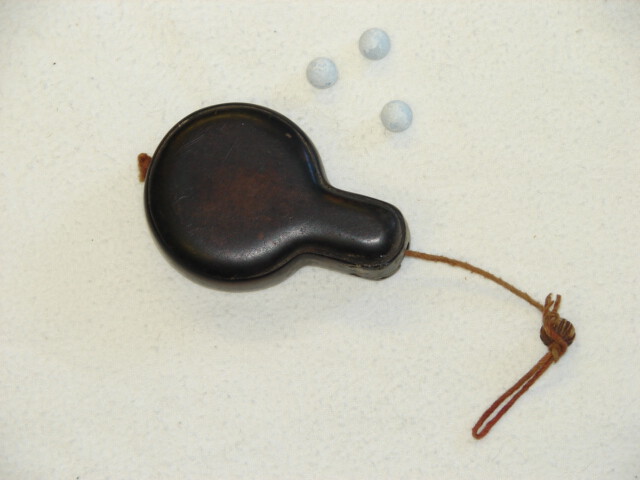

-
This Week's Edo Period Corner
watsonmil replied to Bugyotsuji's topic in General Nihonto Related Discussion
Dear Piers & Others, On July 07, Piers posted a picture of a Buddhist Bowl Bell. I 've been anxiously waiting for my son to come with his camera, ... so that I might add an item to this wonderful thread .. " Edo Corner " .. Many years ago, I was asked to clean up the contents of an old building here in the town where I live. The upstairs floor of the old building had been a meeting room for a turn of the century ... 1880's - early 1900's Secret Society Club. The main floor had been a Drug Store ( Pharmacy ). Being an antique dealer ... I was quite excited, ... and I eagerly got to work collecting up many fine antiques from the cellar ( mostly antique druggist paraphernalia ). The real excitement awaited my wife and I in the upstairs however, ... There was basically an empty room which had been used for storage, ... but also for the early Society meetings. There was one room separate from the main open area, ... and this was padlocked. Having permission to salvage what I wanted, ... I pried off the hasp, and opened the door to what had not been seen for nearly 75 years. Beneath grotesque masks, ... costumes, ... and papers was a black wooden coffin. Thinking this was unusual, ... but no more than the masks and other items, ... sitting on the coffin lid covered in dust was what appeared to be a brass bowl, .... which turned out to be a Japanese bowl bell. We opened the lid. Christ it contained a skeleton ( honest to God a bloody skeleton ) and real. To make a very long story a little shorter, ... after the initial shock, .... I realized this skeleton was part and parcel of the society rituals. I later confirmed this to be true when among the papers was a catalogue dating from the 1890's wherein, ... you could actually order a real human skeleton among other items such as imitation Roman Helmets, Masks, etc. Anyways the coffin and coffin contents were duly reported to the owner of the building. As far as I know the skeleton was donated to a University. The bowl turned out to be one of the most beautiful Antique Japanese Bowl Bells I have ever seen. It had a suspension hole in it, ... and I mounted it as pictured. The bowl is hammer raised ( many hundreds of hammer marks are visible on the inside ). The metal appears to be an alloy of brass or bronze. The dragon is incised either by hand or possibly acid etched. I think it is probably all hand cut rather than done with acid, ... but the detail is so remarkable and extensive and yet it is hard to imagine someone doing thousands of dragon scales by hand ! The bowl ( bell ) is 6 inches in diameter, the height is 2 5/8 inches high. Note the three toed dragon, ... indicating Japanese. When struck with the wooden mallet, ... the ring is very beautiful and loud. The use of the various patinas alone is superb workmanship. All in all it is very fine and worthy I think the most discriminating of tastes. I consider it one of my favorite pieces. I hope you all enjoy it as well. Submitted for the enjoyment of the NMB membership ... Ron Watson

-
Dear Thomas & Brian, I have gone over Thomas's chart, .... and if I may make a single contribution, .... it would be that in the interests of the connoisseurs of the Tanegashima, .... it is somewhat too accurate. As far as classifying calibers as they pertain to the Tanegashima, .... .32 inch thru .39 inch by Tanegashima fanciers would be classed as 1 monme. It would be unheard of to say my gun is 1.21 monme for example. The Japanese with their measurement in monme tend to round off the fractions to the nearest whole number. It is unique in the firearms world for this inaccuracy in calibrating guns, ... but never-the-less since there were NO TRUE caliberation in the manufacturing process, ... the Japanese took certain liberties with their measurements of ball diameter terminolgy. So long as the student of the tanegashima realizes this inaccuracy, ... no harm can be done by the chart. The chart is technically correct, .... but the student must realize and understand the rounding up/down in describing the caliber of any given Japanese matchlock. ... Ron Watson
-
Dear Thomas, You did a nice job in re-creating a ball carrier/dispenser. Are there flea markets, and/or antique shops in Korea where you might obtain items for your firearm collection ? ... Ron Watson
-
This Week's Edo Period Corner
watsonmil replied to Bugyotsuji's topic in General Nihonto Related Discussion
Dear Piers, Just remember : The definition of an expert .... Someone who knows more and more about less and less :D . That my friend should make you feel better. ... Ron Watson -
Dear Pete, Possibly un-noticed by you, .... you have just reaffirmed what I stated a couple of posts back, ... that indeed the subjects were copied by different craftsmen of varying degrees of skill at various times. Hence as I previously stated the proliferation of popular tsuba subjects ( as an example ) virtually identical but for the material and quality. You will note the Fuchi on Yahoo Japan is not even of the same width as Mark's example. The quality of craftsmanship is also terrible as compared to Mark's example which even I can see. . ... Ron Watson
-
Dear Chris, In this case, .... whom but one or possibly two have said that the work is slip shod ( unless this thread has gone off on a tangent I do believe we are discussing a particular set of koshira ). Ford, who is an undisputed artist wrote : " Thirdly, while I would not suggest these are the finest examples of classical Japanese metalwork artistry I don't think it's fair to say they are very poor at all. I think they are fairly reasonable examples of competent craftsmanship. They are not, by any means, art, but they are perfectly honest and well executed pieces of craft." Perhaps they do not meet the highest standard of workmanship, .... but I fail to see where they are slip shod, poorly executed, or somehow belittling the Emperor. I for one like them, Matt likes them, Mark likes them, .... as do many others. Personally I do not like Andy Worhol's work, ... but there are art critics who would dispute my lack of appreciation even though Mr. Warhol as an example painted a bloody soup can as a joke, ... saying the art experts would all rave about his genius. Guess what .... he was right ! I much prefer Mark's masculine Fuchi/Kashira set to some of the gaudy effeminate sets of koshira I see bantered about as fine art by the koshira collecting crowd. ... Ron Watson
-
Dear Matt, I like you believe that the design ( kiku ) that reinhard referred to as a Mon in his argument was exactly as you noted ... the Tehen kanamono of the helmet. I too do not think this is any Mon. Interestingly enough as reinhard points out I always assumed the Kikumon was used with caution, NOTE ( I say used to ) .... but perhaps not as cautiously that ... in a second breath these sword scholars would have us believe that many swords bearing the kikumon and signature of smiths entitled to use the kikumon are many times Gimei. It would seem therefore that the Imperial Chrysanthemum was taken by the Japanese since at least early Edo times with a grain of salt. God, ... how we can argue a point with such weak evidence is beyond me. Little in this field would stand up in a court of law as arguments seem to be based on whatever whim enters the writers mind as they are looking for points to back up their assertations. There may have been a time when the Imperial Mon was respected, .... but it must have been A VERY long time before most of the swords and fittings we see today. ... Ron Watson
-
Dear Franco, You need not have spelt out Kantei, ... I am well aware of what Kantei means and here is EXACTLY what it means: It is without the aid and confirmation of a genuine signature which can be confirmed in comparison to other known signatures an ... " educated GUESS ". I have offered that Matt's set resemble in style and subject matter Myochin ( sans the iron ). I have not yet seen anyone else offer a guess outside of " Showa ". There are no end of fittings which do not meet the exact style , material nor workmanship of a particular school, .... and because they do not, ... are we therefore to accept that since they do not fit the pigeon hole someone has assigned them ( school ), .... they suddendly become less ? If that is the only crieteria that befits what is/is not acceptable in kodogu, .... then I'll eat my hat. I agree working from a set of standards is kind of essential, .... but none save Matt and his friend have FULLY examined the set of fuchi/kashira. If submitted to Shinsa, ... I would bust a gut if the items were papered in " the style of " or conversely in " the school of ". There were I am quite sure kodogu makers who worked independently outside of " schools ", .... and incorporated what they liked from various traditional schools into their work. Just how do you KANTEI these ??? I see this all the time in the field of the Tanegashima. What school does it belong to ??? Half the time although SPECIFIC schools were recognized, ... the particular gun fits no ONE school. Are they all Showa ??? I think not. What I think is that the sword community needs is to loosen up a little and judge items on the basis of what the individual likes, and NOT on what we are told to like by some scholar. ... Ron Watson