Natichu
-
Posts
183 -
Joined
-
Last visited
Content Type
Profiles
Forums
Events
Store
Downloads
Gallery
Everything posted by Natichu
-
Certainly, but in any pursuit there's something to be said for not letting the perfect be the enemy of the good. While there is no replacement for getting to have the item in hand and spend hours studying it with a proper instructor, our knowledge and enjoyment can be improved with the many informational aids available to us. Written setsumei, oshigata, photos, videos like this one. None are a replacement (and I think it's a straw man argument to suggest anyone is saying they are) but all serve to help us, at the very least, enjoy these swords that much more and likely learn more than we did before we saw them.
-
I know Raymond Yan had a folding one for sale recently. Might be worth shooting him a message to see if he has a line on any.
-
My understanding was that shinae and shinae-ware run perpendicular to the blade, whereas the kitae-ware one sees in Hosho run with the masame (as openings in the grain), so parallel to the blade. Markus Sesko defines as follows: "shinae (しなえ) – Cracks or wrinkles running crosswise through the ji. Can be caused by poor steel including much of slag or a rough forging. See also mukade-shinae (百足しなえ)."
-
Many thanks David, seems like that might certainly be the easiest way to proceed.
-
Well that may well make things much easier! Thank you Thomas.
-
I tried emailing in late November, January, and last week. Will switch up the address and see if that helps! Many thanks Lewis.
-
While not related to the kinzogan itself (though to my eye it appears done by the same person), does the sayagaki look off to anyone else?
-
Hi all, I'm looking to sign up for an overseas membership with the NBTHK (honbu), and the information on the website seems to indicate to email them at nbthk.member@touken.or.jp I've sent a few emails (in a mix of English and Japanese) but received no response. I don't see any other form or link to register online. Am I missing something here? Any pointers or recommendations would be much appreciated!
-
While I (unsurprisingly) have no insights to share, I for one would love to see more pictures of the rest of the sword if you're willing to share!
-
While I haven't seen this "study" you're referencing, I'm not sure your conclusions follow or derision makes any sense, at least from your description of it. Do you have a link or source setting out the methodology? More generally, any list of top wines is one person or panel's subjective opinions, and one wouldn't expect a different person or panel to reproduce it. It's not some list with objectively gradiating features that distinguish one from the other in terms of "quality" when clearly they are all good wines. This is why people into wine read reviews and rankings lists written by multiple people and learn to understand the tastes and preferences of the reviewers and how they match up with their own. The question I would have thought more pertinent would be whether the experts (who I'll assume were sommeliers, not just connoisseurs) could identify the wines, not order them based on the results of someone else's rankings. This isn't to say there isn't plenty of bunk in the wine world, but I'm not sure whatever it is you've identified here counts for much. Regardless, back to swords, and while I certainly can't speak to any requirements of assessors, nyusatsu kantei is very much a thing and one would imagine something they participate in regularly. It might be worth your checking out the regular kantei problems posted by the NBTHK (latest here: https://www.touken.or.jp/english/nbthk/swordjournal_December.html) and referencing some of the usual books on the process.
-
Useful article here from Markus Sesko on Tensho vs Keicho suriage: https://markussesko.com/2018/04/25/tensho-suriage-and-keicho-suriage/
-
Very interesting, first as I've been pining after a Nobutaka wakizashi in Eirakudo (https://eirakudo.shop/601981), but also as it reminds me of one of the recent NBTHK kantei problems available on their website. I again thought Nanbokucho Mino and in my head guessed Naoe, whereas the correct answer was Horikawa Kunihiro. While I don't know that I can do a translation any justice, the initial discussion on the sugata points to viable options as Nanbokucho, Keicho Shinto (and very late Muromachi), and Shinshinto. It then goes on to discuss why the first and last options didn't fit the bill. Problem and solution images below:
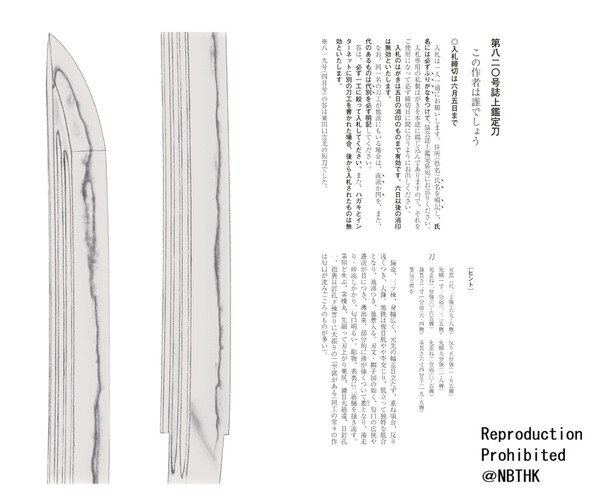

-
Just for example on that point, you have this on Touken Komachi as well (quite a nice sword to my eye, but with a few knocks against being likely shinshinto suriage and mumei): https://www.toukenkomachi.com/index_ja_tachi&katanaA021125.html Kurashiki papers to a jojo-saku ranked smith, and then four months later NBTHK papers Hozon to...Takada. Not to knock Takada (I have a lot of interest in the school) but that seems like a pretty significant downgrade.
-
Thanks for this Jussi. Just in terms of showing my thought process (primarily so that my beginner mistakes can be highlighted for me) to my eye Nanbokucho sugata, with the size and o-suriage pointing to that period rather than a retro throwback from a later period. Masame/nagare in the shinogi-ji pointing to Mino-den, and togari elements in the hamon agreeing with that. Guess is Naoe Shizu (maybe Kanetomo or Kanenobu?).
-
Family Heirloom Koto Blade WW2 Naval Wakizashi
Natichu replied to Rhizosphere's topic in General Nihonto Related Discussion
I may have something that fits the bill that I'm debating parting with. Am tied up for the next few days but want to shoot me a PM? Hozon, late Muromachi, shobu zukuri. Otherwise there are a few good options (at least to my beginner mind) in the for sale section here on NMB. Would also recommend checking out Touken Komachi as Tsukada-san is great to work with and she has quite a few reasonably priced offerings: https://www.toukenkomachi.com/index_en_tachi&katana.html -
Is the mei signed over top of the patina/corrosion on the nakago?
-
NBTHK document genuine or forged?
Natichu replied to noel_azzopardi's topic in General Nihonto Related Discussion
For reference, some of the security features of the Hozon and Tokubetsu Hozon papers are discussed here: https://www.nihontocraft.com/japanese_sword_papers.html -
My apologies for the quote Rohan, but I can't get the spoiler box to work on my phone. Have edited the contents of the spoiler box (so its content is mine, not Rohan's), though conveniently I agree with Rohan's order.
-
My understanding was that the NBTHK only specifies generations in rather rare cases (or I suppose better put, typically does not specify generation). Am I incorrect in this, or is there a peculiar exception for this school?
-
Now that is quite the stunning piece. Not to sidetrack from the original topic too much, but would you mind posting the measurements of the Sukesada?
-
Very interested to see what the more experienced members think, but just on their face they seem quite different pieces, while both gorgeous. A large and wide Enbun-Joji sugata Yamato style katana vs a rather elegant katateuchi-seeming Bizen blade (at least to my beginner eye, given its short length, narrow width, and shorter nakago). I like them both, but would enjoy hearing what draws you to each of them.
-
Phenomenal, thank you very much! That is extremely helpful and greatly appreciated.
-
Hi Michael, Yes, it should be Hoki Province with work in the Shinshinto period (Ansei era ish), and one of the smith's names was indeed Shimizu Yoshiyuki (apparently after being adopted by another swordsmith it seems). I think you have found him there.
-
Swords of the 47 Ronin
Natichu replied to Utopianarian's topic in General Nihonto Related Discussion
Just to close this particular loop, on pages 154-56 of Paul Martin's Japanese Swords and Armor, the author has included photos of several pieces of tosogu attributed to Miyamoto Musashi, as well as a bokuto attributed to him. With respect to the bokuto, Mr. Martin states the bokuto "was made by Miyamoto Musashi at the request of the lord of Matsui Castle, Matsui Yoriyuki. He asked Musashi to make a bokutō...to the same dimensions as he had used in his last duel on Ganryujima. The bokutō is of faulty standard dimensions ensuring its ease of use, just in an extended length ." (italics omitted) -
Swords of the 47 Ronin
Natichu replied to Utopianarian's topic in General Nihonto Related Discussion
Thanks so much for the photos. I can't quite tell from the photo, but was the boshi on the Kiyomitsu ichimai? Looks like it flares out at the yokote, but I can't quite tell if I see a maru and kaeri or if it's just all hardened.