Robert S
-
Posts
500 -
Joined
-
Last visited
-
Days Won
1
Content Type
Profiles
Forums
Events
Store
Downloads
Gallery
Everything posted by Robert S
-
Just to clear up a misunderstanding - that is an original - an original woodblock print. It's not a copy of any other piece of art. A bunch of people who I won't characterize because the language would be seriously foul have confused the whole market by claiming that things like giclee reproductions are "original prints", which they aren't. As a once-upon-a-time full time printmaker, I'll stop there, because otherwise this will turn into a novel length rant :-)
-
I agree that currently AI can be useful, because currently AI are trained on and referencing almost entirely human generated information. But this begins to change as you get an acceleration of AIs learning from AI generated information, including hallucinations. Without safeguards this has the potential to create an exponential propagation of unreliable information, to the point where it becomes unknowable whether or not a specific piece of digital information is reliable. Then new systems of truthing become important - either that the information can be traced back to a pre infocalypse source, or that there is a highly developed reputation checking element attached to every piece of information.
-
It's actually a really interesting point that the only reliable sources may soon be hard copy books published before the advent of AI. I don't remember the title of the book, but there was a science fiction book which considered this possibility - it was called the infocalypse. Here we are living it!
-
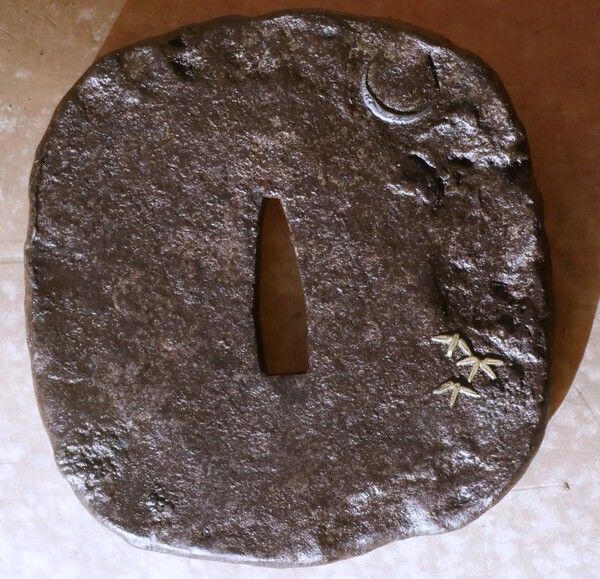
Since I got this tsuba I've worked to stabilize the rust. The rust was purely superficial - I'm pretty certain no substantial metal was lost. In hand it's a chunky piece, and the metal surface is certainly interesting. I'm curious how they achieved it. I've done enough metal working to know that achieving this surface is harder than it looks. Easier to achieve a hammer or file texture. These days I'd take the oxy-acetylene to it... but I doubt they had access :-). Thematically, my best guess is that it's reference to the Tale of the Bamboo Cutter (Taketori Monogatari) - moonlight on bamboo leaves. It's definitely my aesthetic!

-
Slightly Cursed Kanemitsu
Robert S replied to Francis Wick's topic in General Nihonto Related Discussion
Haven't run into that wrinkle yet! I'd love to know what Act and Regs cover that requirement! I'll have to do some digging. -
Slightly Cursed Kanemitsu
Robert S replied to Francis Wick's topic in General Nihonto Related Discussion
Wow, what an epic! As a fellow Canadian, I take this as a major cautionary tale. When you have to involve lawyers, things have gotten out of control! So far I've been lucky bringing nihonto in from Japan and the USA, but fingers crossed. I always ensure that the seller lists the full sales price on the paperwork, to ensure that no confusion occurs. I'd sooner pay the tax than hire a lawyer! Hoshi has far far more expertise than I. I do, however, ahem, have some experience with acid etched hamon . Hoshi may well be right about this, but it a completely different effect than the acid etch on the sword that I have - with mine the edge of the etched area is extremely sharp, too sharp, actually, where-as with this one the edge of the hamon is distinctly blurry. It could be that it was an acid etch on a dampened sword, but it almost makes me wonder if the hamon was done in the traditional way, but by someone with little experience and in a hurry, such that they didn't carefully define the edge. The almost harsh reveal of the jihada also suggests possible poor quality polishing - the jihada should be visible, but this is a bit extreme. If it is Shinshinto, this degree of harshness in the jihada is not a great sign. -
It looks like someone took sandpaper to it in an effort to eliminate rust. Doesn't look to have caused too much damage, but it's unfortunate, as it will mean a future togishi will have more work to do.
-
That mokume!
-
If the casting process is recent, it is possible to achieve very fine lines, etc.... so there is a possibility of Chinese manufacture - the fact that there was almost immediately another similar one for sale is a bit worrying. If on the other hand it is an older casting a good bit of work has been done on it to clean it up. As the similar examples found are not exactly the same, just quite similar, so far it looks more likely that it was cast, and then customized. What I'm noticing is that key figures look identical, buy details such as waves and textures are not. However, it certainly does look like export/tourist grade. The clue I see on that is that it's what I would call "gaudy", yet the quality is not great. Traditional tsuba are rarely gaudy, but if they are the level of craftsmanship is likely to be very high - masterpieces of inlay, gilding and metalwork Gaudiness was mostly (but not entirely) aimed at western tastes
-
Given how precisely all of those fuchi match in size and shape, I rather wonder if they weren't all made as a set, for this very purpose. Totally gorgeous object!
-
It's really an aesthetic decision, but my sense always is that if it has a tsuba, it's more intended to be taken as a ko-wakizashi, and if it doesn't it's more intended to be taken as a sun-nobi tanto. Given the period I'd lean toward the latter. The set of uses of a wakizashi is typically different than those of a tanto, with the wakizashi nominally serving as a "second sword", while the tanto is more a utility knife/last option defensive weapon. I have a sun-nobi tanto in koshirae with no tsuba but which includes a kogatana and split kogai which doubles as chopsticks. The whole thing really is a Japanese swiss army knife!
-
I believe that the first photo is of the old koshirae and blade pre polish. It looks like the major change to the koshirae was to make the saya and tsuka narrower and more elegant.
-
Sword Prices during the Edo period
Robert S replied to Robert S's topic in General Nihonto Related Discussion
I was going to include the 1673 stats, but they look like there may be some issue with completeness at the lower income levels there. While there was a trend of increasing the overall number of retainers over time, the number of retainers under 200 koku is 212 in the 1673 data, and 2288 in the 1700 data. I suspect that retainers of retainers may not be included. It thus didn't look as useful in understanding the total income spread. The book indicates that for Okoyama han, the records available are largely annual for the last +/- 200 years of the Tokugawa period. I suspect that the 1673 records are therefore at the early end, and 1600 - 1660 may not be available from that source. The book does include lots of detail on the finances of bannermen in direct service of the Tokugawa, including wage rates of particular positions, and the number of retainers they were expected to maintain, by class. Most of this data is from the 18th century, though. -
Sword Prices during the Edo period
Robert S replied to Robert S's topic in General Nihonto Related Discussion
Because I'm researching these issues, I got a copy of a book that Markus Sesko mentioned "A Study of Samurai Income and Entrepeneurship" by Kozo Yamamura. (As an aside, a copy of the book popped up in small town bookstore in British Columbia! I'd love to know why :-) ) A good example of the data in the book is a table on the distribution of incomes in Okayama han in 1673, 1700, and 1840 to 44. For 1700: In the year 1700 stipend in koku Number of retainers Total cost 10000+ 6 60,000 5-10,000 3 22,500 1 - 5,000 25 75,000 500 - 1,000 36 27,000 400 - 500 22 9,900 300 - 400 81 28,350 200 - 300 159 39,750 150 - 200 101 17,675 100 - 150 54 6,750 50 - 100 217 16,275 30 - 50 427 17,080 20 - 30 1126 28,150 10 - 20 270 4,050 < 10 93 837 Total 2620 353,317 Median income, koku 20 - 30 Mean income 135 This table includes both retainers paid in koku, and in hyo. The book gives some context about this data: Many of the lower level retainers were in fact paid by higher level retainers, not the han. Thus this han (with a value of 350,000 koku) was not spending its entire nominal income on wages, as it would appear. Many of the retainers at the bottom of the income scale may have been "part time samurai"- foot soldiers who farmed as well. Their stipend thus did not include their income from farming. This table is before any obligatory "loans" back to the han, so actual available income will have been less. At the end of the day, most samurai remained eternally broke. -
Sword Prices during the Edo period
Robert S replied to Robert S's topic in General Nihonto Related Discussion
Hoshi: I totally agree that this wasn't a "Daimyo level" sword that he was talking about. I'm guessing it was more like what today would be a TH level blade, or maybe low Juyo. The top of the top end has always been astronomical, and even high end swordsmiths then had prices which were much higher - Marcus indicates that one smith quoted 100 kan for a new blade, so something like 22 ryo, way above the 5 - 7 ryo quoted by others. The swords that Mori Masana was buying seem clearly to have been "used" swords... could even have been koto. So not (originally) necessarily "off the peg", but also not "name" swords, and in the early 19th century, clearly available from "everyday" sword dealers for lower prices. Robert -
Markus Sesko wrote an excellent summary of samurai incomes and sword prices (https://nihonto.com/samurai-income/), which identified how high sword prices from known swordsmiths were, relative to samurai real incomes ( net of enforced borrowing by Daimyos, retainer costs, etc.). He quotes prices of 5 - 7 ryo and up for new swords, which could, depending on the income level of the samurai, be multiple years of potentially available income. And that is only "potentially" available income, because many samurai, even those with incomes above the lowest level, were chronically going into debt. I have recently been doing a lot of research into samurai economics and culture during the Edo period, and came across another reference to prices of used swords in "Tour of Duty", a fascinating book by Constantine Nomikos Vaporis on the impact of the alternate attendance system. He provides actual ledgers from various samurai of both their regular expenses, as well as of purchases during their period in Edo. A samurai named Mori Masana, who clearly had more money than most, although the source of his money is unclear, bought three swords during his Edo tour in 1828-29 (as well as something like 20 tsuba!). In his ledger he noted priced for two of the swords: 1 ryo 2 shu, and 1 ryo 1 bu. Of the latter sword he notes that it is "a fine sword that I can wear with pride", which given that he was clearly higher up in the ranks of samurai, certainly means that it wasn't a used low level "off the peg" sword, although unfortunately he doesn't give any further details. While this is a very limited sample, it does indicate that even pretty decent used swords were available for a price much lower than a new sword - in a sense, (and obviously with the exception of masterpieces) it sounds like they depreciated with age - probably because they were somewhat "out of style", or didn't provide the boasting power of "look at the sword I had made"! Robert S
-
IA help to study Nihonto (fun)
Robert S replied to Pierre F's topic in General Nihonto Related Discussion
A whole new area of study - the little known Japanese steel boomerang. -
Yup. I do a lot of silk dyeing with natural dyes, many sourced from the woods around me, and all of those guidelines are indeed useful to preserve color. Even so, some colors just fade. I'm sure the Japanese Dyers back in the day were fully aware of all these issues.
-
Wow! I suppose at some level they are real (possibly in the form of real modern fakes), but on my personal aesthetic scale they all rank between hideous and scary bad
-
It's well recognized, including by the NBTHK, that there was a period when "market forces"... possibly including organized crime... let us say "influenced" the award of their papers - the infamous NBTHK green papers. In order to attack this problem whey re-organized their whole system. Does this mean there is no possibility of such influence today? Probably not, but so far the system appears to be producing results which, while not unquestionable, are at least honest.
-
That's what it showed when the auction closed. It's entirely possible that the sale fell through, so it ended up being unsold. Looks like who-ever backed out at $36K was probably wise!
-
But none of the well known smiths using these characters for Nagayoshi seem to have used a niji-mei (two character signature) except perhaps one back in the Heian period, which I think can be ruled out. So it would seem to be either gimei or an undocumented smith.
-
I wonder if the sword you have is in this photo. I believe these are the Japanese officers surrendering at Tientsin. General Worton had a rather interesting meeting with Chou En Lai during this period.
-
Super curious to see the sword itself! That's a really interesting piece of history and provenance!
-
Understanding Samurai Disloyalty
Robert S replied to John C's topic in General Nihonto Related Discussion
Heike monagatori certainly tries to reinforce notions of loyalty - retainers repeatedly saying "we owe everything to you, we will never abandon you"... but it is also completely full of betrayals, clans switching sides, retainers abandoning their lords... It also contains examples of the betrayals of the other side of the deal - lords betraying and eve hunting down those who have served them loyally. Lots of Heike would make Machiavelli proud!