John C
-
Posts
2,706 -
Joined
-
Last visited
-
Days Won
18
Content Type
Profiles
Forums
Events
Store
Downloads
Gallery
Everything posted by John C
-
Ah. Forgot that the tai kanji has more than one meaning. John C.
-
Steve: It looks like the middle row is the date 1944. The kanji on the top left is Tai for "big" or "large" so maybe a size??? I am also interested in what the translators come up with. Trying to learn myself. John C.
-
Now you tell me! John C.
-
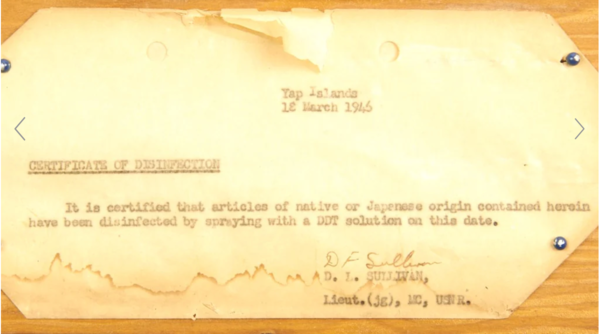
Sure. Here it is with the same date; also listing the contents as two swords. But my intent of the post was about the use of DDT. John C.

-
I tend to agree that a weapon needs to be functional; even if there is some additional symbolic reason to carry it. My purpose in throwing this stuff out there is just to present an alternative. Chinese fake; late war; maybe there is another reason. To prove a theory we have to control for other variables and reject the null hypothesis. I'm just chucking in the control variables so they can be at least considered...then eliminated! John C.
-
No worries. I knew I was opening myself up. I too believe in Occam's Razor, however. That's why "symbol of authority" rather than "functional weapon." Japanese version of the swagger stick. John C.
-
Thank you. This is why I ask here instead of relying on google translate. Google had the first version as Mamoru Hitachi and this version as Mamoru Mutsu. The problem with the translation apps is that they don't understand context. John C.
-
We know Mr. Yao was the manager of the Tenshozan Works in Kamakura, which made the blades. So I suppose the swords could be made there as well. I am not sure, however, the Japan Sword Company has anything to do with the PX sales. Other than the article that talks about servicemen getting USMC swords and swagger sticks made there, I can't find anything that says they supplied the PX with any swords. I probably missed something, however, so maybe someone else can chime in. John C.
-
I am sure the criticism will follow...but what if some of these types of swords were not meant to be truly functional weapons? A corporal gets a field promotion to NCO and just needs a symbol of authority to lead his men? Though I suppose he could pick up a sword off of the battlefield, maybe instead he buys the cheapest thing he can find. John C.
-
I assume so. I was researching souvenir swords (see the bottom sword) when I came across this pic. John C.
-
Thank you both. I could come up with kore but that was about it. Now that I see it printed, I will give the rest a shot. John C.
-
Great! Thank you. John C.
-
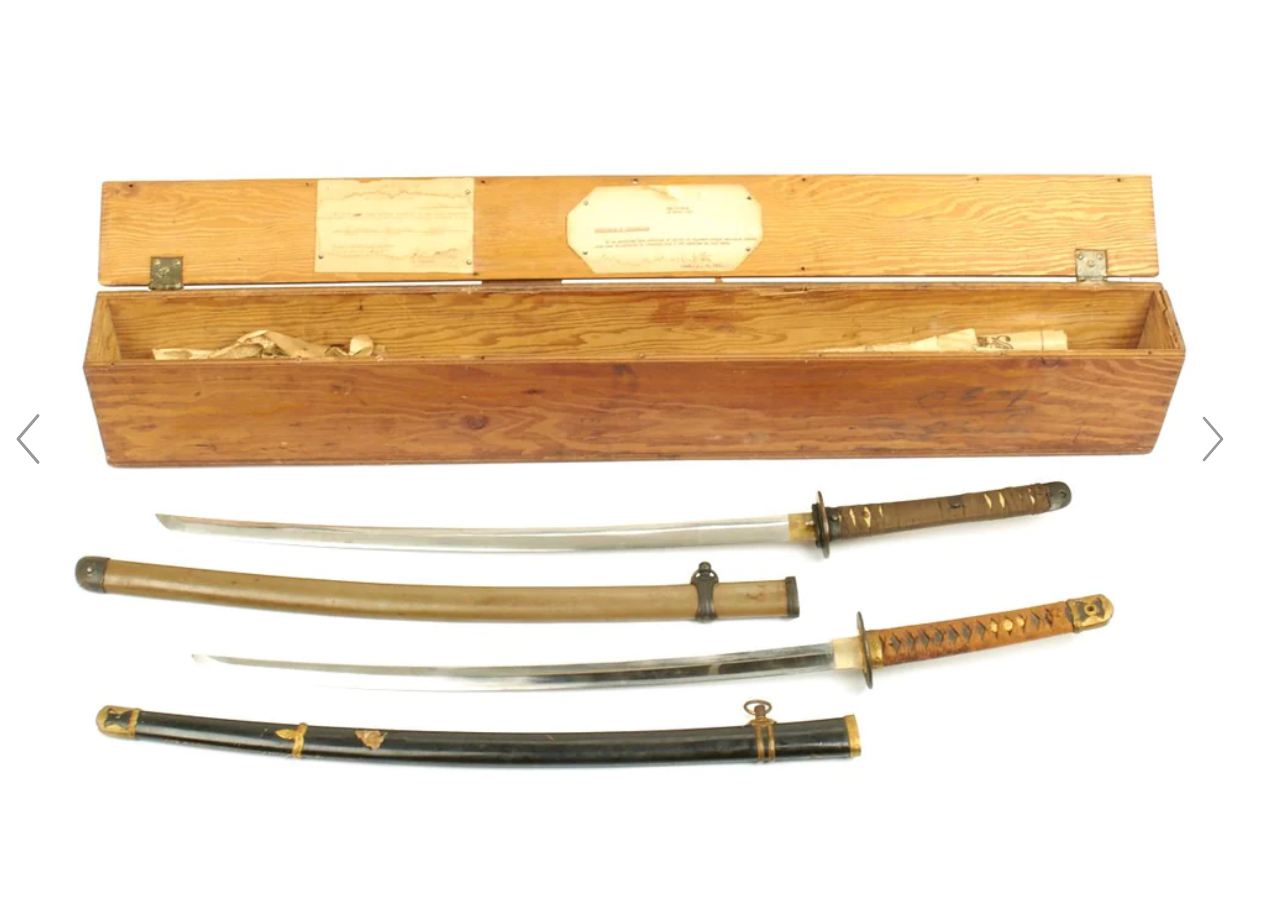
Folks: This label was inside a serviceman's bring-back box with two swords. John C.

-
That's why I am hoping to pull the original document. It may have other useful information about the souvenir swords (e.g. hopefully a description). John C.
-
@Bruce Pennington do you know how to navigate the National Diet library referenced by @Ian B3HR2UH so we can pull the original document re: Capt. Wall mentioned above? John C.
-
Hello: I recently purchased Nippon-to by Hakusui Inami. Inside, there was a drawing of a tsuba with kanji as well as some writing on the inside cover (the darker picture). I made a feeble attempt to look up the kanji, but to no avail. To be honest, even after buying dictionaries, Japanese language workbooks, and downloading signatures, I still suck at it. And this is handwriting! I would really appreciate any assistance you could give. John C. p.s. my genealogist wife found that the previous owner of the book was married to Ayako Ichikawa (born Tokyo 1928), but I don't think I see the kanji for that name anywhere.


-
I suppose it's possible. But I think it would have been odd to mix army and navy parts. Plus the snipped nakago on most of the blades (though not all) leads me to believe these were purpose built. That said, there are blades with normal nakago jiri and signed that I suspect were surplus and used first. Indeed, we are working with the preponderance of the evidence. What we need is a smoking gun! John C.
-
This is only a guess, however I suspect the Japanese Naval Sword company refers to Tenshozan. This Capt. Wall who made the initial statement probably did not know or had forgotten the name Tenshozan. We would need the original document to confirm. John C.
-
Douglas: That's interesting. That is only the second one I have seen with Navy kabutogane and menuki. @Bruce Pennington FYI. John C.
-
I agree. The supplier probably had boxes of these laying around at the end of the war. The souvenir swords were not ordered until 3 months after the end of the war, so they just used existing parts (e.g. the lacquered saya, the Tenshozan blade, the cheap furniture, etc.). John C.
-
Did type 95s ever come with an iron tsuba? John C.
-
To me, this makes sense. If the souvenir sword were modeled after an existing sword, a civilian (?) model would be readily available. John C.
-
JC: Sorry for any confusion. I was trying to follow-up with Bruce's postulate. As far as the existence of a souvenir sword, there is no doubt. The documentation speaks for itself. As to whether or not one could have been carried into battle... I guess nothing is impossible. I can think of one scenario where a soldier might buy a souvenir sword at a PX in 1950 then get sent straight to Korea. Or be in Korea in 1950, go on leave to Tokyo and buy a sword then. I suppose he could then carry the souvenir sword into battle. But that is a lot of "ifs" and frankly not very likely. John C.
-
I might be misunderstanding this, however I am not sure we can tell anything by the textured kabutogane. I did some quick research and found a few (4 or 5) that were stamped and had textured kabutogane (including mine). I did notice, however, that none of the kabutogane of the 11 I found had sakura leaves. Then again, I only found ones that were stamped. FYI: I had searched for "Toyokawa stamp" and just "kai gunto" and looked at every sword that was a souvenir. Found 10 of them; all being marketed as ww2 navy kai gunto. On a separate though related issue, I think a lot of the confusion over these is perpetuated by what Fuller and Gregory had written (see pic). Would it be possible to contact them (or the publisher) about a book revision? John C.

-
Thoughts on this possibly Type 95 NCO Sword -Spurious characters
John C replied to Eds's topic in Translation Assistance
Ed: I think this post may need to go into the Fake Type 95 NCO thread in the Military Swords forum. Not sure if these pics are already over there. John C.