

Bugyotsuji
-
Posts
14,640 -
Joined
-
Last visited
-
Days Won
294
Content Type
Profiles
Forums
Events
Store
Downloads
Gallery
Everything posted by Bugyotsuji
-
Four birds? I like the design a lot.
-
This Week's Edo Period Corner
Bugyotsuji replied to Bugyotsuji's topic in General Nihonto Related Discussion
Enamiya were a famous line of gunsmiths in Sakai. (They may have moved there from Negoro-Ji in Wakayama after Hideyoshi's famous attack on the temple complex, but I'd need to recheck my sources before being certain of my facts...) PS The Mekugi pins will become easier with practise as you discover their movements. -
This Week's Edo Period Corner
Bugyotsuji replied to Bugyotsuji's topic in General Nihonto Related Discussion
Congratulations on the birth of your new baby! -
This Week's Edo Period Corner
Bugyotsuji replied to Bugyotsuji's topic in General Nihonto Related Discussion
You are a brave man, Milt! Looking forward to seeing the signature! -
This Week's Edo Period Corner
Bugyotsuji replied to Bugyotsuji's topic in General Nihonto Related Discussion
Oops, Milt, don't touch any of the pins aft of the wide brass band. Yes, they are for the firing mechanism and are another quite different world. Your picture shows only two horizontal Mekugi pins in the woodwork below the barrel, where you would put your left hand when firing the gun. Those two are the only ones to remove. I need to post this and then go back and look at your gun again to make sure... hold on a sec. Number One, between the foresight and the Fuji sight. Number Two, between the Fuji sight and the firing mechanism. Only those two. It may be that someone has lost the pins for the holes there, so you should make some later... -
This Week's Edo Period Corner
Bugyotsuji replied to Bugyotsuji's topic in General Nihonto Related Discussion
Milt, your gun is covered in decorative brasswork as you say, and this is an immediate indication of Osaka, where flashy merchants wanted to show off their guns. The multi-metalled wheel decorations remind one of a Kabuto Hachiman-za. The brass do-ban band behind the breech is very wide, another indication of Settsu, or Sakai. The moto-meate, or near sight is in the shape of Mt Fuji, another characteristic. Kunitomo guns are often similar to Sakai, it is true, being in direct competition for the lion's share of the market, but they tend to be a little more restrained, or understated. If you open her up, there is a good chance you will find an Osaka smith's Mei there. As to Brian's Republican comment, he lost me too! :lol: On third thoughts, he must mean that you surely do not support the NRA and the gun lobby, Milt? A true Democrat like you would surely want Brian to have your gun... -
Opening a Tanegashima
Bugyotsuji replied to Bugyotsuji's topic in General Nihonto Related Discussion
LOL at Carlo. Wishing you luck in finding a nice one. Brian, you have triggered some thoughts here with your comment on patina. Nihonto can easily change their Koshirae, so any judgement has to fall onto the metal itself, and how it has aged and what any engravings may tell us. With Nihonto, therefore, removal of the patina is an absolute no-no. A Japanese matchlock, however, will almost never change the original fittings, so these can tell us more about the gun and its history than sword fittings would. Guns were not opened and cleaned so much, and in many cases they have rusted more easily, not being in sealed shirasaya. To some extent, therefore, removal of rust, and certainly red rust, is necessary in order to read and stabilize the Mei and the metal surface of the barrel. If you are exposing bare metal, however, you naturally need to ease off... As to hammering it with a hefty hammer, you are quite right. I didn't want to encourage anyone to be too OTT in their efforts to open a Bisen. By the same token, I know someone who is able to open them, and I am sure that besides the gentler methods I outlined above, he slams them hard with a giant hammer, in between heating them to red-hot. He knows what he is doing, though, so I cannot comment. I have seen one Bisen that he snapped in half, (on my previous tan-zutsu; he created a new one) and I have seen the weals he leaves on stubborn Bisen screw heads and the marks of the vise/vice on the barrel, and it hurts my heart. -
Were any Samurai also famous swordsmiths?
Bugyotsuji replied to nihonto1001's topic in General Nihonto Related Discussion
Jon, Miyamoto Musashi made tsuba, I believe, at least. Did you read this related thread? Not exactly Samurai per se, but Daimyo and swordsmithing... viewtopic.php?f=1&t=2524&hilit=Daimyo+Munetada+Uwajima -
Visiting Tanegashima the other day, Ian, we popped into the local museum in Nishi-No-Omote Town, the centre of island life. They have a selection of the earliest known guns in there, including a three-barrelled gun like the ones illustrated earlier in this thread. Interestingly, the descriptions in English and Japanese differed on one vital point. The English card simply said 'Korean'. The Japanese card alongside said, 'Introduced into Japan, through Korea, but originally Chinese'. Just goes to show we should stay on our toes!
-
Opening a Tanegashima
Bugyotsuji replied to Bugyotsuji's topic in General Nihonto Related Discussion
PART TWO .......... REPLACING 1. Having cleaned the inside of the barrel and having lightly oiled everything, replace the Bisen. Note: Close too tightly, and a square-headed one may not fit into the receiving square cave hole in the mechanism area of the stock. Make sure the serpentine is cocked open. Line the screw head with the stock hole, even if you have to back off 1/8 of a turn. Holding the gun upright as before, lower the breech end of the barrel into place and swing the barrel shut. At this point, as with a Nihonto, a light tap will help it fall into the exact place. You may want to drop the whole gun an inch butt-first onto the slipper, but be very careful not to damage the end of the butt. A carpeted floor will be better than stone, for example. Note: You may find a few squeezes will help the barrel sit down deeply and firmly into the whole length of the stock. 2. The Mekugi pins should fit back into their respective holes. Remember, replacing, so start Right, through to Left. They should be fairly tight as they lock down through the loops on the underside of the barrel. Tap them home and see if they feel comfortable on both sides when you hold and aim the gun. Note: The pins may vary in size, depending on their position and the relative thickness of the stock. Don't mix them up! 3. Lower the serpentine gently, as always. Never allow the serpentine to fall directly onto the pan lid without a matchcord. Bad for both the lid and the serpentine. Insert a finger to catch and cushion it if you don't have a length of cord handy. 4. Replace the Karuka, (narrow end first), twist to find the tight spot, and Brian's your uncle. For reference, here at the top of the linked page is an example of a Mei running along the underside of the barrel of Justin's very fine Kunitomo long gun: viewtopic.php?f=9&t=2414&st=0&sk=t&sd=a&start=15 -
The following steps will make life easier for anyone contemplating separating the barrel and stock of their Tanegashima matchlock, in order to read the Mei. Illustrations below, Pics 1~5. PART ONE...... OPENING 1. Remove the Karuka (ramrod). This allows the stock to relax its grip on the barrel. 2. Don't touch any pins connected with the mechanism, the pan lid or any to the rear of the mechanism. Remove the two (sometimes one, or three or four) horizontal Mekugi pins from the Mekugi-ana in the wooden stock, forward of the mechanism, pushing from left to right with the gun muzzle pointing away from you. (Pic 1) You can use your Nihonto Mekugi-nuki pointer to get them started from the left side. They should be made of bamboo, (preferably smoked) but some Mekugi pins may be brass. You may encounter difficulty if the pins have been inserted incorrectly after their arrival in the West. Adjust accordingly. Note 1: Note they will be of slightly differing sizes. Lay them out in order to help you remember correct replacement. Note 2: When replacing you will know the barrel is sitting in the correct position if the pins slip back miraculously into their original positions. Note 3: Some guns have an extra brass band holding the stock and barrel muzzle together. Slip this off, noting whether it has an inherent 'correct' direction to it. 3. You are now nearly ready to separate the barrel from the stock. WAIT. Place the butt of the gun onto a soft object like a slipper and hold the gun upright. 4. Pull back the serpentine into locked open position. It's delicate, and may fall, but be patient and try again. 5. Hold the gun stock near the muzzle, between the straightened fingers and thumb of your left hand, barrel towards your left palm, (Pics 2 & 3) and push the top of the barrel out with the heel of your right hand against the muzzle itself, until the barrel releases from where it is normally seated, with increasing strength if necessary. Some stocks have shrunk over the years, so you may need to bang the barrel out with hits from the palm/heel of your hand. Note: A rubber mallet may be necessary, but in that case you may want to save yourself trouble next time by candle-waxing the inside of the stock to decrease stickiness. (Or whatever your preferred method of gentle lubrication might be.) 6. The barrel should still be seated at the breech end, split out at an angle of about 10~20 degrees? Lift the whole barrel out gently so as not to damage the lock or stock sides. 7. On the underside of the barrel, (Pic 5) you may find the Mei, which is often the location and the gunsmith's name, (as in Nihonto), an indication as to the method of manufacture, and in very rare cases may give a date. You may also find some numbers indicating manufacturing process or related parts for castle guns or guns made in pairs or in quantity. Note: There is a high possibility that it will be badly rusted and almost illegible. Be careful not to attack the rust with any approach that you may regret later. How to deal with that is a separate subject. 8. Look for any lettering (possibly in brush and ink) inside the stock itself which may tell you something about the carpenter. 9. If you are lucky, the large, usually square-headed, Bi-sen ('bee sen') plug-screw will twizzle out of the barrel breech (Pic 4) and make cleaning it 100 times easier. Don't damage the Bisen with a heavy wrench. It will always carry the scars, not good; in the worst scenario the screw will split and shear in half, drastically devaluing your antique Tanegashima. There are methods of removing stuck Bisen screws, but that too is another specialized subject. (Initially you can insert penetrating oil from both ends and tap in all directions with a rubber mallet, and repeat over several days or weeks as necessary.) For a general idea of what they look like opened up, see the three photos in the middle of this page: viewtopic.php?f=9&t=2554&st=0&sk=t&sd=a&start=90 Identify the Bisen screw, the Mekugi pins, the open serpentine, the removed Karuka, the rubber mallet, and the separated barrel and stock.
-
This Week's Edo Period Corner
Bugyotsuji replied to Bugyotsuji's topic in General Nihonto Related Discussion
Good idea. The photos for the illustrations will be in a week or two, when I get back to Japan, if people don't mind waiting. -
This Week's Edo Period Corner
Bugyotsuji replied to Bugyotsuji's topic in General Nihonto Related Discussion
Milt, your gun should open almost as easily as a Nihonto, with a couple of things to watch out for. Looking for and reading any Mei is part of the fun of ownership. If you need a tip or two I can post here for everyone, or PM you. -
This Week's Edo Period Corner
Bugyotsuji replied to Bugyotsuji's topic in General Nihonto Related Discussion
Yes, you are correct, John. The shorter ones were pure pistols, ie Tan-zutsu, or short cylinder/pipe/pistol. Slightly longer ones were for the cavalry, with better range and accuracy, but not too long to make reloading on horseback difficult. Ba is 'horse' and Jo is 'upon'. Often they would have an Ude-nuki-ana cord hole between the Mekugi-ana. Karuka. The scouring stick, or ramrod, is generally called a Sakujo, but the older and more proper name for a Tanegashima matchlock rod is Karuka. They were wooden in general, sometimes bamboo, and had a hole in the narrow end for passing a cord through. They slide in backwards and 'lock' (stick) with a gentle turn to one side. They were easily lost and longer ones probably broke fairly easily in the heat of battle, especially when ramming something extra tight for better fit and therefore range. No point in anything elaborate, therefore, and easily replaceable the night before a battle. Better examples would have a decoration or reinforcement round the tip, but they tend to be plain. Towards the end of Edo there was a switch to metal rods (sometimes on a swivel joint) enabling just such extra pressure when defending against the West's encroaches. -
This Week's Edo Period Corner
Bugyotsuji replied to Bugyotsuji's topic in General Nihonto Related Discussion
Apologies Stephen, for the sidetrack. I've done my best to tie them in somehow! Milt, thanks for posting your Bajo-zutsu. Sakai, I guess. Is that a brass cap on the tip of the Karuka? Any Mei in the place under the barrel? -
This Week's Edo Period Corner
Bugyotsuji replied to Bugyotsuji's topic in General Nihonto Related Discussion
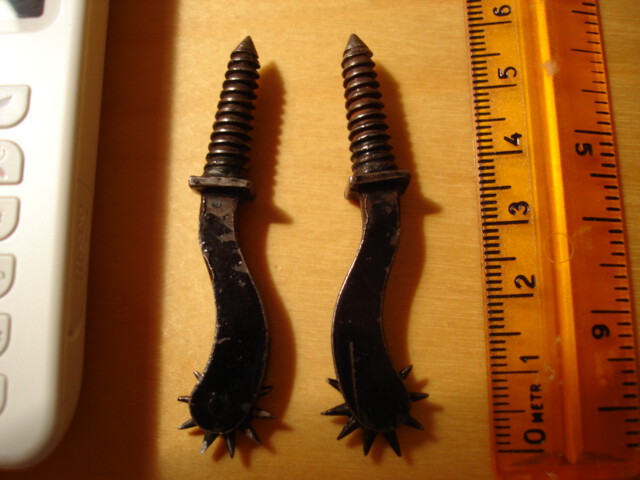
Well, now, you are all guessing wildly but I was hoping someone would know for certain, as I don't. Milt's suggestion is just what the dealer told me. Miniature spurs, possibly as a symbol of the workshop making them, possibly as a project for an apprentice spur maker. I bought them on the spur of the moment, and was chagrined to discover that careful examination of one of them had not been good enough. Never assume that because they are a pair, the other one will be in equally good condition. The dealer showed me the good one. I paid good money for these. When I got home I discovered the other one was jammed/rusted solid and someone had broken one of the very sharp spikes trying to get the wheel to move. Grrrr............ Spurs are called Hakusha in Japanese, which also means encouragement, or urging, today. (Oh, and two days of gentle application of penetrating oil, and very careful work with pliers, files and picks has eventually freed up the second wheel, for the first time in many a year, I suspect.) So how were Japanese horses urged forwards, do you suppose? -
This Week's Edo Period Corner
Bugyotsuji replied to Bugyotsuji's topic in General Nihonto Related Discussion
OK, this is even more seriously off-topic, but it's a kind of quiz. There is no connection with Japan, as far as I know, but I was given a date of about 1820 (Edo Period, innit?). In the UK right now, so please forgive... Questions. 1. What are they? 2. What do you call them in Japanese, if indeed such things were known in Japan? hehehe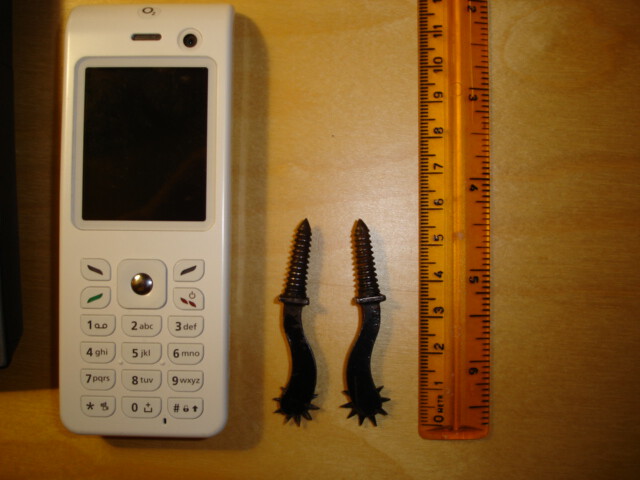
-
This Week's Edo Period Corner
Bugyotsuji replied to Bugyotsuji's topic in General Nihonto Related Discussion
Erm... what kind of a dragon is that, Milt? :lol: -
Hi Nick, the simple answer is the Katana kaji is 'Moritsugu', on 'a day in September'.
-
Symbol of long life, turtle?
-
This Week's Edo Period Corner
Bugyotsuji replied to Bugyotsuji's topic in General Nihonto Related Discussion
Agreed. Very satisfying composition and detail. (Is the Mae-date a face, or an insect, or what, I wonder?) -
He mentions the age on all of his other items, Curran, but not on this one. And all of them end with 'No claims, no returns' at the bottom. Not saying there was anything wrong with it, but with the very high quality of some modern tsuba, and the high price he was expecting for this tsuba, you can never be too safe... IMHO
-
Pete, yes, I looked at that, but I think the top is Nogi-hen. Nobody will know, but in the meantime I would lay my money on Ko-zan.
-
Try Kozan (or Kyozan), if the first character is Kaori...
-
Hmmm... no declaration as to age on this one. Possibly forgot to mention it. And, 'No Claims, No Returns.'

