Bugyotsuji
-
Posts
14,912 -
Joined
-
Last visited
-
Days Won
314
Content Type
Profiles
Forums
Events
Store
Downloads
Gallery
Everything posted by Bugyotsuji
-
Before someone steps in to do the translation, (and it will probably take some very clever detective work) there is a good chance that it is a saying or a piece of popular poetry extolling some aspect of the martial spirit, such as 忠節 chusetsu, loyalty to one's lord. Often the Kozuka has writing on it, but in general this does not lead to any ability to date it. It was often a fashion thing, and even if a name is included, Gimei are particularly common, I have heard.
-
hidden papers can anyone translate some of it?
Bugyotsuji replied to shan's topic in Translation Assistance
My feeling is it is something along the lines Steve says above. A merchant's ledger etc. Often used for linings. -
This Week's Edo Period Corner
Bugyotsuji replied to Bugyotsuji's topic in General Nihonto Related Discussion
No, no, no, not too late and very interesting. Thank you for posting. You can see how the Fukikaeshi is still very important in the design even when no function is immediately apparent. Rumored/rumoured to be reverse ears for catching sounds coming from behind. Whereas Ian's and mine remind me of Roman helmets, the second one there has Arabic associations for me. (And I love the horse armor/armour) Good finds! Now I have heard so many names for these Kabuto. Tatami, chochin, keitai, hitae, and there must be more. -
This Week's Edo Period Corner
Bugyotsuji replied to Bugyotsuji's topic in General Nihonto Related Discussion
Having looked for some time at the tanto I mentioned a few posts ago, and having turned it around in my hands, it becomes apparent that it does have several redeeming features. First of all, the Koshirae was obviously created specially for this spear; it is not a case of a koshirae being adapted to carry a spear tip. The Tsuba and Seppa with square holes were fashioned specifically for the spear Nakago. The Saya is well executed with black Nuri and the Shitodome in the Kurikata is lined in silver. The Tsuka is covered in good Samehada with large knobbles. The Menuki/Mekugi are metal reverse-screw types with Tachibana Mon on them. The tanto koshirae was not done recently, and the general opinion is that the work is Edo. The Nakago is short for a spear, so for whatever reason it has been Suriage, but it was respectfully and proportionately done. There are marks which may once have been a Mei, but they are unreadable now. The sankaku blade was badly rusted, but gentle attention by me from limited experience with rusted spears and arrowheads has reduced the damage and enhanced the appearance. (Not recommending anyone else tries this!) There is a small nick in one edge. The blade has Yaki-ire, and in an ideal world I would and may send it to the Togishi as it would surely end up looking brilliant. Someone treasured this spear enough to give it an extended life in proper and fitting Koshirae furnishings! I hope my period of stewardship will be of remedial benefit. PS In case anyone is worried, it does not need a Torokusho in J, as the 'blade' is under 15cm.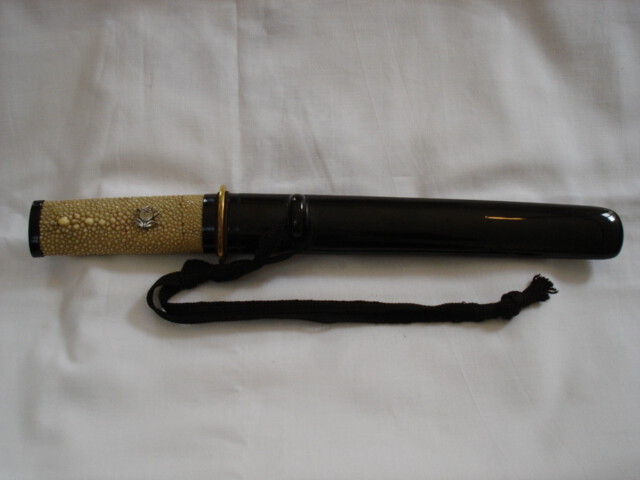
-
What kind of hair is it? :|
-
Personally I like the tsuba and the way the holes work for both the arrowheads and the tsuba itself. If you are wanting a translation of Koichi san's translation, it means
-
This Week's Edo Period Corner
Bugyotsuji replied to Bugyotsuji's topic in General Nihonto Related Discussion
Fantastic, Ian, thank you so much for that. Sets of holes in the iron plates for which no obvious purpose springs to mind had me puzzled; it could just be that such an ensemble as you describe was there originally. Or perhaps it has been adapted... -
This Week's Edo Period Corner
Bugyotsuji replied to Bugyotsuji's topic in General Nihonto Related Discussion
Sometimes you say the right thing, Jean!!! -
This Week's Edo Period Corner
Bugyotsuji replied to Bugyotsuji's topic in General Nihonto Related Discussion
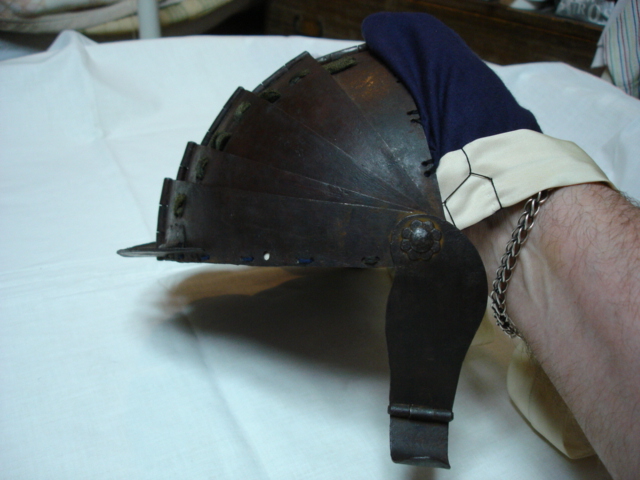
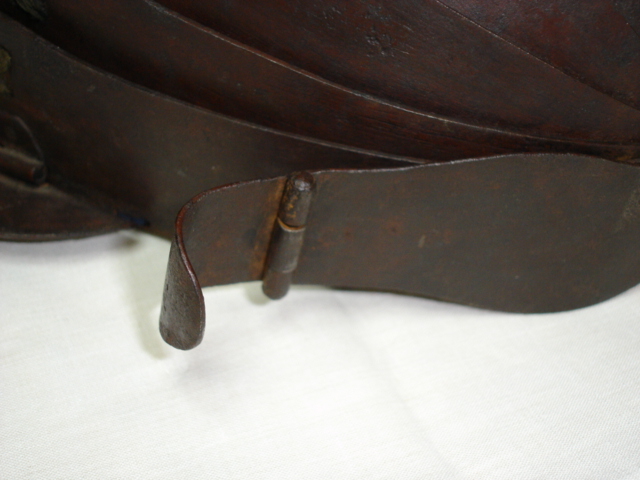
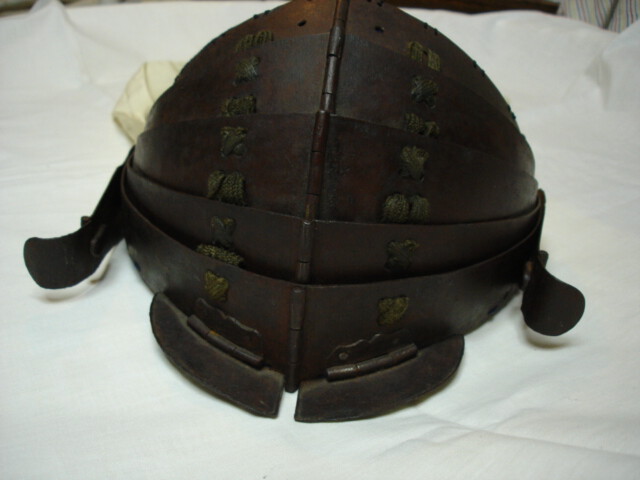
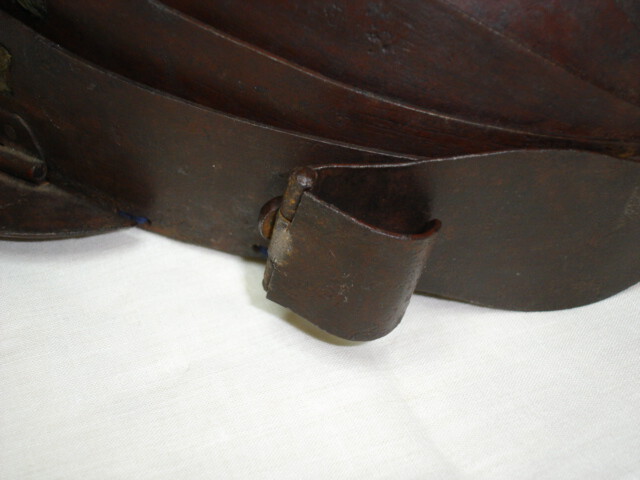
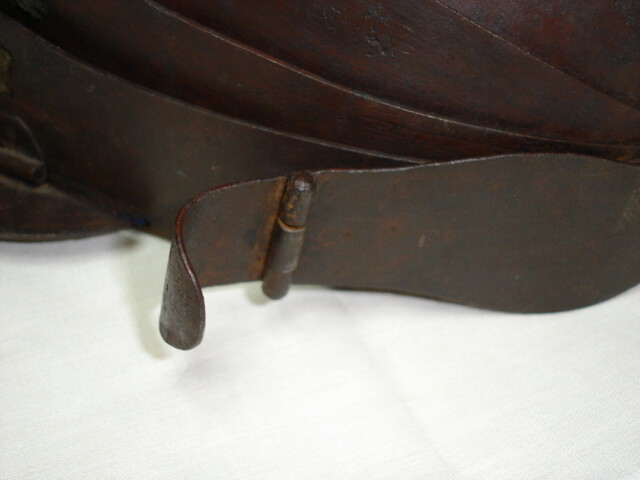
And here with the fukikaeshi swung down into ear protection plus extra strapping position?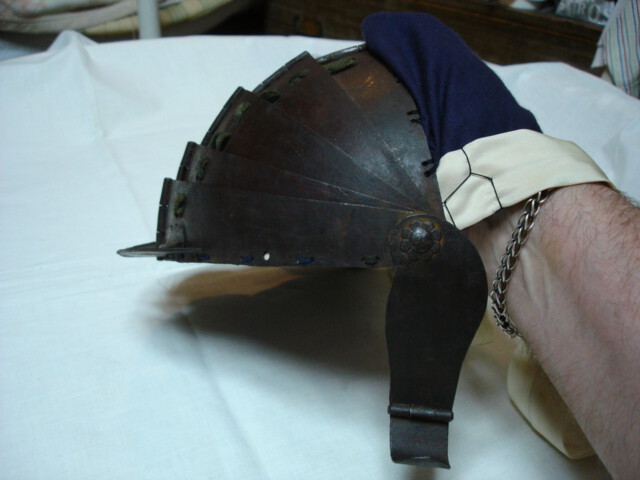
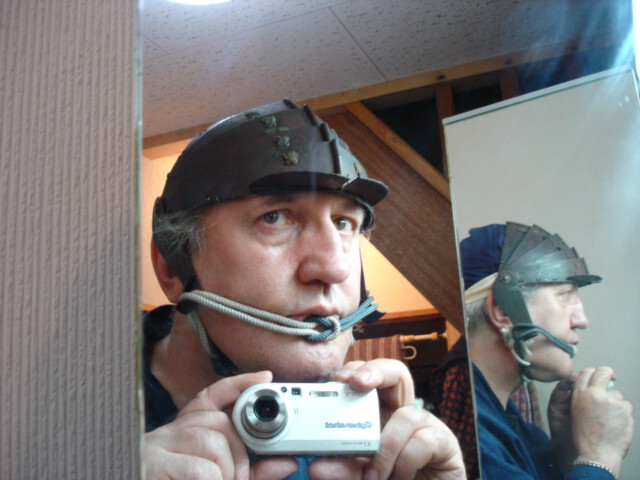
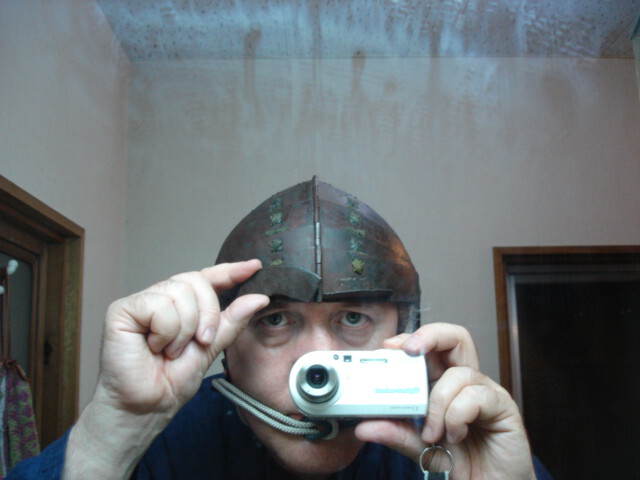
-
This Week's Edo Period Corner
Bugyotsuji replied to Bugyotsuji's topic in General Nihonto Related Discussion
Ian, it would be very interesting to compare pictures. Your description is intriguing. Mine sounds similar in some respects. Is there a photo of the one in the Royal Armouries on the net anywhere? Can you take some shots of yourn? I will post mine. There was actually one more available with some sort of hanging padded iron ear flaps but it looked as though it would give me asthma so I left it. Maybe I can still get it from the dealer... but it will need some patient restoring. Smoke & mirrors...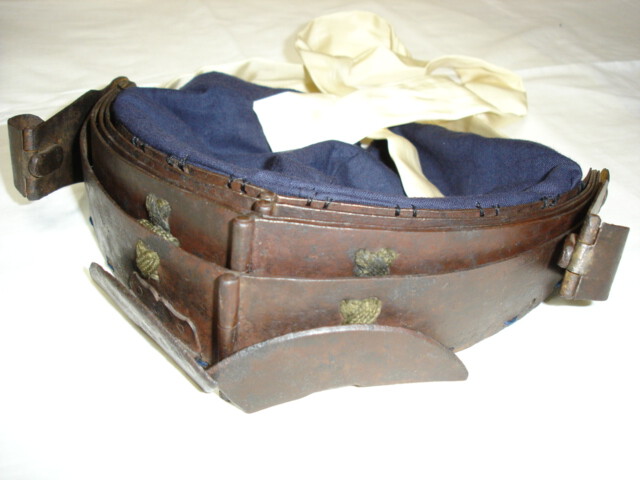
-
This Week's Edo Period Corner
Bugyotsuji replied to Bugyotsuji's topic in General Nihonto Related Discussion
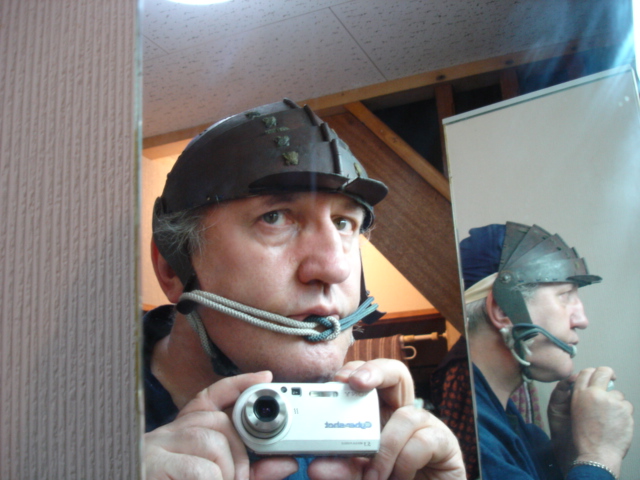
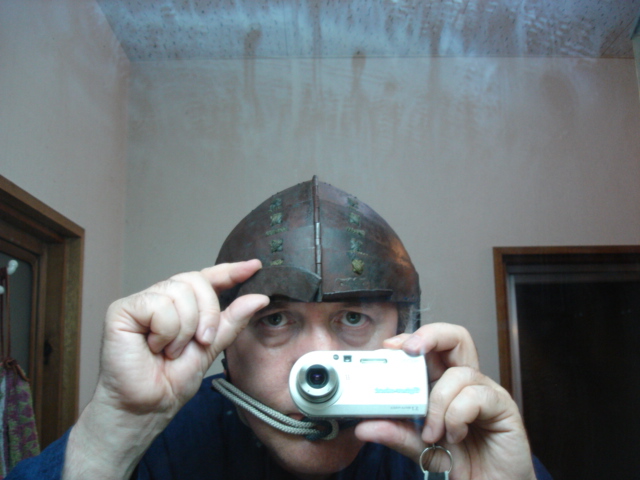
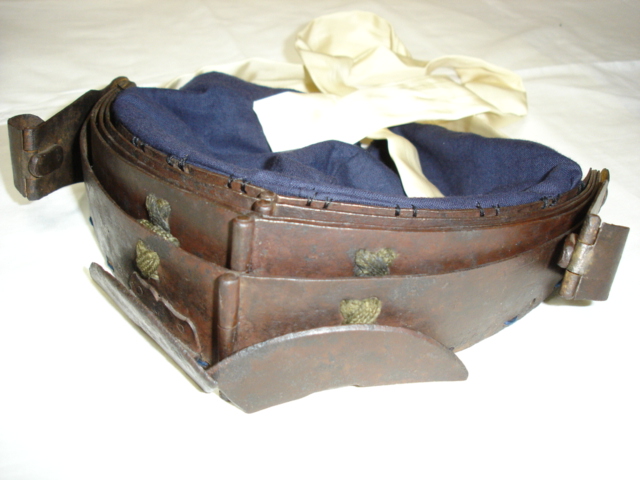
No 1 above, the chochin half kabuto... hmmm. It is completely restored (thanks to the missus for making the E-boshi) and wearable now, but what is in dispute is the use of the Fuki-kaeshi. When I swivelled them down to below my ears and tied a shinobi-no-o to them, a very knowledgable Japanese collector friend laughed. No, no, no, he said, those are fukikaeshi and should not be swivelled down. Again I demonstrated what I thought to be a very reasonable use for these 'fukikaeshi' look-alikes, and he hesitated, sucked his teeth and then added that it might after all be possible, as to his knowledge there is no detailed illustrated record out there. I am now thinking that they served as fukikaeshi decoration in the folded-up position, but in real battle they could have served to hold the kabuto on more firmly and stop it flying off under violent head movement. -
This thread is quite educational. As to the tsuba itself, is it worth the cost of papering? Personally speaking, once burned twice shy. I tend to steer away from any tsuba that gives an iota of doubt. This saves me from spending money. Well, that's the theory anyway! :lol: What's wrong with big hands, Guido?
-
This Week's Edo Period Corner
Bugyotsuji replied to Bugyotsuji's topic in General Nihonto Related Discussion
Two other recent additions are: 1. a folding iron half helmet of the kind favoured by the Shinsen-Gumi in the Bakumatsu period, which I have been assured by my collector friends is, of its type, quite a find. I have had the wife run up an Eboshi and I am now in the process of sewing them together. It has little folding iron sun visors left and right over the eyes, and swivelling iron ear covers with hooks at the bottom to secure a jaw shinobi-no-o. The Eboshi will tie at the back like a Hachi-maki. 2. A shikomi tanto containing a yari no ho, from the end of the Edo Period. And we went to Hiroshima today to take the Shodan Shiken. They allowed me to move up a level. -
This Week's Edo Period Corner
Bugyotsuji replied to Bugyotsuji's topic in General Nihonto Related Discussion
See pic of said cross Mon on p8 of this thread about halfway down the page: viewtopic.php?f=9&t=2554&st=0&sk=t&sd=a&start=105 Well, Bugs, I came across a giant hint today concerning this cross Mon. (Talking to myself!) I bought a set of sleeves, which would have originally been worn under Kote, belonging to the Second Hachisuka Lord of Awa, who was given Awaji Island in 1615 by Tokugawa Ieyasu for his valiant fighting at the seiges of Osaka Castle. Hidden inside each sleeve was this very cross Mon, indicating, according to the writing on the box that they came in, that he was a Christian! Nowhere have I come across any other evidence so far that the Hachisuka used this Mon. I have been calling it 'Ken Juji', although I can find no record of such a name, (except for a Japanese fantasy game advertised on the internet about the Crusades and an upturned Western-style sword as a cross). This Hachizuka hidden cross, if that is what it is, is a lovely example to me of the the church militant, Japanese-style. A cross made out of crossed blades. (Almost a Shuriken, even.) But within a few short years it was to become a deadly secret. -
Menuki came with a strange wood tablet,Translation please?
Bugyotsuji replied to shan's topic in Translation Assistance
Hi Shan, looks like you got a temple/shrine good fortune talisman with your Menuki. Normally Japanese people would never open them up to see what's inside! The cover paper on the right says: O-Mamori (Protection) and the little wooden hanging plate says Narita-san on the front. See: http://www.naritasan.or.jp/ and watch the top picture change. Unfortunately I cannot read the writing on the back, but there is a chance they might be Sanskrit letters. Perhaps Koichi san can help? -
I enjoyed that, Koichi san.
-
Oh, and the Habaki should pull backwards off the rusty Nakago. In the ideal state it should fit fairly tightly in place, and release with a little pressure. I wouldn't use too much force, but after the oil treatment, light tapping with a wooden block and rubber hammer might encourage it to make that vital first movement. Be careful, though, as copper can scratch easily, and some habaki are not as hard as they might look.
-
This Week's Edo Period Corner
Bugyotsuji replied to Bugyotsuji's topic in General Nihonto Related Discussion
Ian, are both hooks designed that way, or is one of them missing the extra prong? My feeble brain is suggesting some kind of barometer. Seasonal references? -
The gold colored/coloured sleeve on the blade is called a Habaki. It is part of the furnishings and blocks our view of the crossover area between the Nakago and the blade. This also slides off. Everything apart from the single flat blade-&-tang can be considered irrelevant to the discussion of your original question. If anything is old and possibly valuable, it will be the core of the beast. Unfortunately the photo quality doesn't quite cut the mustard. Do you have a friend with a digital camera who could co-operate with you? Here's hoping that someone else will step in and help out. I am sure that many people are waiting in the wings!
-
Hi Lori, Just had a quick look at your photos. Thanks for the quick response. If you can separate the blade/tang away from the Koshirae (sword furnishings, eg scabbard, hilt, etc. which are guaranteed to be 'young') and focus solely on getting good, clear close-up shots of the naked Nakago/Tang and naked blade, all over, that would be good. For example, both sides of the complete Tang, including the crossover area with the blade. Some overall shots of the blade, and then some detailed sections. Never touch the blade, and control the whole process by holding the Nakago. Use a soft towel if necessary.
-
Hi Lori, Welcome to the site. Quick answer is... it's anyone's guess until we see it, but it could be traditionally made and have no markings, yes. Slow answer is, take some pics overall and some close-ups of the Nakago (tang) and post them here for opinions. Read the site for hints on what kind of photographs to take. Also, general word of warning. I am sure you are aware that you should not try to clean either the blade or the tang in any way... (The blade maybe once you have learned how...)
-
This Week's Edo Period Corner
Bugyotsuji replied to Bugyotsuji's topic in General Nihonto Related Discussion
Oops... -
Rich, a friend showed me that very Tsuba the other day! On a J auction site last week there was a very rusted and pitted Tsuba from the Muromachi period described as having been damaged 'probably around the time it was made and probably in battle, judging from the age of the rust overall, including in the crater on the damaged edge'. The description went on to say that there was no actual proof, but such a scenario must be quite likely... I can hear the bloke muttering 'Roman da yo, ne!' (Romantic thought)
-
Managed to lose out a couple of times on the auctions, but finally... found a little iron Higo Tanto Tsuba with one hitsu ana opening. It has the Zogan remains of silver Sakura petals all round the Fuchi. The dealer sent it off today, so... tomorrow? Getting quite excited. Let's hope it fits without too much Seppa adjustment. No luck on finding a narrow Kozuka yet, although I have been looking and asking around. They seem to be as rare as*... and even if I found one I am not sure whether it would be within my budget for this project. The Tsuba has eaten up most of that. (*finish the saying! )
-
Sword for "left handed Samurai"
Bugyotsuji replied to stephan_hiller's topic in Auctions and Online Sales or Sellers
Samurai walked tending to the left of the roads/paths. Thus the scabbard would never click together with that of a stranger. Even today, knocking shoulders or bumping someone in public is considered the height of bad manners and can lead to violence if the apology is not accepted. For this reason, even if there were indeed left-handed Samurai, (one-armed for example I can understand) they would have been presented with a serious dilemma out of doors, necessitating some special design to get around the carrying problem.