Bugyotsuji
-
Posts
14,634 -
Joined
-
Last visited
-
Days Won
293
Content Type
Profiles
Forums
Events
Store
Downloads
Gallery
Everything posted by Bugyotsuji
-
This Week's Edo Period Corner
Bugyotsuji replied to Bugyotsuji's topic in General Nihonto Related Discussion
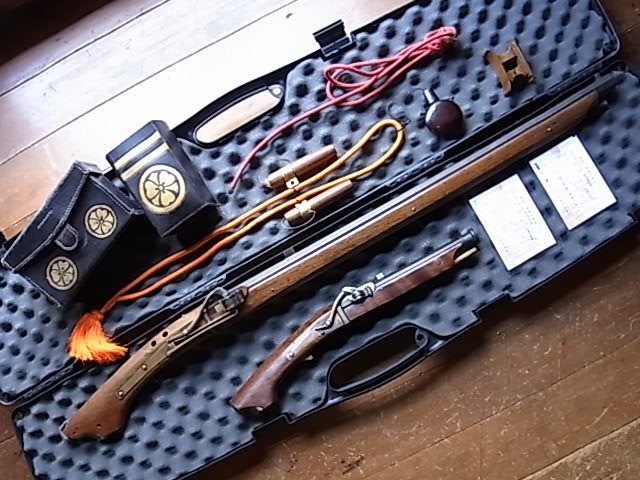
A lovely story, Ron. Many thanks. PS The inside of the gun case.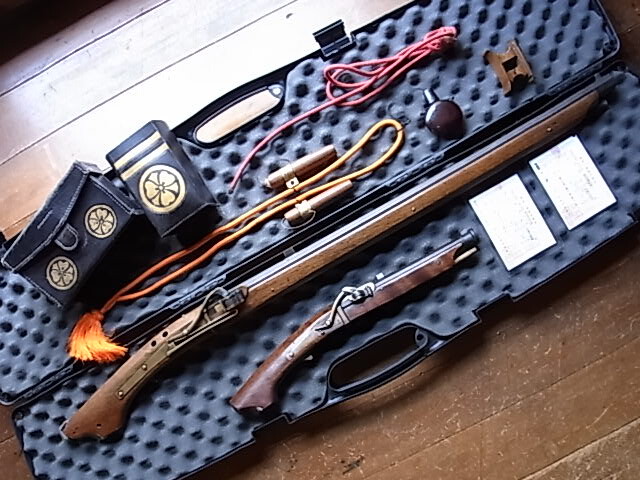
-
This Week's Edo Period Corner
Bugyotsuji replied to Bugyotsuji's topic in General Nihonto Related Discussion
Back to the changing rooms and the rain was gradually becoming not sporadic but constant. Reload, and get your helmets on! came the order. My headscarf and helmet uki-bari were still soaked with sweat as I put them back on for the 12 o'clock midday display, trying at the same time to load three guns in a mass of luggage and boxes and armoured bodies. There is a changing room, but not big enough, so most of us are struggling in the narrow corridor. Hurry, it's eleven thirty already, came the insistent voice. Cursing loudly and freely now. Total confusion. Are we really going out in this? I think incredulously. Finally came what I had been hoping for. Chushi, they say. It's been cancelled. Now we have to wash the gunpowder out, pull all the wet gear off and get some dry clothes on, well, for those that thought this far! hahaha :lol: What I really wanted to say today in recollection, is that if your Japanese Katchu armor/armour or weapons smell moldy, rusty, salty and sweaty, it's probably because no-one was ever able to take individual care of the stuff, leaving it thus exposed to the vagaries of the orders of the particular group leader, and above them the overall planners of the operation. (Mine is spread out in the hall and tearoom today, sprayed with Fabreeze and with luck gradually drying out.) -
This Week's Edo Period Corner
Bugyotsuji replied to Bugyotsuji's topic in General Nihonto Related Discussion
The gong at the front of the line was struck and everyone who had them started blowing their Triton Horagai. Where's yours? someone inevitably asked. Don't want to get the colored cords wet, I replied lamely. The 'rear-car' arrived to carry the O-zutsu big gun boxes to the field. Is there a plastic sheet to cover them, I asked, worried about my black lacquer 20 Monme in its not-waterproof box, even if no-one else was particularly bothered. People looked flustered and bewildered. Sheet? Huh? Luckily one of the members was also worried about his gun and sent his wife to get a plastic tarp from their car. We did the display in the rain. There were some misfires. We got a standing ovation on the way back from the 100-odd 'crowd' who were mostly festival staff, in thanks for putting this on in a spirit of cooperation with the festival, and with no thought for our own comfort. Well, that's what I think they were clapping for.... -
This Week's Edo Period Corner
Bugyotsuji replied to Bugyotsuji's topic in General Nihonto Related Discussion
Well, it was obvious this was going to happen. The weather forecast had been saying for some time that the rainy season would start on Sunday the 13th. We had a big display scheduled for that day, the cherry on the cake of the Toki-no-week festival in Akashi, but I did not want to get my armor/armour and guns soaked. No information came, so I packed everything on Saturday and left the six bags and boxes in the hall ready to roll. Luckily I have a set of 'fake' repro Do, Sode, and Sune-ate as back-up and I found a light khaki Monpe that I could wear underneath at a pinch. Didn't want to get the good Hitatare wet... Left the house at 4 am. We met centrally and packed the van to the ceiling and set off, rain the whole way. (Two years ago we had managed a display at Amako in pouring rain with almost no misfires, proving that if you are careful the Tanegashima can be used in rain for a while, despite the body being soaked to the skin. This was in the back of everyone's mind.) The organizers kept arriving and checking whether we were really going to do this. I could see most of our members were ostensibly up for the parade and the first 10:30 display despite the rain. Sweat was coursing down my face even before I started to get changed. Inwardly I was cursing but once more I had to fall in line with the group plan. I hid my tachi koshirae in my bag, along with the Hayago neckband and my cord-wound Hora-gai and went out to stand in line. Many of them were wearing first-line armour/armor. Some members asked me what had happened to my Tachi, and I simply replied that I didn't want to get it wet. -
This Week's Edo Period Corner
Bugyotsuji replied to Bugyotsuji's topic in General Nihonto Related Discussion
It never fails to amaze me when people can put things together that have been apart at different ends of the world for hundreds of years, or work out that they were made by the same person/workshop. -
First apperance of Hamon?
Bugyotsuji replied to xxlotus8xx's topic in General Nihonto Related Discussion
Carlo, thanks for the link. Wow! I really want to read this when I get some time... :D -
Agreed. Nice suit. Maybe he poked his head through a hole, au photoshop? Should have removed his glasses though. :lol:
-
Try doing searches in Japanese for 侍 写真 samurai photos or 武士 写真 bushi photos, eg http://www.google.co.jp/images?sa=3&q=% ... C%E7%B4%A2
-
TANEGASHIMA HAYAGO ( Quick-loading tubes )
Bugyotsuji replied to watsonmil's topic in Tanegashima / Teppo / Hinawajū
There is a Korean one on display in the Museum on Tanegashima Island. The only shot I can find is just before half-way down this page, the middle photo of three on the left, but this photo only shows the lock section of the gun: http://www.geocities.jp/shimizuke1955/370hinawajuu.html And here's a pic of Sawada Taira giving 5 Korean-made guns back to Korea. http://www.sankei-kansai.com/2010/03/15 ... 021613.php -
Well, I think the truth is somewhere in between. Second from left has his right Sune-ate upside down. One guy is definitely wearing a Hai-date around his ankles, which is unthinkable. (Did they not have enough Sune-ate to go round?) The guy on the right has his right Sune-ate on his left leg. Their Katchu are generally badly-fitting and very mixed stylistically, as if representing very different eras. They have absolutely no idea how to tie their helmets on properly. It has to be a posed shot possibly on fake grass in a studio for the camera. Still a fascinating cameo, and sets the brain juices flowing.
-
TANEGASHIMA HAYAGO ( Quick-loading tubes )
Bugyotsuji replied to watsonmil's topic in Tanegashima / Teppo / Hinawajū
Excellent information Thomas. Many thanks. Actually many Japanese will say they do not like decorated guns and prefer simple sturdy ones. The highly decorated guns have mostly been sold to foreigners, goes the accepted story around here, although you do see some fancy ones in Japanese museums. -
As above. What a mishmash, but a great shot nonetheless! I love it. Many thanks. :lol:
-
TANEGASHIMA HAYAGO ( Quick-loading tubes )
Bugyotsuji replied to watsonmil's topic in Tanegashima / Teppo / Hinawajū
Thanks for daring to say it!!! :lol: -
TANEGASHIMA HAYAGO ( Quick-loading tubes )
Bugyotsuji replied to watsonmil's topic in Tanegashima / Teppo / Hinawajū
Tiger hunters. Are they Korean? (Chinese?) What a great photograph! The bird-beak dispensers are called Karasu-guchi in Japanese. (Crow beak) You can see separate ball bags and on the man on the left a priming powder flask and a matchcord. Almost everything in that picture I use regularly throughout the year. I have a collection of most of the equipment that was used way back when, but still missing a couple of very rare items. Yesterday BTW I saw a little glass case with a toy gun rack and two miniature Tanegashima, with all the supporting accoutrements done in miniature. Must have been hand-made by some ancient gun fan. -
Well, I am feeling a little raw at the moment. The problem is that I mentioned the debate here and he said at once that with swords it's a dog-eat-dog world and you must be 100% sure in yourself and in the sword. He won't even let me see it now, for my own protection. With my first sword everyone told me it was Gimei, but it passed at Shinsa. He says it has to be like that. Thanks for the advice. And yes, I believe that the sword will find me! But was it that one???
-
TANEGASHIMA HAYAGO ( Quick-loading tubes )
Bugyotsuji replied to watsonmil's topic in Tanegashima / Teppo / Hinawajū
Well, I roll my tissue up real tight and ram it down when no-one is looking just so that I can get a good report. Unfortunately a member of the public complained when a flaming ball of wadding threatened to go down the front of her dress, so I now put little rips in it beforehand to help it disperse once out of the barrel. Last summer I spent an interesting day at Bisley with a Yabusame friend firing blackpowder guns, mostly percussion cap. We had big Western blackpowder revolvers, some under-action rifle work, and I even survived skeet/clay pigeon shooting with a 4-bore elephant gun. Smashed the clay first shot too, and very proud of myself for not getting egg on my face (or a bruised shoulder). -
TANEGASHIMA HAYAGO ( Quick-loading tubes )
Bugyotsuji replied to watsonmil's topic in Tanegashima / Teppo / Hinawajū
Ron, we actually use old film containers to pour in measured amounts of the black powder, (mostly 10 gms for Shizutsu long guns, and 8 gms for the pistols, and correspondingly more or less depending on the weapon) ) but some of our members have recently made their own Hayago to replace these rather ugly opaque film canisters and before the displays they can be seen busily filling them in advance. Sometimes the gallery is quite close and they can see everything that we do. I am tempted to adopt this idea. We use thin tissue paper wadding for the first shot only which we prepare in advance. Makes for a good tight bang when we fire the first broadside. During the display there is no further wadding used, but a thorough tamping with the ramrod does seem to settle the blackpowder down into the back of the breech; lack of such prodding produces a sort of hissing firework fizz. -
TANEGASHIMA HAYAGO ( Quick-loading tubes )
Bugyotsuji replied to watsonmil's topic in Tanegashima / Teppo / Hinawajū
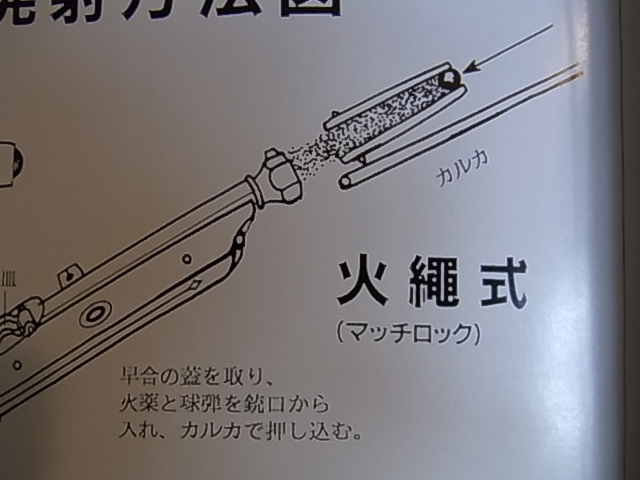
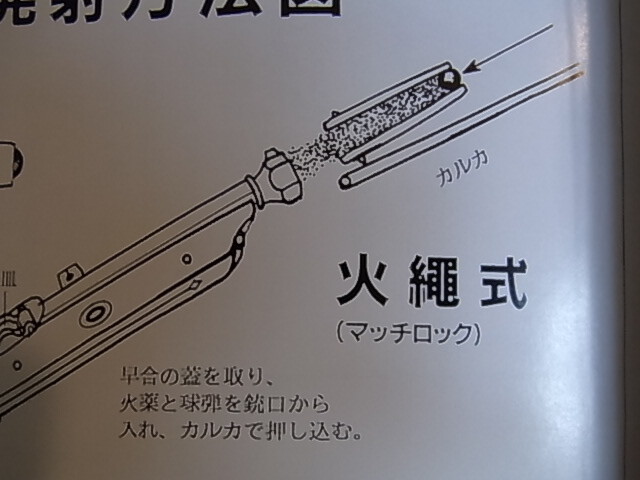
Sawada Taira seems to suggest in his book that the 'Karuka' ramrod was pushed through the Hayago, but I must admit that it would be hard to control the Hayago over the mouth of the barrel with the left hand and organize the insertion of the Karuka with the right. You'd have to grasp the Hayago and the barrel together like the teat of a cow's udder. I suppose you could pour the powder in with the right hand and then do the ball with the Hayago in the left hand after that. This illustration is taken from his book, Nihon no Furu-ju. It's not clear from either the text or the pic what the direction arrow indicates, a finger/thumb, or the Karuka...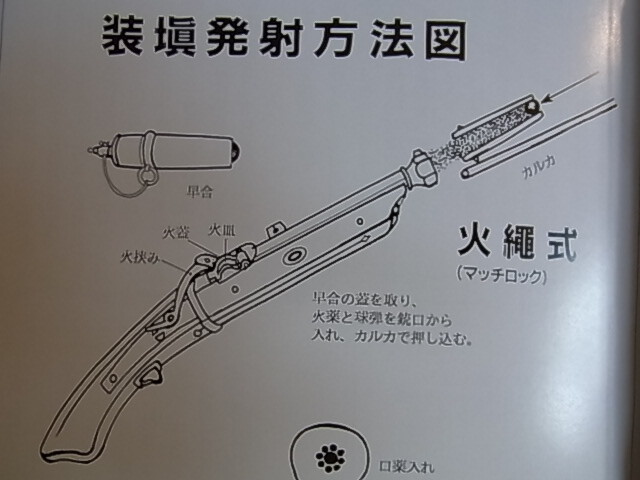
-
Ah, wonderful. Many thanks, Morita san! How do you do it?
-
Thank you Keith.
-
A friend is trying to read this: http://forums.netsuke.org/file?id=989611 The closest I can get is but in reverse??? Would anyone be able to read the first character?
-
The owner has told me he does not want to sell it. So, no piccies and end of thread! Apologies for the false flag, but many thanks for the educational roller-coaster ride!
-
2 Shaku 2 Sun 9 Bu, I seem to recall. Many thanks for the advice, Jean. It's the romantic in me. I need to take a chill pill and make a more rational decision. (Besides which, I am not completely sure how to get the money together this month for everything that has to be done...)
-
Franco, thanks for the prompt. I went back and found the interesting Pressley article that you mention. My guess of 1550 may well be way out. I was told end of Muromachi, but not Momoyama. This is something else I will need to check. So Jean, you think it might be Kazu-uchi mono? The blade is quite striking and gets good comments. I may have to take a rain check on this sword... :| The Koshirae is tachi and beautifully done overall in su-aka. Not gold or silver, but inscribed red copper. The lacquered scabbard, the fittings and the Tsuba were probably made at the same time and are all of matching color and style. Everything is Mumei.
-
Keith, this sword and Koshirae is owned by a friend and it will be featuring in an exhibition next week. If I can find the time, I will nip round there and take some shots of it. Please watch this space if you need pics. Apologies. In the meantime all I can say is that there are two Mekugi ana in the Nakago, and a vertical line of what? ...perhaps 8-10 smallish Bonji down the edge of one side of the Nakago. They could almost have been the Mei, if only they were in Kanji. The other side has a single small Bonji up close to the Habaki, and then a gap and some small Bonji in a vertical arrangement further down. I have seen this sword once for a few minutes, so this is only a general impression. I cannot really imagine that they were on the blade at any time before a Suriage. The plan is to send my present Katana and Koshirae for sale at the dealers' auction and to use the money realized to help towards the purchase of this 'upgrade'.