Bugyotsuji
-
Posts
14,416 -
Joined
-
Last visited
-
Days Won
281
Content Type
Profiles
Forums
Events
Store
Downloads
Gallery
Everything posted by Bugyotsuji
-
Accessories for the Tanegashima
Bugyotsuji replied to Bugyotsuji's topic in Tanegashima / Teppo / Hinawajū
Gary (Tengu) has a nice collection above. -
Accessories for the Tanegashima
Bugyotsuji replied to Bugyotsuji's topic in Tanegashima / Teppo / Hinawajū
John, shot would have been used in the same way for small game, yes. Of course they did not have cartridges as we know them, so, as in the early days of the Wild West, a powder charge would first be poured down the barrel, followed by a load of lead pellets, maybe in some paper wadding to keep the load compact. Trawling some antiques fairs etc. will gradually build your collection. Step by step one gets to Rome! PS I you can get hold of the *Ogawa Collection, you will see many interesting examples of the kind of thing we look for, accessories of the ashigaru and castle lord. * and

-
Tottori Prefecture. Quite a low registration number, close to the start of the ‘new’ registration system.
-
Edo Period Corner Part II
Bugyotsuji replied to estcrh's topic in General Nihonto Related Discussion
And the bad news is that a friend told me that once they get your name on the register they will ask you again the following year, and it will be hard to refuse. This means that from now on it is likely that I will have to do the above display or something equivalent every year, unless I can come up with a good excuse. Hmmm… -
Edo Period Corner Part II
Bugyotsuji replied to estcrh's topic in General Nihonto Related Discussion
篠垂 Shinodare are generally decorative strips on kabuto running from the tehen down towards the bottom edge of the hachi bowl. Tare is from the verb tareru, to hang, or dribble or run down as a liquid. Shino means bamboo, but the word also indicates thin upright strips or ribs of bamboo (or metal) as those of Sune-ate, that protected the shins. Decorative glazing strips for a kabuto. -
These are all good questions, Roland. To answer in detail would take much time, but the hinawa handling secrets of each school of gunnery were slightly different, and may be found in scrolls which sometimes turn up. My training never mentioned use of hinawa-tōshi holes, (although my trusty Kumamoto gun does have such a passage through the upper stock) so it must have been an option for some, or perhaps a convenient place to put the cord while waiting for battle of even for storage or display. Not every gun has these holes. The picture you have chosen above shows the hands the wrong way round. Perhaps this was a special technique for loading when squatting low. It is possible that they are loading before battle, and before lighting their matches. Normally Japanese matchlock cord is of high quality and does not go out, so only one end is lit, the coil is kept on the left forearm, the gunner is standing, and the lit end is in the left fingers. (This changes for a matchlock pistol, and there are tricks for rainy weather.) Cord can also be cut short (Kiri hinawa), with several kept on a special group stand, disposable, handed out for each shot. There were also special metal tubes (called hinawa-ire, do-no-hi etc.) kept at the waist, which held burning cord, saving the time to light one in emergency situations. If you can find a copy of Sawada Taira’s green book, there are many illustrations, though not so many showing burning cords. PS I have been an active member of an old Japanese matchlock troop for over twenty years.

-
Did the Japanese use patched roundballs in teppo?
Bugyotsuji replied to Rolland's topic in Tanegashima / Teppo / Hinawajū
Better late than never! (Besides, my answer to you above took the best part of a year… ) -
Accessories for the Tanegashima
Bugyotsuji replied to Bugyotsuji's topic in Tanegashima / Teppo / Hinawajū
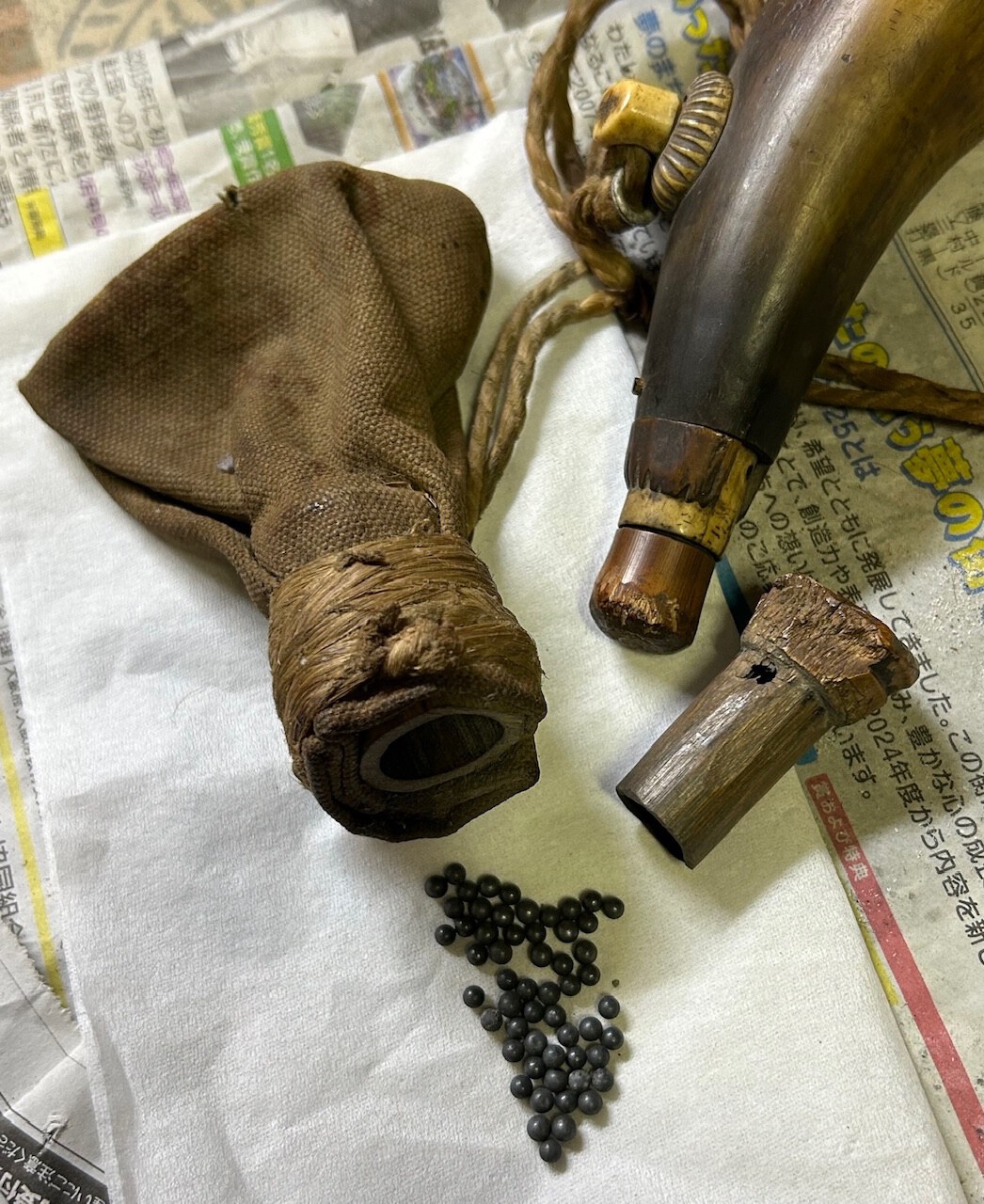
Having given a recommendation concerning what state or condition of powder flask is best, I came across a ‘why bother?’ one that is more typical, well used, with replaced parts. Why did I buy it? See what the ball bag contained. Small round shot, backing up previous discoveries of shotgun pellet usage. (See 22 May 2019 post above.)
-
兼若 Kanewaka(?)
- 1 reply
-
- 2
-

-
Edo Period Corner Part II
Bugyotsuji replied to estcrh's topic in General Nihonto Related Discussion
Nice, John! The Mon are called Suhama. Not so common in my experience, but it probably depends where you are in Japan. Yours is of much higher rank than ashigaru. -
Edo Period Corner Part II
Bugyotsuji replied to estcrh's topic in General Nihonto Related Discussion
These are teppōtai members from Tanegashima. We went to Portugal together in 2010.
-
Edo Period Corner Part II
Bugyotsuji replied to estcrh's topic in General Nihonto Related Discussion
John, I have not heard that one before, but I can well believe it. As you look down to apply priming powder to the pan, water tends to drip off the front lip of your kabuto mabisashi straight into where you are looking. Firing a matchlock in the rain requires special tricks, and a light, broad jingasa would surely help, although it would not be much protection against enemy ball. But then again, Ashigaru were light foot soldiers with only rudimentary armour. The one in the photo is covered in Mon of the Kuroda house. (Kuroda Kanbei) -
Edo Period Corner Part II
Bugyotsuji replied to estcrh's topic in General Nihonto Related Discussion
For the kids, I prepared a flint and striker and challenged them to strike sparks, as part of the old way of lighting a fire or matchcord. Naturally there were other examples of tinder, tinder holders, netsuke ashtray, iron strikers, etc. There were also various instruments for creating noises, which they could try out, a triton (conch), a mokugyo, a shakujo, some hyoshigi clackers, etc. Many objects bore Mon/Kamon, challenging them to see if they could name some famous Daimyo families. -
Edo Period Corner Part II
Bugyotsuji replied to estcrh's topic in General Nihonto Related Discussion
Thanks! Jan and Kat were supposed to be visiting this weekend with their friends Petter and Helena. It was to be my first free weekend in nearly two months, to which I was looking forward, and then suddenly the city had to come and ask me to take part, bang in the middle. Should have refused, maybe. Still, we managed to hang out and do some fun things together!
-
Edo Period Corner Part II
Bugyotsuji replied to estcrh's topic in General Nihonto Related Discussion
Children’s Day Sunday, actually part of the annual Buddhist Kuyosai ritual commemorating the souls of Osafuné swordsmiths. The day started off with speeches, incantations and pinched offerings of incense. Kōzuke Daijo Sukesada’s gravestone is here, behind the dark green bush. I went round later to have a look. “No photos allowed” the sign said. It was the first time I had been invited to do a stall illustrating Bizen guns. I unloaded the car and set up the display at 9:30 am. Imagine my surprise then, when they required my attendance in the special dignitaries’ tent, and to be called in turn by name to go and offer incense and prayers at the altar. I watched closely and tried to memorize the ritualized movements of the Mayor etc., giving an internal moment of thanks for the lives of all those Bizen smiths of yore. Various attractions and events were held during the day for the children, with whole families joining in. Most visitors to my little display were respectful and full of questions, but a couple of the hyper kids were grabbing antiques as if they were playthings, and needed close watching! Family sword play My table


-
Ah, no, I think it is something else that has been made into a maedate, Bernard. Perhaps a post- or wall-plate from a Jinja for example.
-
Identify? Do you mean what does it represent, Bernard, or are you asking which family might have used this Kamon? It looks to me like a folded paper ‘Noshi’ design, with an internal ‘Ken’.
-
Looking for Masakazu and ceramic Netsuké, I came across this in the MCI. Thanks, Pietro above. No.6

-
Accessories for the Tanegashima
Bugyotsuji replied to Bugyotsuji's topic in Tanegashima / Teppo / Hinawajū
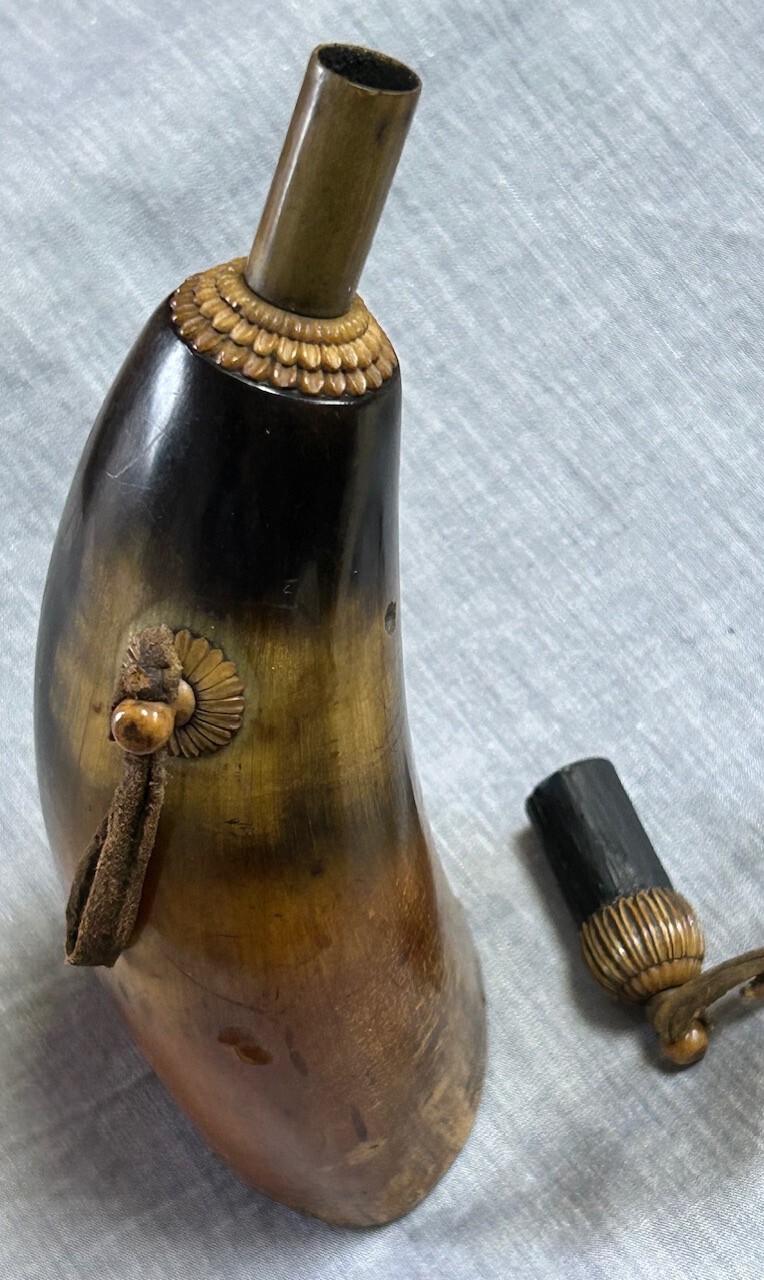
These are to my mind older, from a time when guns were still thought to be ‘Western’, a time of strict imitation, when artisans thought a ‘powder horn’ ought to be made from cow horn. They still retain some Western feeling, but already the artistic sensibility was at work. The ‘frilled’ edges may also pay lip service to Western clothing ruffs which were still somewhat in fashion. Later on, people felt free to create powder flasks in more Japanese iterations. The ruffs often continued however. -
Vesta! That is so neat! The waves look at a glance like Ōmori work, but there were many imitators.
-
For me it’s more Momoyama/Keichō than Edo period, but it’s just a feeling.
-
Hi Billy, yes, but not necessarily just because the holes are the same size. Where to start? Someone has quickly created a Netsuke-like object, hoping for a sale, but the all-round quality is completely missing for a ‘genuine’ old Netsuke.
-
Accessories for the Tanegashima
Bugyotsuji replied to Bugyotsuji's topic in Tanegashima / Teppo / Hinawajū
This topic is surely worth expanding. Looking to post a coarse powder flask I found over the weekend, I discovered this good old thread! These old black-powder flasks can show astonishingly fine work. If you can find one with matching bits (frills), then all the better! See below the collar of the spout, the top of the powder measuring cap, the heads of the pegs, and the flask side-attachment seat. Detail Pouring spout


-
Thanks Pietro for the great feedback, and for showing us your examples. The various coloured glazes do make them more attractive. Surely elements of the finer detail were added by hand at some stage.(?) John, I am not sure if these would be more expensive than bone or metal. Metal Netsuke are rare enough in their own right.