IanB
-
Posts
1,778 -
Joined
-
Last visited
-
Days Won
23
Content Type
Profiles
Forums
Events
Store
Downloads
Gallery
Everything posted by IanB
-
Darcy, Portraits of the 36 famous poets painted by Tosa Mitsuoki (1617 - 1691) are hung around the prayer hall at Nikko Toshogu Shrine. They are National treasures and I suspect the portraits of the poets on the blade may well have been taken from these. Mitsuoki did both commercial work as well as holding the office of edokoro azukari to the Imperial Court in Kyoto. Ian Bottomley
-
Carlo and All, To think all of this neurosis around the world started, if memory serves, in Victoria, Australia where someone was killed with what the authorities thought might have been a Japanese sword. It's as though the rest were waiting for an excuse to apply yet further restrictions on us all. Ian
-
UK Customs and the new legislation
IanB replied to IanB's topic in Sword Shows, Events, Community News and Legislation Issues
This would be useful I agree but the Home Office took the stance from the outset that there must be no licencing or similar administrative work involved. No doubt officers do recognise certain names when shipments come in which would certainly speed things up. As an update, I rang Coventry yesterday and was told that there didn't seem to be any problem with my shipment but that because of their workload it would be another 10 days or so until my sword is released. Ian Bottomley. -
Reinhard, I think your second example is good evidence that embellishments with lacquer was not unknown. In fact the two examples are so similar they may have been made in the same workshop. On the same tack, (and let me say I know nothing of tsuba), I suspect this technique had a much longer history. We all keep coming across iron tsuba, often signed, yet without a vestige of decoration. Were these also decorated in this way originally? I know from my armour experience that lacquering iron isn't always a success. Getting the first coat to stick involves heating the metal before the base coat is added. Get it wrong and the lacquer flakes off. Were these plain iron plates originally decorated with lacquer that has failed to stand the test of time? An interesting thought. Ian Bottomley
-
Stan, I hate to disagree with some of the points raised but the leaf and the flower are not upside down with regard to the tsuba. You could argue the butterfly is or it might just be flying down to the flower. What I agree with is that it couldn't be used on a sword but I don't think it was really meant to. I think it is a genuine tsuba that has been embellished with lacquer to sell it to a tourist in the Meiji period. Without seeing it in the flesh it is impossible to say what they have used to fill the holes in the original tsuba with. If I'm correct, and it goes cheaply, it is an interesting and rare survivor of a period when a lot of artists were struggling to live and were trying all sorts of stunts to get money out of tourists. Ian Bottomley
-
The Royal Armouries collection contains two examples, one by Motohira in a gunto mount the other by another shinshinto smith whose name escapes me (senior moment ). There is another in Liverpool Museum with a long sayagaki to the effect that some retained smith (this time I'm excused it must be twenty years since I saw it) was ordered to study the original and make two copies. The daimyo selected the one he liked and gave the other to the smith. Ian Bottomley
-
UK Customs and the new legislation
IanB replied to IanB's topic in Sword Shows, Events, Community News and Legislation Issues
Mark, I'm sorry that happened. I suspect that they had taken the attitude, quite rightly from their point of view, that if it came in over the counter the owner didn't want it and it should be destroyed. I do not think letters from organisations such as the ToKen would do any good since most police forces will not have heard of them. This idea has to be accepted at a higher level and then it can trickle down. Things have been mooted and we will have to wait and see if there is any interest shown in the idea. Ian -
UK Customs and the new legislation
IanB replied to IanB's topic in Sword Shows, Events, Community News and Legislation Issues
All, In a more charitable vein and being serious for once, I feel that the guys at the International Hub are in something of an impossible position. They have been taxed with implementing a law that requires them to differentiate between something real and something fake that by definition imitate the real with varying degrees of closeness. How can they differentiate without many years of study. I used the analogy of the £20 note. A bank worker might recognise it, if it is sufficiently bad, but most members of the public couldn't. We have had enough examples on the NMB which members could not agree was real or not. What is needed is a system of help; a pool of people willing to advise either the police or customs in those cases where there is doubt about the authenticity of a sword. I would be grateful for member's views on this idea. Ian -
UK Customs and the new legislation
IanB replied to IanB's topic in Sword Shows, Events, Community News and Legislation Issues
John, Better than that, I was able to mention I had done some of the preliminary work with the Home Office and include a page for the consultation document on the amendment to the act with my name on it. With a bit of luck that might cause a few minor palpitations amongst the stony-hearted ******s. I have also been reading the act and although I am no lawyer, para 6 is reasonably clear since it states that for paras 3 & 4 (collectors and martial arts practitioners etc) ... a person shall be taken to have shown a matter specified in those paragraphs if - a) sufficient evidence of that matter is adduced to raise an issue with respect to it; and b) the contrary is not proved beyond a reasonable doubt. Now this suggests to me that if you do offer evidence that a sword is old, they have then to prove it isn't. I suppose the word 'sufficient' might be a sticking point but you will have raised an issue. They then have the onus put on them to prove it isnt old. Ian -
HM Revenue and Customs seem to have moved with some haste on the new legislation. Having bought a sword in Japan I am now trying to get it through the 'ring of steel' that has been erected around our islands. They appear to have adopted an attitude that assumes the import is illegal. After sitting for a week in the infamous 'International Hub', during which time the tracking system reported that it was awaiting Custom Charging, they then put out a standard letter of notification that the parcel has been detained. This letter is an absolute delight. Couched in pseudo legal gobbledygook even the opening paragraph is incorrect since it states that the parcel contains a 'prohibited sword(s)'. In fairness it goes on to mention the act and rather coyly tells you about the 'defences'. Finally, just to fill you with confidence in our noble law enforcers, it describes the parcel, listing: SENDER, with my name and address and the DECLARATION with 'ANTIQUE Japanese SWORD 300 YEARS OLD'. Just to make life easier, they send you one of those really friendly little government booklets full of dire warnings about seized objects being destroyed, and other sundry useless information. It does however state that there is no time limit on how long you can take to make your claim for the recovery of you property but suggest a month. The letter however graciously gave me 14 days. Finally there is the sneaky little entry that states that '... to restore a seized thing this will normally be on payment of a fee.' That fee being of an unspecified amount 'depending on the specific circumstances'. So you import a perfectly legal object that they say is illegal and then have to prove it to be legal and pay for the privilege. Pure govermental emb*gg*rment! I will keep the board posted on developments. Ian Bottomley
-
Guido, I did not say the yokote was not a ridge, of course it is, but the sharp line you see with a well polished sword is caused to a large extent, by the striations from the polishing stones meeting at right angles - hence my comment about it being an optical effect. The loss of the polish through abrasion also rounds the ridge and it loses its definition. This is what I think has happened here. Unlike the shinogi, the yokote is a much more shallow angle which when rounded makes its original position rather indefinite except by reference to the junction of the shinogi and ko-shinogi. Ian Bottomley
-
I have to agree with Peter, the real hamon is clearly visible above the acid etch. The tsuba is real, the menuki look nice enough (of shakudo with touches of gilding) the binding is real and so is the same. The way the muck and dust has accumulated around the menuki and the build up of verdigris on the tsuba and seppa are just right and virtually imossible to fake. As for the yokote, its largely an optical effect anyway and once the polish has gone can soon be blurred. What I am seeing is a perfectly genuine sword with a blade that some idiot has scrubbed up with wire-wool and etched a false hamon on. I would get the black deposit from the etching off straight away to make sure it doesn't do any more damage. In the UK we have an impregnated wadding metal cleaner called Duraglit which will do the job and is mild enough to not harm the blade. Ian Bottomley
-
Brian, Could the square holes be for a form of screwed mekugi? If the female part had a square body it would stop it turning. Never seen one but never say never. Ian Bottomley
-
Gentlemen, My sincere thanks for taking the time and trouble to give your opinions. It is much appreciated. Ian Bottomley
-
Gentlemen, Thank you for your opinions. I too had lent towards Bizen but was put off by the tang shape. Yes, I think it is ubu but the lack of polish in the machi region makes it difficult to be dogmatic. What is definite is that there is no yakidashi. I have taken some measurements of the thickness across the back with a digital caliper and this suggests to me that the blade hasn't been shortened. Since the mekugi ana is punched and not drilled, I feel it is earlier than later. The yasuri are in fact quite faint in the flesh and the colour of the tang is fairly dark - the photo is a bit deceptive. My gut feeling is that it dates from the early shinto period but I stand to be corrected. Ian Bottomley

-
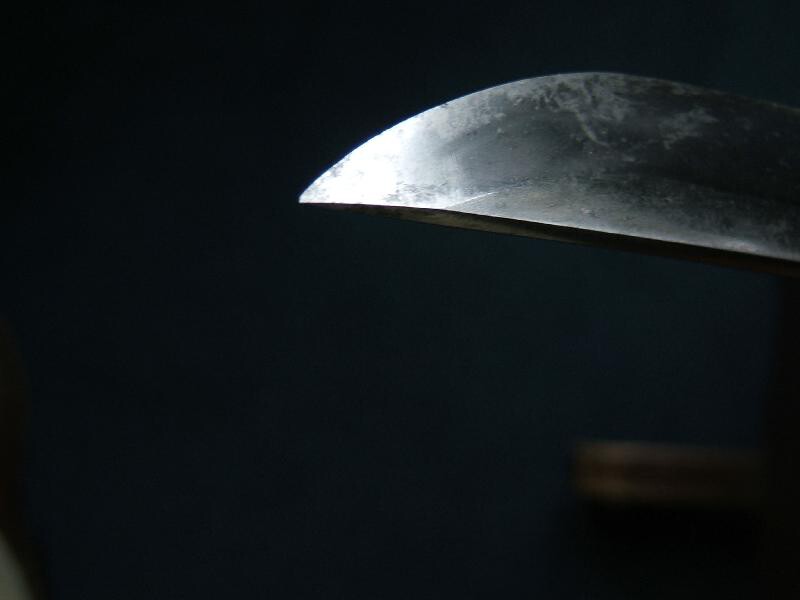
All, A few months ago I acquired this blade in a local auction. Although not rusted the polish has dulled somewhat but sufficient survives to reveal a very interesting hamon. Being an armour buff at heart, my range of sword texts is rather limited and I have failed to turn up anything similar in what is available to me. The blade is ubu and mumei with a 21 1/2" nagasa with the hamon in nioi deki. I cannot see any nie anywhere (but that may be the polish). The hada appears to be a fine itame, mokume. The boshi is very obscured but looks ko-maru. The yasuri are kiri. I would be grateful for any suggestions. Ian Bottomley



-
All, A few years ago a gentleman in the UK sent me some photographs in an email about a couple of swords he had bought from a friend in Northern China and asked for my comments. One showed the side of a saya with embossed plaques showing samurai galloping around on horseback and similar scenes. The overall shots were of a pair of tachi with the usual, if somewhat over-done mounts and applied ornaments along the saya. One had the hilt covered in metal plates, the other same with applied ornaments. I replied to the effect that they seemed as far as I could judge from the pictures rather elaborate Chinese copies of tachi. He was however persistant and sent more photos. One of which showed an ashi which far from being crude was superbly chiselled in silver, of a mass of sakura, with the stamens in gold. A careful look showed that all the conventional mounts were en-suite, silver sakura with gold details. Intrigued, I asked about the blades and was sent two large photos of each sword with close-ups. Both had blades signed 'Sa Yukihide saku kore', one dated 1853 and the other 1857. Neither tang showed much patination and the two signatures were by different hands but reasonably cut with sujikai yasuri. The nakago-jiri in both cases was kiri. One blade had a dragon horimono on the omote with a prunus branch on the ura whilst the other had prunus on the omote and bamboo on the ura. Again, in both cases nicely done. So what he had were two court-tachi style swords, one with the hilt and saya covered with not very nice metal plaques (apparently copper) and the other covered in same, both with matching mounts of high quality, but with rather unpleasant 'samurai theme' ornaments and a pair of interesting but almost certainly fake Yukihide blades. Further enquiries revealed that the guy he had obtained the swords from told him they had been hidden by his family during the Cultural Revolution and only brought to light now that things have relaxed. My gut reation is that they might be relics from the Manchuko court that were supplied in the early Showa period. Since I have not permission to publish the pictures, I hope you will forgive me in not doing so. Ian Bottomley
-
All, One of my more pleasing duties as a curator was to comment on items brought into the museum by the public. One day a gent came in with a gunto he had bought from a friend of long standing that had reputedly been in the friend's collection 30 years. By chance the museum had bought a selection of repro swords from India on the basis that in a few decades they would have patinated and become very difficult to identify. Yes, you have guessed it - the gunto was one of these. I asked the gent to wait a few moments and brought our fake gunto for the gent to compare with his recent purchase. He went rather pale and muttered 'The b*st*rd' through gritted teeth and left without saying another word. A Sad end to a relationship I feel. Ian Bottomley
-
Brian, The kamon of two rows of three coins(?) is that used by the Sanada family whilst that engraved on the reverse looks like a mulberry leaf. As far as I know the Sanada did not use this at all. One variation of the latter, without the circular frame, was used by the Matsura family who were daimyo of Hirado but the best match I can find, in Seishi Kamon no Jiten, is for the Ono family. Why or how the two families Should be linked on your kashira I do not know but someone else may. Ian Bottomley
-
UK Nihonto and acid etching
IanB replied to carlitobrigante's topic in General Nihonto Related Discussion
Adam, We are not all barbarians in the UK. Yes, a lot of the trade, and some collectors, have fallen into the trap of 'gilding the lily' by having blades 'freshened up' by non-Japanese techniques, but I see far less of it these days. Contact with Japan from the UK has not always been easy. When I started collecting in the 60's, Japan was as remote to me as the moon. I did have a blade polished about 1970, by Mr Hakusui of the Japan Sword Co. and it cost me £35 - many weeks wages. I think you will find that nowadays the members of both ToKen Societies regularly send blades to Japan, despite the erratic attitude to such unimaginable behaviour taken by Her Majesty's Customs and Excise (now renamed Customs and Revenue). This noble body seems to levy duty on a system based on tossing a coin -heads you pay heavily for the privilege of them allowing you to spend your money abroad, tails we will levy a modest charge for no reason other than it brings a bit more cash into the coffers. Ian Bottomley. -
Anssi, Lacquer is remarkably resiliant provided it does not dry out. I have forgotten most of the chemistry I knew, but as I understand it it is made up of polymer molecules surrounded by attached water. If the latter is lost it is irreversible and the result is a dry looking absorbant finish that holds fingerprints and other stains permanently. To avoid this, a humid environment (60% relative humidity) and just as important low light levels. About 50 lux is considered reasonably safe for temporary display. Long term storage should be in the dark, hence the use of brocade bags. Ian Bottomley
-
UK Sword Ban
IanB replied to Brian's topic in Sword Shows, Events, Community News and Legislation Issues
All, Finally a snippet of news on the proposed legislation. Yesterday, Sunday, a television show called 'The Politics Show' did a feature on the proposed ban. This was only broadcast in the West Midlands area so many of you may not have seen it. It was fairly brief and the reporter was at least sympathetic - making the point several times that it was rather 'knee jerk' and about as enforcable as the 'Dangerous dogs' legislation that was brought out. Various politicians appeared making sound bites about 'the public are demanding this legislation' and 'the police are demanding it' and so on but at least they did conceed that collectors and martial art practioners would be exempt. Clive Sinclair was shown briefly with some of his collection to put our case - many thanks to him for that. We were ensured that the police would be able to distinquish real from replica but the slightly disturbing aspect was that the idea of certification was mentioned. This idea had been ruled out in talks with Home Office officials. So we are no further forward in reality but things do seem to be going in our direction. Ian Bottomley -
This Week's Edo Period Corner
IanB replied to Bugyotsuji's topic in General Nihonto Related Discussion
Piers, Yes, I think the blade of the kogatana was a brass tsunagi. Ian -
This Week's Edo Period Corner
IanB replied to Bugyotsuji's topic in General Nihonto Related Discussion
Piers, How I envy you being able to wander around picking up treasures like the powder flasks and hammer . Your mention of the brass-blade reminded me that years ago I had a silver mounted tanto of the highest quality (solid gold signed menuki) and white deer-skin bindings. That had a brass blade in the kogatana. Of the two priming flasks I do like the lacquered one. Ian Bottomley -
This Week's Edo Period Corner
IanB replied to Bugyotsuji's topic in General Nihonto Related Discussion
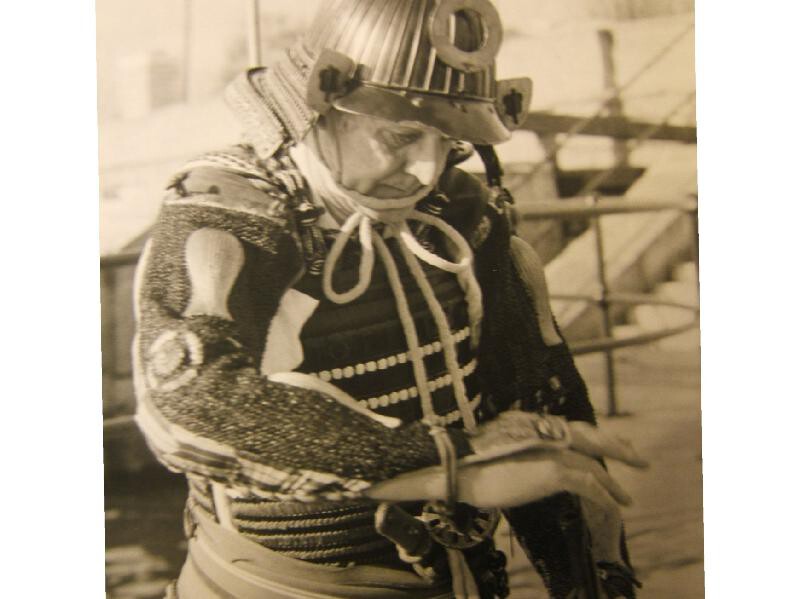
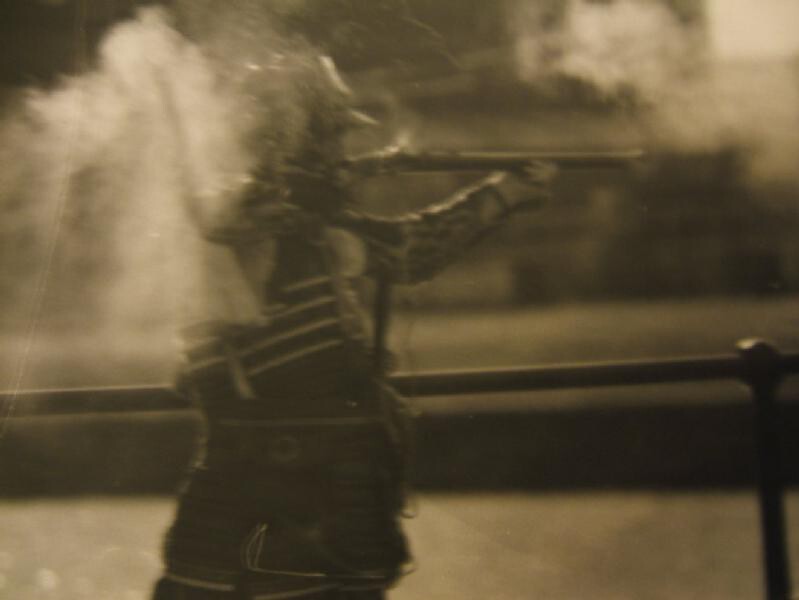
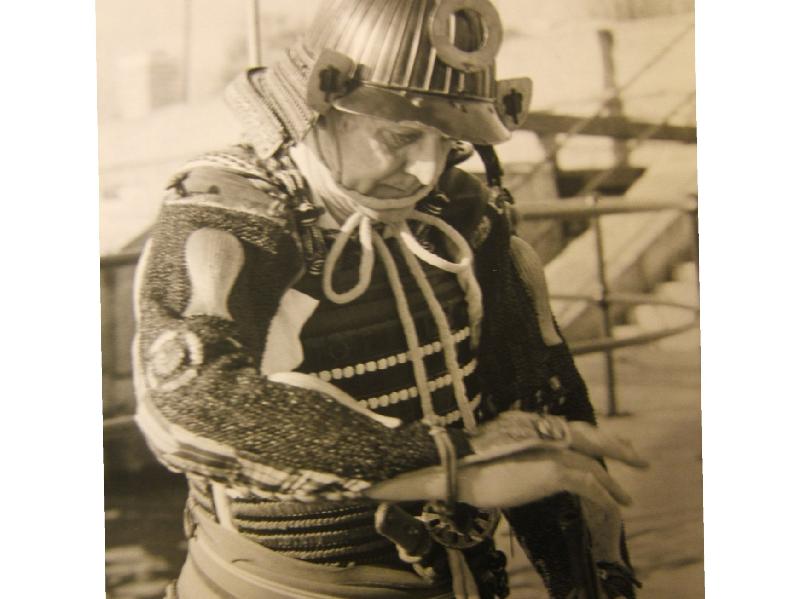
All, Not to be outdone, I am reproducing a couple of Daguerotypes of me firing and loading a matchlock. Of course there was no colour photography around in the 1870's so you cannot appreciate how colourful the armour is . Ian