IanB
-
Posts
1,778 -
Joined
-
Last visited
-
Days Won
23
Content Type
Profiles
Forums
Events
Store
Downloads
Gallery
Everything posted by IanB
-
This Week's Edo Period Corner
IanB replied to Bugyotsuji's topic in General Nihonto Related Discussion
Piers, After reading that translation, my k*ntama were already aching in anticipation!! The Royal Armouries has an original copy of the book illustrated by Kuniyoshi that originally belonged to Basil Robinson who wrote the definitive book in English on that artist. These mini-cannon are interesting but there is still the problem of where have all the old muskets gone. Were they really melted down for scrap? Somehow I think not. Here is another possibility - in the early Meiji period thousands of okkashi-to were sold off to (a) South East Asian country (ies). I believe a large batch were discovered in Thailand or somewhere similar about 10 - 15 years ago. Could a lot of the old munition guns have gone abroad somewhere? I don't know but it is a possibility. I have also seen an old hinawaju barrel re-used for centrefire cartridges by fitting a Snider breech and re-stocking. I wonder how many of those were produced. Ian -
This Week's Edo Period Corner
IanB replied to Bugyotsuji's topic in General Nihonto Related Discussion
Eric, A lot of guns aren't signed and I doubt that many of those made for mass orders would be. Also, unlike swordsmiths who have been recorded to death, although we know a lot of gunmaker's signatures, and Piers can correct me on this, I am not sure we know the dates when many of these guys worked. The same situation applies to a lot of armour makers - so much armour is unsigned and so much was recycled in a new guise. This did not always mean the whole piece - they would break up old do and re-use the individual plates, even cutting them up to save having to forge new plates. Ian -
This Week's Edo Period Corner
IanB replied to Bugyotsuji's topic in General Nihonto Related Discussion
Piers, You pose an interesting question. You are correct that many guns would be lost or destroyed as a result of battles but most would be collected up afterwards since they were valuable weapons and would certainly not be dumped or melted down. Don't forget the Tokugawa were paranoid about being challenged for many decades after Seki ga Hara. No doubt many guns ended up on racks in castles - I remember seeing racks for hundreds of guns at Hikone, but the Ii were Fudai Daimyo and it is natural they would be allowed to keep plenty. Although I have no proof, my guess would be that the Tokugawa would collect up as many guns as possible and stash them away in case of trouble, to arm the Tokugawa armies. Saris in his diary for 1613 mentions a vast Tokugawa force (many thousands) posted near Osaka and relieved each year by others whose task was to sweep into Osaka, Shikoku or Kyushu if trouble arose. No doubt such a force would be kept in-being during Hidetada's reign and possibly even Iemitsu - both of whom were terrified of a Portuguese / Japanese Christian alliance mounting a coup. There is also the fact that a lot of guns were decorated at a later date, and possibly restocked and generally re-furbished for use in parades and so on. Would we recognise these as being esentially old guns? Ian Bottomley -
Big exhibition in Paris
IanB replied to Jean's topic in Sword Shows, Events, Community News and Legislation Issues
Uwe, I don't think the mail is attached to the men itself. It is very heavy mail and I think it just hangs from the nose piece. My guess is that mail is very near rigid and just hangs over the mouth opening. You do wonder why it was made. Obviously a very special commission . Ian Bottomley -
All, In general I have not found black lacquer to be a problem provided it is sound. Red is a nightmare as I said before and gold lacquer I leave well alone. The gold layer is so thin it is so easily damaged. Tony's comment about nicotine is interesting because you do get a brown gunk off as you clean dirty lacquer, but in some cases I think it is the degradation product of lacquer itself. You would have to chain-smoke for decades to get off the quantity that sometimes occurs. I have heard of vegetable oil being used, and once tried wiping black lacquer with a tissue having a smear of olive oil on it. Initially the result looked good, but it soon went patchy. There is also the dilemma of whether to wax the lacquer after cleaning black lacquer. In the past I have done it and it doesn't seem to have done any harm. As I said, I do it if I have cut off the upper layer of red lacquer, but no longer use it on black, just buff it with a soft cloth. I store my bow (I only have one now) horizontally on two pegs - what else can you do with the wretched things - they are so unwieldy. And yes Tony, I should be going to the next Birmingham. Ian
-
Ron, As John says, lacquer will stand water, acids, alkalis and solvents --- but only if it is intact. It only takes a crack and water will get in underneath. To be safe, use alcohol on cotton wool. If you have patches of persistent dirt and you can see the lacquer under them is sound, wet a cotton bud with saliva and rub it around. The enzymes in spit work wonders. I have not yet found a satisfactory cleaning agent for red lacquer. Our conservation team tried all manner of way to clean up an Ii family helmet done in red lacquer. I have had the same problem with the inside of face masks. The problem seems to be that the lacquer is so heavily loaded with pigment that the dirt is absorbed by the particles rather than being on the surface. The only way I have managed to clean it, and it is drastic, is to use metal polish to cut off the top layer and then seal it with wax polish. You can get away with it once if you are careful but I really don't recommend it. Ian
-
This Week's Edo Period Corner
IanB replied to Bugyotsuji's topic in General Nihonto Related Discussion
Piers, Far be it from me to do that to you. However, wrapping a well known kamon with the leaves or flowers of another kamon is not uncommon - See Eiyu Tasano Kamon where there are plenty of examples. However, Nobody seems to have wanted to wrap the Shimazu with anything. I have been through almost all my books on kamon and yours isn't there so you can keep breathing. Ian -
Hawkins, Yes this is real cloisonne and is a Meiji export piece. You can see the cloisonnes at the mouth of the scabbard where the koiguchi is missing. Many years ago there was an enormous one sold at Christies (?) in London about 10 foot long. I remember seeing it hung on the wall during the viewing. Brought a fortune as I remember. Be very careful with the mount - when damaged cloisonne work loses a great deal of its value. The missing koiguchi should be easy to replace since I note the fittings are plain. Despite being export ware, these items seem to fetch a great deal of money in auctions - so well done you. Ian Bottomley
-
This Week's Edo Period Corner
IanB replied to Bugyotsuji's topic in General Nihonto Related Discussion
Piers, I take your point about the silver plate being underneath as being visible when loading. However, it is also visible in that position when guns are stored in a vertical position. Many regimental markings on European guns are either on the trigger guard or underside of the stock because when placed in a rack, they sit best with the top side facing the rack. It was also normal to thread a chain through the trigger guards as security - hence the underside of so many munition weapons look as if they were used crack walnuts with. Ian B -
Metallurgy seminar at Leeds
IanB replied to John A Stuart's topic in General Nihonto Related Discussion
All, I worked with Dave Starley for years and we did some interesting work on armour plates, yari and other topics. If you can get there, I would recommend you do so. Sadly I will be elsewhere on a long-standing commitment. Ian Botttomley -
This Week's Edo Period Corner
IanB replied to Bugyotsuji's topic in General Nihonto Related Discussion
Piers, Dutch metal is a cheap alternative to gold. It is a brass (84%Cu, 16%Zn) that can be beaten into leaves similar to gold leaf but a bit thicker. It does tarnish eventually, but keeps bright a very long time. Ian -
This Week's Edo Period Corner
IanB replied to Bugyotsuji's topic in General Nihonto Related Discussion
Eric, Thank you for the link. Now at last I can feel confident in fitting these items onto a pole and sticking them on the backs of some armours. Still haven't found No3, but it is there somewhere. I have another sashimono doo-dah in the form of a pole with a small trefoil finial that once sprouted a spray of bamboo and paper feathers. I have made one new feather (they were all missing) and I am begining to get the urge to complete the rest. Like my poor tiger's tail, the feathers will need a lot of gilding - might use Dutch metal what with the price of gold today. Ian -
Ed, This is clearly not a Chinese fake but a military or semi-military dirk of some kind. It is obviously related in style to the more usual naval dirk but the bamboo decoration is in contrast to the more usual cherry blossom motifs, and most naval dirks have a same grip. I wonder though about the originality of the kashira. It does differ slightly in patination from the other fittings and I wonder if it was originally from something else - although it is consistent in style. Note how the border and double volute above the cut-out is engraved on the kashira, but apparently in slight relief on the other fittings. I have seen a dirk, can't remember where, with a turtle-shell grip with three cherry blossoms along its length but not being terribly interested in military items, virtually ignored it. As for its age, I suspect it might be Taisho or early Showa rather than Meiji Ian Bottomley
-
This Week's Edo Period Corner
IanB replied to Bugyotsuji's topic in General Nihonto Related Discussion
Piers, No, sadly it was missing when I got it. It had a rather poor attempt at repair using a bent twig covered in gold paint, but it looked so wrong so I removed it. I can do a new tail with no problems, but imitating the bright gold lacquer .... I am not sure how that might be done. Ian -
This Week's Edo Period Corner
IanB replied to Bugyotsuji's topic in General Nihonto Related Discussion
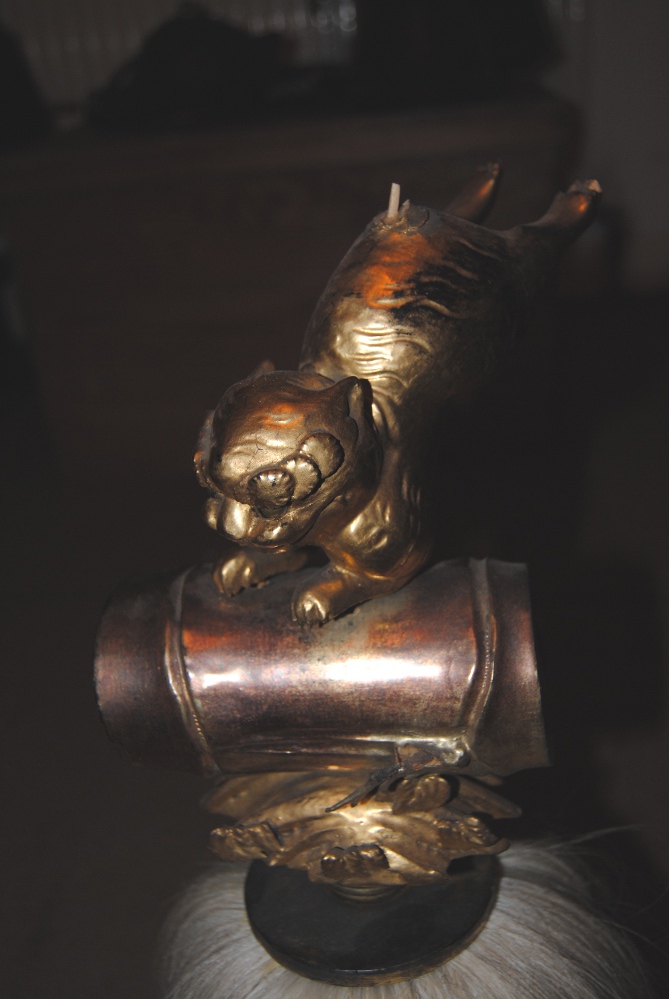
Piers et all, Sorry for the delay in getting these images on line, but life throws up too many distractions. For some reason I cannot find the third one. I know it is in my armour room somewhere, possibly in a box, but which one? The tiger leaping onto bamboo is about 24" high from the base of the stand to the tiger's hind legs. As you can see the poor creature has lost his tail. The drum on a stand is nearer 18" high. When I find the fan one I will add it since it is most like a regular matoi finial - three sided with a kamon on each face. It has two discs like the others but no hair and may well have had cloth or paper streamers. From memory it is about the same size as the drum one. Ian


-
This Week's Edo Period Corner
IanB replied to Bugyotsuji's topic in General Nihonto Related Discussion
Piers, I will do that. Out of curiosity, what did you think it was? Ian -
This Week's Edo Period Corner
IanB replied to Bugyotsuji's topic in General Nihonto Related Discussion
Piers, Well, well. I have three of these objects, two being mounted on squares of wood with a rough spike to hold them upright - but sadly no boxes. The subjects of mine are: a tiger leaping onto a section of bamboo, a drum on a stand and a fan. The first two have the discs below the lacquered objects with fringes of hair sandwiched between them and the bamboo tubes are pierced for a retaining pegs. Exactly what they are I have never been sure about. They may be sashimono in their own right, or just the tops for sashimono poles, or maybe for banner poles but mine would seem to be a bit small for that. I suspect they are the former - see the famous Nagakute screen where almost all the samurai have a gilded object on a pole rather than a hata sashimono. There are fish, baskets, scale weights and all manner of objects. I would be grateful to learn what you can find out about them. Ian Bottomley -
Gents, you are missing the fact that it isn't a simple kirimon but has further gentian leaves hanging below. No idea what it represents but I suspect some Taisho or early Showa organisation. Ian B.
-
John, You may be correct about the covering of the helmet. I have however seen a fabric covered one, I think in the Watanabe Collection in Tottori. You are right about butted mail - it just opens up if pierced. The Japanese did make riveted mail but it is as rare as hen's teeth (see earlier posts). However, since Japanese mail is always sewn onto a backing, it doesn't open up in the way that un-backed butted mail does. Ian B.
-
Eric, Never seen anything like your 'hook / spike' items. The hook bits look a bit sharp for hanging on your belt - could they have been some form of tool? The one with the spike may have fitted into a wooden handle whereas the other has an integral one. As for the helmet - what a fabulous item. I suspect it may have been originally covered by something else. The quality of the sewing and the materials of the shikoro are far higher than the present outer cover. Do you thing it might have had a padded cloth cover originally? I have a mail hood with a little leather peak attached - but interestingly with sections of deer antler fastened over the temples. It also has a hemp cord, covered with leather, that fits into the nape of the neck to hold it on. Rather an odd arrangement but it presumably worked. I have seen old bows made into riding whips and once into a walking stick. I agree that the spirally lacquered truncheon seems to have been made from a spear shaft. You cannot beat re-cycling. Ian Bottomley
-
Mark, Yes. Lamellar armour occurs in many early Persian paintings and all over the Middle East. In many cases it was replaced by mail at a later date, often with plates over the vitals (see Mamaluk and later Turkish armours). Lamellar was the ideal type of armour if you did not have access to metalworking facilities capable of making reasonably sized lumps of iron. You can make it out of small scraps of metal, rawhide, bone, antler or even hard wood. We have an early Chinese armour in the Royal Armouries acquired in the 19th C. made of red lacquered rawhide scales. It is of the same form as the two pictured above but without the 'shields' and with the addition of shoulder guards and a rawhide multiplate helmet. The coat part has been relaced several times and some of the scales are replacements but the shoulder guards appear to have the original lacing. Although rawhide lamellar is reasonable, when its made of iron it is unbelievably heavy. We have one from Tibet (that may be Mongol) and it is a nightmare getting it on and off the dummy. Piers, the 'shields' occur on several types of armours. Some Pacific island peoples had armours, of coconut fibre, with a standing shield behind the head to stop the wearer being accidently hit by stones thrown by the women folk, who followed their husbands and contributed their bit to the action. In the case of these Asian armours, the 'shields' are primarily arrow protection. By slightly turning the body when you see an arrow coming at you, they protected the head and face. Exactly the same idea was used by the Japanese with the fukigayeshi of Heian helmets. They stuck out at right-angles from the sides of the helmet so all you needed to do was turn your head and they covered your face. Ian Bottomley
-
Eric, Looks like what you have there is a jute made from a yari shaft. It clearly has the original kabura maki and a hadome. Perhaps it was used by a village headman who couldn't afford a real jute but needed one for his badge of office. Ian Bottomley
-
All, Now that 2012 has arrived here in the UK, let me wish all of the members of the NMB a successful, harmonious ( ) and happy New Year. May you all acquire the item on your dream list. Ian Bottomley
-
John, Lamellar armour actually has its origins in classical antiquity. I was fortunate to be present at the examination of a lump of mud from the Roman Fabrica at Carlisle that supplied the western end of Hadrian's wall. You couldn't see much, but an X-ray revealed three curving rows of scales from a throat guard. As soon as I saw the image I said 'NODOWA' - the archaeologists poo-poo'd the idea since according to them the Romans didn't use throat guards. Eventually they decided it was a neckguard from a helmet, but the inside curve was far too small. Rather satisfyingly, a tombstone turned up a bit later showing a warrior wearing -- guess what ? Yup a scale neckguard. This Roman lamellar, including lorica squamata (and part of one of these turned up at Carlisle), was of iron or bronze scales held together by turns of bronze wire - almost certainly on a leather or fabric backing. Following the Romans, the idea spread eastwards and lamellar coats fastened down the front occur in Turkey, Persia and Central Asia, ending up in China and finally Japan. These were held together by leather thongs and a lot survive from places like Tibet. Interestingly, only one occurrence is recorded from Europe - from the grave pits from the Battle of Visby on Gotland (1361). The Scandinavians travelled through Russia and traded in Constantinople. Almost certainly the lamellar armour came from there. Ian
-
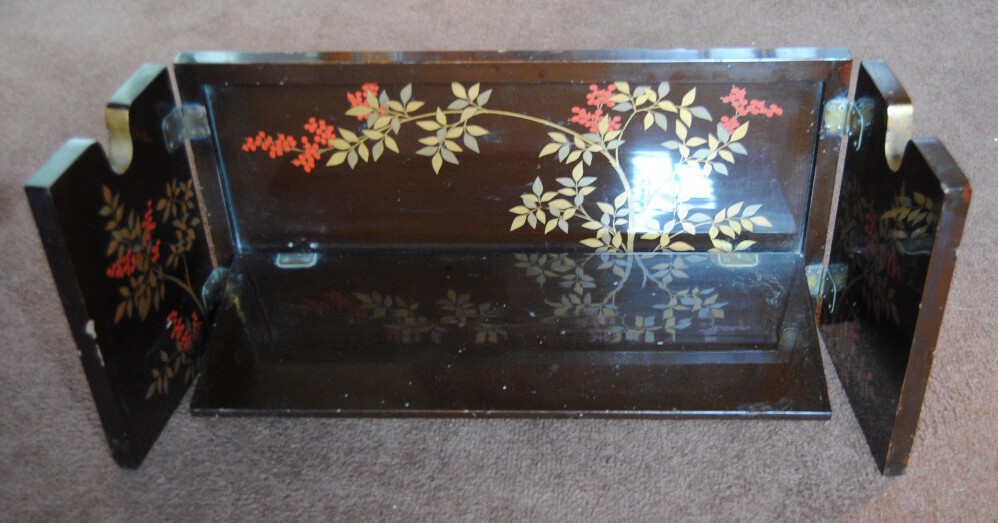
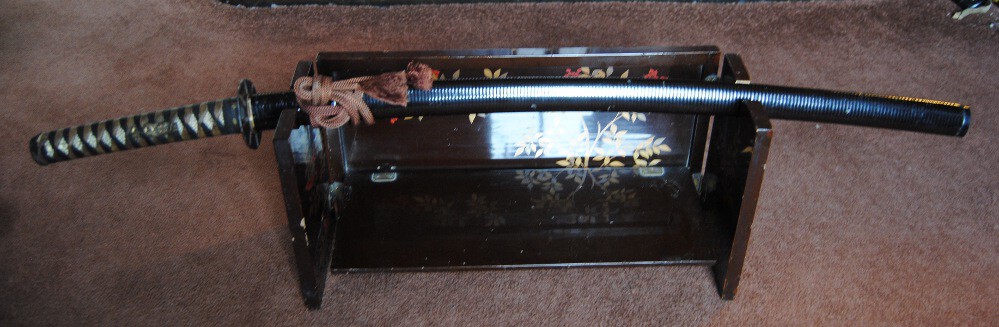
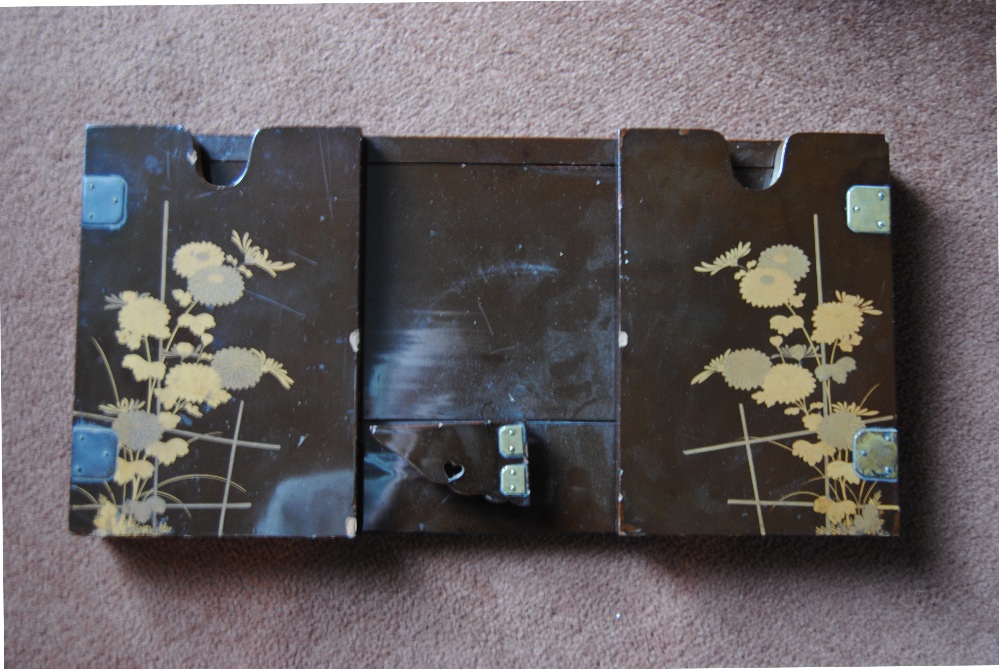
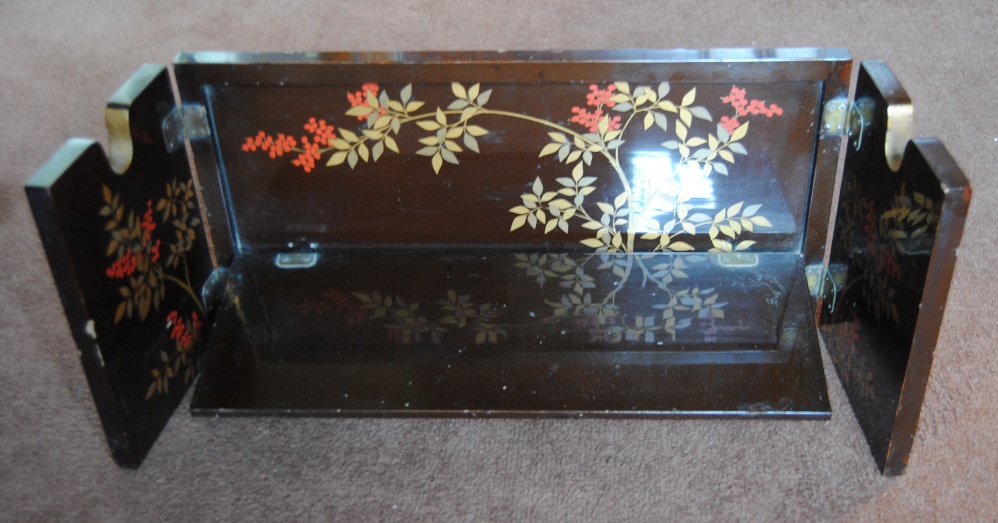
All, Herewith a somewhat different folding katana kake I bought a couple of years ago from dear old Po of blessed memory. It was a Christmas present from me to me - always better than socks. It was missing a couple of hinges when I bought it, but a few hours with sheet brass soon fixed it. I just love the lacquer work, which is as good on the back as the sides. The fold-down shelf part is recessed into the back part when folded up. I have a theory (and that is all it is) that these folding stands may have been used in inns for when a samurai was staying. They store in a small space but could be put out in a room when needed. I'm probably wrong on this but who knows. Ian Bottomley