Marius
-
Posts
3,212 -
Joined
-
Last visited
-
Days Won
26
Content Type
Profiles
Forums
Events
Store
Downloads
Gallery
Everything posted by Marius
-
That explains everything. The bullet wound is interesting, nevertheless. I am just a bit wary of the romantic notion of battle scars. That is why I think that this thread has a rather low educational value.
-
So you want to see more pictures because the article on Usagiya's site has intrigued you? Any particular reason you want to see battle scars? Will you or other members learn something from it? Do you want to be able to tell a battle-scar from a flaw? This is easy to do. Too many idiots ruining swords by hacking bushes, cardboard, PET bottles etc. OK, these are not exactly battle scars, but hard to distinguish from such. You get: hagire bent blade (shinae when straightened) broken blade hakobore kirikomi (I wonder how easy one can produce fake scars) But watch out - a blade can break even if the samurai was trying to hit a dog with the mune of his sword (http://www.nihontocraft.com/Suishinshi_Masahide.html) So don't go into raptures if you find a flawed sword. It might not be a battle scar, after all... What else do you want to know? BTW - I am overawed by the "bullet" pics shown by Thomas. How romantic. This must have been a very considerate bullet - it has left the patina intact. Sorry to be sarcastic, Thomas, but the patina on your nakago looks strange.
-
Rick, can you post the dimensions please? Nagasa and motohaba being the most important.
-
Nondescript, late Edo, run of the mill tsuba. "Factory" iron. Mass product.
-
Grev, The two overlapping circles (I know, they are elypses) are reminiscent of wachigai. The honeycomb on the seppa is a tortoise shell.
-
Thanks John, Do you remember if those koshirae with maru tsuba were tachi or uchigatana? Judging by thickness, I would suppose tachi...
-
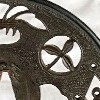
Henry, your tsuba certainly looks like the one on Suenaga Takezane's scroll. It seems very likely that it was mounted on a tachi. There are four forms of tsuba, which were mounted on early tachi (I have excluded the kara tsuba and the Tamuramaro sukashi tsuba from this list): shitogi, genshi aoi, aoi and aorigata. We also have thisinteresting picture of Ashikaga Takauji holding a huge sword in his right hand, a regular tachi hanging from his belt. The large sword could be a nodachi - it has a large kuruma sukashi tsuba. After you visit the shrine, please do not forget to post your findings :-)
-
Henry, your tsuba always makes me Fact is - we have no idea on what kind of sword those ubu tsuba with no hitsu-ana have been mounted. We can only speculate - tachi? nodachi? nagamaki? uchigatana? I guess the only way to learn is to get information on swords which rest in various shrines and temples. There are actual fighting weapons, not only those made specifically as offerings. Sakanoue no Tamuramaro's tachi with a very imporatant iron tsuba is an example here. Jim Gilbert has shown an interesting example of a tachi mounting with a nerikawa tsuba, in th Oyamazumi Jinja: http://home.earthlink.net/~jggilbert/nerikawa.htm
-
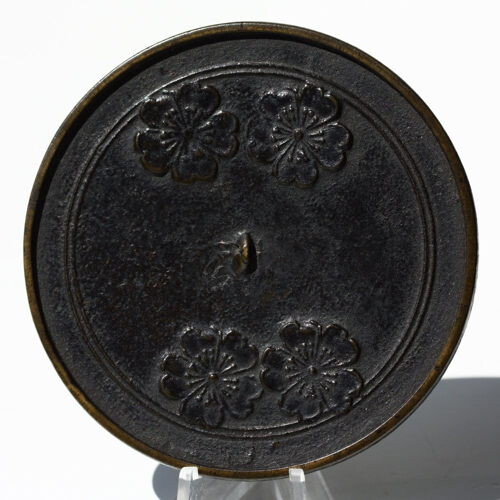
# 2 - variation of the wachigai crest. The kakihan depict kikko - tortoise shell. Not necessary a mon, just a symbol.
-
dumb question regarding seppuku
Marius replied to Marius's topic in General Nihonto Related Discussion
Thank you, Kunitaro-san :-) -
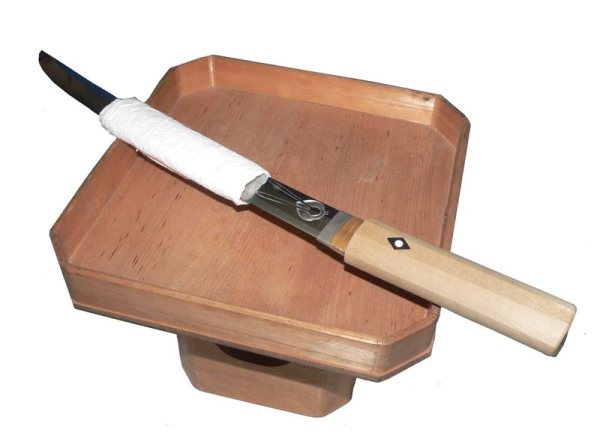
Gents, During the seppuku ceremony there was a stand for the tanto. The samurai committing seppuku would grab the tanto with his left hand, put it in his right hand and then grab the stand with his left. He would tuck the stand under his buttocks to keep him from falling on his back. I believe the film here shows it quite correctly (WARNING: not for the faint-hearted). https://www.youtube.com/watch?v=SVE7aqrva0g I have attached a picture of the stand. Question - how is this stand called in Japanese, please?

-
I guess he was trying to say a bright nijuba hamon, that is all. Care to share your ko-Mihara with us? I like this school and the swords are not expensive compared to more popular schools.
-
No problem Alex, it is good to discuss these things. I just thought that we had better keep the discussion on track. I am just too serious at times and too full of myself :lol: In this particular case this may be due to the fact that I have just held a lecture on the development of tsuba between from the 8th to the early 17th century and uchigatana played an important role in this context. But since this is turning into a conversation of my humble self with Henry, heck, why don't we go wild! Why not speculate why they didn't use tanks or something
-
Thanks for the cross-link, Henry. It is very useful.
-
Alex, Uchigatana are known from the Heian period, when the katana as we know it today was nonexistent. Musings on shields make no great sense without knowledge of samurai warfare, tactics and weaponry. (BTW, you might be surprised that Yayoi period warriors, who were no samurai, of course, have used wooden shields). Besides, my post was meant to show people that the uchigatana has appeared pretty early.
-
6, 7 and 8 - please look into Japanese familiy crests: 6 has suhama and a variation of bishi (don't know which). 7 has a crane, sangaibishi (NOT lightning), and paulownia. All are crests. 8 tsuta (sort of ivy)
-
You can find a pic of nijuba here: http://www.nihontocraft.com/nihonto_hamon_hataraki.html BTW, nijuba is a kantei point for Yamato and Yamato-influenced blades.
-
Nijuba - double hamon. But this reflection you are referring to is just the effect of using a scanner. In the pics you cannot discern a hamon. What you see is kesho polishing. ko-Mihara? Good choice :-) You have certainly read this article: http://www.nihontocraft.com/Mihara_Nihonto.html
-
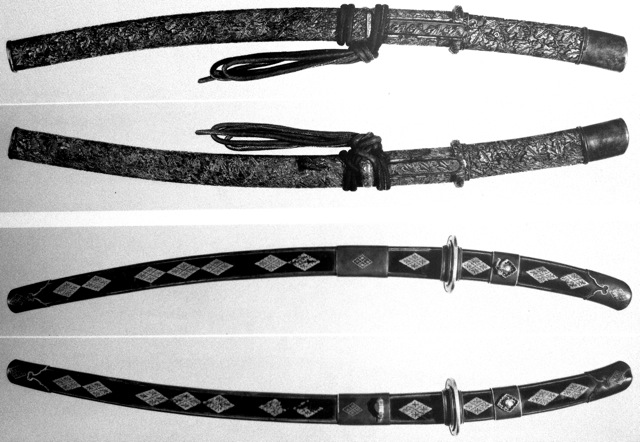
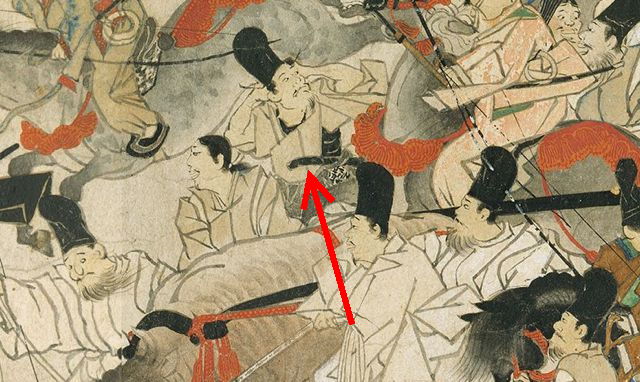
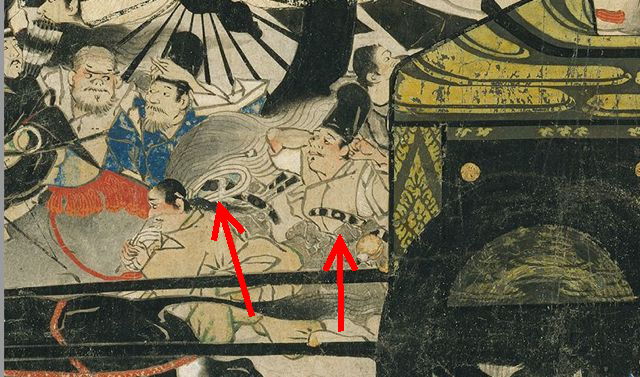
And here is a kebiishi from the Ban Dainagon scroll. And two early uchigatana published in the "Uchigatana Koshirae" book by the Tokyo National Museum.


-
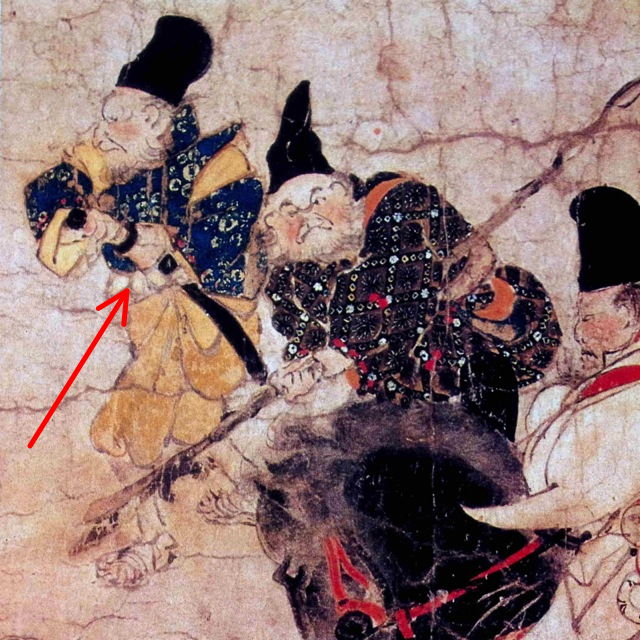
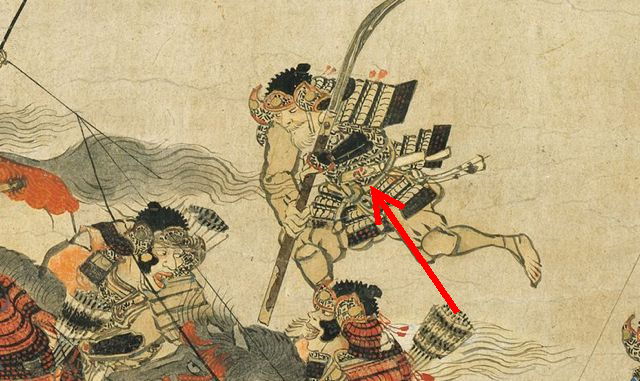
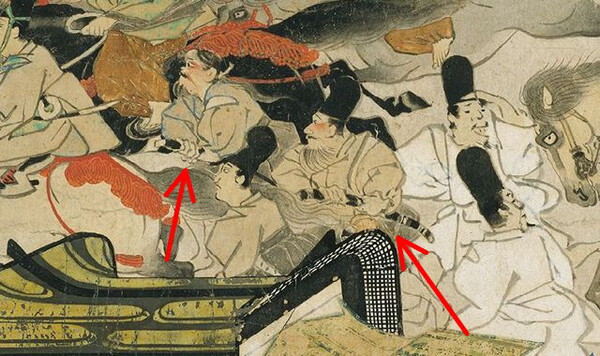
Gents, whoever wants to see some early uchigatana in Japanese scrolls, is encouraged to look at the Heiji Monogatarki Emaki (Heiji scroll), which is shown in great detail here: http://www.bowdoin.edu/~ktravers/projec ... intro.html Please go to the interactive viewer: http://www.bowdoin.edu/~ktravers/projec ... iewer.html I have found a few instances where footsoldiers (apparently of lower rank) carry uchigatana. Now, early uchigatana were pretty short, comparable to the later wakizashi companion sword. The scroll describes events of the Heiji disturbance in 1159 (i.e. in the Heian period), which were the interact to the Genpei war. The scroll has been painted in the second half of the 13th century, i.e. in the Kamakura period. I have chosen all views of uchigatana I could find. Uchigatana are also to be seen in the Ban Dainagon scroll (http://en.wikipedia.org/wiki/Ban_Dainagon_Ekotoba) - the kebiishi (police and judicial officers in the Heian and Kamakura periods) carry such swords and not tachi. Sasano has chosen exactly this part as an illustration of early uchigatana use in his "Tosogu no Kigen". On kebiishi: http://www.britannica.com/EBchecked/top ... 2/Kebiishi Please note: We are talking about the uchigatana being used as the principal and not a as a companion sword. The uchigatana depicted here have a pronounced curvature. They should not be confused with koshigatana, the forerunner of the tanto. It seems, that the samurai in picture 6 may actually be wearing a koshigatana as his principal sword. Enjoy :-)


-
Aaaaah! Thank you Alex! Photobucket has a crappy interface, but this is beyond criticism. What moron has designed this feature (or rather bug)? OK, here is my comment: Judging by the decoration of the saya and the mediocre workmanship of the kodogu, it is a late Edo, low/mid-grade koshirae. Don't ask me about a school. Rather gaudy, nanako work far from competent. Still, a nice find. Speculative mode ON: This kind of koshirae would be worn by a:
-
No sir, I view them on an iMac. My Photobucket pics are OK.
-
Alex, not a good idea. Cotton gloves are slippery, you risk dropping the blade. Just do not touch the blade with your bare hand, and have a piece of soft, white paper to rest a long blade on when viewing. If you have not read this manual, please do. Page 3 and 6 describe how to view the sword. http://nbthk-ab.org/pdf-files/swordcare.pdf
-
George, do not repair anything on the koshirae, please. You will diminish the value of the koshirae or even damage it. Best policy is to enjoy it as it is. Your pics are low resolution - it is impossible to say anything about the koshirae, sorry. Nice to hear that the pats are matching
-
No, no, I was warning you not to scratch your blade when trying to remove the stains with uchiko. Your stains are most likely someone's finger prints, which have resulted in rust. Could also be something in the saya, you never know