Marius
-
Posts
3,200 -
Joined
-
Last visited
-
Days Won
26
Content Type
Profiles
Forums
Events
Store
Downloads
Gallery
Everything posted by Marius
-
Jean, thanks, post adjusted. My spell-checker has let this one go unnoticed, but it was very obstinate when it came to correcting tanago-bara (thread the yahoo.co.jp Muramasa). It insists on tango-bars
-
Ko-Bizen, ko-Aoe, Awataguchi. Quiet elegance and superb workmanship (as Darcy has shown with his excellent pics of an Aoe sword). Unfortunatelly, I can base my opinion only on oshigata, descriptions and photographs. So, I am an armchair "expert" When it comes to "lesser" schools - at least I have had exposure to some of them. This makes me the worst kind of nihonto student - a semi-educated idiot (which is worse than an utterly uneducated beginner). I highly value Enju, ko-Mihara and ko-Uda. While ko-Uda has more rustic charm, Enju and ko-Mihara show an amazing precision of forging and the steel is something to behold...
-
Gents, this spot is tiny - this is a macro picture This is not umegane, just a burst bubble of spittle. Uchiko and oil should be quite enough. Alan, when handling a blade, always wipe it before re-sheathing.
-
Muramasa fever on yahoo.co.jp
Marius replied to Marius's topic in Auctions and Online Sales or Sellers
I must admit, I had that though, too, after a cursory glance, But I wouldn't be so sure if the second mekugi ana is proof of anything. If you look at the Okanehira (http://www.sho-shin.com/biz4.htm) you will see that two (or perhaps more, as they are overlapping) out of several mekiugi ana on its ubu nakago are in really strange positions (or so it would seem). PS: you have meant tanago bara and mekugi ana, of course :-) -
Muramasa fever on yahoo.co.jp
Marius replied to Marius's topic in Auctions and Online Sales or Sellers
You mean: "was the nakago adjusted to tanago-bara?" -
http://page6.auctions.yahoo.co.jp/jp/au ... enlargeimg
-
Wakizashi - identification
Marius replied to dynkykato's topic in Auctions and Online Sales or Sellers
Gheorghe, You are itching to buy a Japanese sword, aren't you. Well, don't do it. Buy and read some books first, and your first purchase won't be a waste of money. A list of books for beginners can be found on this forum. -
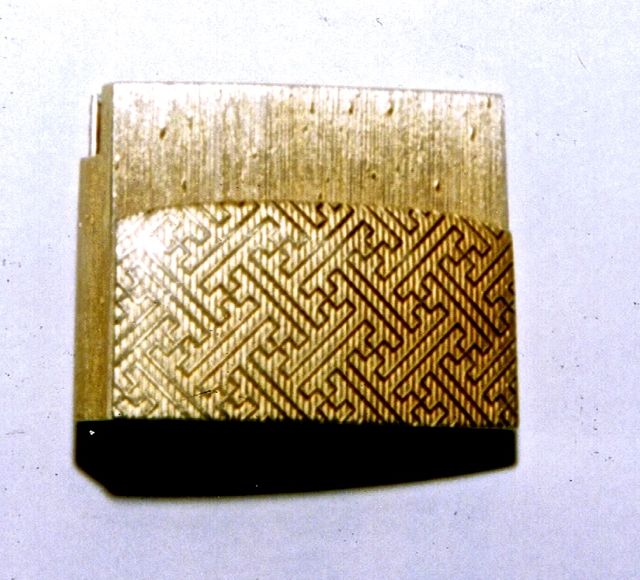
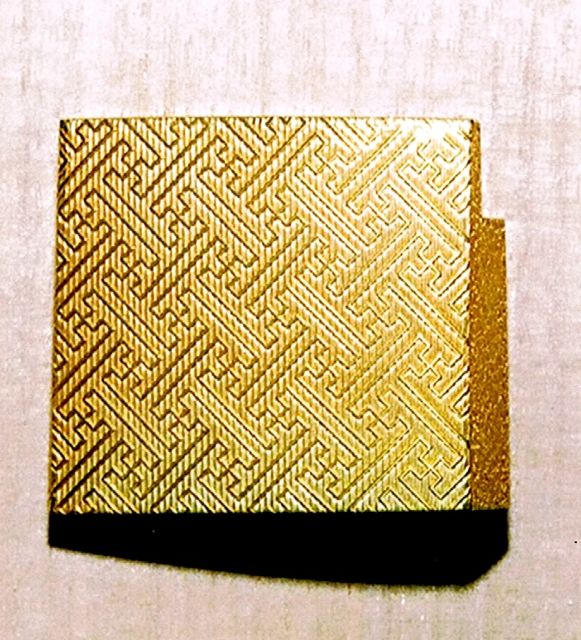
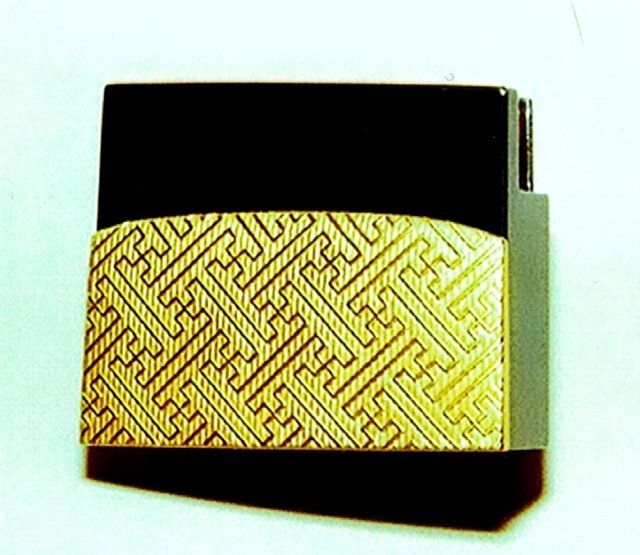
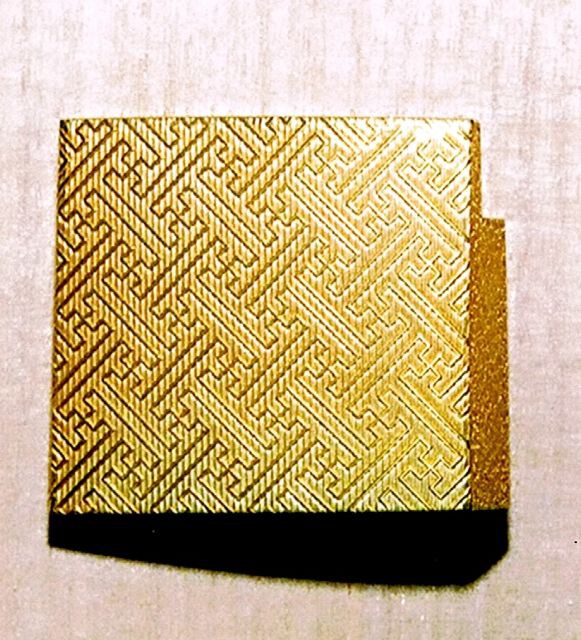
For your enjoyment, attached are pics of Brian Tchernega's manji habaki. The pictures are by Arnold F and the text is also based on what I got from Arnold: "According to Brian only he and his master are making habaki with that manji design. You would think that the perfection of the design comes from some sort of rolling process of a steel die over the sheet (of gold) but he says it is all done by hand" "#1 seems the most popular, while #2 is probably less common as everybody seems to put the highest "value" on type 1. However, the manji design he has learned from his master looks even more beautiful when seen on a larger field. (...) The blue-black part of #3 is shakudo that he makes with a high amount of gold. The sheets of gold are 22k." Enjoy :-) And.. many thanks Arnold!


-
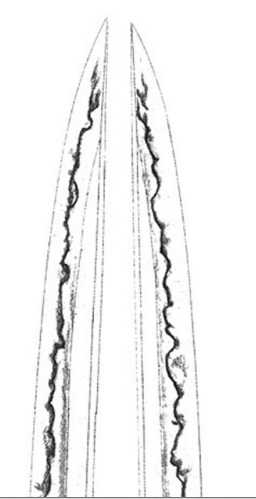
What about this one? It is a naginata naoshi, and I deliberately post part of the oshigata only... This looks very much like the tsuruginoya.com wakizashi... Very pointed, indeed...

-
What a waste of meteorite
-
I see. That would be a good definition of Satsuma-age. Thank you John :-)
-
http://www.tsuruginoya.com/mn1_3/a00259.html but this one seems to have a boshi? I even see a turn back... Not sure if this sword qualifies as Satsuma-age?
-
Brian, just so that the discussion does not end up in a "cute" and "nice" sort of fudge. I think all those pieces are pretty bland. Rabbits are nice kinko work done on a terribly boring iron plate. Boring and lifeless, so very... late Edo run of the mill tsuba. Sorry to be a contrarian. Better to study some real masters and not ... this. I am now ready to take the flak
-
Keith, can you be more specific? Who is selling what? Give us some pics, please, an we shall see if the items are real. futakoromono means a matched set of kozuka, kogai and perhaps also other parts of kodogu (sword fittings) I think you need some basic books about the Japanese sword and its fittings.
-
Online Arthur Church tsuba collection at the Ashmolean
Marius replied to growlingbear's topic in Tosogu
I am paying attention to the hammer work. And it does not look at all like any of the three/four Yamakichibei acknowledge by scholars (o-shodai, shodai, nidai and sandai). It is so... over the top, quite clumsy. Don't let yourself be fooled by the shape and design. This tsuba is interesting in its own right, but Yamakichibei? Nah. Late Edo, revival piece. Futagoyama at best... -
Online Arthur Church tsuba collection at the Ashmolean
Marius replied to growlingbear's topic in Tosogu
I dare say that the Yamakichibei from the Church collection looks like a late Edo copy. The hammer work is nothing that you see in the shodai or nidai, and the tekkotsu are wildly overdone. Yamakichibei experts, chime in, please? Thanks for sharing this excellent resource, Very good photographs, some interesting tsuba. -
Kyler, As much as I understand your desire to use a nihonto for iai, as much I would advise you against doing it (buy the sword, by all means, just do not use it for iai). The reasons are as follows: 1. You will affect the polish. 2. You will have to have a new koshirae made to use. Unless you settle for low quality, you will have to spend more than on the sword. BTW, kitae-ware are quite common in Koto. Not a big deal, to be honest. Oh, and welcome to club Once you have caught the bug, there is no cure
-
hint1: what metal (alloy) is it made of? Is that iron? copper? brass? or rather something else? look at the pores in the metal hint2: can you see how the gilding was done? Do you see the splatters? Does that look like good workmanship to you? hint3: carving: are those flowers really carved? advice: look at some real tsuba, buy some books. You'll get the hang of it very quickly
-
Dave, Chris is just stating facts. Nothing confrontational about that.
-
edited.
-
David, is that your pics or is the patina dry and uneven? Looks lie it has been re-patinated. I might be wrong, of course.
-
Ok. I got my Honzon Token and new questions :) ?
Marius replied to gauze3539's topic in General Nihonto Related Discussion
Arnold, do you perhaps have photos of this excellent two piece habaki by Brian? -
You are welcome, Henk-Jan Aikuchi seems a relatively "new" term, as is tanto. It is also worth to consider the "Kenshin koshirae" used with a long uchigatana - they have no tsuba...