Ford Hallam
-
Posts
3,091 -
Joined
-
Days Won
78
Content Type
Profiles
Forums
Events
Store
Downloads
Gallery
Everything posted by Ford Hallam
-
Hello Paul, I think you get the gist of my comments regarding black lacquered same and doe skin wraps on hilts. I've heard that suggestion that it denotes a retired warrior but frankly it never really convinced me. The use of lacquer as a waterproofing agent was very commonplace. Some years ago the Tokyo National museum held an exhibition of all ( as many as they could gather anyway ) the uchigatana koshirae that are still extant. Apart from those examples belonging to high ranking warriors ( and preserved in temples and shrines etc. ) the overwhelming "look" is of a plain black saya, black lacquered same on the tsuka, Doe-skin wrap, plain iron fuchi, lacquered buffalo horn kashira with the wrap over it and a simple ( often quite thin) iron guard. My impression of Hosokawa Tadaoki's personality is that as an veteran of many of the earlier campaigns his taste was informed but the utilitarian nature of these battlefield weapons, hence the adoption of certain traits. From the sounds of it your Tensho koshirae is spot on, as long as the hilt is well waisted, I think the waisting and significant flair at the kashira end is a real pointer to this style. The Higo hilt is quite a different shape. To be really accurate to period, a lacquered horn kashira to end off. Of course you can't go wrong with a good Owari guard. Jean, you are quite correct with your assumption. The area you are referring to is called " kozuka atari". It can be seen on fuchi from many different scholls. You probably also know that the Higo swords often include a unique implement called a "umabari" or horse needle, for letting blood from the horses legs! These would often take the place of kozuka or kogai. regards, Ford
-
Hi Rich, I reckon you've been mesmerized by those Higo tosogu books of Mr Ito's, I got mine a couple of weeks ago. Absolutely fabulous!, thanks for the heads up there. I think it is actually very difficult to keep in mind a broader view of the subject while we inevitably tend to focus in on specific artists or schools, if only for a while. Ford p.s. Another fairly common Higo trait is the tendency to lacquer the same on the hilt black. This was common battlefield practice pre; 1600 and was intended to prevent the same from rotting in the often damp conditions while on campaign. The use of doe skin on the hilt dates from those time as well.
-
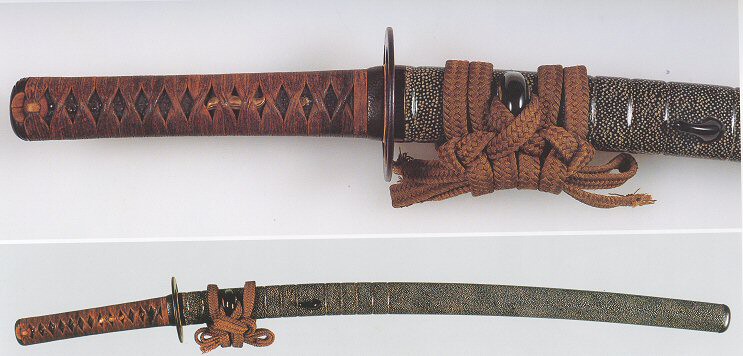
This is the aforementioned Kasen Koshirae.
-
In general I think it can safely be said that the shape of the fuchi and kashira used in the Higo style of mounting are quite distinctive. The fuchi has the so called, jar lip, shaped profile, ie; it tapers in toward the handle. The kashira is invariably of a rounded domed form. These traits are of course seen on swords from other areas but in Higo, after the time of Hosokawa Tadaoki, it would appear to have become "de riguer". The taste in Higo would also seem to favour doe skin for wrapping the hilt, and polished and lacquered same on the saya. Tadaoki's own sword, mounted in what has become known as the " kasen koshirae" style perfectly illustrates these traits. Tadatoki was a very influential leader, not only in Higo, and was hugely influential in supporting and encouraging the metalworkers of his domain. As an accomplished aesthete he no doubt had a major influence on their artistic expression and also the popularization of the classic Higo style koshirae. Ford
-
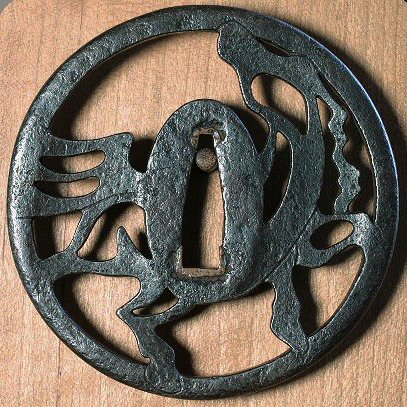
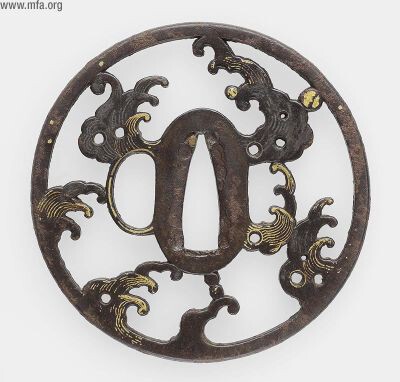
This image is of a very similar tsuba in the Boston Museum of Fine Art, there it's described as Kyo-Shoami, 17th cent. I think this is the most pleasing composition of the 3 in any case. Joe Earl told me that most of the attributions of fittings in the BMFA were made by Ogasawara. But as we all know, there will always be differences of opinion in these matters. With regard to the first tsuba that was posted though, I must agree with Rich T. and others who suggest a Choshu/Bushu feeling. What I find interesting is the possibility that the Boston museum example is possibly the starting point for this designs evolution. It seems to me to be an exceptionally well designed piece, It feels as though the maker was the original artist because the design has been so well understood. The later versions don't work as well, in my opinion, precisely because the makers didnt understand the composition, balance of elements and overall feel of the original Kyo-Shoami piece. This is perhaps a very good example of how popular motifs evolve, or devolve, over time in the hands of less inspired makers. The example Rick T. posted is an interesting exception, in that while it is clearly inspired by the earlier Shoami model it has a very distinct character of it's own and was clearly very well executed by it's actual designer. As such, it's an original too. Food for thought, maybe? Ford
-
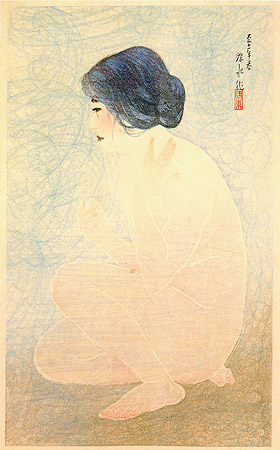
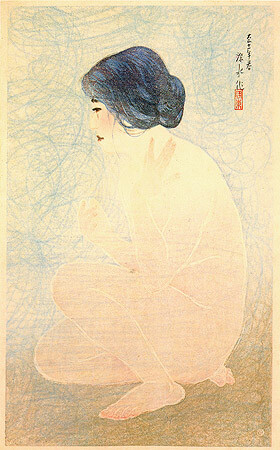
To add to the growing picture here's some more info. The apparent "collaboration" with Ito Shinsui would appear to be based on copying one of his paintings. Ito Shinsui was renowned for his :bijinga", paintings of beauties, including partially clad, or nude ones. He lived from 1898 until 1972. I've not found the actual painting that was used in this case but here is an example which may give you an idea, I believe it is a woodblock print, with hand finishing touches.
-
I've just realised, as my request to see the tsuba would indicate, that I didn't see the second page when I made my first post re; the hakogaki. Having now seen the tsuba in question I would suggest that it was produced in Japan, possibly by an amateur and most likely post 1950. And while not a daisho....that's still a nice pair. :D I would guess, based on having dealt with quite a few pieces of metalwork of this period, that what appears to be inlay in gold and silver is actually plating. An examination of the inner edge of the nakago-ana, where the silver of the figures reaches, may give a clue as to whether it's genuine inlay or not. cheers, Ford p.s. these ladies are extremely well endowed too, another dead give away! My research would seem to indicate that that would be a relatively recent possibility and is still somewhat rare. Also, a true appreciation of Japanese beauty should not require such blatant westernization.
-
Hi Bob, While the mei you've posted looks very nice indeed and I second Stevens appeal to" see it all", I have to agree with Rich (T) with regard to the hakogaki. The box is undoubtedly far too new and the ink is also far too clean and fresh. Smudged seals, particularly in such a garish red are always very suspect in my book. And finally, if you compare the style of brush work with the example that Pete Klein was good enough to share with us, they are demonstrably quite different. Taking the other factors, I mentioned, into account we must assume that Pete's one is the genuine one. This, of course, in no way means that the tsuba your hakogaki describes is in any way inferior or suspect in it's own right. that's my opinion, for what it's worth. cheers, Ford
-
Hello Koichi, I had also wondered about that gap that you mention. If there was a 5th cow then it would be placed in a very odd position, as it is, the arrangement is not very good but the missing one would make it very unbalanced. It is also difficult to see how this missing cow was actually attached. It doesn't appear as though it was inlaid, no cavity. That leaves us with the possibility that the cows are sue-mon, attached to the plate by means of a pin that passes through the plate, but I can see no hole. Was it simply glued on? this is the most probable answer. There is in fact a bit of pitch type glue residue in the area where the missing piece was. So it would seem that at least the maker had intended to have 5 elements. My comment about 4/shi is no longer relevant but I am still not convinced of its authenticity. I noticed that the vendors have a disclaimer on their ad. They won't vouch for its authenticity either. Anyway, I think I've said enough. I know I wouldn't pay one yen for something like this and I very much doubt that any of the regular posters on this forum would either. Some poor sucker will though. I'd also suggest that we may begin to see better fakes of this sort in the future too, they'll probably be described as "mid-Edo" :D
-
The tell tale signs are not in any way secrets that I wanted to keep to myself, rather, I didn't have time to go on at length last night. The most obvious technical point is the incredibly inept use of the chisel. This was simply not carved by any Japanese craftsman, in addition to which it's fairly obvious that whoever carved this didnt really understand the image they were carving, probably copied from a book. It's one thing to say a piece is of low quality but an entirely different thing when it has no real connection to the way the genuine article was made. The nanako is also very amateurish, the punch didnt indent the ground enough to produce a full bead. It looks a little like the sort of nanako you sometimes see in very early work. Whoever did this is clearly just getting to grips with the technique. The whole piece is made of copper, made to look like shakudo, gold and copper. If you consider the wear pattern it seems inconsistent that the horse/cow (?) which has evidently lost its gilding and is now showing copper also has a fake shakudo black. If that horse was supposed to appear as shakudo, why has it got traces of gold in the crevices? The horse/cow that appears to have no black on it has only copper and traces of gold showing. There are 4 creatures on this kozuka, 4 reads as "shi" in Japanese; this sounds like the word for "death" in Japanese. It's very unlikely a late Edo artisan would commit that faux pas. Admittedly shiirimono do appear to be rather sloppily put together but at least they were put together by people who understood the basics of the craft and the construction of the objects they were making. This kozuka really doesnt demonstrate that to me at all. One final thing to factor in to your consideration is this, given the guild type system that dominated the crafts in Japan in the past, it is highly unlikely some completely unskilled chap decided one day to start knocking out things of this "quality" without any apparent background or training in the craft. At the time of the haitorei it is estimated that there were some 16 000 metalwork artisans working in the sword fitting world, no place for someone so incompetent. but, this is obviously just my opinion. Each to their own. Cheers, Ford
-
hi Guys, Frankly I'm quite shocked at these images. Thinking about it though it was inevitable and means that this game is really no longer for the uninitiated. This seems to me, to represent a new level of faking from our mainland, Oriental friends. I won't go into major detail at this point but would like to draw attention to this (to me anyway) new area, and level, of fakery. There are in fact ( at this stage) quite a few tell tale "give aways" but it does suggest that these fellows are working hard to stay ahead of our game. As always, let the buyer beware! and never trust the apparent source of any items offered for sale on the net. It's not that difficult to hide your real location. so; be careful out there. regards, Ford
-
Hi Franco, I don't think it's very old but it's certainly not modern. If you consider the copper gilt inlay, each of those smaller pieces, and the large main piece, is true inlay. That is a lot of work, it would just not be cost effective today to use that sort of technique unless the end result would earn a decent price. Thats aside from the scarcity of skilled makers to do to the inlay. Admittedly, it's not of the highest quality in artiistic terms but I still see it as a genuine antique Japanese tsuba. Probably very late Edo; Bakamatsu period. I think the present condition is as a result, initially of neglect, ie; lots of excess rust, which has subsequently been stripped off with acid or something similar. This sort of treatment leaves the metal porous ( not a good thing ) and looking dry, this can then often appear to be a cast piece. Brian, in this case the inlay is, as I mentioned earlier, gilt copper. If the inlay had been brass and made as late as I'd imagine I'd suggest a revivalist Heianjo piece. But as to where it was made, that's probably anyones guess. Mine would be Kyoto. cheers, Ford
-
I will have to disagree with Franco on this one. I'm a little bothered by the pinkish 'highlights on the first image, could you confirm whether that is a image defect or whether there really is a copper-ish film on the iron as it seems. Having said that it would seem as though the copper inlay is genuine and that as you pointed out, there is a trace of gold remaining. I wouldn't be gold leaf but either mercury amalgam gilding ( fire gilding; kin-keshi in Japanese ). the proportions and overall shape of the tsuba is perfectly fine though. I don't see any reason to dismiss it as a Chinese fake at all. Judging from the state of the iron, if the image is to be trusted, I would suggest that it has been overzealously cleaned of it's patina in an acid dip. This would also explain the copper film, if it is actually present. If you put iron and copper in an acid bath together you will get an electrochemical reaction which results in the iron being copper plated. I'd be very interested to hear your thoughts on your tsuba bearing what I've written in mind. Hope this sheds some light on the subject. Cheers, Ford ( the tsuba making guy )
-
Hi Steven, I think Simon is absolutely correct with regard to the meaning of the marks but I would add that they are actually written ( or more correctly; brushed ) in sumi ink. It is pretty durable stuff, being composed mainly of carbon, and a bit of organic binder. Japanese artisans to this day will just as easily use a brush to mark something as a pencil, although they do occasionally cheat , by using bottled ink. :D cheers, Ford
-
Hi Steve, the kogatana , or any small blade without a mekugi ana, generally falls outside any production limits. This is also why apprentices are allowed to make them before they are qualified and licenced smiths, they obviously don't need to be registered in Japan. Cheers, Ford
-
Hi Anthony, I have a slightly different take on you kozuka. The areas of the design which are below the surface of the ground, intaglio or shishiai-bori in Japanese, is very characteristic of Sugiura Joi and his followers. He was a Kyoto based artist, who, along with Nara Toshinaga and Tsuchiya yasuchika made up the so called "Nara san saku"; the three makers of Nara. The use of iron in this way with quite high relief is actually somewhat reminiscent of Toshinaga too. The shape of the kozuka butt is Higo-esque though, Higo was close to kyoto so there could easily be some influence there. So I'd place it in that area and probably second half of the Edo period. regards, Ford
-

The way of warrior-samuraie on youtube
Ford Hallam replied to Bushido01's topic in General Nihonto Related Discussion
The film footage actually come from a BBC series entitled "The way of the warrior, the paradox of the martial arts" and was filmed a little over 20 years ago. The Katori Shinto Ryu is considered by many authorities to be one of the most well preserved classical warrior training systems. There are losses to the curriculum but never-the-less, it's methods and philosophy offer a fascinating and perhaps unique glimpse into the ways of the warriors of old Japan. These old schools ( koryu ) practice Iai-jitsu ( among other things ), which is the purely practical form of what has today evolved into the slightly more "socially acceptable" and less combatitive practice of Iai-do. Actually, for anyone interested in learning a lot more about Otake Shihan and the school, I would recommend this, as yet unpublished, book purely on the basis of previous offerings from these authors. Here's the link; http://koryu.com/new.html enjoy cheers, Ford -
Hi there , Mariuszk. Seems to me you've got a lovely looking blade the and it does indeed appear to exhibit a classic Hizen "look". You may find a bit more to whet your appetite on this somewhat specialised site, http://www.hizento.net/home.htm. congratulations on your new "baby", regards, Ford
-
Greetings all, I've recently posted a basic overview cum tutorial of sorts, on The Carving Path. I've tried to give a working description of the finer points of classical Japanese nunome zogan. While I'm aware that not many collectors and students of tosogu will actually want to try their hands at this sort of thing, I never the less thought it might provide a bit of insight into the process. So, for those of you interested, click here.http://www.thecarvingpath.net/forum/index.php?showtopic=902&st=0 regards, Ford
-
Hello Max, In my opinion it looks like the Kao was either cut with a round gouge shaped chisel or something like a ball burr in a Dremmel drill. This would imply that this rather poorly shaped and executed Kao was added by someone completely unfamiliar with the more usual Japanese metalwork techniques. It's hard to tell from the images you've posted but this would seem to make the whole inscription suspect. Just my opinion, cheers, Ford
-
Hi Milt, the design was actually based on a rearing horse in an Italian Renaissance painting! and thanks for the vote of confidence regarding the second tsuba. It has actually confounded more than a handful of quite senior "experts" both in the East and the West. So, honour is satisfied . Brian, thank you too, for the kind words, and yes, as I mentioned above, it's a rearing horse looking back over it's shoulder. and for anyone who may be interested, I've just posted a series of images and a basic description of one of the styles of nunome-zogan on a forum site for carvers in miniature. Click herehttp://www.thecarvingpath.net/forum/index.php?showtopic=902&pid=7518&st=0entry7518 cheers, Ford
-
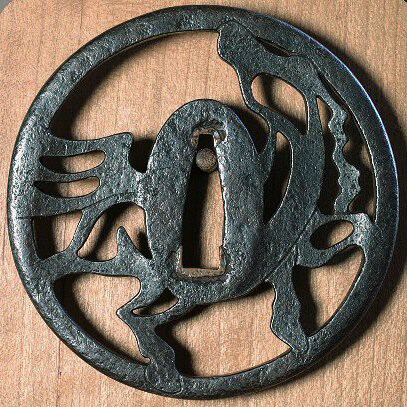
Thanks for the kind comments Rich. As I mentioned it was made in 1991, that was last century!, surely that's not modern? :D The patina was an experiment that didnt meet my expectations at all, far to dry and granular. So what would be the consensus of opinion on this one then? The colour shown in the image is pretty accurate, it is perhaps a little richer with some brown tones in natural light. This also exhibits fine layering on the edge. cheers, Ford
-
Morning everybody, this being the 2nd of April, the day after April Fool's day! I felt sure someone would call my bluff on this one. The tsuba is one I made in about 1991 in Cornwall, England. I have a sneaky feeling some of you may have suspected as much..... cheers, Ford
-
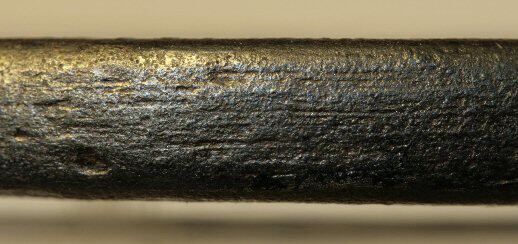
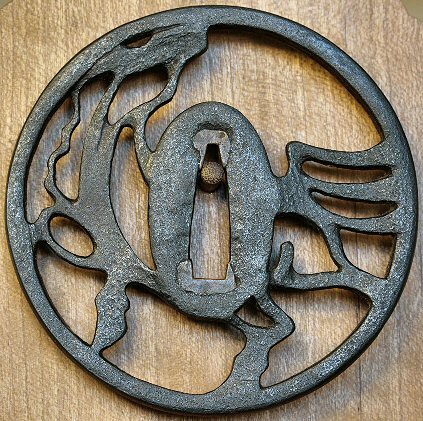
greetings all, Just wondering if onyone had any thoughs on this tsuba. The edge seems to exhibit layering/tekkotsu (?). thanks, Ford
-
The Bizen Osafune Museum is definitely worth a visit if you are in Okayama prefecture. I was artist in residence in a small museum there for a month last November so can heartily recommend a trip there. Do try to arrange your visit to catch the demonstrations though as that aspect of the museum is a major part of it's attraction. If you have any interest in pottery or are in desperate need of a good tokkuri and sakezue then you can travel to the next town along, Imbe. This is the home of the famous Bizen yakimono, wood fired local pottery which has been made there for hundreds of years. The town is littered with potteries and shops selling their wares. As for the sake, try Gozenshu's Yamahai. somewhat off post, sorry! but I trust of interest.