Ed
-
Posts
1,856 -
Joined
-
Last visited
-
Days Won
44
Content Type
Profiles
Forums
Events
Store
Downloads
Gallery
Everything posted by Ed
-
I have known the seller in question for somewhere around 10 years. He may be remotely located (I'm yet to figure how that plays on his collecting interests ??), but he is definately an honest, stand up guy. I'm sure if you have questions he will gladly provide answers.
-
Book Review - Gai Sô Shi by Robert E Haynes
Ed replied to Brian's topic in General Nihonto Related Discussion
My copy arrived today. :D -
Simon, Saw this post, and while this not exactely what you were looking for, I thought it may be of some interest to you. This is a Saneo from the period when he signed "Toshimasa". Sadly part of the mei was lost when it was cut down for mounting in a sword cane. The late Mr. Yoshikawa of the NTHK polished and papered it as well as did a sayagaki. It was published in the Token To Rekishi #580. Forgive me in advance as the photos are substandard. http://yakiba.com/Wak_Saneo.htm
-
Grey, I had a tanto with this inscribed on the shirasaya. The following is what I was able to find on it, might save you some time. Namu Myōhō Renge Kyō - 南無妙法蓮華経; Devotion to the Law of the Lotus Flower Scripture) is a mantra that is chanted as the central practice of all forms of Nichiren Buddhism. The mantra is referred to as Daimoku (題目, title; also, in some schools, O-daimoku: お題目) and was first revealed by the Japanese Buddhist teacher Nichiren on the 28th day of the fourth lunar month of AD 1253 at Kiyomizu-dera (also, Seichōji) near Kominato in current-day Chiba, Japan. The practice of chanting the daimoku is called shōdai (唱題). The purpose of chanting daimoku is to attain perfect and complete awakening (enlightenment). Namu: The words na and mu derive from Sanskrit. A close translation of its meaning is "to devote oneself". Nichiren established the practice of chanting Nam-myoho-renge-kyo as a means to enable all people to put their lives in harmony or rhythm with the law of life, or Dharma. In the original Sanskrit, nam indicates the elements of action and attitude, and refers therefore to the correct action one needs to take and the attitude one needs to develop in order to attain Buddhahood in this lifetime. Myoho: Myoho literally means the Mystic Law, and expresses the relationship between the life inherent in the universe and the many different ways this life expresses itself. Myo refers to the very essence of life, the mystic law which is "invisible" and beyond intellectual understanding. Renge: Renge means lotus flower. The lotus blooms and produces seeds at the same time, and thus represents the simultaneity of cause and effect. The circumstances and quality of our individual lives are determined by the causes and effects, both good and bad, that we accumulate (through our thoughts, words and actions) at each moment. This is called our "karma." The law of cause and effect explains that we each have personal responsibility for our own destiny. We create our destiny and we can change it. The lotus flower grows and blooms in a muddy pond, and yet remains pristine and free from any defilement, symbolizing the emergence of Buddhahood from within the life of an ordinary person. Kyo: Kyo literally means sutra, the voice or teaching of a Buddha. In this sense, it also means sound, rhythm or vibration. "When deluded, one is called an ordinary human being, but when enlightened, one is called a Buddha. This is similar to a tarnished mirror that will shine like a jewel when polished. A mind now clouded by the illusions of the innate darkness of life is like a tarnished mirror, but when polished, it is sure to become like a clear mirror, reflecting the essential nature of phenomena and the true aspect of reality. Arouse deep faith, and diligently polish your mirror day and night. How should you polish it? Only by chanting Nam-myoho-renge-kyo." —Nichiren, On Attaining Buddhahood in This Lifetime
-
In a word, WOW !! Due to a computer glitch, I have just been able to watch the video. Ford, your skills are truly transcendent. I am overwhelmed with every aspect of the project, from the time requirements, the patience, the skill, etc., etc.. Your ability to take a raw piece of metal and convey such a sense of life is astonishing. You deserve the highest respect, and you certainly have mine. Thank you for sharing.
-
Damn, Does that mean I will not be receiving the new home theater I ordered ??
-
This tsuba appears to be mokume, not carved to my eye. Generally, in carved examples the lines are much more prominent or exposed. Looks like tsuguhira to me, 継 平. Seppa - no clue, but looks like regular seppa would work resting flat against the high points. I have one shaped like this as well as two other mokume tsuba, all by Tsuguhide.
-
I just wanted to inform the sword community of the passing of Dean Hartely, Col. USMC Ret. Dean passed away early this am. Many knew him, many more knew of him. He was one of the US sword communities forefathers. He was President emeritus of the JSS/US and was instrumental in the formation of most, if not every sword club in the US. Dean was like a father to me, having been a friend and mentor for many years. He was a gentleman and a scholar, and will be dearly missed.
-
If you are looking at restoration then selling, depending on what you have in them, plus restoration costs, I think you will have a hard time recouping your money. Imho neither look worth spending money on restoration, but I respect a man's right to do what he pleases with his own money. Not like Obama wanting to rebuild Haiti with money we don't have !! (yeah, yeah, I know stay on topic) What was interesting to me is that the one with the turtles, depicts "soft shell " turtles. I have never seen that before, very unusual.
-
Stephen, Keep looking, maybe by the time you find one my new pond will be full of water and fish. Then you can mosey down south, sit on the bank and catch a mess.
-
Peter, Very nice, the nie has formed gorgeous sunagashi. Thanks for sharing. Jean, Wow, very evident in peters eh ??
-
Grey, I have sent 4-5 swords to France, without difficulty. Sounds like Jean has given you all the info needed. The only thing I would add is with the "proforma" or Invoice. I always attached one to the outside of the box and boldly mark it "Customs Invoice" and also send a copy via e-mail to the customer to have when claiming the item.
-
Florida Sword Show
Ed replied to Ed's topic in Sword Shows, Events, Community News and Legislation Issues
Some of those older guns mentioned, like the Le Mat, or your Colt Patterson should be allowed as they are percussion guns and don't use a cartridge. Funny you should mention a Le Mat Jean, I was looking at one a few weeks ago. Guy wants to sell, but it has a lot of pitting and he wants a lot for it. You know it's designer Jean Le Mat resided in New Orleans, and it was designed with the help of General Beauregard of the Confederacy. It was a great gun, nine shots, plus one round of 16 ga. buckshot from the second barrel. Kind of gun you want at the poker table, -
Mark, George , Thanks for sharing, Nice Tanto's. Jean is right, scanners if used properly can produce quiet satisfying results. Personally, I prefer photos(if they are good). I think the problem with George's photo it was not photographed or save with high enough resolution, making the photo impossible to enlarge without it becoming grainy. Jean, I don't really know how to reply to your nie question. It would be quite a task to research enough period pieces to establish a pattern regarding nie vs nioi in shishinto yoroi doshi and the smith's rationale behind it. To me, I would venture to guess that it was a matter of school/smith preference/ability or as you said perhaps something related to the period or style of the times.
-
Florida Sword Show
Ed replied to Ed's topic in Sword Shows, Events, Community News and Legislation Issues
Bummer, I wouldn't want to see it turn into a modern gun show, however I would like to see cartridge era guns like Sharps carbines, old Winchesters, Colt pistols, etc.. -
Mark, You have me on the ammo point :lol: . Seriously though, I know the importance of a good knife and if I had to choose between gun or knife in a survival situation it would be the knife without second thought. In years past I was able to participate in a few Tanto jutsu seminars as well as spend some time in Batangas Phillipines where they are notorious knife fighters. Though I did not train long enough to become skilled, it was awesome to see and learn some of the vicious techniques of these Mantasdaga practitioners. If you can locate more photos of your tanto post them, we would like to see them.
-
Thank you Jean and Eric. I really like the other two as well, the nie in Peter's is great and the Ayasugi Hada in Erics is equally good for a shinshinto sword. Peter's appears to exhibit more of a standard shinshinto muji hada (could be the pics) but the nie really shines. Wish we had some better photos of Peter's. While not as pronounced as Eric's, the atypical hada in my own is what first attracted me to it. I do like shinshinto swords with retro hada. Jean, Ok, I'll bite. Where are you going with the yoroi doshi related to nie thing ? Forging / Yakiire ? Period preferences ? Smith preferences ? Functional ability ? Aesthetics ? ???????????????? In closing, if I had to be in a knife fight, I'm bringing the Glock !! It was either Confucius or Boudreaux who once said, "one should never attend a gunfight with a knife", or "one should never show up to a knife fight without a gun". Remember boy's and girls, God made man, Sam Colt made them equal.
-
Eric, I suspected I misunderstood your meaning.
-
Per the original request of this post, here is another Yoroi Doshi Tanto for your viewing pleasure, hopefully. Tenryshi Masataka; c. 1830, Chusaku. Grandson of Ozaki Suketaka, son of Takashige. Worked in Settsu then later in Kyoto. Produced mostly suguha in nioi. The motokasane of this tanto is just shy of 0.5". tight ko-itame with horimono of suken on ura and dragon on omote. http://yakiba.com/Tanto_Masataka_merge.htm Eric, I may have misunderstood your post regarding the Kama, "we don't understand it's use", if so please disregard. The Kama is an Okinawan weapon, originally a farm implement. This particular one is the smallest I have seen, but it is a kama no less. There was one for sale a few years ago on one of the Japanese web sites, full size, in koshirae(guess you call it that), mounted for use at any rate, not shirasaya. Would have bought it, but alas it was sold upon inquiry.
-
Florida Sword Show
Ed replied to Ed's topic in Sword Shows, Events, Community News and Legislation Issues
Hi Clive, Yes, I wasn't going to mention names, but that is what I heard as well. Though I did hear he was planning to combine antique guns with the sword show. Who knows, guess we will see next year. Regards. -
As we know the Florida Token Kai will no longer host their annual show after this year. The good news is that I am hearing rumors of the show continuing through other means. One rumor is that one of the long time collectors may take it over and change the venue to a sword and gun show. My guess is they will anounce something at the show.
-
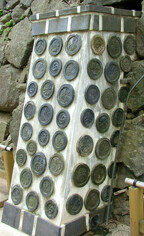
Himeji Castle was affiliated with numerous clans over time, including the Ikeda. Towards the rear of the castle there is a display of tiles related to these various clans. I am including a small photo of it here, however you can not distinguish the individual mons. If you care to see a much larger photo there is a provided link as well. http://yakiba.com/Himeji_Mons.htm
-
Just FYI, the kabuto is a Paul Chen, Hanwei repro.
-
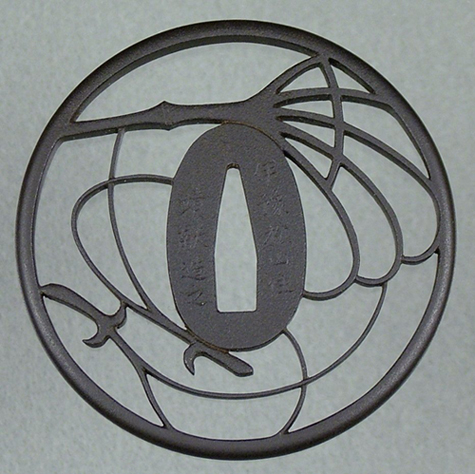
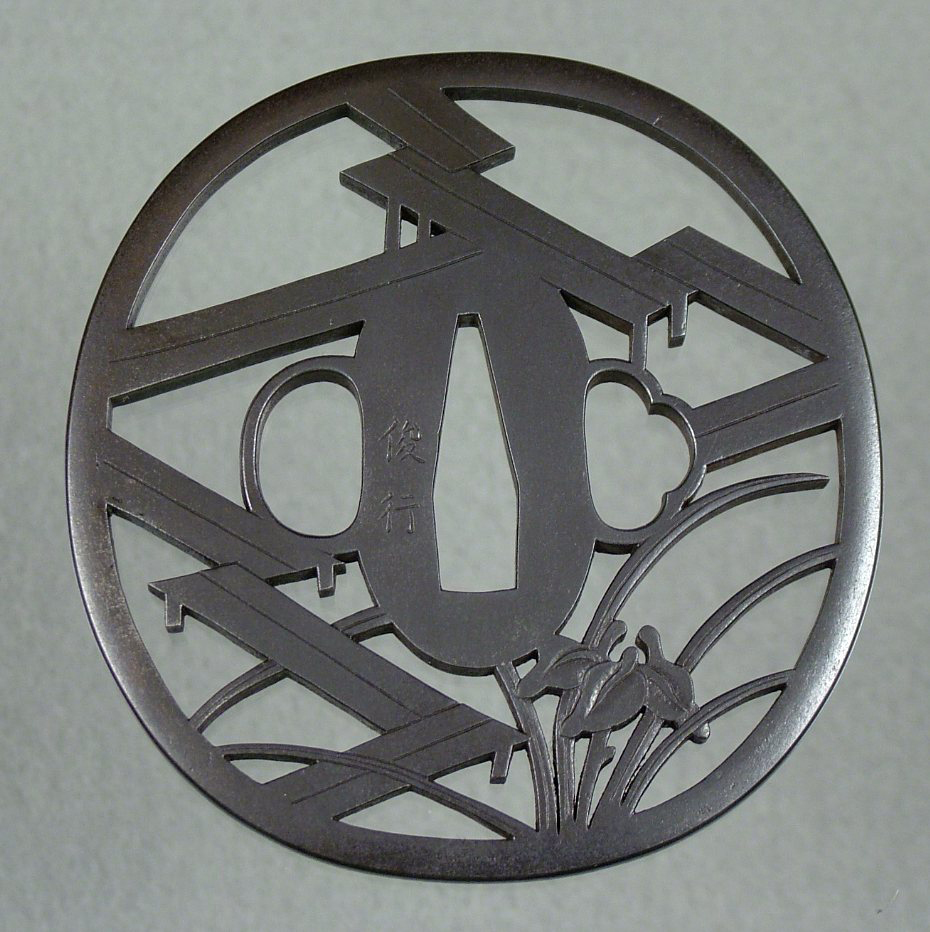
Now that it seems this topic is nearing a close, I just want to say three cheers for such a great discussion. I was proud to see such honorable behavior, though a couple of times I thought the gloves were coming off. Although in truth I don't see where an answer was agreed upon, merely a resolve to converse further, perhaps privately. It has been a really great read and I think (hope) it has made everyone involved(readers and participants alike) stop and think about their own view of the subject. For the most part I could simply copy and paste Barry's comments as they pretty much reflect my own. I too feel swords are swords, and tsuba are tsuba old or new as long as they meet at least a general criteria. Whether or not you like them or validate them is purely a personal opinion. But, I do agree that personal opinion is subjective, it would seem difficult to give a objective opinion on anything in which you are involved, ie; objectivity: intentness on objects external to the mind / external reality. I have owned several shinsakuto and fully appreciate modern tsuba. Again, like Barry my problem has always been that for the money I could buy a wonderful old sword or tsuba. And honestly for me, in my humble and subjective opinion, modern swords and modern iron tsuba (none I have found) do not have the quality of steel seen in the hada of older swords or tsuba. There was one shinsakuto I thought I would have always kept, but alas just recently someone liked it enough to trade me a Kanemoto Tanto with koshirae and presentation box. Forfeit the new for the old ? Hell yes I traded. Once again like Barry, I have contemplated one or two of Ford's tsuba that were not for sale and would love to own that Tiger one. I always liked the one I think he modeled it after. I am including photos of two modern iron tsuba made by Mr. Tomoaka which I like a lot. In closing I hope we will see follow up on any revelations brought about by this debate.
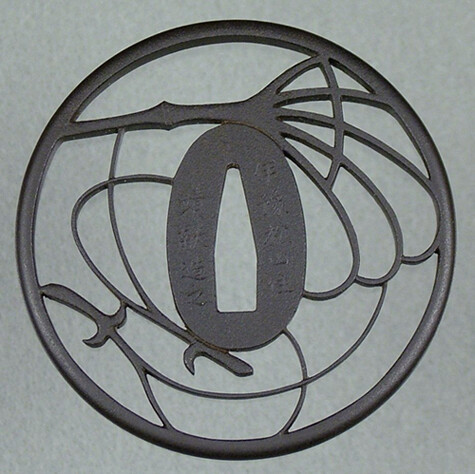
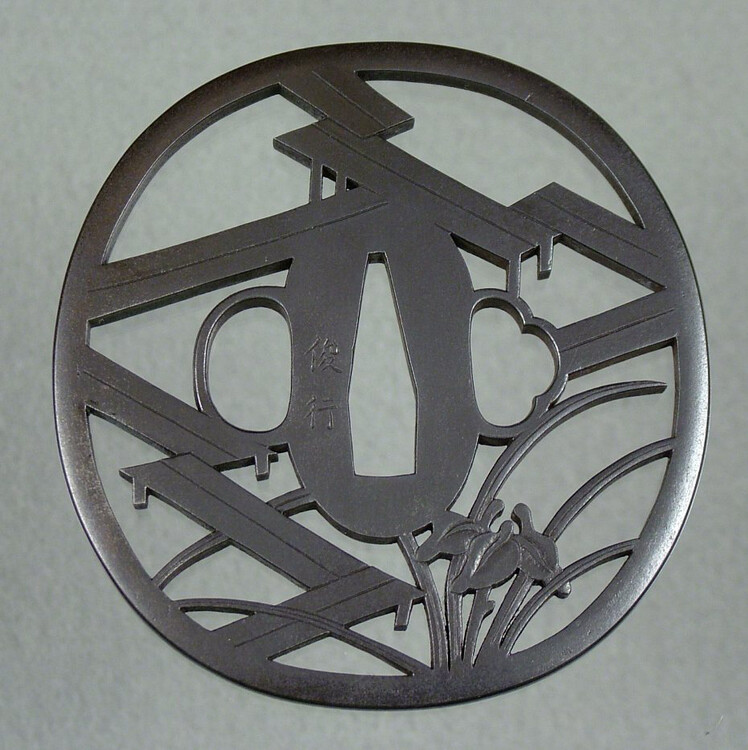
-
Eric, Great fun, normally I don't have time to participate here. However your timing was perfect as I am currently stuck at home nursing an injury. I knew that one looked wrong as stated in my post, yet I dismissed it due to it's smaller size. Though no one else stated a problem seeing it, but I could not see it that well enough to scrutinize it. Perhaps it's my monitor, surely not my eyes. Again, thanks for giving me something to do.