Marc BROQUIN
-
Posts
163 -
Joined
-
Last visited
Content Type
Profiles
Forums
Events
Store
Downloads
Gallery
Everything posted by Marc BROQUIN
-
Hello Sencho, I come back on your old post related to this Fuchi you posted in 2007, as far as I progressively look at all the past discussions. The signature is after HAYNES GOTO SEI-I (H.08047.0). Working in Edo, he apprently was born in 1795 and signed a piece dated 1867. He was a student of GOTO SEIJO. Source W-372-U-1, W-405-L-1, W-II-187, Kp-168. Kao is not shown. It is the only one GOTO described in Haynes. I do not have this Wakayama book to look at the mei in order to appreciate if legit or not. But as far it is not a very well known GOTO, there is a big chance it is a true one. Best Marc
-
Hello Simon, I pass a part of my summertime to review the old discussions of the NMB I had not the time before to look at. I have cheked in the Haynes with these specific kanjis. The only one described with a recorded Kao is not this one. Apart this particular one, there are 6 other Kuniyoshi : 1°) one is a Tosa Myochin, ca. 1800, no Kao described, but worked in the style of Tosa Myochin. 2°) one is the 6th master of SUWA family school, ca. 1800, Higo, Kumamoto, no Kao described. 3°) one is JUSABURO KUNIYOSHI, ca. 1800, from Sekishu, Hamada (Iwami Province), no Kao described 4°) one is ca. 1700, from Karatsu in Hizen Province, follower of Masakuni 5°) one is ca. 1800, from Raku, Kyoto in Yamashiro province 6°) One is from Sendai in Rikuzen Province From my point of vue, it seems not to neither Tosa Myochin work nor Suwa Higo nor Sendai, nor Hizen. Remain Iwami and Kyoto. Difficult to say but I would bet for Yamashiro Kyoto. I have one FK from the Kuniyoshi with the recorded kao and it is not the same as yours definitely. Best regards Marc
-
Hello everybody, I have arrived at the same conclusion as Rich. It could be an early Choshu tsuba. It is said in the Baur book : "Early Choshu work was influenced by Umetada Myoju (mentioned by Ford) who spent some time at Yamaguchi and by Shoami (mentioned by some other members): thus examples by Nakai sometimes show incrustation of the softer metals on the iron ground (which is the case). So my answer would be early Nakai Choshu, but the first Nakai, NOBUTSUNE, died in 1703 so it does not fit with the mentionned dates.... Other possibilities ? Friendly, Marc
-
"I don't know anything about this kinko school, this one is Hozon. Can someone tell me more about the school (or send me some scanned information through e-mail) and is the subject meaning something special?" Hello Jean, Have a look in the Baur Collection to the work of SEKIJOKEN MOTOZANE (MITO) # 1210. There is an FK having this type of base design of woven basket. But also you may find that type of base in ITO SCHOOL Best Marc
-
Interesting tsuba but unknown carver (Natsuo den ?)
Marc BROQUIN replied to Marc BROQUIN's topic in Tosogu
Hello all, Thanks a thousand time for this very intresting and enriching exchange. Yes we can close the subject on this tsuba. You have produced a lot of monkeys from different artists so I will share with you one apparently carved by SEISHINKEN MOTOTOMO as a cherry on the cake (as we say in french). Best regards to all. Friendly, yours Marc

-
Interesting tsuba but unknown carver (Natsuo den ?)
Marc BROQUIN replied to Marc BROQUIN's topic in Tosogu
Hello All, I am surprised to have generated a so extended discussion on such a subject. And I am also really interested by all the ideas exchanged in so few days. To come back to the initial discussion : the said tsuba was for sale in a recent auction (March 14th) in France precisely in Montluçon near Moulins (Centre of France). It was certainly the best carving of the auction. But if the carving is nice, we can see in the karakiri repeated traces of the chisel which is not the mark of an excellent carver. it's why I was sure it was not from Natsuo, together with a certain roughness of the design. I hoped the signature was from one of his students but I must admit it (according to the carved date): it is most certainely a copy or fake wanting to imitate NATSUO's work. Thanks to all contributors of this forum. It has allowed me not to buy it ! Friendly, yours Marc -
Interesting tsuba but unknown carver (Natsuo den ?)
Marc BROQUIN replied to Marc BROQUIN's topic in Tosogu
Hello all, Sorry for the obverse you deciphered Koichi San. I think I was a bit sleepy ! I checked this morning on the Haynes and it is said that SEKIBUN III born in 1869 worked with NATSUO around 1885. It does not fit with the date : he was not born !!! What else ? best regards Marc -
Interesting tsuba but unknown carver (Natsuo den ?)
Marc BROQUIN replied to Marc BROQUIN's topic in Tosogu
"Hello all, I post this tsuba for its spectacular carving. I cannot decipher the kanjis but I am sure many of you will be able to give their ideas. kind regards Marc" Hello all, When I wrote those words, I must say that I had some ideas "behind my head" as we say in french. I was nearly sure it was not from NATSUO because the carving had not this natural mixture of simplicity and complexity of NATSUO (Reinhard is right, workmanship doesn't fit). I was sure also that the 3rd kanji was O; the same O that appears in Natsuo. it was a track for me. Who is able (by tradition) to use a part of the master name : one of his students. So I checked yesterday with all your information you gave in the different answers and found : As far as my research is complete the only student having taken the O from Natsuo and having a simple kanji for the begining is ...... FUMI O (the FUMI equivalent to BUN in BUNSEI) in other words SEKIBUN III, who was a student of NATSUO and having taken this name FUMI O. And there is at the end of the book related to NATSUO a tsuba made by FUMI O with this signature KANSAI (which was one of the artist "family" name of NATSUO) FUMI O. Of course this signature being relatively rare, and fitting partially with this one of the Natsuo book, I cannot say it is shoshin. But I have the impression it is because of the quality signed by a "second gun" artist and not by the master. I let those comments to your appreciations. Anyhow and it is true : what is written on the reverse ? Perhaps Koichi San could give us the solution ? Kind regards to all Marc -
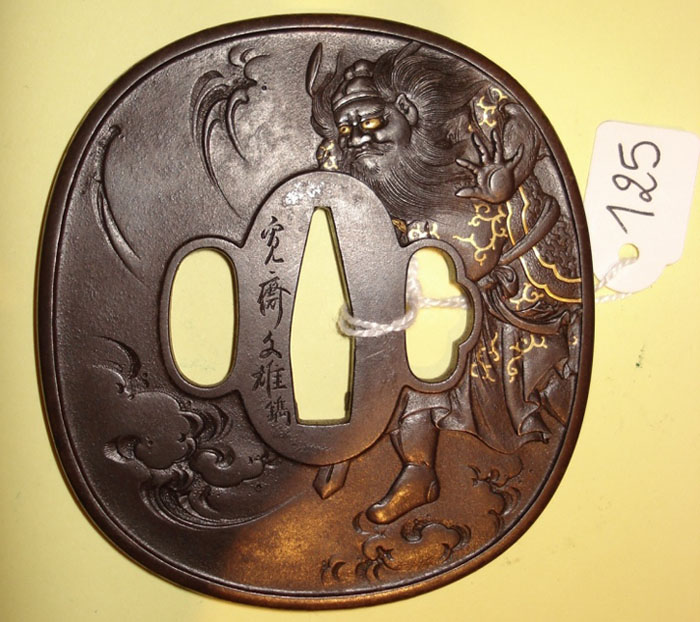
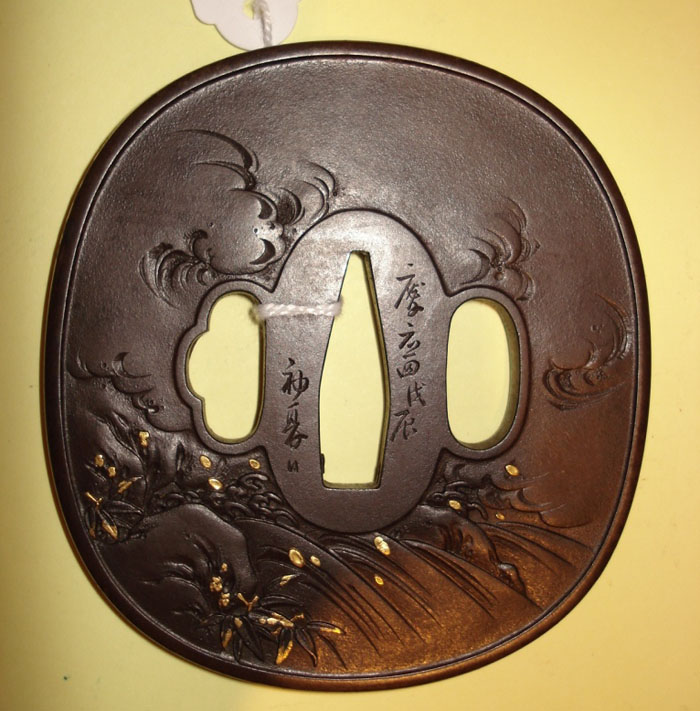
Hello all, I post this tsuba for its spectacular carving. I cannot decipher the kanjis but I am sure many of you will be able to give their ideas. kind regards Marc


-
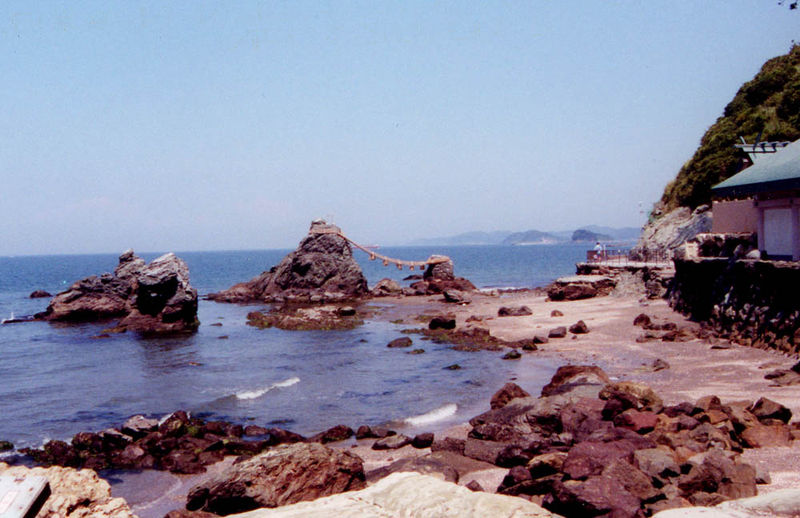
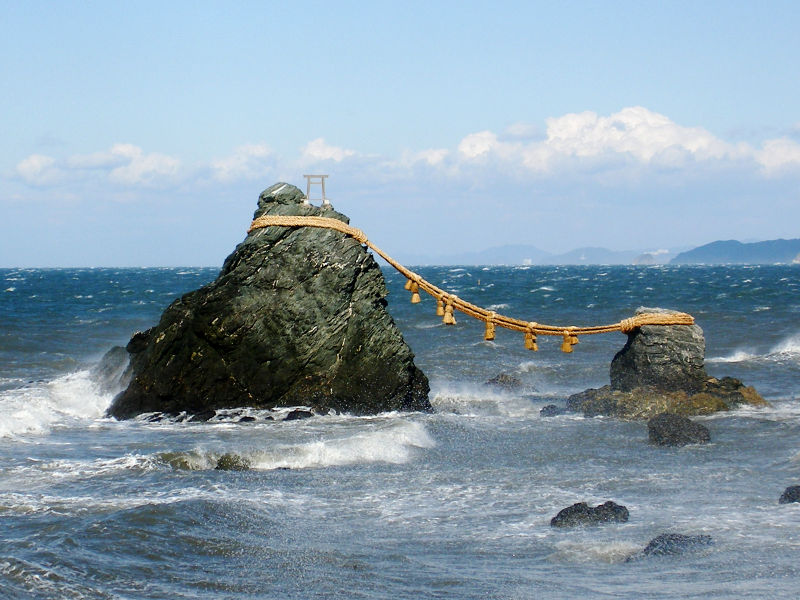
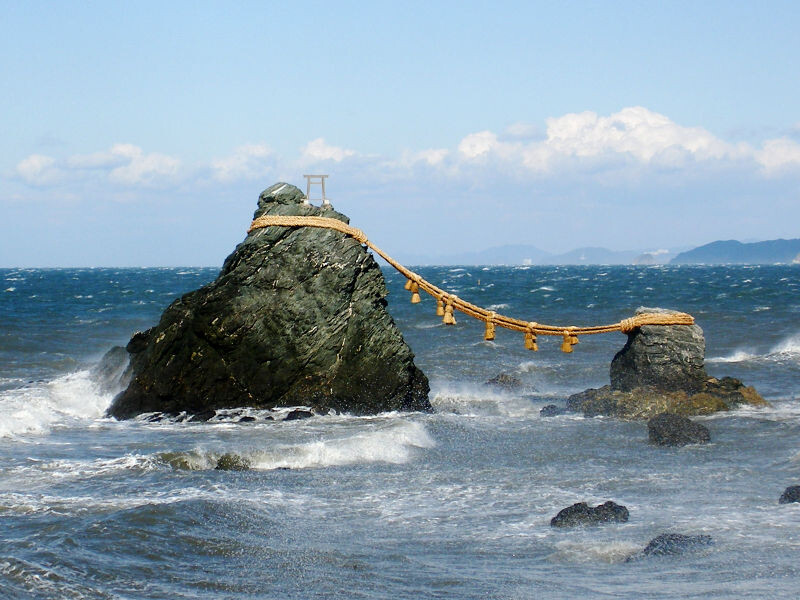
Hello, To complete a bit on that topic I found that on Wikipedia : Meoto Iwa Meoto Iwa, the wedded rocks Meoto Iwa. At low tide the sea recedes from around the rocks.Meoto Iwa (夫婦岩?) or the Husband-and-Wife Rocks are a couple of small rocky stacks in the sea off Futami, Mie. They are joined by a shimenawa (a heavy rope of rice straw) and are considered sacred by worshippers at the neighbouring Okitama-jinja. In Shinto belief, the rocks represent the union of creator gods Izanagi and Izanami. The rocks therefore celebrate the union in marriage of man and woman. The rope, which weighs over a ton, must be replaced several times a year in a special ceremony. The larger rock, said to be male, has a small torii at its peak. The best time to see the rocks is at dawn during the summer, when the sun appears to rise between them. Mount Fuji is distantly visible. At low tide the rocks are not separated by water. Okitama Shrine is dedicated to a food goddess Miketsu. There are numerous statues of frogs around the shrine. The shrine and rocks are near the Grand Shrine of Ise, the most important Shinto location. When I was visiting this place a couple of years ago the guide told us that it is the symbole of creation of Japan . Best Marc Please find 2 pics of Meoto Iwa
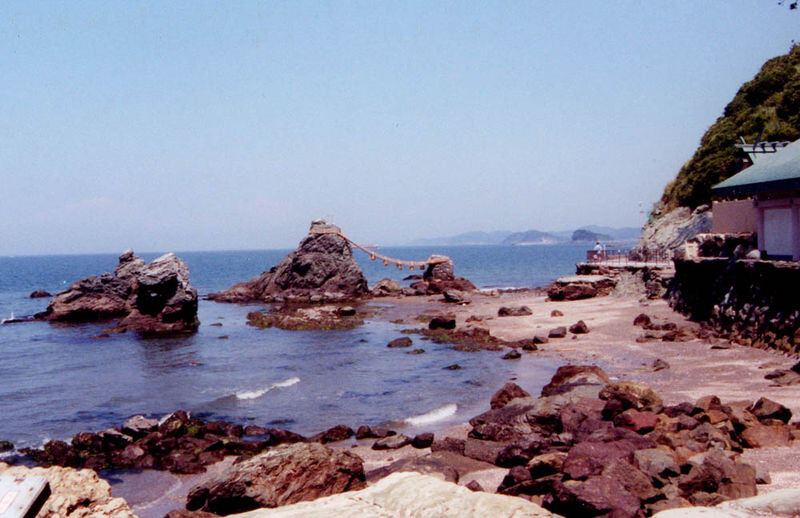
-
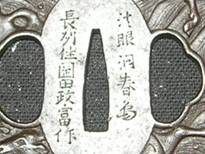
Thanks to all, particularly to Koichi San for this determination. First of all I think that the first right kanji is really written in Sosho, in opposition with Reinhard. It is sufficient to compare this 法 with what is written on the tsuba. OK for the others they are regularly designed. It's why I was blocked. I tried to find the 2 others : 洞 which was for me an other kanji KAWA and not TO, such as in KAWAJI and 春 HARU (read SHUN in some cases). The reading for me was then KASHUN who is a tsubako present in the Church collection and living in HAGI, fitting well with the fact MASATOMi being from CHOSHU. Finaly, the 5th right sign is certainly a kao. If this tsuba was for honouring the memory of TOSHUN or KASHUN, there wouldn't be a kao at this place, dont you think. Some times tsuba were made by 2 people. Could this be the case ? Toshun or Kashun for the design and Masatomi for the execution ? I submit this approach to your discussion. Best regards and thanks for your help. Marc
-
Hello, I can't find the precise translation and even meaning of this right inscription on this tsuba. Could you help me ? Thanks Marc

-
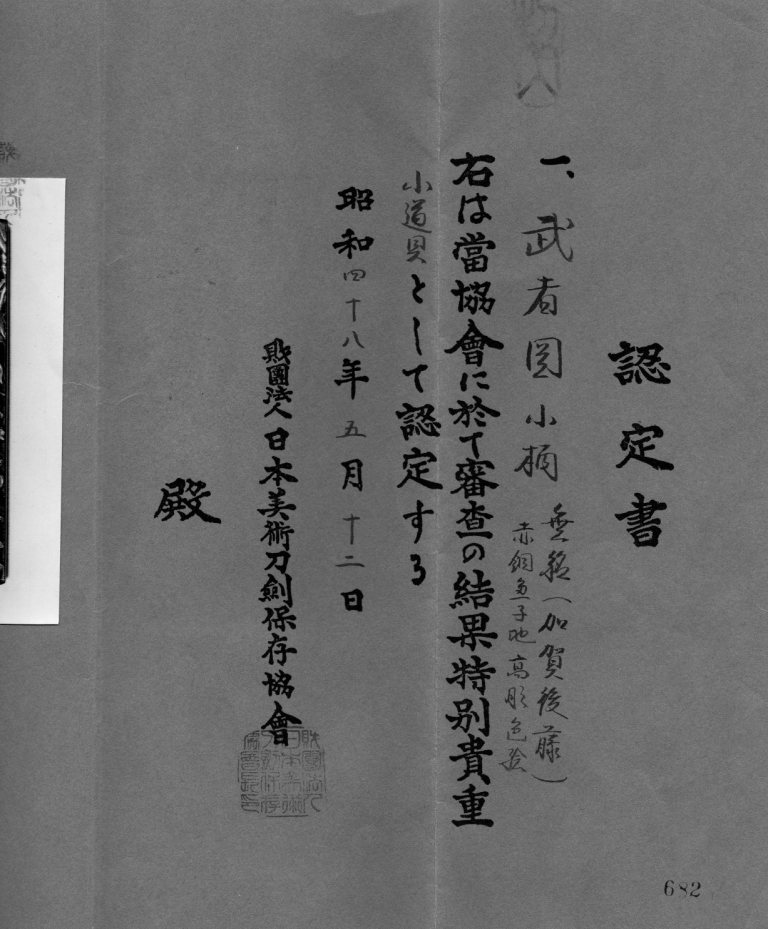
Hi All, An other point related to this kozuka is the NBTHK attribution. it should be correct as KAGA GOTO by I can't read on the certificate what is written above this attribution within parenthesis. Could you help me. Best Marc

-
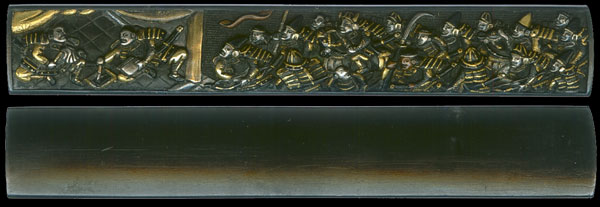
Hello friends, I bought this kozuka a couple of years ago andI tried many time to find the theme of the subject. I must admit it : it was unsuccesful. So, I submit to you this kozuka if anybody has an idea. Kind regards Marc

-
Hello This tsuba is astonishing by its composition. It is not easy at first to give any school name OWARI & AKASAKA were mentioned. It should not be KANAYAMA because of iron surface, design and rim. KYO-SUKASHI are by nature more aerated. It doesn't remain a so massive yo-sukashi. Bevelled rim is not common but Ford is right. It appears in some KO-AKASAKA tsuba. Ford mentions TADATOKI 1st (4th AKASAKA) but also it appears in MASATORA tsuba (see TSUBA KANSHOKI P205 bottom) but in any case the design is generally more fluid and bevel doesn't continue with such flat internal ridge. The rectangular design of hitsu ana can be seen in some KO OWARI tsuba and also in some YOSHIRO ZOGAN MON SUKASHI tsuba from muromachi to early edo. Bevelled rims appear also in TOSA MYOCHIN tsuba and in that case the design is often massive. Its why I would tend towards this determination : TOSA MYOCHIN early EDO would be my answer. For the design, I have not found anything in my doc fitting with it. Best regards Marc
-
Hello, :D This tsuba is interesting by its size. It seems it was not made to be mounted on a katana but to be offered as a precious gift. The method of carving looks like carving of a MITO SCHOOL. There is no kata kiribori which is found frequently on JOI's tsuba. It is not also the Carving of GOTO ICHIJO even if the waves from the reverse could fit with this attribution. I think naturally towards SEKIJOKEN MOTOZANE but I am perturbated by the gold honzogan seal. I do not remember any tsuba of this artist bearing such a seal. Perhaps RAKUSEI TOSHIHARU pupil of TANAKA KIYOTOSHI with minute gold iclusion and golden seal (see TOSOGU TREASURE OF THE SAMURAI, SARZI AMADE Ltd) or more likely later on OKAWA TEIKAN (or SHIHO) famous for its big size tsuba and even living in Edo, following the MITO traditions. Best regards Marc