MassiveMoonHeh
-
Posts
224 -
Joined
-
Last visited
-
Days Won
9
Content Type
Profiles
Forums
Events
Store
Downloads
Gallery
Everything posted by MassiveMoonHeh
-
Back in 2009 the Metropolitan Museum of Art, New York held an extraordinary and important exhibition called the Art of the Samurai: Japanese Arms and Armor, 1156-1868 [Held from October 21, 2009 to January 10, 2010]. The reason it was so extraordinary is because; One, this exhibition took over ten years to put together - in large part due to the incredible efforts of the organiser and curator Morihiro Ogawa. And secondly, the Japanese Agency of Cultural Affairs allowed over 200 works of Traditional Japanese Swords and Armor including 34 National Treasures, 64 Important Cultural Properties and 6 Important Art Objects from over sixty collections to leave Japan for the first time to form part of this one time exhibition. As an exhibition it was unparalleled to have so many important works from so many museums, shrines, temples and private collections in one place, even compared to anything ever done in Japan. As part of the exhibition, as is common practice, the MET released a catalogue of the exhibition by the currator of the exhibition, Morihiro Ogawa. The catalogue is over 368 pages and 16 years on from the exhibition is still available for sale, in its second print. You can still pick one up a first edition second hand, but a new copy retails for around $60 in paperback and over $200 in hard cover. Recently, I found a link to a free PDF copy of this catalogue on the MET's website: https://www.metmuseum.org/met-publications/art-of-the-samurai-Japanese-arms-and-armor-1156-1868 As a collective English book on the history of the Samurai and their omote dogu or "external equipment", explained through Japanese National Treasures and Important Cultural Objects I think it may be a first and is certainly second to none. With the bright photos and explanations for each piece I think it is a fabulous thing to have for reference (and enjoyment.) This in my opinion is one of the more important exhibitions and books in recent times on the subject. Grab a copy whilst the link still works.
- 4 replies
-
- 11
-

-

-
 Back in 2017 there was a discovery by Yoshihara Hiromichi of the oldest sword book, the The Mei Zukushi from 1351, discovered in the Saga Prefecture Library. This book was discovered on some of the the back of the 277 pages from the Ryuzoji family Documents. In 2021 the documents were restored and put on display - the above video was released then. Here is the original article written by @Markus back in 2017: https://markussesko.com/2017/12/26/the-new-oldest-extant-sword-document/#:~:text=The Mei Zukushi is dated,to reward allies and vassals. The links to the documents and transcripts in the article no longer exist as such I have also included the link to the documents in the Saga Prefecture Library: https://www.sagalibdb.jp/komonjo/detail?id=60657 for future reference.
 -
The British Museum is hosting a Samurai Exhibition from Feb through to May 2026 in the Sainsbury Gallery. Looks like they have done a lot of work on this one and it should be a goodie for those who can mane it. There will also be a book for sale for those interested. For more info there is a nice write up on it by Jimmy Chen: https://www.thecollector.com/samurai-british-museum-book-review/
-
I think you will see, like all things, words matter. It was never said it was a government organisation it was said to be "government sanctioned". Even the link you provided advises the same. Hope this clarifies. Have a good day.

-
Agreed, the Shinsa is unique in the world as a government sanctioned event that authenticates an entire asset class and accessories. To have experts that have to complete decades of study to recognise the artist is just incredible - I am unaware of any other area like it - be it art, science or any other activity. That there are some many smiths and traditions it is incredible how much knowledge you need to have to become a recognised expert and even then when you speak to a master authenticator with 40 years experience they will still say they are learning. It is remarkable. Almost super human. The closest we have to this in the west is the individual authentication boards or committees for an artist. But even then these groups focus on one or maybe a few artists not an entire asset class. As we move forward I would love to see some of the western art influence this extraordinary eastern art. Things like having a catalogue raisonné for the big named smiths would be a massive move that would greatly improve this art form and have many advantages (aside from the fact that you will finally be able to see all the recognised works of the smith in one collective work - which in itself would be wonderful.) I hope this will happen sooner rather than later. But for now like you I am completely and utterly engrossed. There is no art form like Nihonto.
-
Jūyō 68 Results
MassiveMoonHeh replied to Jussi Ekholm's topic in General Nihonto Related Discussion
@Wim V & @Jussi Ekholm thank you so much for taking the time and passing on this collated data. It is super appreciated and valued. -
Does anyone have any confirmed numbers for items submitted to and passed at Juyo and Tokubetsu Juyo Shinsa from 1st through to 71th Juyo and 28th Tokubetsu Juyo Shinsa, respectively? Doing a little analysis. Thank you.
-
A little AI fun with the Tenka-Sansaku
MassiveMoonHeh replied to MassiveMoonHeh's topic in General Nihonto Related Discussion
And Masamune. grok_video_2026-01-01-11-41-27.mp4
-
A little AI fun with the Tenka-Sansaku
MassiveMoonHeh replied to MassiveMoonHeh's topic in General Nihonto Related Discussion
Here we have Gō Yoshihiro. grok_video_2026-01-01-11-33-22.mp4.jpg.af10323f11138dbe622908b429140a48.jpg)
-
Threw the Hon'Ami Kojo image of the Tenka-Sansaku into AI to try bring them back to life. Just a little fun. grok_video_2026-01-01-11-45-05.mp4

-
Hoshi this was probably the best thing I have ready all week - certainly made me smile - great write up. Thank you so much for taking the time out to share your hard earned knowledge. I woudl say you did Darcy proud!
-
Jussi, just noticed that Shinsa 35 Book 1 Item 266 and Shinsa 61 Book 1 Item 83 are both missing in your PDF - if you were looking for any feedback. Thank you.
-
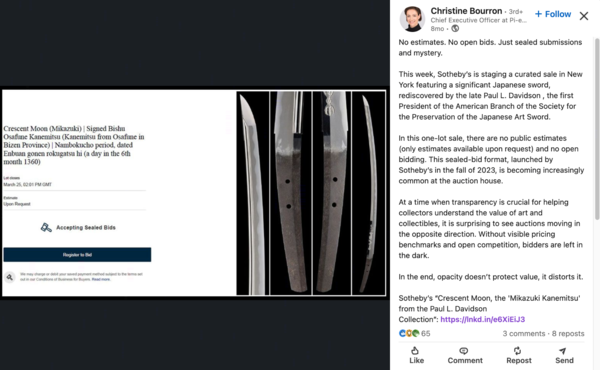
Robert, apologies - I never meant to discredit the art work or cause you to rant. My comment was such that being a woodblock print (which I did mention it was) there are multiple prints around (experts suggest 8,000 were printed of The Great Wave, although only 100 are now said to survive) from the same woodblock - so it is not a one off like a Nihonto. Yet even as a multiple it outsold our back room deals on Top drawer original nihontos and even the latest original one off Mikazuki Kanimitsu closed bid auction (although maybe it didn't - we just don't know) and the price of this print was not hidden but very public. With Sothebies even putting out a YouTube video of the event to drum up more business. Because records are exciting and bring interest and people into a space. This was more to the point of what I was suggesting rather than the print was some knock off gilcee print. Please accept my apologies.
-
While Japanese blades remain in a 33 year vortex of very little appreciation because, I am reliably told, Japanese society just operates differently to the rest of the world. Somehow Japanese art has managed to escape the back room private deals and just set a new world record for a woodblock print (yup, not an original - a print...) at an auction. Is the Nihonto market really that different that it requires a different way of operating? Makes you wonder... 👀
-
Agree 100% on auction houses being outliers. But even though they are they represent transparent price action that is sorely lacking in this space. They are also an indication of the strength of the current market that the international community does watch. And yes, at the moment Nihonto is not even on anyone's radar due to the auction houses being a outlier in the Nihonto market. Case in point... the 54% clearance rate after the sale of the Mikazuki Kanemitsu in the same auction. This tells you everything you need to know about how the global community currently sees the Nihonto market - it is not something anyone is touching. That is a valid point and really great insight regarding the example you use of selling rare coins. Whilst you have great price data you also have smaller margins but the price trend is up. With Nihonto there is no price data, the market is fragmented and difficult to understand. And yes dealers do differ massively in the price they charge which makes it even harder for a buyer to understand. I suspect however like your coins shop that for the majority of Nihonto sellers they are also making a very small margin on their sales because their market is so small and there is very little demand meaning the price trend is not up. You can tell exactly how well a dealer is doing by how quickly their swords sell (or how long they stay on their website) and for the younger dealers who started their YouTube channels during covid how many are still producing content. Most are not doing as well as their optimistic view suggests. I would love to see this change and for these sellers who are the bread and butter of Nihonto transactions to be rewarded for their hard work and effort they put into this space. They truly are the link between the old community and the new enthusiast and if they do well the community does well. Thank you for your insights - it is really appreciated.
-
Jussi, first a massive thank you for everything you do, share and contribute to this community. It is a real privilege to be able to learn and grow from all the information you put out. So thank you. I did have a chuckle that a person with 575 pages or price data is not interested in price. But I also get it, data is important and without we cannot identify, learn or grow. I agree with you 100% that prices are variable based on location, type of operation, number of employees etc. A private seller with no overhead is able to make a sharper deal than a person with 10 staff and a shop in one of the more exclusive neighbourhoods to attract a certain clientele. I also agree that price is a matter of what you are comfortable with. For a more experienced hand who has 575 pages of price data that they privately collected this is an easier task. For a newb who has just joined the space and wants to buy their first sword this is less so. Dropping a few thousand dollars of your hard earnt money on something from a few hundred years ago can be an extremely daunting task. The sweaty palms and lump in your throat perhaps gives away that whilst you are massively excited you are also spending more money on something than you ever spent and you just hope you are doing the right thing. Without some guide or price transparency this task becomes a massive uphill battle that means you can only enter this space if you do years of research... for many people they just don't have the time or the inclination and that can result in poor decisions or worse they become overwhelmed by the task of getting into Nihonto and so after a couple of weeks of playing with this new hobby - they walk away. Do I want to see more museums buy Nihonto? Yes absolutely. Do I want to see more museums outside of Japan buy more Nihonto - 100%. I have no issue with this but what I do wish we had more of was price transparency to allow this market to develop properly and grow. Whilst price is not the most important thing what it does do is create a natural curiosity. Most people don't understand crypto, equities or art. But most know that Bitcoin is a thing, AI is gonna change the world and Monet and Da Vinci are two of the greatest artists in the world. Money or new highs attract the attention of the masses. And yes it can get messy but it also creates a new community base of die hards and wannabe die hards and everything else in between. It creates an interest, a mystique, an aura that creates a market and puts these things in the collective conscious of the people. Nihonto are culturally super important to Japan but even in Japan the younger generation is abandoning the traditional... they see old things as being super uncool. It is the great contradiction that the names of some of their favourite manga characters are based off the names of famous Nihonto blades - but not many know this and certainly most have never been to their local museum to see any of these blades... why because they are just not interested. Price is a double edged sword. It can price out the true fans but it also brings attention to a whole new audience. Nihonto to me should not be guarded jealously for a select few that spend 10 years to study the subject (and by the way I love that there are people who dedicate their lives to this artform - the collectors, polishers, sword smiths, shop owners, appraisers, professors, museum curators, etc. - without them doing the hard graft this space dies.) Nihonto however are a beautiful and incredibly intricate form of art that needs to be shared with the whole world. And to do that the old equation for any asset class must come into play: Price + People = Global Recognition Change one and the other two are affected. If we could keep price down forever but gain more supporters, collectors, hobbiest, fanatics and the like - great. But that is generally not how the world works. It does not mean we all have to like it - I am simply suggesting that for this space to grow we need to consider how we help it grow. And one of the important parts of this equation in a Capitalist world is price. And by the way - I agree with you, I prefer a knowledgable shop owner any day to a cold corporate auction house. I am not the one batting for the auction houses here - I just see them as a necessary evil that can and do help with global recognition.
-
I do not hold any position and perhaps I am not switched on, so please explain it to me not like I am a salaryman from Tokyo but like I am a child who loves swords and one day when I grow up wants to be a Samurai.
-
Jussi, how you going with this project? Any books we can look out for you?
-
I wonder if this is what Nobunaga thought when he was born into the not very influential nor powerful Oda clan? I jest and appreciate the sentiment, as concerning as this sentiment is. I am simply trying to find ways to improve the Nihonto's lot - it deserves better. I think everyone in this space wants that - Japanese & foreigner.
-
I am not keen on starting an argument either - I hope we can chat and debate. In terms of transparency depressing a market... I am not sure how much more depressed the Nihonto Market can get... 33 years of not breaking the All Time High seems pretty depressed, no? In a small market one needs to keep your good customers happy because you have not other options, lose them and you lose your business. This unfortunately is a double edged sword as it also leads to private sales and stagnant price action where the market does not grow.
-
Whilst I hear stories of private sales being the way things work with Nihonto blades and it may be, I know for damn sure that an open market pushes prices a lot higher than closed private sales. I agree with Christine's sentiment here 100%... this market needs more transparency. It is the only way we see prices appreciate and start to see these incredibly historic and culturally important pieces start to get the respect they deserve. I want to see the highest prices not be rumoured guesstimates that some Museum in Japan has paid but I want to see a healthy market where private collectors across the world push to have their favourite blade knowing that there is someone else that wants that blade as badly or even more. Until this happens we are stuck in a negative feedback loop that just perpetuates sideways/ downward action. As a community we should demand openness and transparency at every level. From NBTHK and their database of swords through to shops and auction houses. Transparency benefits everyone. We will see this space grow, NBTHK will make more money, collectors will see some returns on their favourite pieces and Nihonto will finally join the realm of valuable art comparable in price to art works from China, Europe and the Americas. Transparency is key.
-
I like computers, programming & databases. There is always a way of itemising and listing any aspect of anything. Obviously it is how we apply these itemised bits to an algorithm but it is possible. Something like blades a lot of the work is already done since the Edo period and the graders like the family Hon'ami. NBTHK have trained experts who use these same criteria (some are better than others). An origami from Kōetsu for a Masamune carries some weight. Later origamis perhaps not so much. Issues come in around humans and making money but getting an objective result I believe is possible. If we can get a consensus on what is worth grading and program it into an algorithm we will beable to grade an sword 0-10. AI will also help massively here going forward. I know massively off topic. Love spit balling. Thank you.
-
The real market? As in the Japanese market behind closed doors or the open sale of swords in Japanese shops? And in terms of prices haven't change in 100 years? Are you saying they are the same price they were 100 years ago or they are the same price adjusted to inflation?
-
Absolutely fair and valid comment on the Kunimitsu. Thank you. Wise words all round. There will always be outliers. And that is where perhaps I have an issue with the current grading by NBTHK. I can see what they have done and it makes sense but as you say there are massive differences even at the same grade. Some are ToJu worthy and others just slipped through. A grading system kind of like Comics would really help. Such that the blade is graded on the quality, current stare and historic significance (provenance) all from 0-10 giving a combined score of 0-10 would make complete sense and would definitely help. If we knew that a blade was grade 9.8 vs a grade 7.6 it would make life a lot easier for the inexperienced collectors and I suspect supercharge the prices on outliers and standard blades as people can understand it a lot better. You don't need a doctorate to understand that a blade grade 9.8 is better than a blade graded 7.6. Any way just thoughts.