nulldevice
-
Posts
657 -
Joined
-
Last visited
-
Days Won
1
Content Type
Profiles
Forums
Events
Store
Downloads
Gallery
Everything posted by nulldevice
-
 That is one of the references I’ve used as well as my books to create what I’ve gotten so far. It’s a great resource and I probably should give it another cycle through and add some schools I’ve no doubt missed.
 -
I'm working on compiling a list of the main koto swordsmithing schools, the province(s) they worked in, and the years they spanned for a project I hope to share with the NMB shortly which I think many will enjoy! I have a public Google Doc link which I'll share below that anybody can access and I've added a number of schools and probably have a lot of mistakes that I've made along the way. This is where I hope that NMB members can help out in helping me curate this list and refine it. I've probably missed a number of key smiths, dates, schools, etc. and I'm hoping that some collective reasoning can help me past the finish line. https://docs.google.com/spreadsheets/d/1NiQi34M8brY-21pM2N3z1emOqvEutC65F4godYsvJM0/edit?gid=0#gid=0 Many thanks in advance and I hope what I've got cooking up will be of use to many once I'm finished up! I've also added a page for Shinto schools but I haven't started on anything as I don't really know how they should be classified outside of the Gokaden (maybe just province?) but if you want to add them, feel free! The data will be used.
-
https://japaneseswordindex.com/kanezane.htm Read here for more information on this smith.
-
Anybody can help identify this sword or katana ?
nulldevice replied to Dekabyu's topic in Fake Japanese Swords
These are unfortunately not authentic swords. -
NBTHK Papering Guidlines
nulldevice replied to Cookie_Monstah's topic in General Nihonto Related Discussion
https://www.touken-matsumoto.jp/en/info/rank_criteria From the link above: Hozon Token 1) Edo and earlier blades with correct mei, or mumei blades on which the time period, kuni and group can be identified, may receive Hozon paper. 2) Blades that meet the criteria given above can receive Hozon paper even if they are slightly tired or have kizu, as long as those may be permissible in their appreciation. 3) Repair on jiba is permissible, unless it significantly impairs the beauty of the blade. 4) Blades made in the Meiji period and later can receive Hozon paper only when the blade is well made and zaimei. 5) For Nambokucho and earlier zaimei blades by famous smiths, re-temper can be permissible if the blade is valuable as a reference, and if the jiba and nakago are sufficiently well preserved. However, this will be documented as "yaki-naoshi" in the paper. 6) Blades are put to "reservation" (horyu) if a decision could not easily be made on the authenticity of the mei. This also applies to mumei blades in which an attribution is difficult to make. Tokubetsu Hozon Token 1) Blades with Hozon papers, good workmanship and state of preservation can receive Tokubetsu Hozon paper. 2) Blades with the following conditions are excluded from point 1. a. Re-tempered blades may not receive a Tokubetsu Hozon paper, as a rule, unless they date not later than Nanbokucho, are zaimei, by famous smiths, if the blade is valuable as a reference, and if the jiba and nakago are sufficiently well preserved. However, this will be documented as "yaki-naoshi" in the paper. b. Muromachi and Edo period mumei blades may not receive a Tokubetsu Hozon paper, as a rule. However, if a blade is attributable to a famous smith and in excellent condition it may receive Tokubetsu Hozon paper. Juyo Token Blades with Tokubetsu Hozon paper can receive Juyo if one of the following points is true: 1) Blades of extremely high quality workmanship and state of preservation, and judged as close to Juyo Bijutsuhin, may receive Juyo Token paper. 2) Blades that meet the criteria given above and made in or before Nambokucho may receive Juyo Token paper even if they are mumei. Blades made in the Muromachi period have to be zaimei and blades from the Edo period and later, as a rule, have to be ubu and zaimei to receive Juyo Token paper. Tokubetsu Juyo Token Among Juyo Token, the ones of excellent quality and superior condition, judged as the same as the top level Juyo Bijutsuhin, or conceivable as equivalent value as Juyo Bunkazai, may receive Tokubetsu Juyo Token paper. -
Thanks! One of these days I'll get one of these handwritten inscriptions 100%!
-
鉄地真丸形両櫃 梶の葉透し 無銘 尾張栃畑 江戸時代初期 昭和五十三年孟秋 宗完 Iron ground, round shape, twin hitsu-ana Paper Mulberry leaf openwork Unsigned, Owari Tochibata Early Edo period Early autumn, Shōwa 53 (1978) Sōkan (Kao)
-
If you are near any one of the big shows in the US (Vegas, San Fran, Chicago, Orlando) you can go and see many swords ranging from a few hundred to hundreds of thousands of dollars and everything in between. Personally, I'm glad I waited to attend a show and see/feel/hold/study blades in person before my first purchase. On the other hand, my budget wasn't happy that I waited as I ended up inevitably spending much more than anticipated later on, but I'm not mad about that! Most importantly, I got to see after reading lots of books and online articles what was actually quality and what wasn't in real life with knowledgeable people who could point out the differences to me and teach a newcomer like me a few important lessons.
-
Signed 丹波守藤原照門 - Tanba no Kami Fujiwara Terukado. He was a Jo-Saku ranked smith and with green papers, I would assume its a gimei. For $2500, you can get a signed blade, I don't think you need to feel rushed to get a signed blade with green papers. You can find a papered wakizashi, probably even signed with modern NBTHK papers for that price. Just looking at the big dealers (Aoi, Eirakudo, Nipponto, Touken Komachi, and others) there are dozens of signed wakizashi with Hozon and some with Tokubetsu Hozon papers right now available around 400k JPY and below. I think more importantly than getting a blade right now is, if you can, figuring out what you want and why. What blades appeal to you and what ones don't and why?
-
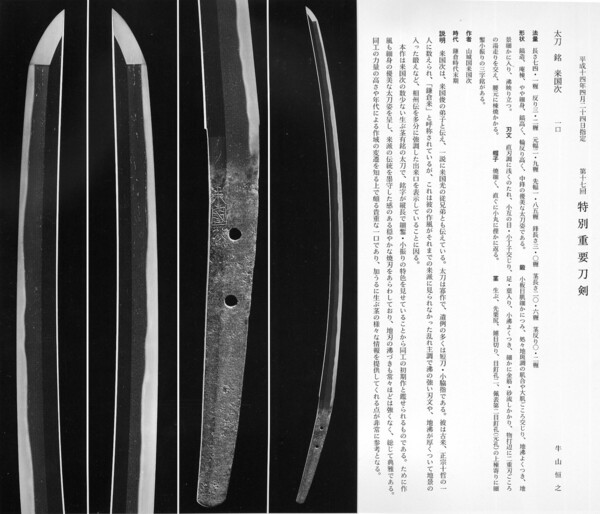
Here are 2 Tokubetsu Juyo examples of signed Kunitsugu work, a tanto and a tachi

-
An excerpt from Hiroi Yuichi:
-
Pretty sure it says it’s a Hitstsura Wakizashi “minayaki” meaning tempered all over Hitatsura meaning a full tempered blade. Lots of good examples for hitatsura can be found here: https://www.nihonto-museum.com/collection/sagami-school-mainline/akihiro also see Masahiro, Hasebe Kunishige, etc.
-
WHO LOVES TO GAMBLE
nulldevice replied to lonely panet's topic in General Nihonto Related Discussion
4 kissaki included with 1 tachi!? Thats an incredible deal if I've ever seen one! -
You should be able to figure this one out by yourself. The kanji are really easy kanji to see and draw and are commonly used with few strokes. I'd recommend https://kanji.sljfaq.org ...as well as "Translating Mei" tool we have here: It will only make you more capable if you do this yourself because you ask about a LOT of swords here and many of them have very easy mei to read.
-
Looking for help with Katana identification
nulldevice replied to TheTinkerBard's topic in Translation Assistance
Even drawing the kanji as you describe it (remember that many of these smiths have what we call "Chippy" mei where the strokes don't form perfect representations of the kanji that we see on the digital screen today (don't even get started with Japanese calligraphy...)), here are the results on a very good "Handwritten Kanji" deciphering tool. The top result is still "Nori" and the other matches don't really make sense as they aren't used for names with only some appearing as parts of places or titles. Here is a thread with a mei from Tsukahara Kanetsugu, in this case the Kane is exactly what we'd expect from that Mino style and you'll see it everywhere. Once you recognize it, there is nothing mistakable about it: And another Kanetsugu: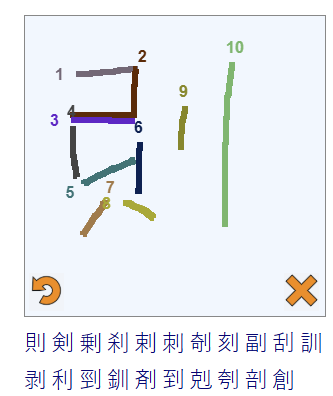
-
Looking for help with Katana identification
nulldevice replied to TheTinkerBard's topic in Translation Assistance
It’s definitely not Kanetsugu. Mino smiths had a very distinctive way they wrote the Kane 兼 kanji and this looks nothing like that. Noritsugu looks correct. -
祐國 - Sukekuni
-
Shintogo Kunimitsu 新藤五国光 The date looks to be Showa 2, 12th month (December 1313): 正和二年十二月
-
Looks like a great show Sam! I'm still hoping to make Vegas show this year! We'll see how the newly inbound family member will be coming along around that time!
-
That book is the Japanese (Original) version of "The Connoisseur's Book of Japanese Swords (刀剣鑑定読本) by Kokan Nagayama. Its English translation is one of the most common books for sword collecting and comes highly recommended here.
-
You are correct the TH papers state den Hasebe Kuninobu and not Kunishige. I think that blunder with Aoi should be corrected but you did your due diligence and found the misattribution. There are 3 Mumei Hasebe Kuninobu in that database, 2 with den attributions and 1 TH with a direct attribution to Kuninobu. The 2 den Kuninobu are both Juyo daito, and the first makes mention of Kunishige and says: "Kuninobu is said to have been either the younger or older brother of Kunishige, and many works show the style of Hasebe Kuninobu. Among his works, suguha pieces can also be seen, and three signed tachi are extant." I believe this comment about 3 tachi being extant is now outdated as this came from Juyo 20 and there is another zaimei tachi from Juyo 21, and 1 other Tokubetsu Hozon zaimei tachi listed as well. I suppose the 3 that were being discussed in this explanation are the JuBi Tachi, the one in Shizutani Jinja, and another Juyo/TJ blade from Juyo 16. (Thanks to Jussi again for the data here!) The Juyo 43 den Kuninobu says the following: "This is an ō-suriage mumei katana attributed to Hasebe Kuninobu. The Kyoto Hasebe school is considered a hitatsura group contemporary with Sōshū Kunishige and Akihiro, and Kuninobu is the representative figure. Kuninobu is known for his characteristic hamon composed of notare and gunome with yahazu (arrow-notch) tendencies. Suguha works are also seen among his pieces. In most cases, the Hasebe school shows a foundation of notare mixed with gunome and yahazu elements, displaying a gorgeous Sōshū style. This katana prominently displays these characteristics. The form is also typical of the Northern Court period, around the Enbun (延文, 1356-1361) and Jōji (貞治, 1362-1368) eras, making the attribution to Hasebe Kuninobu most appropriate." There is 1 other TH Mumei Hasebe Kuninobu listed in the database, but being TH, there is no more context on it.
-
Do you have pictures of the books in question?
-
I find this explanation of a Tokubetsu Juyo (Den Masamune) appropriate and fitting with the explanation by Hoshi and images above:
-
The blade looks to be signed Tsuda Echizen no Kami Sukehiro. A Shinto smith who signed in this grass style script. He’s also a Sai-Jo Saku smith so the likelihood of gimei is very very high.