Clive Sinclaire
-
Posts
339 -
Joined
-
Last visited
Content Type
Profiles
Forums
Events
Store
Downloads
Gallery
Everything posted by Clive Sinclaire
-
Jim Whilst not wishing to belabour the point, it may well be that Yukihiro actually experimented with nambamtetsu or Dutch steel, but there is no evidence of which I am aware to say this. I believe the Dutch forging that he studied was in the manufacture of firearms rather than swords. He also seems to have been quite a traveller and experimenter, as he was known to have made swords in Hiroshima as well as Nagasaki and and to have studied the Ichimonji school in Edo with the Ishido group (as did Hizen Tadakuni), inscribing ICHI in his mei. He eventually seems to have settled in Saga. Others that used Namabamtetsu, such as the Yasatsugu group in Echizen, readilly mentioned this in their mei didn't they. Also I think most Nambamtetsu was imported from the Indian sub-continent. Regards Clive Sinclaire
-
Gentlemen I have HIZENTO HIKKEI handy which does not suggest that shodai Yukihiro ever used "Orande tetsu". He certainly was in Nagasaki working with Hisatsugu and Tanenaga in 1650, and noted on some blades "Orande Kitae o-motte saku". This means he studied Dutch forging methods but not that he used Dutch steel. Further, Eguchi Shoshin suspects that this inscription was put onto his swords (I own one myself) almost as a marketing ploy to enhance his prestige. Incidentally this reference states he received the Dewa Daijo title in 5th year of Shoho (1648) and Dewa no Kami in 3rd year of Keian (1650) Regards Clive Sinclaire
-
UK Sword law
Clive Sinclaire replied to Kevin's topic in Sword Shows, Events, Community News and Legislation Issues
Kevin I applaude your idea but wonder if it is wasted effort. I attended several meeting at the Home Office where we mamaged to negotiate so many "defences" against the law (ie. all swords over 100 years old, completely exempted, all swords made before 1954 (including Showa-to)exempted, those made after 1954 by traditional means, exempted, swords used for historical re-enactment, exempted, swords used in martial arts, exempted) that it is really something of a toothless tiger. You are correct in saying that it was a useless piece of legislation but I would not really want them looking at it again in case they made it more difficult rather than rescind it altogether. Clive Sinclaire -
S F Show
Clive Sinclaire replied to tetsugendo11's topic in Sword Shows, Events, Community News and Legislation Issues
Dan I also had a gimei removed and required an attribution to a shinshinto piece. Maybe they could tell that the mei had been removed, but I doubt it. I don't think I will bother putting it into shinsa for a 3rd time! Incidentaly, I also had a tsuba rejected as it was unsigned and considered as "probably Showa period", again with no attribution. I guess if they felt unable to attribute the pieces to any name in particular, it was better to reject it as it at least saved us $150 dollars a piece for a worthless arrribution! Clive Sinclaire -
S F Show
Clive Sinclaire replied to tetsugendo11's topic in Sword Shows, Events, Community News and Legislation Issues
Gentlemen I returned home yesterday from the SF taikai and shinsa. I was pleased to see many fine swords which included 3 daito by Kasama Shigetsugu (with the characteristic Fufo-kaen horimono) and 2 tanto by the same man. These latter were especially interesting as I have not seen tanto by him before and both had fine koshirae, the first being a Rai utsushi and the second in Bizen-den and showing utsuri. I also saw a fine, though rather short special-order Koyama Munetsugu which appealed to me. I confess that I do like shinshinto Bizen works! The illustrated talk on fine fitting by Mike Yamazaki was erudite in delivery and fascinating in content, whilst Bob Benson's talk on shinshinto blades was illustrated by Masahide, Munetsugu, Sokan etc. I was a little disapointed not to see many Hizen-to although Barry Hennick was kind enough to show me his Masahiro (thanks Barry) whilst Moses Basseras had another and a Tadakuni. All the shodai Tadayoshi, however, remained hidden from me. As far as the show itself was concerned, the dealer whose rable I shared, returned home without covering his expences and had a disapointing time. I was pleased with the social side of the taikai, meeting many old friends, including Yoshihara Yoshindo, Lonnie Kapp and others. I enjoyed the trip and San Fran is such a nice city to explore after the event. As for the shinsa, I was suprised that a mumei blade had a rejection slip rather than an attribution. The paper said "this is a sword by a modern smith of recent manufacture and must be signed" - a new one on me and I understand there were others similar. Regards Clive Sinclaire PS If you go to http://www.To-ken.com and enter Member's area, you will find details of the Tampa show in Feb 2011. -
Paul Call me old fashioned (quite justifiably) but I have never bought a sword that I have not held in my hands and closely scrutinised and even then, of course, I have made mistakes. Whilst I know it is now common for deals to be struck on the internet and that papers help justifiy prices and authenticity, I am afraid it is impossible for me to buy in this manner any more than I would marry a woman who I had never met except for some pics on a wensite, even if she was classed as Juyo Token and let's be honest chaps, buying a sword is far more important than getting a wife for goodness sake! I still feel that the papers should only be of Hozon level and I have no problem that this would be a disadvantage for dealers. (The new group you were thinking of is the NBSK - Nihion Bunka Shinko Kyokai) Regards Clive Sinclaire PS: Chris, couldn't resist pointing out the little irony - sorry old boy
-
Chris Isn't it a pleasant irony that you argue against the gaining of papers at shinsa (or more, the reliance of papers from shinsa I suppose) when you represent the NTHK-NPO that issues such pearls of wisdom! Although most of the swords in my collection have been to shinsa, mostly NBTHK shinsa, I have never had a particular urge to send tsuba, of which I have about 50. Isn't it strange that the urge for authentication seems to apply mostly to blades but to a lesser extent on other things? I am of the opinion that it is undeniable that, although to a lesser degtree in Japan perhaps, papers have a huge influence over the price of swords and this has led to a huge reliance on them as well as exploitation and corruption in some cases. I am from the school of thought that the only papers should be at Hozon level (in NBTHK terms) saying that the blade is genuine if signed and attributing it if not. It would then be up to the dealer or buyer to access the quality and agree a price accordingly, rather than a dealer saying this is a Juyo Token and therefore worth twice the price for a similar blade without such a paper. I think ths would make a far healthier market in swords and encourage potential buyers to know the subject better. Clive Sinclaire
-
Hi Chris I agree with almost all that you say here and would be interested in your opinion of Nakahara's views on Mumei blades which he says "as a rule, I usually reject mumei katana". Reluctantly, I find some of his views on this quite convincing. Regards Clive
-
Hi Javen If not shinshinto then it has to be koto with a boshi like that. There is a sue-koto smith listed in Hawleys as Chohoji Masatoshi working in Hitachi 1558-73 and also in Sagami, with a note that he was "a top hand at naginata" (MAS 1635). The nidai of the same name appears to have only worked in Soshu (Sagami province). I cannot find him in the Taikan but I guess this is most likely your man, but it should go to shinsa. Bob is a fine polisher isn't he, but I think he owes me a drink or two. Will catch up in SF no doubt. . Regards Clive Sinclaire
-
Hi Javen Well that's shot my shinshinto theory down, apart from anything else it is the wrong Masa character. I am just on my way out for a birthday dinner so will get back to it later if others have not already done so. The polisher? Clive Sinclaire
-
Dear Javenowens (is this the correct name?) Firstly I think the polish looks pretty good, can you say who is responsible for it? I am afraid that I cannot see the mei on the nakago but the whole thing hints at shinshinto to me. I particularly say this because of the midare-komi boshi and the light and patchy patination on the nakago. The visible jihada does look a little large in places however. Maybe it is just me, but I cannot see any mei, Masatoshi or otherwise on the nakago, Can you give a better pic of this or is the Masatoshi just an attribution? If it is indeed Masatoshi, Kishinmaro Masatoshi should be considered. Of course, this is my personal opinion only and made without actually being able to see the piece properly and in hand. Regards Clive Sinclaire
-
Gentlemen I am very surprised how this topic has developed since my little "book review" and I am a little concerned that the emphasis on looking at actual swords may have, in some minds, been largely ignored. Indeed, I think someone even said that all their info had come from the internet, which concerned me somewhat. I guess I have been very lucky over the years in not only seeing, studying and handling good swords, including National Treasures, but have also been taught by those considered as experts in the subject. The reference books that I rely on most frequently, such as Fujishiro's Koto and Shinto Jiten (AFU Watson's translations) and the Koto, Shinto and Shinshinto Taikans seem not to have been mentioned so maybe I am doing it all wrong. I think my point is that the ONLY way to gain any understanding of Japanese swords is to go to Japan and study GOOD swords rather than be diverted by Showa-to and the like, simply because they are affordable. Yes, it is difficult and expensive, but I am convinced it is the only way and this is the best advice to beginners. I do not totally subscribe to the "don't buy any swords just buy books" advice, to beginners, I would rather say "buy books and read them on the plane to Japan". By the way, well done Ford with the tsuba in the NBSK book - it looks very good. It was also good to see Brian Tschernaga's habaki and David McDonald's tsukamaki - congrats to all three! Clive Sinclaire
-
Dear Ian Now I think I remember Nakagawa sensei from one of the Will Adams festivals at which my dojo have often done kendo demonstrations. Of course, I also know all those in the picture on your link, taken at the BKA's Masamune Dojo near Birmingham, UK so I feel a bit more relaxed about it now. I will do my best to attend on 30th August although I only get back from the San Fran taikai a few hours earlier! Regards Clive Sinclaire
-
Hi Piers and Tony Thanks for that Piers, I have some reservations about somebody described as "an old style Bushido samurai"! which is why I asked if anyone had any further details of Mr Nakagawa. I presume that you don't have anything more Tony? Tony, to clarify, although our Token-Society of GB secretary may have personal internet access, I was refering to our Token Society of GB website, where I alone control what is published in an editorial capacity. As you have made valuable contributions in the past, always through me, I thought that you understood this. Finally, in the present climate of political correctness, I have some concerns, which I believe are shared by others, of cutting demos in front of 8 year old kids and their families. Best wishes Clive Sinclaire
-
|Gentlemen I wonder if anyone can give me any background to Mr Nakagawa as I am afraid I have never heard of him. Also, I have spoken to Victor Harris, who under the Christies banner is a trustee of Chidingstone, who was also unaware of this event there being held there on 30th August. I have e-mailed Chiddinstone for further details but had no reply so far. Regards Clive Sinclaire PS: I have had nothing from you Tony, have you for some reason sent it to somebody else in To-Ken Society of Great Britain who has no website access?
-
Gentlemen I am sure most of you are aware of the recent publication entitled "Facts and Fundamentals of Japanese Swords" written by Nobuo Nakahara and translated by Paul Martin. Phrases such as "Polishers should not be allowed to earn a living destroying swords" promise the reader a few unexpected opinions and helps make it a very good read! I have reviewed this interesting book on http://www.To-ken.com/Articles. Your comments would be welcome. Regards Clive Sinclaire
-
Purpose of 'surrender' tags?
Clive Sinclaire replied to Bugyotsuji's topic in General Nihonto Related Discussion
Gentlemen The names and details on "surrender tags" were certainly there so that the swords might eventually be returned to the original owners, as has been said here. However, I would caution those who laudably wish to return swords to the family of the previous owner as this might not be as welcome as you might think. Japan's militaristic past in the early Showa period in particular, was not something many "ordinary" citizens wished to be reminded of in a post-war Japan that was experiencing an amazing booming economy mainly by trading with those that had beaten them in the war. Swords were an unwelcome reminder of the "kuroi-tani" or "dark valley" of militarism that ended up causing them so much misery and suffering. This is one of the reasons why Showa-to remain illegal in Japan. The story is a nice one but............. Regards Clive Sinclaire -
The attached is Compton with the Kunimune and Sato and Homma Clive

-
Hello Russ I have a couple of pictures, 1) the splint and 2) the lacquered saya revealed. I cut the leather with a razor blade along the seam so that it might be possible to replace if necessary. I'll send these as PM as I am having difficulty posting them here. Clive Sinclaire
-
I have seen this once before. The sword in question was a Bizen Norimitsu and under the two foul-weather leather saya was a beautifully black lacquered inro style saya. Unfortunately the saya had been broken and there were several splints holding it together. The 2 leather saya gave additional support to what I am convinced was a field repair. Unforunately the Norimitsu blade has ha-giri and so overall the sword is in rather a distressed condition. I was given this by an old school chum, whose uncle had acquired it in the Burma camapaign. When I first saw the repair I was struck by the thought that I was almost certainly the first to see it since the owner, over 60 years earlier! I now keep it as one might a "rescue" sword of no value but which has now been honourably retired! Clive Sinclaire
-
Interesting bashing weapon
Clive Sinclaire replied to estcrh's topic in General Nihonto Related Discussion
Gentlemen I remember seeing a tetsubo many years ago that contained a large blade inside it! I think the whole thing was from the Bakamatsu period and was not of great quality but interesting nonetheless. Clive Sinclaire -
Hi Brian and Tom Thanks for your help Regards Clive

-
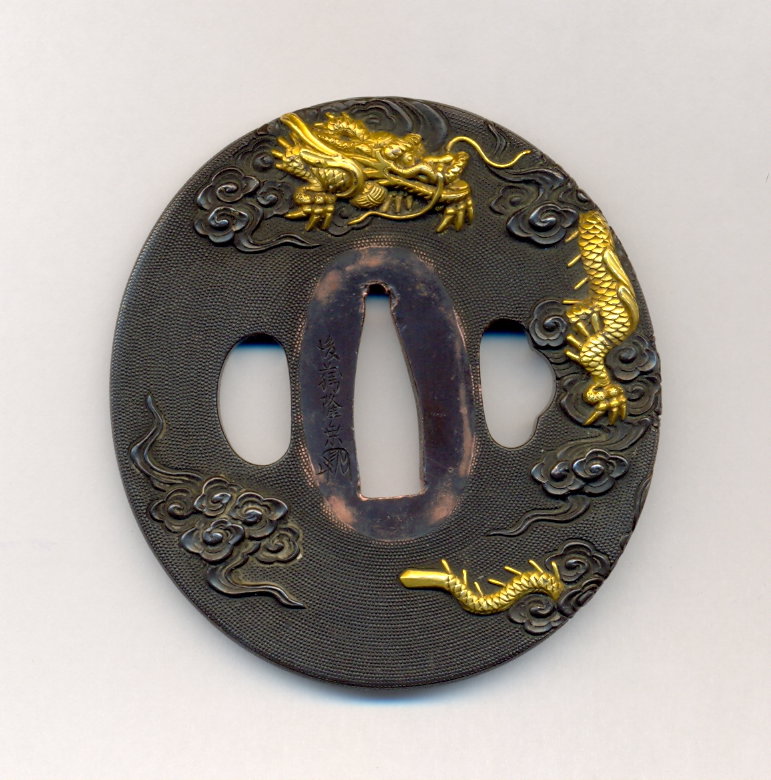
Gentlemen I have recently acquired quite a pleasant tsuba signed Goto Ryujo. Unfortunately, I am ashamed to admit, my literature as well as my knowledge on tosogu is very inadequate and what little I have of both, does not trace this man. If anyone can place this Goto artist within the entire Goto school and share this with me, I would be most grateful. I am sorry to be such a bore! Clive Sinclaire
-
Gentlemen Thanks very much for the very useful input. I had tried to Google search without much success but I will drop Ron Hartmann a line for permission to quote from his Yamanaka note. Please put Yen 150's worth of insense down for me Phillip and I'll owe you a drink. Regards Clive Sinclaire
-
Gentlemen I wonder if anyone could point me in the right direction. I am researching for a magazine article and am interested in finding out what swords were carried by any of the 47 ronin in the revenge attack on Lord Kira. I know a couple which are a Rai Kunitoshi and a Kanemitsu but that is all. Any assistance would be greatly appreciated. Regards Clive Sinclaire