Graybadger
-
Posts
19 -
Joined
Content Type
Profiles
Forums
Events
Store
Downloads
Gallery
Everything posted by Graybadger
-
Thank you Steve, for sharing these resources and your thoughts. Best regards, -Greg
-
Hi Steve, I have appreciated the beauty of Yamaoka Tesshu's calligraphy and I have read and appreciated his translated book "The Sword of No Sword." But calligraphy without translation is mere decoration, devoid of meaning. Can you tell us where to find the "famous poem that he brushed to provide instruction on calligraphy for his wife" that you mentioned? Or any other translations that identify the characters that he is depicting? Thanks, -Greg
-
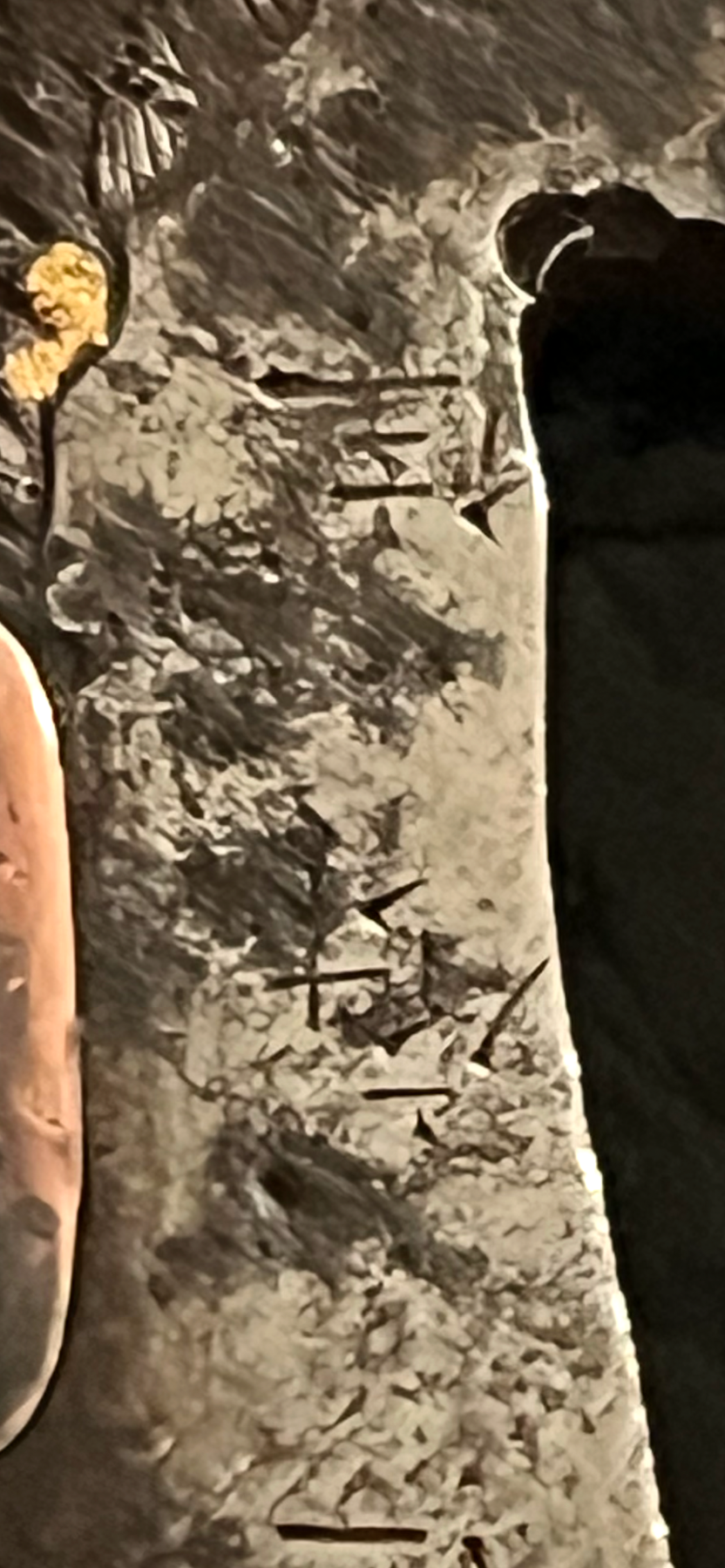
Jason, I believe this is representing a waterfall, with the vegetation and insect in the foreground. If you notice the top edge of the grooves have a slight curvature, like the water at the top of a waterfall as it passes over the ledge. The bottom has no such curves. Also, I think this is wet-location vegetation such as may grow in the mist of a waterfall.
-
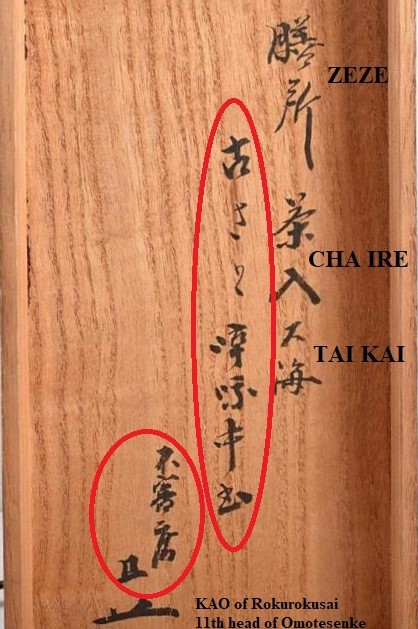
Box inscription for tea ceremony tea container
Graybadger replied to Graybadger's topic in Translation Assistance
Thank you both so much! Any other thoughts or insights are appreciated. -
Please help if you can. This is the inside lid of a container for a "chaire" pottery tea caddy for Japanese tea ceremony. I cannot read the parts circled in red. The writing is apparently by Rokurokusai, the 11th head of the Omotesenke tradition during the time that the Tokugawa shogunate was abolished. This writing would normally attribute a poetic name (mei) to the chaire, and perhaps identify the maker or age. The right line identifies it as a dark-glazed tea caddy with a wide mouth design ("Zeze chaire taikai") but the remainder is too stylized for my beginner skills. This was a recent purchase for my personal collection and I am very grateful for your help. Sincerely, -Greg
-
Box inscription for chawan tea bowl
Graybadger replied to Graybadger's topic in Translation Assistance
Thank You! -
Hello. I bought a teabowl made by Onisaburo Deguchi and it came with a box with the artist's signature and seal and a "name" for the chawan, but I can't read the part shown here. I can't identify these kanji. Can you help?


-
It may be relevant that the Mongol invasions of Japan in 1274 and 1281 revealed the need for more robust swords. I read somewhere that thin tachi blades would stick in the boiled leather armor of the Mongols. Subsequent study of bent and broken blades by swordsmiths resulted in a movement to heavier blades.
-
or...possibly ancient Japanese court noble's hat.

-
I have a pair of menuki in this same design motif, shown in the attached photo. I also saw another pair sell as lot 133 Sotheby's London on March 30, 1994 from the RB Caldwell collection (sold £782=$1157 at that time). I have seen these described as falconry jesses for "takagari" on several occasions, which I accepted until now. The photo of the set shown currently for sale include a horse riding crop. I now concur with the identification as 四方手 'shiode' horse saddle parts.

-
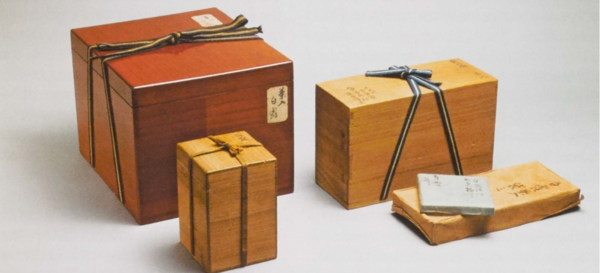
Just wanted to share a link to a delightful article with in-depth discussion of a chaire tea caddy for Japanese tea ceremony and the elaborate set of boxes for it and the related pieces, and beautiful photos of the boxes. see https://studiopotter.org/looking-white-dew
-
Thank you! I am surprised to learn this is Goto. I assumed from the style that it was Soten.
-
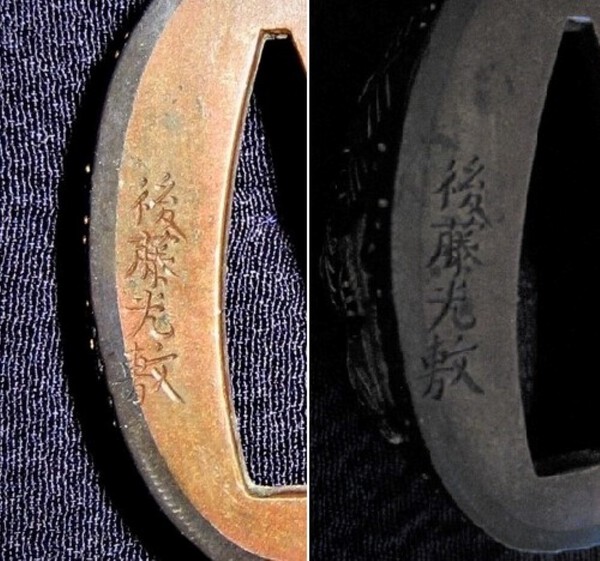
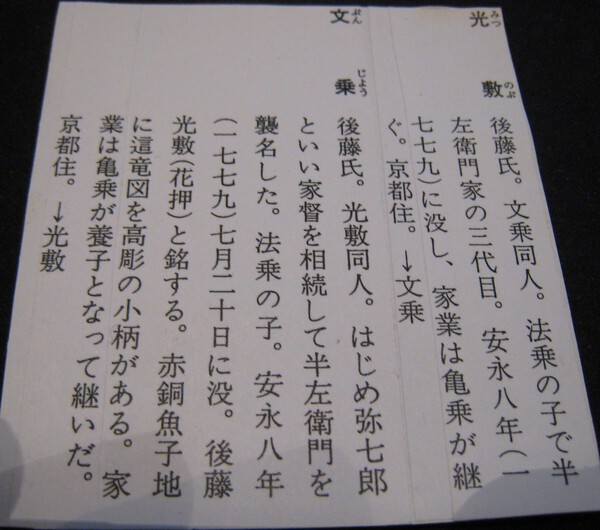
Seeking assistance with reading the signature on this excellent fuchi, please. It also came with this note, and I would be very grateful to know what that says. Thank you! -Greg

-
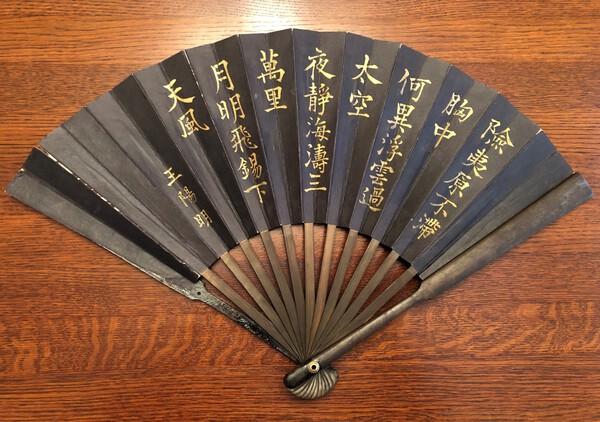
Tessen with poem by Wang Yang Ming
Graybadger replied to Graybadger's topic in Translation Assistance
For those who may be interested, here is a photo of the front of this tessen. The characters indicate (roughly), "Heaven and Earth possess Spirit" and "High integrity is a virtuous achievement."
-
Tessen with poem by Wang Yang Ming
Graybadger replied to Graybadger's topic in Translation Assistance
Thank you Steve M ! Are you indicating that this poem is known by the title: 泛海 ? -Greg -
Tessen with poem by Wang Yang Ming
Graybadger replied to Graybadger's topic in Translation Assistance
Proposed translation
-
The attached photo shows my Japanese tessen (iron-bound folding fan) with dark brown paper and gold calligraphy of a poem by Chinese neo-Confucian scholar/poet Wang Yang Ming. My first question: Can anyone tell me if this poem is well-known, and a title? I have made an attempt at translation, shown in the images, but I would appreciate any input or corrections you may offer. Thank you. -Greg
-
Thank you Guiseppe! The fact that NBTHK (arguably the world's foremost authority on Japanese swords) has used the term 重ね厚く ("thick kasane") to describe your sword is significant information. The fact that your sword received the high rank of Juyo means that it was subjected to intense scrutiny and careful description. Your photo of the overall sugata makes it clear that this is not subject to any exceptions in the standards. Your measurement across the mune is 2mm (distinctly narrow). Your measurement from shinogi to shinogi is 7.6mm (thick). While the broadly accepted definition of kasane is to measure across the mune, this highly authoritative source has measured at the shinogi and calls that kasane. I suggest that to argue about which is "correct" is not useful. I will henceforth describe these as, "Kasane (motogasane) measured at mune: 2mm. Kasane (motogasane) measured at the shinogi: 7.6mm." I am more interested in accurate descriptions than arguing about being "right."