kaigunair
-
Posts
733 -
Joined
-
Last visited
-
Days Won
1
Content Type
Profiles
Forums
Events
Store
Downloads
Gallery
Everything posted by kaigunair
-
oh boy, just came across this bakemono: (scroll down to monster #7): http://pinktentacle.com/2010/04/kaikida ... er-scroll/ he carries a stick too like the #2 figure....
-
check out http://pinktentacle.com/2010/04/kaikida ... er-scroll/, monster number 8...
-
Thanks all for the kind comments. Christian, put the book on my wishlist as it does seem interesting indeed. My bookshelves are already overflowing, so I need to make more space for bookshelves to hold for all the great books out there that I don't have! John, thanks for the clarification about rimpa....there was a similar rinsendo with the korin crows theme (a past post), which is why I thought maybe rimpa influence. But sumi-e makes sense...I still have a feeling there must be a formal name for this style....??? Tom, its weird how often that happens that only after asking the question, the answer shows up on a goggle trolling search. I would still appreciate any suggestions or confirmation about the bakemono, since I'm only really sure about the last two-tailed cat...
-
hmmm....well, there's something called a "night parade" or Hyakki Yagyo: http://en.wikipedia.org/wiki/Hyakki_Yak%C5%8D or perhaps related to a 100 scarry stories marathon session : Hyakumonogatari Kaidankai My guesses so far: 1) Tanuki or Tengui 2) Kappa or Aoandon (blue lantern spirit related to the Hyakumonogatari Kaidankai) 3) Nekomata – The Split-Tailed Cat looks like its the night parade!:


-
may be an amabie type mermaid? http://en.wikipedia.org/wiki/Amabie this might be helpful, but I wish the gallery pics were larger... http://en.wikipedia.org/wiki/Konjaku_Ga ... ond_Volume
-
After much wait and outrageous shipping fees, my first (and possibly last) shipment from a big auction house finally arrived (and I thought ebay was bad) . I believe it is rinsendo school. Unsigned. The shibuishi seems to be in fairly good condition and very shiny/reflective still. I enjoyed what looks to me like a very detailed and delicate rendition of a costume parade. Perhaps it was because halloween had just past? Any how, thought I would ask if anyone can identify the creatures, or animals depicted in my most recent kozuka. Perhaps this is depicting a festival I am unaware of? my googling only comes up with a post 1950's festival called the Uwajima Ushi-oni Festival. I see a kite/lantern, streamers and possibly a flute/shakuhachi and another stick....Japanese pinata? I was also wondering if this is considered rimpa style or if there is another name for prints done in shadow outlines...perhaps a Japanese term for shadow boxes or silhouettes? Would appreciate any help with better understanding the meaning behind this kozuka. Thanks in advance.

-
Fishing for some more experienced opinions. I don't own any of the pieces, so this is just a study session for me. I do have a probable rinsendo school item coming, and was hoping to possibly hear about some defining characteristics...but it seems there isn't much interest in this school... ?
-
Thanks Chris for the detailed write up! I think both you and Lance have covered the difference of the depictions of the crows better than I could have. Here are a few of my other thoughts: -I like Lance's idea about the texturing of the moon in the Christie's example as being intentional. That was eye opening for me. -There is a whole lot more care given in the katakiribori of the branches, especially the thickness and angles of the cuts in the Christies examples. -The Moss/leaves are done much better in the Christie's example. The big thing for me though, was comparing the rending of the water at the bottom of the kozukas: -The Bonham's looks very rough and not thought out. -The Christie's is well thought out. I actually think, barring the similarities in the lighting and level of detail of the photos, the Kogai looks more like the Christie's kozuka for the following reasons: -the water is rendered liked the Bonhams' examples. -the moss/leaves are shaped more like the Christie's than the Bonhams -The lines of the crow implies feathers like the Christie's, vs the outline of the Bonhams kozuka. How the kogai is different than the Christies' kozuka: -moon is not "textured". -the branches are rendered with a little more angled, has more details, than the Christie's example, but better done than the Bonhams. Highly possible they are by three different hands. I do think it hard to compare the quality of the shibuishi since the lighting and lense choice appear affect that aspect greatly. Its also too bad the lighting/angle on the Bonham examples cut into the crow details. Looking forward to seeing what other details I might have missed.
-
Thanks lance! Very detailed write up and I wholly agree with your comparison points (much better said than I could have put it too). I did think the kogai was closer to the Christie's auction, but will take a second look now... Would love to hear more opinions!
-
I've admired Ogata Korin's crows and moon print, so when a rinsendo school kozuka recently came up for auction, it piqued my interest. I thought it might be interesting to compare two kozuka of the same theme, but that appear to reflect two completely different skill levels. What's great is that both auctions have very high resolution close ups that zoom. Unfortunately, neither has any rear signatures, but then I'm told its best to judge a piece without regard to the signature. Bonhams (2013) http://www.bonhams.com/auctions/20493/lot/37/ Christies (2012) http://www.christies.com/lotfinder/Zoom ... ID=5618030 (http://www.christies.com/lotfinder/arms ... tails.aspx) I don't know if either of these are genuine Mitsumasa, but I feel one is definitely better than the other. Both could be gimie, but if one isn't, then I have a strong feeling toward one being genuine vs the other. Would love to hear what aspects of each kozuka people are comparing to arrive at a same/different opinion. I'll post my novice opinions hopefully after hearing what the more experienced have to say, as I'm looking forward to seeing how my eye compares.... Thanks in advance. ps: here's a kogai from 2010. I think this one matches up to one of the kozukas up top... http://www.bonhams.com/auctions/18493/lot/71/
-
Nice find. Good to know the NBTHK would paper this smith & signature + kao. Note: Not sure if the certificate states tetsugendo (too small for me to make out...not sure that they would even do so on other known tetsugendo pieces?), but the seller's comments state "一説に鉄玄堂尚茂の門人という" = "One theory is the smith is a tetsugendo student". I'll admit that in light of the NBTHK paper, it does not seem like the kao represents the gi in gimei (偽). My error. Hope your auction does well.
-
Hmmm...well, not sure if this is significant, but the jiita (red copper colored metal) is actually also on the 3 side, not counting the opening for the ko-gatana. So not sure it could be set on top of a shakudo base from which the fuji would come from, but perhaps that is the case...
-
I'm at a loss to know how to tell. Me feeling is that it would be just as difficult to mask and patinate the different parts (I'm assuming both shakudo colors would have to be patinated to get either result) as it would be to use different metals (which would also have had to be use on the sides) while joining them so seamlessly.... That ichijo is also quite lovely, though i see it in a different way than the kanatsugi; if i had to explain it, the kanatsugi's appreciation seems to be more technical in nature while the ichijo's is so much more about the art (the strokes/bori work). Guess that's why ichijo's works are held in such high esteem and command equivalent prices.
-
Ed, thanks! Wanted to check on something and it turns out, Ishiguro Masatsune was also listed as a direct student of Yanagawa Naomasa! I wonder if the three of them were together in the same room learning and/or making kozuka together.... Thanks runagumc, I think I got the better brother too. I'll one up you and say I'd prefer an example of the teacher of the yanagawa school founder...Yokoya Soyo or Somin, I'm not that picky ! Thanks for the reminder about pickling vs patination. I do hope someone can clarify the technique....
-
Thanks all for the kind comments! Mt.fuji does seem to transfer especially well onto the kozuka format, could make for a substantial book in itself, if one does not already exist? Ed, love the example in your website too! I hope I run into an identical example one day (would love to know who it's by). Tom, that makes sense, how the color effect is due to lack of pickling vs a different metal. Compared to many of the examples I have seen of bad gold guilding, seems the brothers were adept at masking and controlling the patination process? (Also, thanks again for letting me volunteer at the shinsa!)
-
Thanks John and Geraint for the kind comments. Geraint, yes, there is an area where the etching was not done too, right before the summit. I just realized after looking at the photos that there is an additional effect of this type of etching: seems to me that you can get some interesting lighting effects depending on where the light source is, with parts of the etching showing up when towards the light and the other side turning to black. Maybe I'll experiment with my macro lens light, following a hypothetical arch of the sun to see how Mt. Fuji shows up....
-
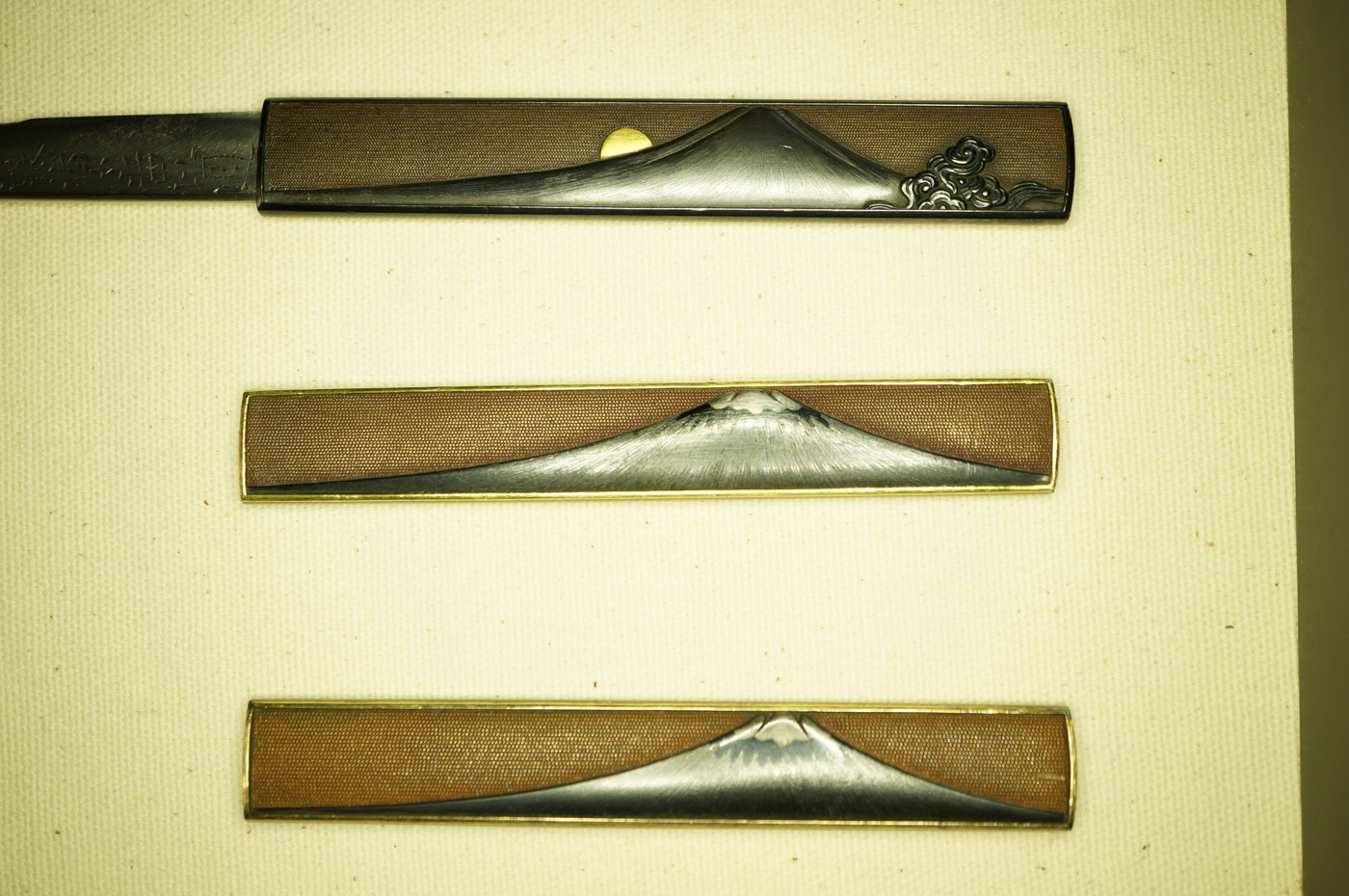
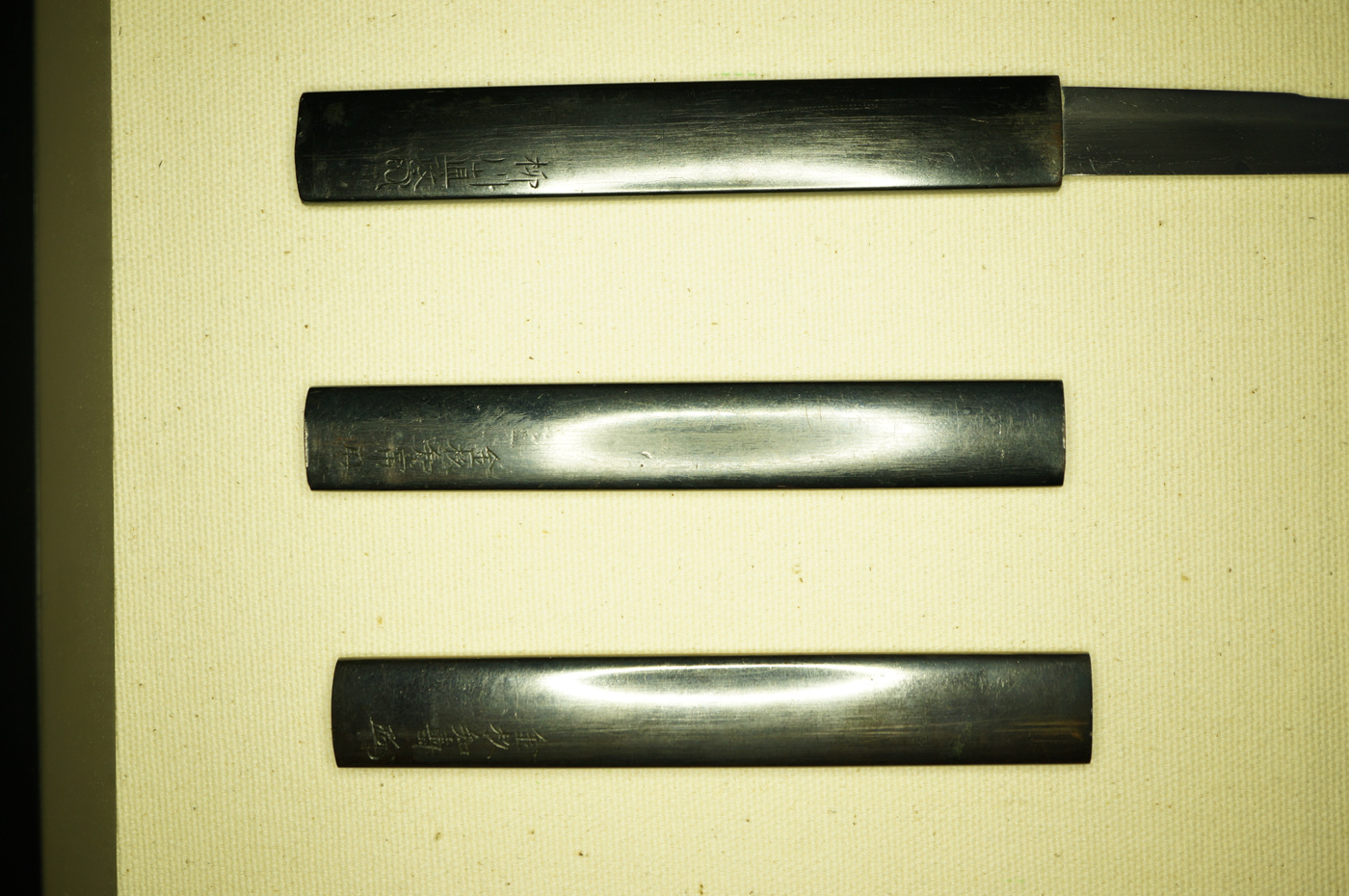
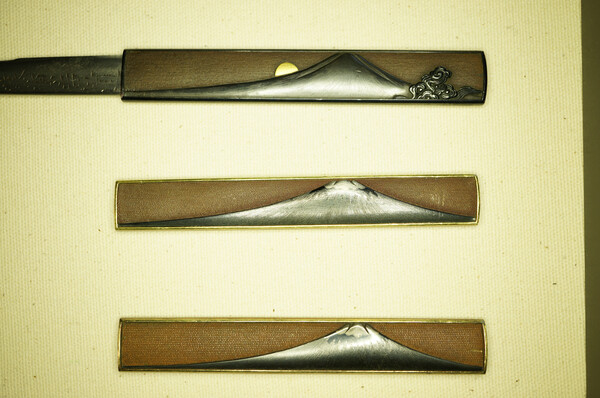
Well, I was finally able to meet up with a friend to take pics of this group of kozuka. I had always admired my Ncjsc buddy's two kozukas (top and middle), and when I saw that there was what appeared to be an identical kozuka at Mike and Cyrus' table (tetsugendo.com) at the august show , I told him about it to let him have the right of first refusal. Well, after the show ended and when I was sure he had decided to pass, I swooped in...and am very glad I did. Props to Mike for a great deal and super fast shipping as usual! Turns out, the kozuka I picked up was NOT by the same smith as my friends: it was by his brother! My kozuka is by Tomotoshi Kanasugi (Haynes 10124.0) of Satsuma Province while my friend's was by Tomotsune Kanasugi. Both brothers evidently went to Edo and studied under Yanagawa Naotsune. In addition to a Kanasugi, my friend also had the yanagawa signed kozuka (the top example). It is signed Yanagawa Naomasa, the top yanagawa guy himself. Since it is unpapered and there are tons of forgeries (as well as variations of his recorded signatures), it would be very hard to call shoshin, but I thought it would still be a good example to show how the Kanasugi brothers stack up. Like Mario and Luigi, the Kanasugi brothers appear to be a smash! The nanako ground is very fine and done in a redish/brown background (not sure if this is a type of shakudo or something else). There is etching in the hill area of Mt. Fuji which is capped in shibuishi. Of further interest is how they treated the body of the kozuka: while the front rim is gold gilded, the sides are a copper red (like color of the nanako) and the back is the dark shakudo. More and more I see its the little details that indicate quality. Any info on the Kanasugi school or examples of their other work would be much appreciated! Looking forward to hearing comments and opinions. The pictures show the kozuka in the following order: Top: Signed Yanagawa Naomasa Middle: Signed Kanasugi Tomotsune Bottom: Signed Kanasugi Tomotoshi


-
Katonk: slang used to refer to Jpn-Americans from the mainland by Hawaiian born Jpn-Americans during ww2 (think 100th battalion / 442nd RCT). Used to describe the sound their heads made when knocked around by the "buddah-heads". As you can tell, they didn't always get along... With regard to reproduction military gear, both Nakata and another well known maker whose name escapes me now would stamp their items with a seal for "military item" or for "repro". Sometimes people would post pics of these items thinking the stamps were military acceptance marks. But it was pretty evident to the Japanese consumer. some repros are done very well so if someone were able to remove the mark/stamp, it would be very hard to know with some aging. So at least you know where I am getting some of my ideas which may seem far fetched. Well, about wraps it up for me. For the most part, an enjoyable and hopefully enjoyable thread.
-
Ok, sorry David. That part I didn't realize could be taken personally, but i see it has. But know I consider myself a gaijin, as I am an ABJ and have always been seen as such by native borns. I am also a katonk. I'll change it to "western foreigner" seeing as how the context of that term was misconstrued and has taken away from the more important points, which I was looking for real responses too... Mike, those eiju pics are helpful. Would be nice to see similar works by other mainline tetsugendo smiths to see how he stacks up...
-
After all this and still no idea? Not even alittle? *edited out* As one collector to another, it's OK to want a piece to be genuine. Plus, being able to link to an NMB thread discussion that supports a genuine call helps when one tries to sell a piece later on, right? Looks like this has become a great thread for anyone looking for info on seiryuken eiju, though could use some known tetsugendo pics. So we've all added to the knowledge base of the forum. Oh, and btw, YOUR WELCOME. Your thanks really isn't necessary though since I'm in this for all the glory, fame, and accolades that come from posting heated discussions on the NMB, not to mention the truck loads of cash the moderators pay me for each response I compose. If I could add one last opinion, perhaps we may also deduce this particular example is from a workshop, one located in Yokohama. Having a kao that says "gi" could indicate this was not meant for domestic consumption. And I can imagine the dock side hacks having a good chuckle regarding their added "kao" at the expense of their unsuspecting western foreigner customers...all just in my opinion of course.
-
oh, and if gimei is this: 偽銘 then that first character, 偽 looks kinda looks like this kao..... ...in my opinion...
-
hmmm, still the same design, and... http://www.zacke.at/en/catalogue/sword- ... er-pattern "A slightly ovoid Marugata with both Hitsu and an even rim. Both pieces, except the Seppadai section presenting the same pattern of four-lobed blooms in geometric order. Both Tsuba signed and with a yellow inlay Kao. Excellent signature Sosho Seiryuken Eiju. Haynes: recorded under Naofusa H 06602. The Kao is probably to be read "Gimei"." I'm personally not sold on the idea this is related to a school or workshop. It seems, like many artists who have tons of gimie pieces made (yanagawa, omori, ishiguro), there are many imitators; however, that doesn't necessarily mean there was a workshop, right? I mean, if the standard is going to be this, then shouldn't "workshop" attributions be given to that large body of other pieces, that we normally designate as gimie because the same forgeries pop up? Again, I could be totally wrong, but I am stating that I am basis this upon the fact that this signature doesn't look that tight compared to the knowns, and the work isn't sublime. Not even close compared to those "gimie" where even if the work is pretty good, but still considered gimie if the signature does not match. So, other than multiple exact copies of this design using the same signature and kao popping up, what is there to show a workshop vs someone putting out a batch of like tsuba, labeling them with a known/semi-famous person, and selling them as such? The big question is: Does this design, the work itself, even fit into the tetsugendo school style? My limited opinion is that it does not, so I would love to see tetsugendo work that looks like this one. Make me a believer! PS: Guido, I would love a list of good tosogu books showing only juyo and above pieces...is there such a compiled publication? Please PM me any suggestions!
-
Trying to strong arm my comments in submission? I can provide more reasons why, in my opinion, I think this is a gimie (but really, why bother since, in my opinion, I'll never have been collecting as long as you have been an NBTHK member ) I'd be interested to know what references or examples you are using which supports that this tsuba signature is shoshin. The only examples, in my opinion, that are on the 'net which have anything close to a seal like yours, are ones that have the exact pattern (In my opinion, I've already stated what's in the one book in my library ). I find that curious/suspicious, in my opinion. What I opine is that the signature on your example is too close and clumsy to what the documented examples are supposed to look like for Seiryuken, in my opinion. Here's what I think a seiryuken signature should look like, in my opinion: http://tsubaka.ru/14_en.htm (last pic on the page, in my opinion) and a papered f/k set, in my opinion: http://www.edo8.jp/products/detail.php?product_id=96 What I am not sure of is whether this work is at the level of a tetsugendo school student, in my opinion. In my uninformed opinion, it doesn't seem very inspired, but perhaps it is for an iron tsuba, in my opinion. David, in my opinion, I'd really like to be wrong about this gimie call. So I'm ready to be schooled and shown how to properly evaluate your tsuba and come up with a shoshin/genuine call, in my opinion. It'll help me learn a whole lot more, add to my body of knowledge, and make up for my lack of membership in the NBTHK, in my opinion . BTW, I'm probably wrong anyway, since I was wondering why no one else called out gimie before my comment...or perhaps.... ...oh, in my opinion of course....
-
Wow Mike! what a gift for your daughter! hope she treasures it (and is perhaps a chip off the old block?). The usagi tsuba signature looks text book as does the seal. I'm guessing its papered (is it perhaps tokubetsu hozon or juyo?). Compared to the usagi, the patterned example signature would seem more like a gimie than a different artist - it appears to be copying the signature of the same naofusa/seiryuken as seen in the usagi (and in wakayama), but is less smoothly rendered and off in a number of places; that kao/seal is way off. I also notice that the examples don't have the same nakago ana finishing punch marks as this one does; usually smooth with no marks like the usagi, or more utilitarian cut outs for fitting a particular blade. But if the quality of the tsuba itself is at tetsugendo school level, I guess there's a chance this is an uncatalogued signature variation. Is this one papered?