PietroParis
-
Posts
784 -
Joined
-
Last visited
-
Days Won
4
Content Type
Profiles
Forums
Events
Store
Downloads
Gallery
Everything posted by PietroParis
-

Netsuke Identification-help needed
PietroParis replied to C G Forrester's topic in Other Japanese Arts
Indeed, it's a mass-produced souvenir: https://ebay.us/m/1HJRYB https://spicersauctioneers.com/catalogue/lot/3854b156aa2e7af44cf82585fc6f87b3/2a6fa85538c56e3991b429b74f737ad8/antique-and-fine-art-lot-294/ In these cases I usually suggest a comparison with a genuine example, but I don't recall ever seeing an antique version of this model. Anyway, this is what genuine birds in wood might look like: https://www.metmuseum.org/art/collection/search/59041 -
This is an old acquaintance, it was already there in 2021 (see page 2).
-
Namitoshi on eBay:
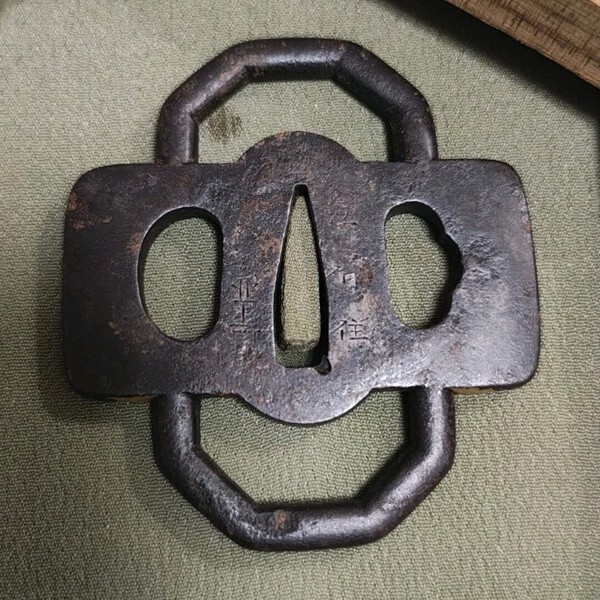
-
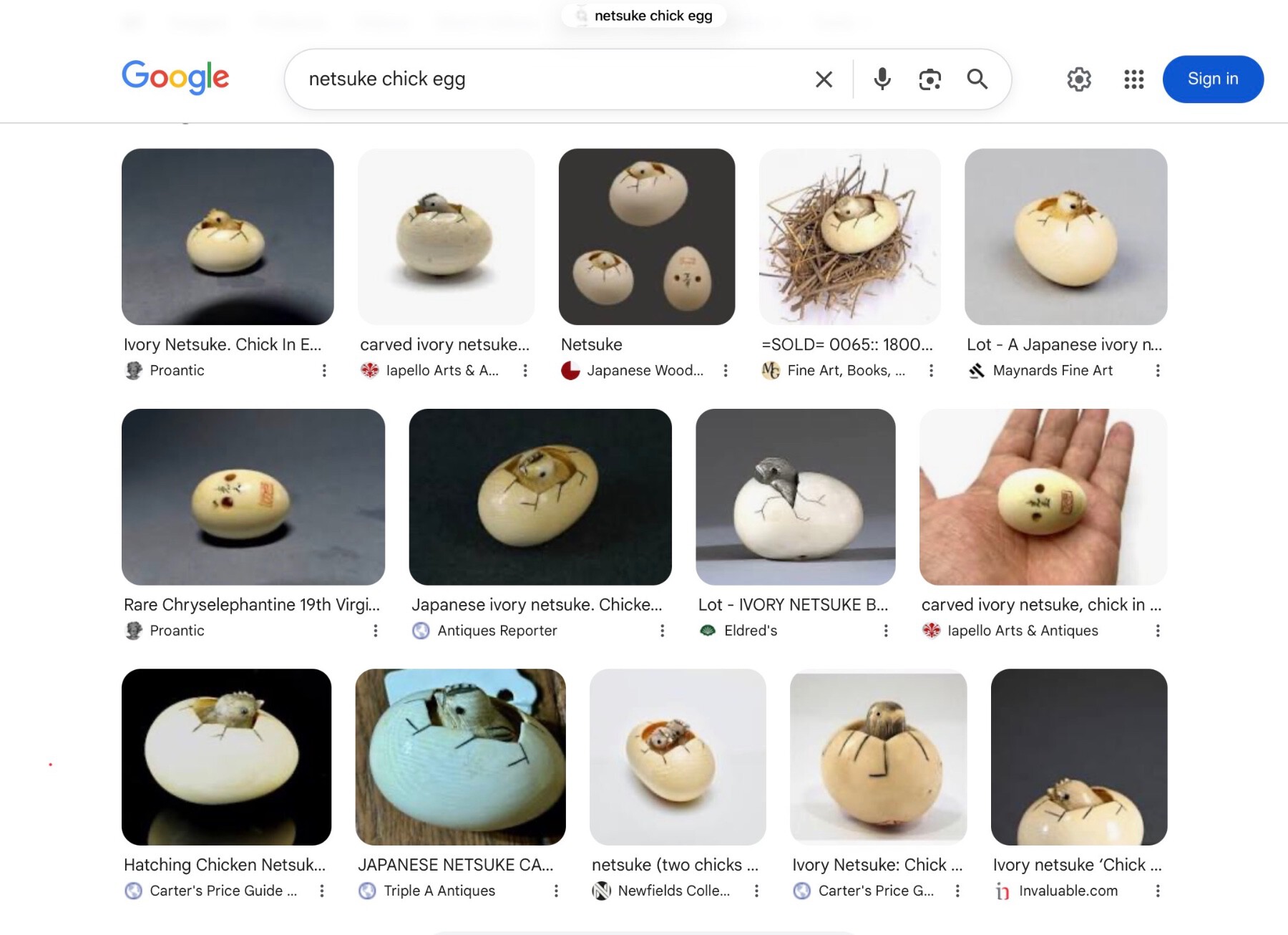
The "chick and egg" thing is indeed modern and mass-produced:

-
Another faux, sorry.
-
I'd say the signature is consistent with the whole piece: a modern fake.
-
I always thought that Schreger lines occur only in elephant and mammmoth ivory. A quck google search doesn’t provide any evidence of the contrary. https://cites.org/sites/default/files/eng/resources/pub/E-Ivory-guide.pdf
-
IMHO: The bird could be a carved tagua nut, in that case it might still have some age. The zodiac animals look modern (and possibly Chinese) to me, and I have doubts also concerning the bathhouse scene (those ladies look a bit too "buxom" for a Japanese antique, and also the faces don't look right). I have few illusions about the oni, but more pictures might help. P.S. concerning the others: the Dutchman is a modern fake, the shishi is not a Japanese netsuke (possibly Chinese soapstone of undetermined age), the bamboo shoot doesn't look very old but it's better carved than most in this bunch. The signature 孝正 Takamasa/Kosho is unrecorded, probably made up although it could also be some post-WW2 (or even contemporary) professional carver. P.P.S. as mentioned by others above, the smokers are a decent Meiji-period export piece.
-
On dating I would trust Ueda, who had access to documents such as temple registers, more than Meinertzhagen who relied on stylistic considerations. So I would take the 1907 death at face value. Either for some reason Kohosai stopped working for the last 30 years of his life, or Meinertzhagen places him a bit too early (note that Davey says late 19C).
-
This BTW shows how misleading the condition of a netsuke can be. Without the signature I would have thought your monkey to be about 100 years older than what it must be.
-
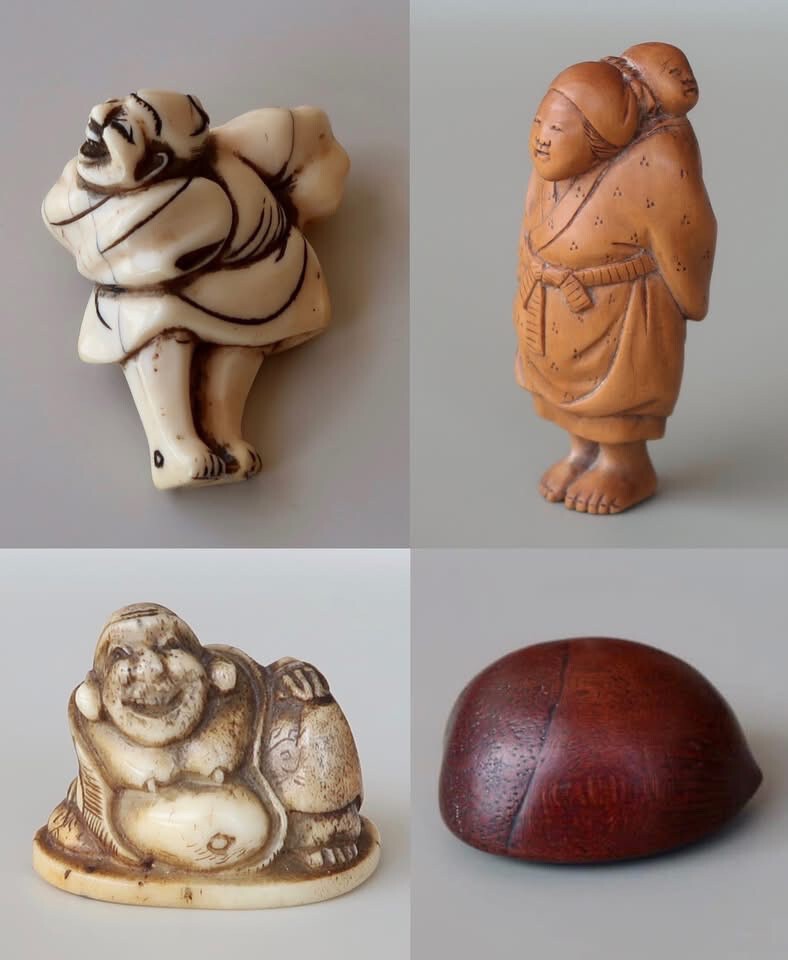
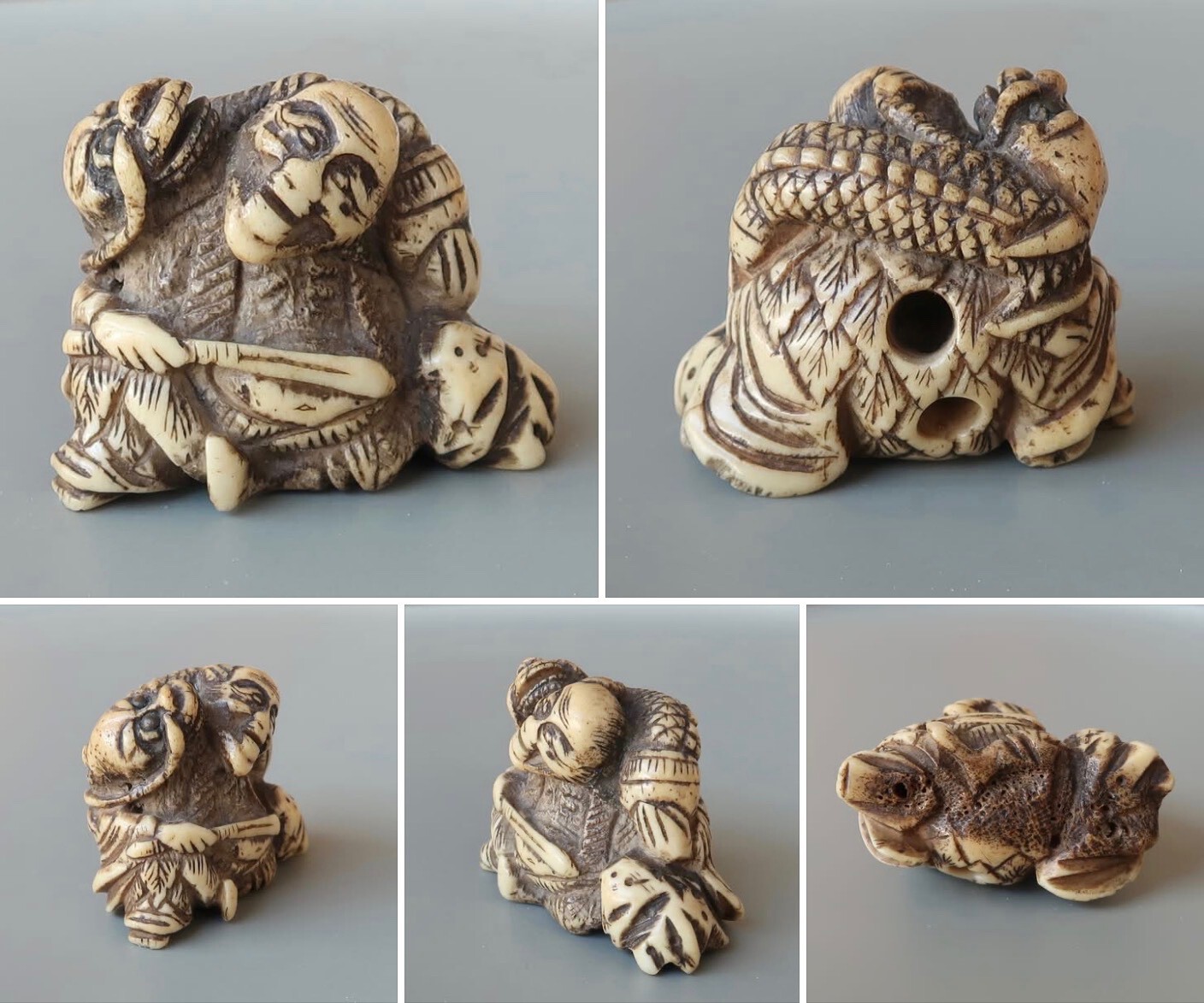
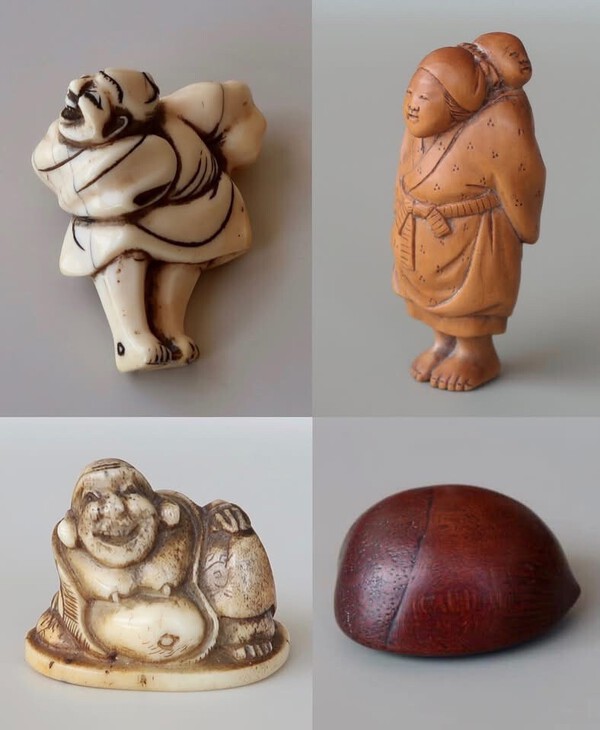
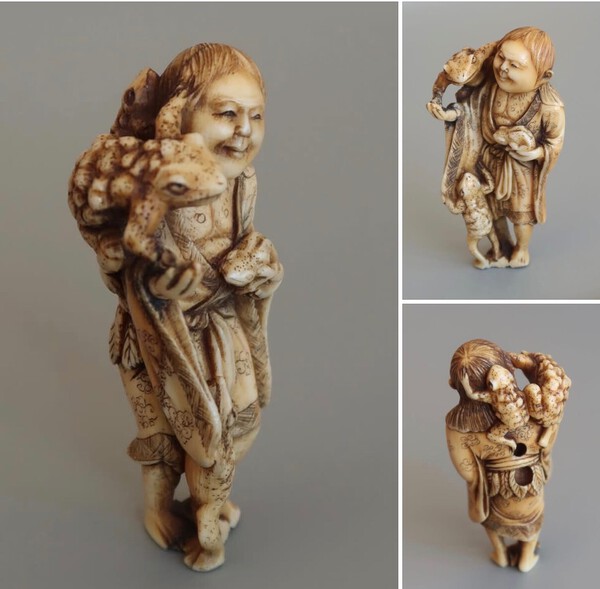
Budget netsuke is one of my favorite netsuke topics (mostly out of necessity... With some luck and patience you can buy genuine antique netsuke even for less than 200 euro, but you need to know what you are doing to distinguish them from the 99.9% of fakes you will find in that price range. These for example I paid around 100 euro each (two on eBay, one in a flea market and one in a local auction): This one was 70 euro in a flea market: This one I paid around 100 euro at auction but it has some obvious damage:

-
This is a crude carving made for export in the 20th century. I would have guessed hippo tooth. It has no value to experienced netsuke collectors, but I guess someone might buy it as curio for 30-40 GBP.
-
Well you did accurately tell that the one posted here is fake. My point is that all the “rules” you can think of have exceptions, but after you have seen (and possibly handled) hundreds of genuine pieces the fake ones will just seem obvious to you. (Note that I’m talking about tourist trinkets here, sophisticated forgeries are a different matter).
-
To be fair, this isn't entirely true. Many genuine netsuke (especially later ones from the 19th century) have cord holes of the same size. Also, signatures were uncommon on earlier netsuke, but became more and more common in later times, and while some of them were indeed artistically made, others were just cursive scribbles. Check out these reference books for examples of both kinds: https://archive.org/search?query=lazarnick
-
Moreover, the signature is the infamous 玉石 Gyokuseki, one of the most common on this kind of tourist trinkets. A Japanese collector I know even thinks it is meant as a pun, because it means "gems and stones" and is used to denote something dodgy. https://jisho.org/word/玉石
-
The five you showed so far (including the one in the other thread) are indeed modern tourist trinkets. If you post a few group photos of the remaining 20 pieces we will let you know if there's anything worth a closer look.
-
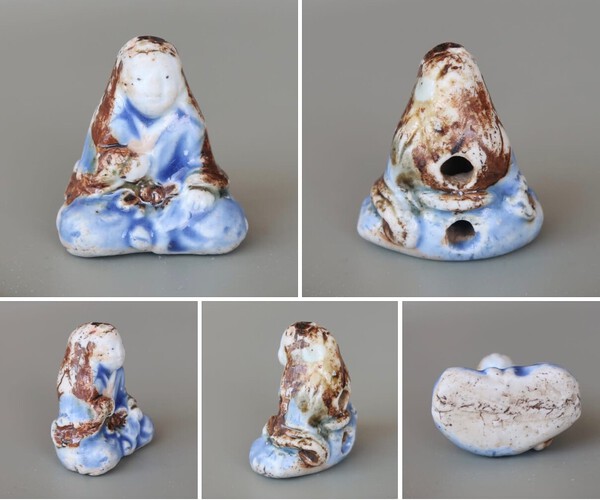
As they are hollow inside, I think they were molded in two halves that were then joined together before the firing. Sometimes (as in the possibly unfinished example below, also in my collection) you can still see the joint:
-
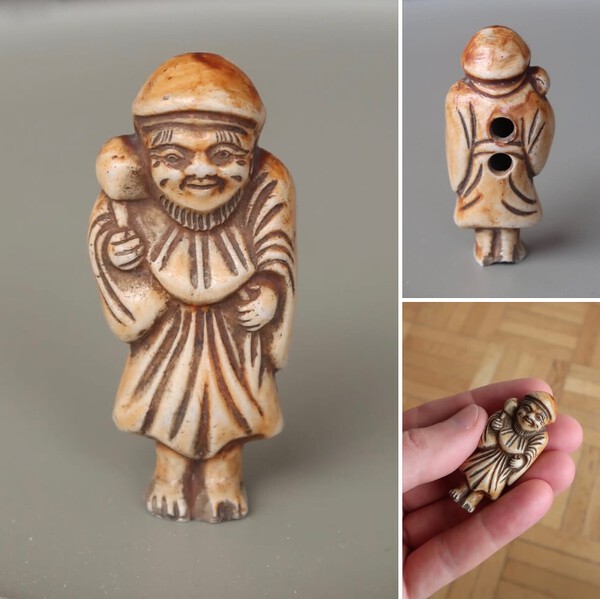
The seal is 正一 Masakazu, a common one on the crane sennin model. Here is my contribution in this category (but no seal):
-
I guess Piers meant to be Socratic, but since he didn't reply for a few days here's my quick opinion: no, it doesn't look authentic. It does not look much older than the 30 years you mention.
-
The pagoda in his hand would rather point to Bishamonten, probably part of a "Seven Lucky Gods" series. The signature Gyokuseki is very common on modern Chinese souvenirs, some even think it's a pun because in Japanese it means something like "dodgy".
-
Our replies crossed Piers, but great minds think alike!
-
To summarize: 1) it’s definitely Ono no Komachi in old age rather than a Shojo. 2) The characters appear to be the ones identified by Piers, but the signature is not included in any list of netsuke carvers. 3) the top-down hole is not what you would expect in a netsuke, but the item seems too large for an ojime (i.e., the bead that is positioned on the cord between the netsuke and the object that hangs from it). So this piece remains a bit of an enigma to me. Based on these pictures I would generically place it in the 19th century, but I can’t say exactly what it is or whether it has been tampered with at a later stage.
-
I’m afraid it’s something more permanent, it appears to have formed a thin film. It’s like some kind of furniture oil. There are also a few tiny blisters where the film separated from the surface:

-
This for the record is my own Komachi, bought from a German auction without seeing it first in hand. It was described as “bearing a shiny patina”, but I suspect that it was in fact coated with some kind of varnish by a misguided collector or "cowboy restorer"...