

Ray Singer
-
Posts
5,243 -
Joined
-
Last visited
-
Days Won
142
Content Type
Profiles
Forums
Events
Store
Downloads
Gallery
Everything posted by Ray Singer
-
Thanks Ted, I really see what you mean. There is a different feeling of nagareru in places. I always have a hard time evaluating steel color, I am sure it would be much clearer when compared against another sword to see if there is more of a whiteness in the steel. It is also interesting to look at the boshi in this tachi. While the sword overall does not have nijuba, there is a strand of nie floating above the boshi which is crisp and bright like a line of kinsuji which has floated above the hamon. This is only visible on one side. As far at the nie activities in the ji, they seem independent of the kitae. The nie utsuri does not follow along with the pattern of forging, but rises and falls like a midare utsuri. I really need to scan the photo from the Juyo Nado Zufu, which shows this well (or if someone had volume 49 handy, they should be able to see this piece). I have a tanto which also had this same dual attribution. It was originally papered by Kotoken Kajihara to Rai Kunitoshi in older polish. The sword was evaluated at the NBTHK, who said it was a high quality Yamashiro sword and should go Juyo to a Rai smith. After polish the sword received Tokubetsu Hozon to Enju (and will not paper higher). I can see easily in this sword why the attribution went to Enju. There is full length nijuba on each side, very similar to the Awataguchi Kuniyoshi tanto in the beginning Rai show catalog. Other Enju I have seen are very similar. The hada is more itame nagare compared with the tachi, but I think this is due to the steel being less healthy by comparison..
-
Thank you everyone for your feedback on the sayagaki. It is interesting, considering that Rai and Enju worked in two different geographic locations, that there would not be a more distinct difference in the jigane. Did they really use different base materials or did the Enju import their tamahagane from Kyoto in the early days of the school? Kunitoshi was a versatile smith, especially if you agree with the theory that niji kunitoshi and rai kunitoshi represent the long working period of a single smith. It does not seem out of the realm of possibility that he would occassionally vary his boshi. I am surprised that the sword did not receive an attribution to Den Rai Kunitoshi, or perhaps there are other Enju features not mentioned in the sayagaki? The sword does not have the prominent nijuba I have seen in other Enju, but it does have a very vivid full length nie utsuri. I will attach a few photos below...
-
I would greatly appreciate help with one additional sayagaki. Prior to receiving juyo (and before I owned it) this sword had a Honami Koson kinpun mei to Rai Kunitoshi. This sword did not pass (I am told due to the o-maru boshi). The kinpun mei was removed and the sword was resubmitted, passing as Enju.

-
Thank you Franco, the polish was done by Kuroda-san, a mukansa togishi. The activity in the ji was brought out beautifully, with bright chikei throughout the sword. My photos don't capture this at all. As for the yokote, this was present in the previous polish...
-
Curran, I think you are right about a third generation working prior to Oei. I went back through my papers and Tanobe's original letter (pre-polish) states that the sword was made in late Nambokucho and would be a work of either the second or third generation. It is interesting that the sayagaki seems to include the shodai as a possibility...
-
Hi Paul and Veli, Unfortunately I neglected to take photos of the nakago before leaving town this weekend but I will take some when I get back. The ken horimono is original. The two hi formed by the sides of the ken continue in parallel with the soe-bi, running deep into the nakago. The suriage is very old, at least mid-muromachi, and the nakago is well finished in kurijiri. You can actually see another example of this style of horimono in another posting in this forum... viewtopic.php?f=4&t=5678 What I am fairly certain is not original though is the short bo-hi in the ji. My feeling is that it was added to excise some kizu in the blade. Actually, this is the main reason I am not submitting for juyo. The sword is otherwise flawless and very healthy, however I am certain that this piece of ato-bori would keep the sword from passing... - Ray
-
Wow Stephen, you have an excellent memory . It was 1999, and the sword I found in Tampa was a shodai Hizen Masahiro. Unfortunately I had to sell that piece along with a few others to purchase a very special ju-to Enju tachi being offered by Bob Benson. I will post photos of the Enju later in the week. The next owner of the Masahiro had a nice Higo style koshirae made. It recently sold on Mike Yamazaki's website: http://www.ricecracker.com/japanese_swo ... a/sk16.htm
-
One of the forum members asked that I post photos of my Nobukuni. Tanobe placed this piece to late Nambokucho, and was not able to give the specific generation. Sayagaki with translation follows... 城劦信國 – Joshu (= Yamashiro no kuni) Nobukuni 但薙刀直無銘也初代與應永信國ノ閒ニ位置スル工而年代ハ南北朝末期也 地刃ノ出来宜敷殊ニ互乃目ノ刃取ノ形ニ其特色ヲ顕現シ候彫物モ巧技也 - However, it is a Naginata-naoshi without a mei. The smith is thought to be Nobukuni between the 1st generation and later one in Oei era, and the period is around late Nambokucho. The workmanship of the blade is good. Especially, the shape of its Gunome pattern clearly shows his characteristic. Also the carving is excellent.


-

Nobukuni sayagaki - translation assistance
Ray Singer replied to Ray Singer's topic in Translation Assistance
Thanks Stephen, I will definitely get take some photos of the Nobukuni and upload later in the day. Brian's habaki is interesting in that the gold koke pattern overlays another pattern of straight yasurimei... Thank you Moriyama-san for the translation of Tanobe-san's sayagaki. This basically affirms his earlier letter about the sword... Best regards, Ray -
Met Show
Ray Singer replied to Pete Klein's topic in Sword Shows, Events, Community News and Legislation Issues
I only had an hour to visit the show this past weekend and may have simply missed these pieces, but I did not see the Hasebe daito or the Suiryuken koshirae on display (both pictured in the catalog). Is the plan to exhibit these later in the show? - Ray -
Nobukuni sayagaki - translation assistance
Ray Singer replied to Ray Singer's topic in Translation Assistance
I need to share the beautiful habaki Brian Tschernega did for this piece... - Ray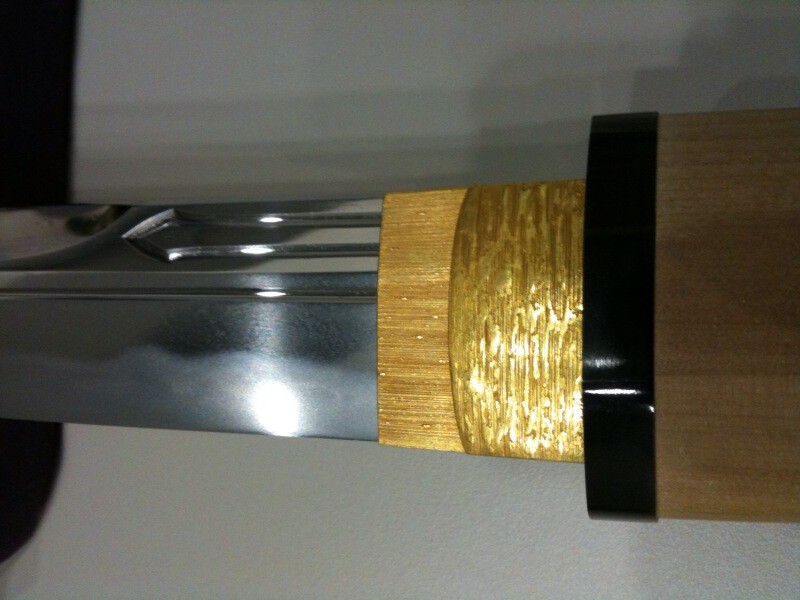
-
Would greatly appreciate assistance translating the sayagaki on a Nobukuni naginatanaoshi in my collection. The sword was sent for Tokubetsu Hozon prior to polish and passed to Nobukuni, late Nambokuchi jidai. At the time, Tanobe-san sent a letter saying that it was difficult in its current polish to determine whether this was a work of the shodai or nidai. Please see the photo below of his sayagaki after polish was completed... Best regards, Ray

-
Interesting placement of the mei on this piece... https://www.aoi-art.com/auction/en/auct ... 1213703271 I assume that space was reserved on the nakago for an additional inscription, perhaps this was one of 2-3 pieces made for a special order. Thoughts? - Ray


