Bugyotsuji
-
Posts
15,095 -
Joined
-
Last visited
-
Days Won
323
Content Type
Profiles
Forums
Events
Store
Downloads
Gallery
Everything posted by Bugyotsuji
-
Since this thread went quiet I have been thinking and talking about it with various people. The long gun you posted, Thomas, has more resemblance with some of the Inatomi School Keicho Period long guns, many of which were sent over and used in the Korea campaign. They are quite rare in Japan today, but I have seen about 10-12 examples in the last 10 years here. I took some photos today of a couple of 160 cm examples, the 'baby' one slimmer, the other much heavier and with 4 sights. They tend to be long and quite straight, even through the butt. What I learned recently is that the very straight ones are called Chosen-yuki (? or something, need to check the word) Keicho-deppo, and the reason for this is that the straighter ones packed tighter into the boxes they were shipped over in. Unfortunately I am not optimistic about the two countries cooperating on forming a muzzle-loading club or a matchlock demo troop. The reasons seem stupid to outsiders but too real to those involved. I think it would be better for the Koreans to go ahead and form something and work from there with inner pride.
-
Thank you Christian! :lol: To tell you the truth I do not have high hopes, but it might be an interesting exercise, ...or it might not. One other problem is that it will be gone for some months... but then, out of sight, out of mind?
-
PS Ian I had a look at padsaws and see what you mean. http://www.google.com/search?hl=en&safe ... 24&bih=579 How long a history have they? I wonder if the idea leaked across the globe? (The saw is on the back of an otherwise regular blade, though...)
-
Well, here is the promised follow-up. Junichi, thank you for the photos. Yesterday a friend gave me a sheet of Ho-no-ki and said I should make a shirasaya, perhaps somewhat like yours, for it. Your wood looks like persimmon. Another friend showed me some photos and explanations as to what these saw-bladed Kogatana are. The books say that the Ninja story is a myth and these were probably everyday tools for samurai, although he conceded that they are not very common. They seem to have been introduced around the beginning of Edo, I think he said. The saw itself would not be soft as the tips would have been deliberately yaki-ire hardened, he was saying. He reckons it started life as a kozuka, but first proper use of the saw would have immediately made a mekugi a necessity, so the hole may have been introduced later. I pointed out a slight bend in the blade and asked if it would be OK to introduce opposite bend with the fingers in an attempt to straighten it. He warned me that this risked a snapping in the temper line and the introduction of a fatal flaw. As to the Mei, he said it would not have to be, and might quite possibly not be that of a Katana-kaji. I asked about rough budgets for shirasaya and polishing and he suggested if done locally here around 150 dollars US for the shirasaya and another 150 for the polishing. Whatever type of saya you choose, you would have to take care inserting and removing it. (If you to slide the blade along the mune, you will destroy the sheath.) He showed me his collection of kozuka and kogatana in shirasaya. Some wonderful examples. Max jealousy. He concluded that it might just be better just to leave it as is and allow the imagination free play. Thanks for reading this far.
-
Cast copper, granted, but no mention of Kagami-shi mirror maker there...
-
Just posted a reply but the old glitch threw out the post. Second time lucky? Thomas, in the parallel discussion here on the Myochin tsuba, I posted a link to a different supposed mid-Edo cast tsuba, with a short description about the maker: http://www.tsubanomiyako.jp/SHOP/T-056.html The maker is said to be Yoshihisa of Yamashiro. The word used to describe his tsuba is "Imono-tsuba" 鋳物鍔 made in igata 鋳型 a mold/mould According to the description on this web page 鋳物師による鐔は無銘が多いのですが ”most tsuba made by cast tsuba makers were unsigned, but (this one ...)
-
Is anyone interested in the idea of submitting this tsuba for Shinsa, just to see what the board might say? Entirely in the interests of science, of course. Would they stick to the books? Is there any fresh and independent thinking out there? Is there something we are all missing? Perhaps it is time to chase this one down. (Naturally their easiest escape clause would be the single word 'Gimei'.)
-
Lee, what would you have said? PS Keep it diplomatic, but let her know that you know what she suspects, but you are too polite to say it. PS You have five seconds to formulate your answer...
-
Well I have seen poor quality cast tsuba covered in lacquer. Presumably the lacquer was designed to do the rust prevention. As to the climate in Japan it is at its worst right now. Depressing...
-
Yes, that's a hard one. Lovely story.
-
My problem is that I was presented with this Tsuba with great and solemn ceremony. My subsequent suggestion that it might be cast iron was met with derision and anger by someone I otherwise respect. He seemed to think that I was being ungrateful to the original giver, looking a gift-horse in the mouth? I quickly shut my mouth. So, what can I do with it? I can display it, or hide it, or perhaps give it to someone, but not much else. It is surely a good example of something, though!
-
Nothing to do with the price of fish, but I ran across this expression today. What is 'malleable cast iron'?
-
Before we start going around in circles, please see this thread from the end of April: viewtopic.php?f=2&t=10307
-
This Week's Edo Period Corner
Bugyotsuji replied to Bugyotsuji's topic in General Nihonto Related Discussion
PS The Daijirin Dic says an Uchikai/gai-bukuro is a long tubular bag for carrying a) feed for a hawk or a dog, or b) food for a traveller or soldier. Oh, and here is the silk bag which contained the amulet/talisman holders. I was told it must have been part of a priest's clothing. "In good condition for its age". Might adapt it to be an external purse to affix to the Do of my armour.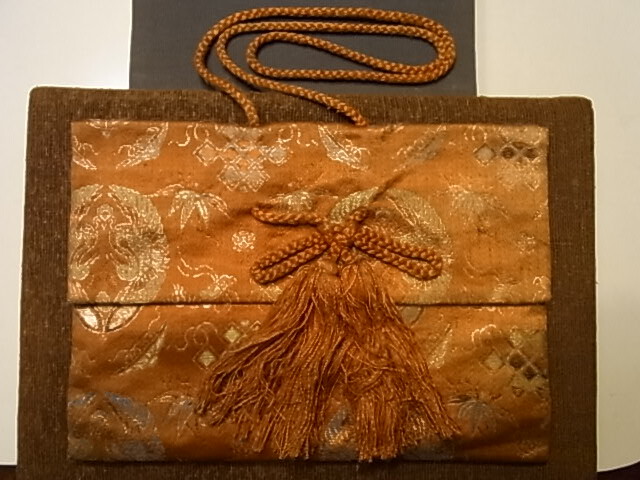

-
This Week's Edo Period Corner
Bugyotsuji replied to Bugyotsuji's topic in General Nihonto Related Discussion
Ah, so a kind of a lucky charm holder. The three little bags were inside the old silken bag of a priest which was closed with strings in a way that was not easy to open. Here is a photo of Eric's sausage bag. Sasama Sensei calls it an Uchikai-bukuro, but my Daijirin Dictionary calls it an Uchigai, (or Uchigahi, Uchigae), short for Uchigai-bukuro. Differences by provincial dialect? 打飼袋 NB Note the large 馬杓子 Bashakushi (reading? ...his index is not complete) in the background.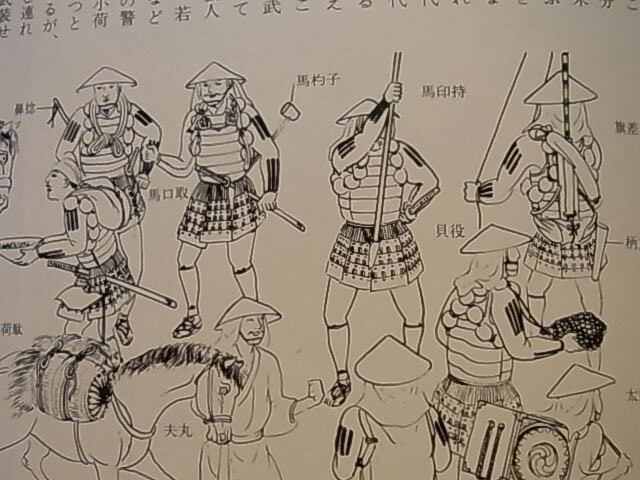


-
Hachiwari with nihonto style tsuka.
Bugyotsuji replied to estcrh's topic in General Nihonto Related Discussion
Not a little correction, but thank you for the diplomatic words, Moriyama san. My subconscious registered the Kanji was wrong, but for some reason impatience overrode that still small voice. Appreciating your guidance, as always... Too right about the lightning conductor, Eric! -
Hachiwari with nihonto style tsuka.
Bugyotsuji replied to estcrh's topic in General Nihonto Related Discussion
Eric, this side says 雷除 or Protection against Lightning. The other side says 天下奉平 or as I explained above it is a wish or prayer for Peace on Earth (simply expressed). Word for word it says, Under Heaven Deliver/Offer/Render up Peace. Often you will find combinations of these words inscribed at Jinja (shrines). -
This Week's Edo Period Corner
Bugyotsuji replied to Bugyotsuji's topic in General Nihonto Related Discussion
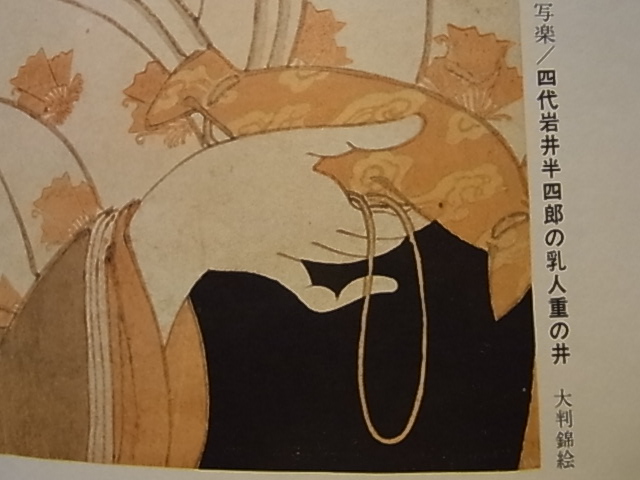
Perhaps ladies had a smaller, refined version then. (?) Sharaku. (Plus three I found hidden in a larger bag at an antiques fair a few months ago.)


-
This Week's Edo Period Corner
Bugyotsuji replied to Bugyotsuji's topic in General Nihonto Related Discussion
Eric, I have seen a lady in an Ukiyo-e holding one of these, but it was quite small. How small/large is that? -
Ian, I have put that into my pot too. Thank you. Did you see all of Nobody's link(s), Ford? http://www.geocities.jp/ntooma/kogatasya.html Are you saying that you think their classification as 'kogatana' must be wrong? Bearing in mind that the blade is triangular in cross-section, retaining the function of a yaki-ire cutting edge. Over the next couple of days I hope to show it to some Kinko workers and sword afficionadoes in this area. Let's see what opinions I can trawl there for the pot... will report back in due course.
-
Ah, yes, thank you Moriyama san. Most interesting. That site lists it as a Kogatana. The saw teeth appear to get smaller towards the kissaki. Once again the Mei are too close to the edge, as Brian says. Mine also has a double row of serrations, but a little worn, and one at least seems to have lost the very tip. (Pic 2, 8th tooth from machi) Perhaps as Toryu, and Lee, say above, a nifty toy for a samurai, but it got about as much use as the saw blade on a Swiss knife. (ie zilch)
-
Very good. Many thanks for the input. I was beginning to think cutting bamboo or whittling a branch for a makeshift walking stick, or fukuro yari. Or edging closer to where you are Thomas, the making of a bamboo fan. I know samurai and their families would supplement their income sometimes by such work.
-
Hachiwari with nihonto style tsuka.
Bugyotsuji replied to estcrh's topic in General Nihonto Related Discussion
You're right, Eric. It is quite elaborate. Does it look 'natural' or as if someone sharpened it up? As a kind of Utopia to be wished for, many Jinja have these words inscribed in stone or on wooden tablets. 天下奉平 Just guessing Eric, but does it say 厄除・方除 on the other side? -
Ken I would play with Ron's idea, and worry at it until you get it. I have a funa-dansu which had no keys, and a local man made a complete set for me, (posted on the site somewhere) which goes to show that sometimes the impossible can be reduced right down to the possible! :lol:
-
Often katanadansu were tied up with flat cord like a tomobako, with a special bow on the top. Now if you could figure out a fancy knot, that could become an added obstacle on the course to the treasure.