Markus
-
Posts
966 -
Joined
-
Last visited
-
Days Won
28
Content Type
Profiles
Forums
Events
Store
Downloads
Gallery
Everything posted by Markus
-

The classy-ist joint in town is at it too
Markus replied to Henry Wilson's topic in Military Swords of Japan
Hi Vaidas, Thanks for the clarification. It´s always better to know a bit of background for giving an advice. Don´t withhold, this is exactly why this sub-section "Military Swords of Japan" was opened. -
On the basis of the sugata (i.e. the shallow sori, the length, and from the position of the signature on the tang I assume it is not [at least not much] suriage), I wouldn´t say Kanbun but somewhere close. This in combination with the accentuated gunome repetitions which allude with much phantasy somewhat to sanbonsugi, I would go for Shitahara, which leads finally - with incorporating the parts of the signature (namely a "Yasuyoshi" [安吉] and the remnants of a 大 which could also be a 太) - to Tôta Yasuyoshi (藤太安吉), who worked around Enpô (1673-1681). Just my 2c so far and maybe far-fetched.
-
The classy-ist joint in town is at it too
Markus replied to Henry Wilson's topic in Military Swords of Japan
Hi Vaidas, I think the question is: are you collecting military swords and naval dirks in special? The fittings or rather the condition looks quite nice, but the question above decides anything about the price. My personal opinion, for 350.000 you will find a more, let´s say "interesting" piece, even in katana length with mounting, where much more can be seen on the blade (from the point of view of a nihontô enthusiast and collector ). -
I think that hits it on the nail, because the tsuba uses the character (奥) for "Oki", and Kotetsu used this from Meireki 2 (1656) to Manji 4 (1661). Afterwards, he used the character (興). So when we follow the theory that he went to Edo quite early in the Meireki period (1655-1658), this tsuba comes exactly under what I would say as "transitional period" from katchûshi to tôshô. This tsuba is also depicted in the "100 Tsuba and Sword Accessories" from where I know it, and interestingly, it is exactly depicted beside of the namako-sukashi of Musashi.
-
The classy-ist joint in town is at it too
Markus replied to Henry Wilson's topic in Military Swords of Japan
Hi Vaidas, the translation of No.492 reads as follows: "The dagger mounting (tanken-goshirae) seems to be for a naval officer of either the grade of a naval field or company officer. The saya is of a blueish samegawa, and the fittings show a cherryblossom motif, which are all in all elaborately executed. The habaki bears kebori carvings of the two characters "chû" and "kô" (loyalty and filial piety), and one might feel the spirit of the naval officer when being at the front with this dagger at the waist. The mounted blade is of a classical, old style unokubi-zukuri, and the hamon is a noble suguha. The signature reads "Yamato no Daijô Kunitake", and was probably engraved with an emphasized meaning of "the Warriors of the Land of Yamato". The condition of both the blade and the mountings is very good." -
Hi Barry, The white kanji above the part John explained read as "same-seishiki" (鮫制式), which means about "for mounting in same". Probably the saya was one of the samezaya of naval swords.
-
I know the piece so I´m out of the race.
-
I fully agree with Rich, and the piece in question reminds me on this one: http://www.e-sword.jp/sale/0810_6022syousai.htm So probably a mid to late Edo tôshô...
-
Fujiwara Kunitsuna Katana
Markus replied to YukouYukimura's topic in Auctions and Online Sales or Sellers
I wouldn´t insist upon that the person in question was important. -
Fujiwara Kunitsuna Katana
Markus replied to YukouYukimura's topic in Auctions and Online Sales or Sellers
Hi Tyler, FYI: the other side of the tang starts with "makari-mochi Hosoi ...", the rest is unfortunately illegible. "Makari" is a prefix which emphasizes the following verb, therefore the fragments of the beginning could be translated as "proudly owned by [a certain] Hosoi ...", or "the proud owner Hosoi ...", followed by the illegible part. The left column is a date, namely "Meireki gannen hachigatsu-kichijitsu", "a lucky day in the eighth month of the first year of Meireki (1655)". -
Could some please tell me what this mei says
Markus replied to dirk marshall's topic in Translation Assistance
Hello Dirk, Although the third character on the right is nearly lost through the mekugi-ana, my reading would be: -
This is a dating: Shôwa tsuchinoe-tora fuyu (昭和戊寅冬, Shôwa, year of the tiger [1938], winter)
-
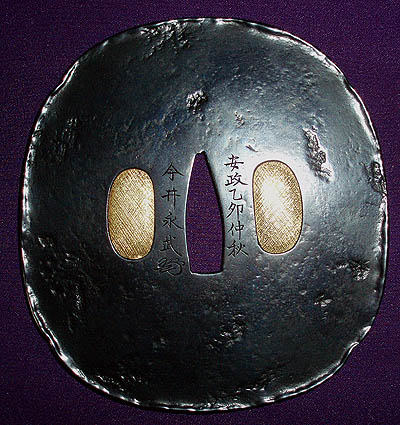
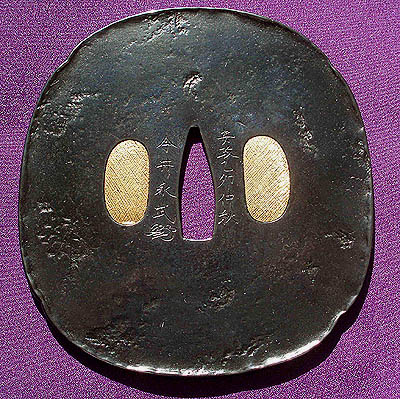
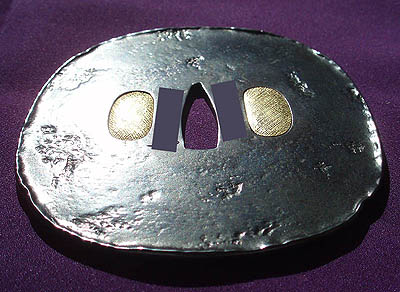
Well, those who tried to participate did, and so I will solve this kantei. The artist ist Imai Nagatake, and the piece is signed: Imai Nagatake (今井永武) [kaô] - Ansei kinoto´u chûshû (安政乙卯仲秋, "Ansei, year of the hare [1855], eighth month") Yes, he was a student of Gotô Ichijô, a passionate waka poet, lived and worked in Kyôto, born 1818 and died 1882. As it is hard to pin it down to a certain artist with more techniques shown, I will give atari to Ford, Jean, and Curran. Now, how does one come to this artist. First, the raw material: iron, shakudô, suaka, shibuichi, yamagane, brass ... (I´ve tried to get the blueish-black shakudô, so that it is dinstinguishable from iron) I think everyone got the shakudô, and this precludes before (nearly) all tankô artists. What remains is (in a chronological manner) Ko-Kinkô (as John said), Gotô and sidelines, followed by the kinkô artists of the Edo period, the machibori group, and the metalworkers of the late Edo/bakumatsu period. Second, the interpretation: sukashi-tsuba or ita-tsuba Third, the shape: It shows a hardly accentuated mokkô-gata, with a very slight tendency towards aori. This in combination with the thinness and the ubu nakago-ana pins it relative quickly down to one of the late Edo/bakumatsu kinkô artists, especially to Gotô Ichijô who was (among others) renowned for such a shape. As Reinhard pointed out, such pieces were made at the beginning with old Momoyama works in mind, and so is the interpretation of the surface. Hawley mentions an interesting note, namely that "this artist kept more to the classical style and designs of the early Gotô Ichijô school". This tsuba is such a piece right out of the textbook. What was at the back of my mind with this kantei was, to present for a change once more a softmetal tsuba, because we already had some iron and sukashi works in the past. I think it was not that hard to vote for Ichijô or his school, and I must admit that I am very fond of the shape he and his school (and of course other contemporary artists) applied. As a comparison, I would like to add a picture which was shot under different lightning, with the result that it could be very easily mixed-up with iron. FYI: I´ve bought this one on the following site: http://japanesesword.de/ Fortunately, I recently had the chance to look at it hands-on, but there is more nice and reasonable prices stuff there so please take a look. for your interest.

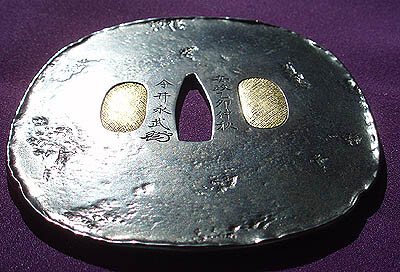
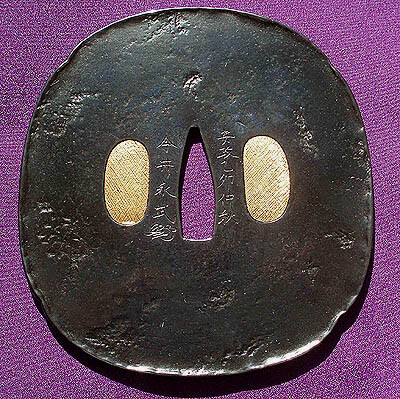
-
At the moment, (of course ) Ford is right on, but not atari. Well, I must confess that with a certain motif showing more techniques, it is quite hard to pin it down to a certain artist. As my fellow countryman used to say, "I´ll be back".
-
I think I missed some simleys at your first reply.
-
Hi Pete, How´s that quick bid coming?
-
Hi folks, As its quite a time since the last kantei, I would fill the gap and provide you with a new one. At first, I would just like to give you the pictures, allowing you to soak in the workmanship and execution of the piece. I am sure there are some out there which could pin this one down to at least the school at once, so I suggest to withhold or to use the spoiler function. It measures 8,0 cm in the width, and 8,5 cm in the length. The thickness at the rim is 0,35 cm.
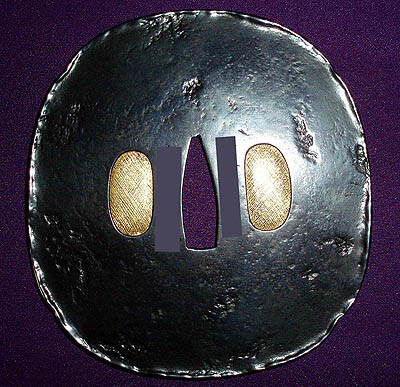
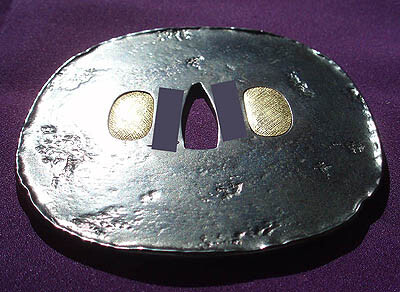
-
Hi Joe, The two characters read "magoi" (眞鯉), which means "black koi carp". However, "Makoi" (another reading) is a city on Hokkaidô. I am not sure what those characters mean in combination with your shirasaya.
-
-
Hi Shan, Although I can´t contribute anything particular to the/your sword in question, I would like to add that there are a lot of hamon compositions which do not have a determined nomenclature. It is then just expressed through a enumeration of all of the features seen along the form of hamon which makes so to speak the "main topic". Such a mix as on your drawing for example would be described just as "gunome which shows some togari-gunome-like elements" (gunome ni shosho togari-gunome-gokoro majiri, 互の目に所々尖り互の目ごころ交じり).
-
Hi Ted, I think its a writing variation of "tsuna" (綱), namely basically with this one as basis (網).
-
Regardless the price or if its a "bargain" or not, it is interesting that it got Tokubetsu-Juyo papers for the blade AND the koshirae as a set.
-
what does the description sugest?
Markus replied to shan's topic in General Nihonto Related Discussion
Hi Shan. Don´t worry, probably I saw too much Chinese fakes recently, that´s why I am seeing things... -
what does the description sugest?
Markus replied to shan's topic in General Nihonto Related Discussion
Hi folks, Maybe it´s just too late her in central Europe (just returned from the pub ) but the weakly cut bôhi, the uniform hamon, the hardly existing yokote (if there was once a yokote which got just worn, the areas before and after the place where it was wouldn´t look that uniform), and the two huge identically sized mekugi-ana let ring my warning bell! However, let´s wait for the polishing. -
Probably an unrecorded gô. I was not able to find any entries for my (suggested) reading of "Yûshûken" or "Ushûken" (友州軒).