Rivkin
-
Posts
2,459 -
Joined
-
Last visited
-
Days Won
20
Content Type
Profiles
Forums
Events
Store
Downloads
Gallery
Everything posted by Rivkin
-
Outline of boshi would be really helpful if you can catch it. There are couple of options and it would negate some of them. Its most likely something Yamato (Mino) derived, the question if kaeri is long, sharp and thin, or not.
-
Its a fun blade with fun sugata... there used to be an orikaeshi mei, probably to some koto Bizen, and it probably was so crazy they took it out with even papering the blade. Strangely enough it has distinctive grouping so it kind of goes as Oei Bizen style, not more popular ones like Kanemitsu. Yet, shinshinto probably. The quality of work itself appears to be decent, its easy to observe, so I personally kind of like it. The only thing is the resale value like indicated above. This is kind of stuff which can be difficult to sell at a sword show... But if you buy for yourself, then it should be an enjoyable sword. Usually this is a bad advice often for the first time buyer, but its not a bad first time sword at all, and I would not mind owning something like that personally. The only thing I would advise is getting it papered. Even just one day NTHK NPO shinsa in Tokyo. It does not seem to be Yokoyama Bizen line. Might be someone following Chounsai Tsunatoshi.
-
Without looking into my books: Kaga tends to have well defined, confident signatures, this one is a tad sloppy. But that's not the main argument - tall, distinctive groupings are late Bizen style which was seldom copied one to one. Kaga Norimitsu tends to have much more "midare" hamon where there are many very small togari and choji, but nioi-guchi also tends to be less defined. It can have a tall grouping, but those would be isolated and sort of by themselves, not part of repeating pattern.
-
Unfortunately the way its written I suspect gimei. The style is unmistakenly sue-Bizen, but there were shinto people (Tatara Nagayuki) who popularized it once again. I would lean towards late Muromachi Bizen with gimei signature.
-
Thank you, @ROKUJURO, @PietroParis, @Matsunoki, @Bugyotsuji I blame facial expressions on drinking.
-
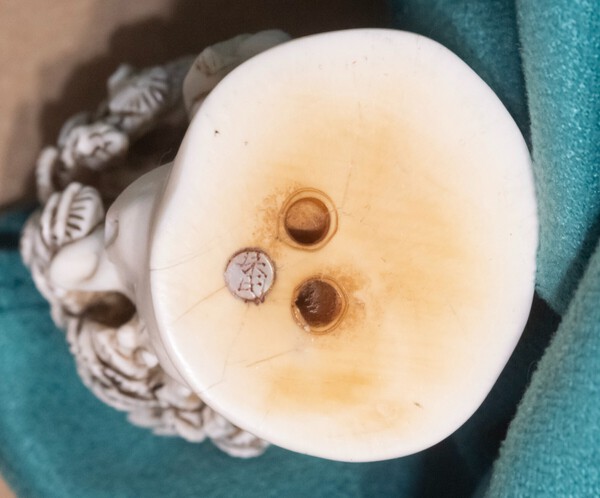
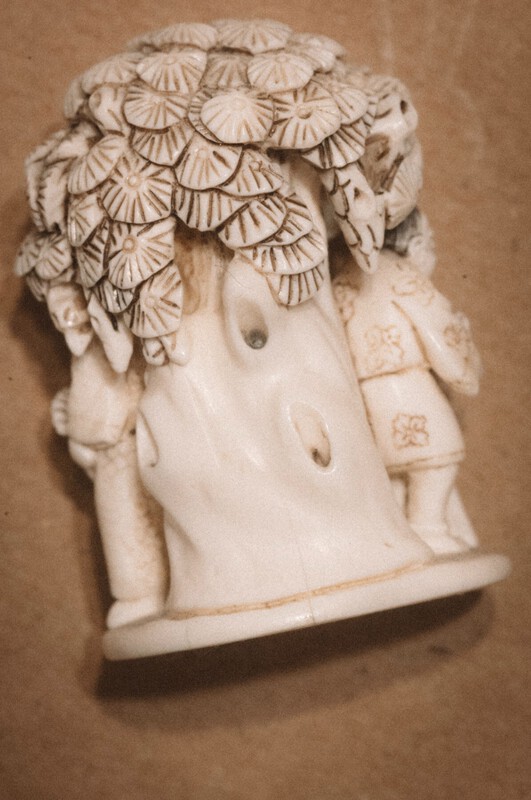
Gentleman, behold!!!! Another faux or its actually Meiji?


-
I am biased because its mine, but this is what I would be looking in good Omiya. Strong nie presence, sunagashi throughout (even if mostly in ko nie), bright and reasonably consistent nioi guchi, good jigane. Its really an under-appreciated school because a lot of work like this is not associated with a super-jo-jo-name-saku. It also benefits a lot from good sashikomi polish. By comparison I would suspect Aoi art is a notch lower. But it needs to be seen in hand.

-
I feel bad giving an honest opinion about items of Japanese sellers if it is interpreted as an endorsement Art Fair dealers... something I would prefer to avoid. Omiya can be very attractive. They seldom have good utsuri, but can have very nice hamon. Here the jigane is a bit rough, nioi-guchi does not seem to be consistent (which good Omiya is expected to have), overall its not the top Omiya for the price, but also photography and polish make it difficult to ascertain by photos alone. Maybe hamon plays hundreds of shades of blue, and its really beautiful.
-
Its a rare case where I would ask someone to show this blade to Tanobe sensei before doing anything else. The forging might be good quality also.
-
My Japanese skills are meager, but both postings are great examples of obfuscation. Eirakudo sword is papered to Seki Kaneuji. Very indirect relation to Nambokucho Kaneuji, who dominates the description. Late Muromachi work, its ok but a bit bland and ambitious. Fuyuhiro - nowhere it says this is the first generation. Yes, its probably Tensho period work. Again its not real quality, but beginner friendly in terms of being easy to appreciate, showy.
-
Nakago shape is a bit more late Muromachi, but at the same time its strong Mino influence with rather tight jigane... Echizen Seki would be a decent guess.
-
Unfortunately it is not the Rai Kuniyuki. The work has distinctive, harsh nie, very large featured hamon, very chaotic and non-traditional. Edo period work most likely. But can be still attractive.
-
Very personal thoughts: The blade is Muromachi. The style is "Soshu Nobukuni". The polish and condition are poor. The signature is in line with Muromachi style Nobukuni (large, centered, equal height characters, the strikes themselves are a good match for depth/etc.), but it is not an obvious match the personally recognized Nobukuni generations (at least my guess). Yes, green papers, with such condition repapering might be jeopardized even though nothing here is obviously fake, at least to me.
-
Personally I think its late, as in late Meiji period most likely. Many elements are not very traditional, but rather a mixture with western art and decorative techniques of the period. Interesting, attractive, but Goto Ichijo - I don't know.
-
Auction house will send photos to a friend who will do B- job on translating signatures... and that's about it. You'll get better information going through a trouble of good photography and posting it here.
-
Jigane appears to be tight, not very distinctive itame, nioi-guchi is broad, hamon is relatively broad suguha, there is some ko nie foaming and overall forging is kind of crisp. I would vote for Edo period, Hizen or about. Hizen itself we would expect more prominent jigane, but it could be out of polish.... Other schools also have tried their hand in such style, even Yokoyama Bizen.
-
Unfortunately each one has to be photographed individually, or at least no more than 3 per frame, front and back, strictly from above - no angles, no lazy smartphone shots. Sorry, but this is the only way to appraise those by photo, which is possible to do. There are some nice pieces here, couple for which I would offer 1500 as is, and I am sure you'll get a very decent description of what you have with better pictures.
-
Away from books, but the mei does seem off.
-
Nakago has a Mino feel to it, and Kane kaji is common in Yamato-descending Mino lineages, which is a lot... So Mino smiths, late mid to late Muromachi is a possibility. Its easier to be sure seeing the blade. Is I a person of knowledge is arguably a more difficult and esoteric question.
-
It would be nice to see closeup of hamon… otherwise so far looks ok
-

New Video from British Museum
Rivkin replied to MassiveMoonHeh's topic in General Nihonto Related Discussion
Hiring a competent curator makes department head look dumb with little to no practical benefits. -
Japanese sword, mumei, civilian mounts, WWII adaptation?
Rivkin replied to Nafta's topic in Military Swords of Japan
With such low resolution I can't really see much. -
You are doing it wrong, Jacques. You are supposed to say "I am but an eternal student of the sword, humble in knowledge". You friend is then supposed to chime in with "Jacques is a Scholarly Scholar! Celestial star, who shines over the True Path", etc. etc..
-
Little is seen regarding the blade but this particular narrow wide periodic gunome with visible yet uneven "nioiguchi" can be XXth century lower grade work. Japanese. Strange that it still needed very drastic nakago work, and there are other things which are a tad off. So yes, original Japanese parts, but how did they come together is something I am puzzled to say.