Marius
-
Posts
3,170 -
Joined
-
Last visited
-
Days Won
26
Content Type
Profiles
Forums
Events
Store
Downloads
Gallery
Everything posted by Marius
-
Morita-san, Arigato gozaimasu
-
Just picked up my wakizashi.... (EDIT - resized pics now)
Marius replied to gtstcactus's topic in Nihonto
Have a look at the patina. There are several tell-tale signs... Is it "dry"? What is the colour? Does the tang smell in any way? Are there any pittings? Other signs would include mizukage, but this is not always proof of re-tempering... The best thing would be to ask the polisher, anyway :-) -
Dear All, this is clearly beyond my modest abilities... This tag was attached to a kabuto. I suppose it is a dealer's inventory tag, but I would be grateful for your help. Thank you for your time

-
Just picked up my wakizashi.... (EDIT - resized pics now)
Marius replied to gtstcactus's topic in Nihonto
OK, based on your pics only... I might be wrong, so take this with a grain of salt: 1. Tang looks like it was burnt at some time, do I see fire-scale here? 2. Yakiba is unusually broad 3. Hamon slides down before thehamachi, and the notare is somewhat unusual Conclusion: this might be a retempered blade (saiha) -
It is a badly battered blade. It has probably been buffed in the past. Here are blade shapes: http://www.ksky.ne.jp/~sumie99/styles.html
-
The seller says "tosho", not "ko-tosho". That would explain the price. It would be nice to know what the hakogaki says...
-
Dear All, has anyone any experience with this dealer? http://www.silk-road.us/higo.html Thanks for your time :-)
-
What do you think does this motif mean? Thanks for your time
-
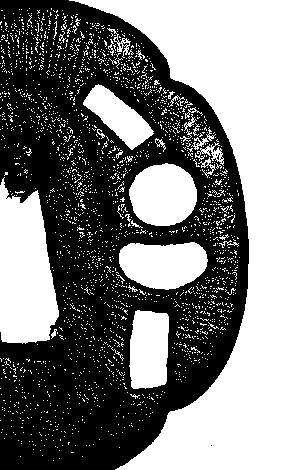
This is not a tsuba. It has no seppa dai. IMHO, of course
-
David, this is a wonderful tsuba. Very good example of how good ko-Shoami can be. Another example is here, you might want to see it quickly before Rich pulls the plug (he has sold it, and I could not afford it at that time ) http://www.nihonto-bijutsubu.com/person ... mokko.html
-
The plugs are nice, no? Seriously - zogan is gone, what a pity. The huge lumps of tekkotsu on the plate show that this might be a late tsuba, a revival piece. In such tekkotsu are often overdone in an attempt to imitate pre-Edo tsuba. On this tsuba it looks like the maker could not control tekkotsu - these lumps are unsightly. Just my two cents
-
There are remnants of zogan on the rim. The workmanship seems quite crude without being deliberately restrained. Thickness is quite substantial as well, and I don't see the iron being of very good quality. The composition of the sukashi lacks elegance so typical for ko-Shoami My guess is mid or late Edo.
-
Kanekiyo it is, then. Thank you, gentlemen
-
Dear All, my eyes must be getting tired, I managed to decipher Kane... but the rest is mystery. Please forgive my endless ignorance

-
Sorry about that, I have confused two simple things. Apologies. I have edited my post accordingly. What I wanted to say, was that one would not expect a yaki otoshi on a shortened sword. Hence my suspicion it has been retempered. A wide yakiba (tempered part of the edge) in connection with a worn hamachi is an additional indication of a possible saiha (retempered blade).
-
Jason, Well done with your sale As to this wakizashi - what strikes me is the unusually wavy hamon and broad yakiba, the fact that despite the sword having been shortened, the hamon starts above the hamachi (yaki otoshi) Also, the condition of the nakago is not good (I cannot see yasurime, the patina looks dry). Difficult to judge from photographs, but maybe this blade has been retempered (saiha).
-
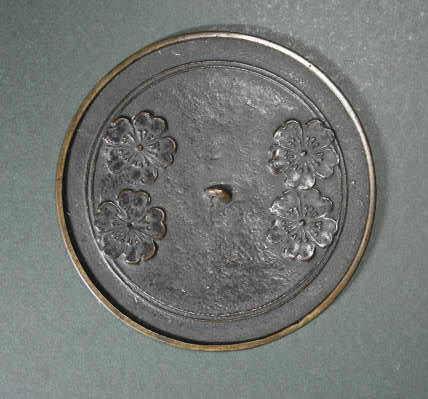
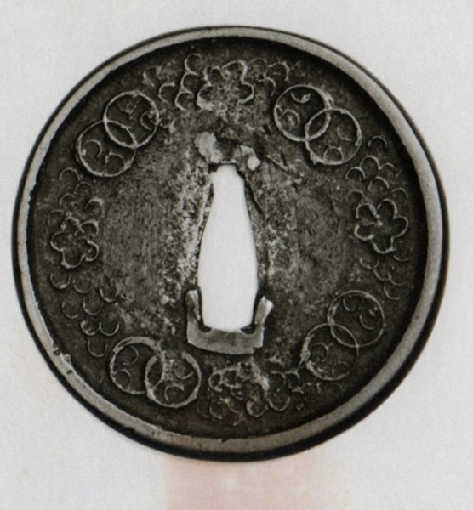
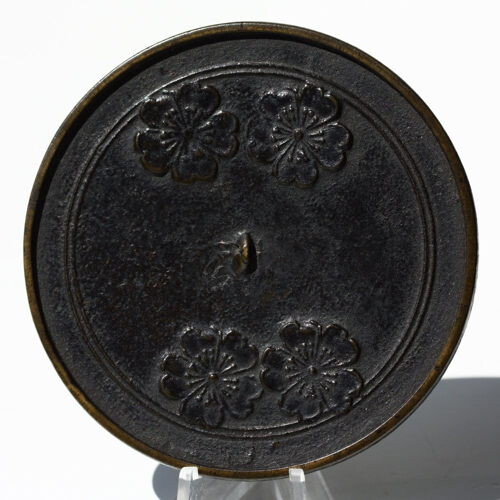
OK, to make a point: I believe that kagamishi tsuba were the work of mirror makers. There must have been several styles in mirrors, ranging from the austere and simple to the very ornate and precise. I have attach three pictures: two kagami and a kagamishi tsuba from Sasano's book. Look at them and compare them.


-
Yes, this is called suriage (to shorten) or o-suriage (to greatly shorten) and its the purpose was to reduce the length of a blade. Shortening was always done from the nakago side as the removal of the boshi (tempered point) would render the sword unusable (exception: Satsuma-suriage). An interesting article on suriage is posted in the "Articles" section of this Forum, here is the link to the PDF file: http://www.nihontomessageboard.com/articles/Suriage.pdf In a nutshell shortening was done in these cases (but of course not exclusively): 1. When a long sword (e.g. a tachi) was to be converted into a katana 2. When someone wanted to have a wakizashi made from a katana (or naginata) 3. When a sword has developed hagire (crack trough the tempered edge) and was long enough to be shortened 4. When a sword was too long for the new owner
-
Dear All, I am looking for any sources on kagamishi tsuba and mirror makers. I would love to study the problem of a relation between the tsuba and the mirrors. Many scholars think that kagamishi tsuba have not necessarily been made by mirror makers... It is a valid point if you compare some high-end Momoyama mirrors with their rich, detailed and very crisp ornamentation with the simple (yet tasteful) ornaments on most kagamishi tsuba... Quote from Boris Markhasin's intersting article: "One aspect of the kagami-shi designation that continues to puzzle me, is the fact that the level of artistic detail and technical complexity represented in kagami-shi tsuba is consistently at a much lower level than that represented by contemporaneous bronze mirrors. Perhaps we have once again been led onto the wrong path by empirical observations? Perhaps the kagami-shi tsuba would be better classified as tachi kanagu- shi tsuba created utilizing techniques derived from the practice of mirror making. Thus leaving the designation of kagami-shi for the craftsmen that produced only mirrors such as the one pictured below." Here is the link to the article (PDF file): http://www.shibuiswords.com/kokinko.pdf BTW, if someone has the English language pamphlet to Sasano's booklet "Kagamishi tsuba", I would love to buy it. I have bought only the book, with no translation...
-
It is a cast copy - a mold has been produced using a real tsuba. Not sure it is modern, as the quality is poor. Here is an interesting discussion about cast tsuba: viewtopic.php?f=2&t=7588&st=0&sk=t&sd=a&hilit=cast+tsuba+modern
-
I would rather say it is warabi (bracken). Other info on this tsuba: 1. it is regrettably stripped of patina, possibly over-cleaned by some zealous amateur (it could be repatinated, but only by a specialist) 2. it seems to be late Edo work, possibly Owari 3. it is a small tsuba (for a wakizashi or tanto)
-
Ford, John, Interesting discussion, thanks for that As this is highly interesting for me (given my penchant for irogane ko-tsuba) I am delighted to have started the thread :D
-
Sorry for a stupid mistake I have meant shinchu and NOT shibuichi, of course. I will adjust my previous posts to avoid confusing readers of this thread. Apologies
-
Good, that means that we one be reasonably sure in the case of some tsuba made of copper (I would say suaka). But where is the cut-off for our assessment? It is very tricky indeed. Yamagane will patinate to some very dark colour, I was told, is that true? Patina on suaka will look differently... Here is a picture of yet another tsuba - no nakago ana scratches to confirm that it is copper, but that is what I (hopefully reasonably) assume... When I look at old soft metal tsuba I find it very tricky to asses what it is made of mostly when it has dark patina. Old shinchu does not patinate so easily, I was told, and retains its golden colour, which is said to be especially rich if the shinchu was imported from China.

-
Ford, as said before, I agree with your opinion. However, I suppose that even without scientific equipment (without wanting to be absolutely precise), one can make an assessment, well, an approximation in some cases. Some of my tsuba must have been mounted until quite recently, and the metal has been exposed in some parts of the nakago ana. I think that if I can see shiny copper, I can reasonably assume that the tsuba is made of copper? I am talking about the tsuba here (picture attached). Obviously, I a not going to scratch the inside of the nakago ana of my tsuba just to "see" what metal it is made of. Most of my tsuba have the old patina inside all ana... BTW, having had a second (and third) look at the tsuba which began this thread I can accept almost any possibilty - yamagane, bronze, brass...