Marius
-
Posts
3,212 -
Joined
-
Last visited
-
Days Won
26
Content Type
Profiles
Forums
Events
Store
Downloads
Gallery
Everything posted by Marius
-
My comment on the two holes: these are fairy typical in earlier sanmai tsuba (look at those three identical tsuba here: http://yakiba.com/Tsuba_Ko-Kinko_Group.htm - they all have these holes). In this particular case (Henry's "ko-kagamishi" tsuba) there could have been two plates attached to the tsuba, serving as a kind of o-seppa. But then again, they look fresh and have been drilled. So this theory might be spurious. My comment on this item as a tsuba: No Japanese tsuba was devoid of seppa-dai. In this tsuba we don't SEE seppa-dai, but it might have been there, around a smaller nakago-ana. Slender seppa-dai for slender earlier koshirae. This seems a Japanese and not a Chinese tsuba. In Haynes' Gai So Shi we can admire a stunning tsuba (#002a). It is a Chinese copper tsuba with a lovely rim, beautiful carving of vines and a very narrow nakago-ana of hira-zukuri profile.This tsuba is so different from the ko-kagamishi.... I have attached a picture for your enjoyment

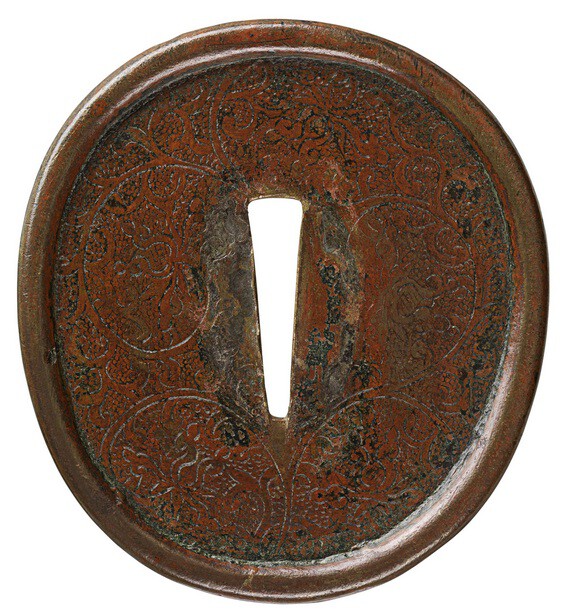
-
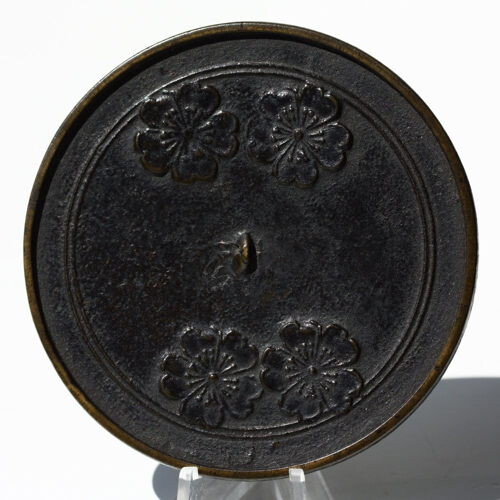
Dear Hoan, Apologies, but you are stating the obvious, I am afraid :D Yes, It was NEVER a mirror. My point is - one might think it was NEVER a tsuba. Do you see a seppa dai? I don't (which does not mean it is not a smaller seppa dai made to accomodate those slender earlier koshirae), and I see a nakago ana cut right in the middle of some decorative motif. The nakago-ana looks like it has been enlarged, though... Chris, I sincerely hope this tsuba is not a "threat" to anybody, although I'd love to see it as a threat to a collection I would love to see it as a treat for members of this board :D
-
Whoa! We are discussing Mr. Burawoy's tsuba now, and while that is a not a bad thing per se, what I was really envisaging was to learn if Henry's (and Mr. Burawoy's) tsuba was indeed a tsuba when it was created? And was it Japanese or Chinese? And what do NMB members think of the theory that whoever made this tsuba was a mirror-maker?
-
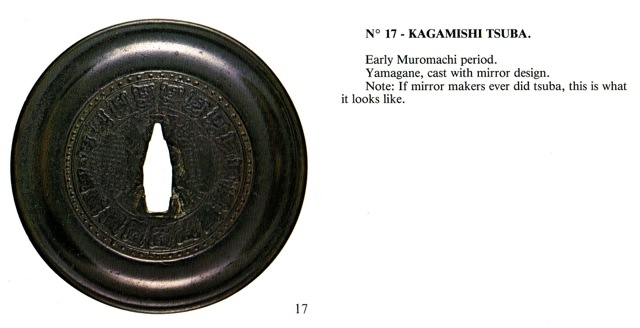
Interesting remark, Christian, thank you. Here is a blow-up of the ideogram/logogram on Mr. Burawoy's tsuba. I see it is the same symbol, all over again.

-
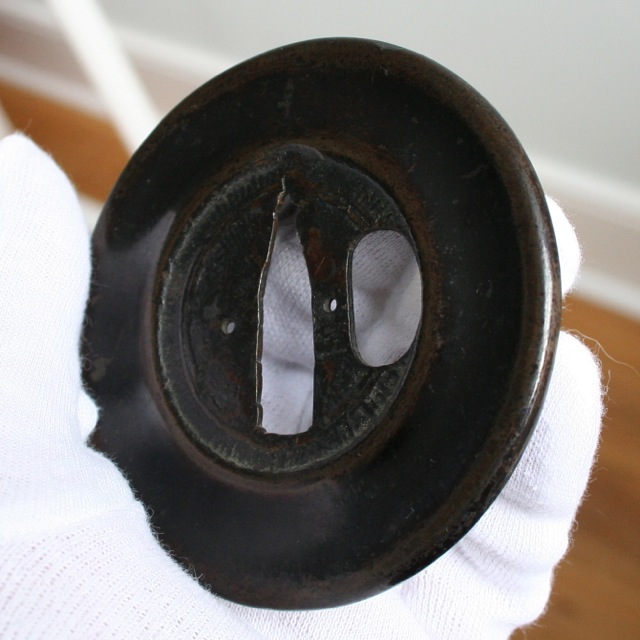
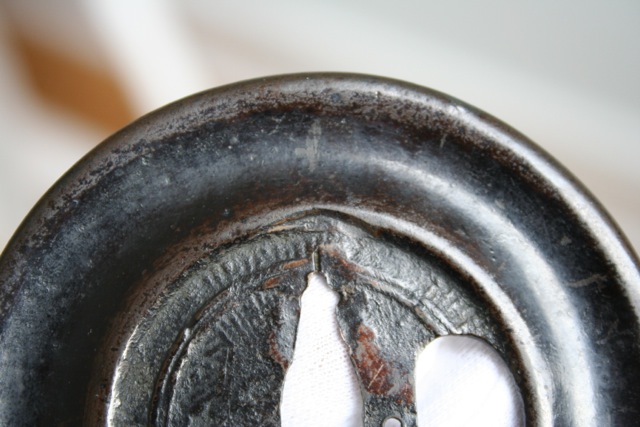
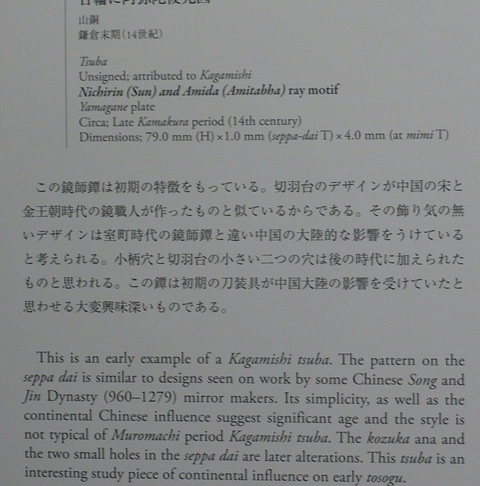
Gentlemen, Allow me to post a few pictures of an interesting tsuba which used to be in Henry Wilson's collection. It has NBTHK origami to ko-kagamishi, is made of bronze and lacquered. There are a few theories concerning this tsuba, one of which is that it was conceived as a different object and converted into a tsuba. I can just attest that it was never a mirror, as both sides are identical. Pictures are attached, including a scan of the description form the KTK catalogue where it was published. Let me kick off the discussion with a picture of a similar tsuba, published by Robert Burawoy in his "The Picture Book of Old Tsuba". The scan shows not only the tsuba but Mr. Burawoys thoughts on it. Please feel free to comment. I trust this item deserves to be discussed :-)


-
Thank you Thomas And of course many thanks to Jean, too :-)
-
Janusz, No idea what this horrible "bonji" is supposed to mean, but it is of such low quality that the only reason it has been carved is to hide some flaw Don't shoot the messenger - it was not me who have defaced this sword, I am just pointing out that this "horimono" is an abomination Sorry for the bad news...
-
Resources for Determining Age/School Without Mei
Marius replied to CrimpSoup86's topic in General Nihonto Related Discussion
Start with books: http://home.earthlink.net/~jggilbert/reading.htm -
Nihonto collecting survey
Marius replied to Jussi Ekholm's topic in General Nihonto Related Discussion
Survey Monkey allows only 10 questions (in the free subscription). I guess Jussi will have to be more concise -
Nihonto collecting survey
Marius replied to Jussi Ekholm's topic in General Nihonto Related Discussion
Jussi, a word of advice - why not using some free online survey service? It would have been easier for us and for you? -
I am not saying that they are right I agree, steel will crack when under pressure. I have once owned a tanto, a thick yoroi doshi by Tosa Yoshimitsu, and it had these cracks in the mune. I really wonder what causes them... In this particular case, the tanto was too thick to bend (motogasane of 9 mm, nagasa of 22 cm).
-
Chris, thanks. What do you think of the distinction mukade shinae/shinae as outlined here: http://www.ksky.ne.jp/~sumie99/flaws.html (scroll to "shinae")
-
Would anybody have an idea wht the motif on this kozuka signifies? Pic attached in two resolutions. The higher-rez is watermarked, generated by Photozoom Pro (thanks for the tip, Uwe!). Thanks for looking :-)


-
Gents, does anyone have pictures of shinae? I could find a few only on the Usagiya site... Also, opinions on shinae from the metallurgical point of view would be very interesting. Oh, and I don't mean the shinae which appear as the result of bending/straightening the blade, but those which are related to the quality/pureness of the steel. Thanks
-
Thank you, Kunitaro-san!
-
Sorry, this is way beyond my modest capabilities. Could anybode please just tell me, WHO has done that sayagaki? I don't need anything, just the author, if you can identify him. Thanks

-
Uwe, I am overawed by your proficiency with Photoshop and other image editors. I would love to see some examples of how you have spotted flaws etc. But allow me to remark that there is only one way, and it is much more efficient and time-consuming and which you have (indirectly) pointed out yourself: Buy from trusted dealers only. Forget eBay, unless it is a trusted dealer who you buy from on eBay. Honestly, I don't think you can spot flaws that have been edited out, regardless of what you do. The reason is simple - most pics on eBay are low resolution.
-
Thanks, Richard. That does the trick for me :-)
-
Richard, well, it could be nails. Nobody knows for sure. I have never seen such a representation of nails. Here is one from Rome, matching the time of Jesuit activity in Japan: "Rome, Italy. The "Monogramma del nome di Gesù", in marble and bronze, by Bartolomeo Ammannati (1574) on the façade of the Chiesa del Gesù in Rome" And the "tokei" is pretty obvious. Yes, it is a Christian symbol. Incidentally, it must have been you who has made photographs f Fred Geyer's superb collection of tokei tsuba (KTK, can't remember the vintage).

-
RIchard, Correct me if I am wrong but IHS is not a symbol, but a Christogram and an acronym of Iesus Hominum Salvator. Of course you might be right with the nails. But I would feel more sure if they looked more similar to those on the crest of the Society of Jesus (Jesuits) who were at the forefront of the abortive christianisation of Japan.

-
Omodaka and vines, I think.
-
-
Curtis, As for the fittings - if the maker is highly rated, I would say that a paper will greatly add to the value. If not (as I believe is the case here), the paper will not add any value. As for the sword - a paper will always add value to a signed sword. But it is always more likely to get pink-slipped. Looking forward to the f/k pics :-)
-
New poll, just out of interest...
Marius replied to Brian's topic in General Nihonto Related Discussion
John, In nihonto, with knowledge comes an urgent problem - lack of cash -
New poll, just out of interest...
Marius replied to Brian's topic in General Nihonto Related Discussion
Brian, this shows: 1. the level of knowledge of NMB members, and correspondingly: 2. their age/wealth. No?