Gakusee
-
Posts
1,962 -
Joined
-
Last visited
-
Days Won
22
Content Type
Profiles
Forums
Events
Store
Downloads
Gallery
Everything posted by Gakusee
-
Life member of the Honbu in Japan and supporter of the EB, who are an amazing group too.
-
Wow, lovely mini museum Gary! Indeed this is beyond most would call merely a collection. What is your approach - sengoku period to early Edo?
-
Thank you for posting it, Gary. It is always enjoyable to see high-quality swords from time to time here. Oftentimes, the majority of the posts have the low-end starter blades which newcomers enquire about, unless people post about militaria shows etc. That is normal and understood but blades like yours are a rare treat. Not much activity, hamon etc can be seen here apart from the Nanbokucho kissaki in this stout blade. Interesting, unusual horimono too. Could you please clarify: is this kinzogan or kinpun mei? Unfortunately I cannot see the detail on my mobile and the eyes are not what they used to be. Thanks again.
-
I will play. Nabeshima Toshiro Meibutsu


-
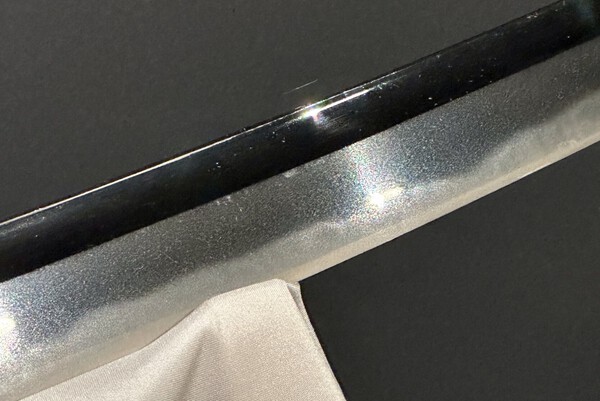
The issue perhaps, Jussi, is that you like oversized swords, which at that size might not necessarily be the most refined? I have seen very few large swords that have the fine jigane and complex high quality hamon I like….Usually the longer and larger, the less interesting to me, unless they are ubu zaimei top Heian or Kamakura blade by one of the better smiths - usually top (ko) Bizen. The best sword in my view is the OKanehira. Huge, but with the finest craftsmanship from top to bottom. So, I attach a few snaps of it. There is not forging flaw over 80cm+, very wide and meaty blade - sprinkled with konie in the “wettest” possibly way



-
 For sure….with Juyo. But ToHo and HoTo you need to call them
 -
Uwe I think this is priced so cheaply because of the hakobore… Also Kuniyoshi has a rather different style to Hisakuni. Different tastes and activities and so on.
-
if in doubt, you can call the NBTHK and check. It will take a bit of time as the people speaking English might not be on shift, and the English speaking people (junior) will need to consult the more senior people (speaking mainly Japanese), but if you have a few days/a week, it should work.
-
Currently Available Tokubetsu Juyo Token on the Market
Gakusee replied to treverorum's topic in Wanted to Buy
That (first Juyo) Norishige is not available any more and that was not the price….Regardless, amazing sword. -
You don’t sound ready to own an Awataguchi sword … Study more and when ready then buy such a sword. When you have attained that knowledge, you will know whether to buy it or not. In any case, per the NBTHK this is “only” Awataguchi, but the Honami sayagaki (as homework, identify which Honami this is, his sayagaki are here on this forum) gives it to Hisakuni (the Awataguchi with most refined jiba). The setsumei, notwithstanding, specifically mentions that “the deki of the jiba are excellent”
-
There are so many things wrong here…. Main one being that the sword does not look like Osafune Nagamitsu in workmanship. Also, compare a genuine Kojo origami herein. I have had a few Kanzan sayagaki…. Let us just say that this one above looks very intense in the ink colour and execution….

-
Just a quick thanks to the members
Gakusee replied to Brian's topic in General Nihonto Related Discussion
Swift convalescence and take it easy, Brian - stress also unlocks all sorts of health issues through the over-release of hormones. Wishing you all the best. -
Let us thank Jacques for the kantei and congratulate Jussi and Thomas. It has to be that and no other bickering please.
-
I agree on all of the above. This to me seems enhanced with an etchant. What do we think?
-
From a friend (and also disclosed in Japanese for those of us who actually bother to go to the Japanese source - I advise more people to try and do it rather than rely on 1-2 forum posters for that): Pass vs Submitted Swords 52/649 (8%) Tosogu 33/199 (16.5%) Koshirae 6/32 (18.8%) Very low pass rate, similar to last year. Probably a composite outcome of shinsa panel line-up, (lack of) degree of confidence (hence some items need “further study” and another attempt), good quality blades drying up etc etc
-
Well, the oshigata does look more Osafune Bizen than the sword actually is - hence the need to know nie vs nioi, utsuri or not, indeed the finesse of the jigane or the slightly more outstanding typical Bizen hada (even though some have very fine hada)….
-
It is interesting and encouraging that newer members and younger collectors have started delving into which Juyo sessions to consider. Twenty-thirty years ago merely having a Juyo was enough as they were “scarcer” literally due to there being fewer in general and fewer in the West. There are indeed various considerations about “early” sessions (usually pre-15), the 1970s, the most recent ones. There is a lot to be said and analysed. Let us just say that some of the most recent shinsa sessions are head-scratchers in different ways to the prolific 1970s. Just some caveats: the 1970s also had great swords in them. Don’t disregard a sword just because it is from a session between 20-27 or thereabouts. Don’t look only at length. Sometimes the longer specimens of a smith’s production are frankly the more boring ones. I have seen it with many “greats” from Kamakura where the most flamboyant or stereotypical examples are suriage or mumei. Of course, here I am talking about old Koto and not Muromachi and later, where you will want zaimei ubu, ceteris paribus. Not all smiths and schools even within the same sessions are equal. There are always better and more renowned smiths and schools which pass alongside more average or mundane smiths and schools. However, there are certain statistical distributions and brackets the NBTHK broadly conforms to. Also, you could have a ToHo blade which is superior to many Juyo. Perhaps it is on its journey to greatness and simply has not passed that hurdle yet… Numerous factors play in there. You will need knowledge and understanding as to why a big name sits at ToHo still…. Anyway, this is an advanced area of knowledge and collecting and do not rush to conclusions.
-
Very nice altogether. Piers: how much of the armour is genuine old armour? Do people wear modern repros? Some of it looks old but from the distance I could not tell. Also, what about the swords? Thanks
-
Well, Uwe, it was great to see you there, albeit momentarily. Wish I had more time there, and to socialise too, but it was nice to see a lot of people we know both in person and also in your videos. Great job documenting for posterity!
-
Dear Uwe, thank you so much for the images! It is as though we were there ;).
-
So, a couple of thoughts. Naginata were not always as “artistic” as normal tachi or katana. This is not to say they were not well built but the main focus was on functionality rather than fine jigane, scintillating hamon, beautiful hataraki, etc. So, on average I have noticed, anecdotally, they are more robust. Also, if you notice the weight of this blade, it is actually rather heavy for its short length. Therefore it must be thick and robust and it renders itself suitable for testing once the long tsuka mentioned above is attached.
-
While technically indeed daisho comprises a long sword and short sword, historically, as Kiril says, the term really signified the presence of a long blade and a short blade (not necessarily by the same smith or even school, or era) in a long saya and short saya respectively. Ideally, the koshirae were a matched set (not the blades necessarily; if the latter were a set - great, but not a must) from an aesthetic but also “regulatory” point of view during Edo (since daisho codification emerged at the end of Muromachi). As extra colour about definitions, see the last sentence of the second NBTHK text below: ie, only banzashi were strictly regulated but otherwise free interpretations of daisho emerged. Below comes from the NBTHK: “In the Edo period, in public places, samurai wore daisho koshirae, which were called Hakama-zashi (worn inside of the hakama pants belt), Ban-sashi, or Denchu-zashi (worn inside of the castle). These styles were not always the same and depended on the samurai's status and the area. Basically there was a hilt covered with white same and wrapped with a black cord in the hishimaki style, a kashira made out of black painted horn, and a saya lacquered with black urushi. The tip of the katana saya had an Ichimonji design (a flat bottom on the saya), and the wakizashi had a round bottom on the saya. The tsuba had a polished shakudo ground with a mon, i. e. it was a Kenjo-tsuba (a formal design), or had a scattered mon design. Usually a Mitokoro-mono consisting of a kozuka, kogai, and menuku provided sophisticated matching pieces.” With kudos to Markus Sesko, same idea but elaborated slightly differently by the NBTHK again in this second text: ”A daishō is a pair of uchigatana and wakizashi and the practice of wearing such a pair of swords is assumed to have emerged at the end of the Muromachi period. With the Edo period, a formalized daishō-koshirae came into existence which was used at an attendance at a castle and which was referred to as kamishimo-zashi (裃指) or banzashi (番指), The official code of the Bakugi Sankō (幕儀参考) defines such a formal daishō-koshiraeas having glossy black-lacquer saya, with the sayajiri of the dai being straight and that of the shō round, with the hilts being covered in white same and wrapped hishimaki-style with black braid, with the kashira being of black-lacquered horn, and with the fuchi being of shakudō with either a nanako ground or a polished finish. The tsuba was proposedly a Kenjō-tsuba of polished shakudō and the mitokoromono first-class Gotō works. The only decoration should be family crests highlighted just in gold iroe and the sageo should be black braid, although for presentation purposes also purple sageo were used. Apart from the above mentioned official use however, daishō-koshirae were not regulated by the bakufu but several interpretations emerged that base on the banzashi regulations.” Furthermore, while the NBTHK in the texts above specifically refers to wakizashi, strictly speaking the Edo period sho could be a tanto too. We can see that in this Juyo daisho set appended here. If we go further back in time, when warriors wore tachi suspended from the waist, they often had a secondary blade thrust through the sash - koshigatana. Could have been a long tanto or kodachi. There are various depictions of such samurai in scrolls, paintings etc. From memory, the depictions did not seem to indicate matched fittings and outward appearance. Attached below are Nanbokucho and early Muromachi koshigatana. Their form could be viewed as the predecessor of the wakizashi function, just the way katana gradually replaced tachi. On the last point, for formal occasions even during Edo period, specific tachi koshirae were required. Some time ago I had put together a few slides on koshirae for our Society and you can see in the enclosed image that in the case of the hitatare outfit, the displayed figure is actually carrying a tachi and a tanto or koshigatana through the sash.


-
NBTHK Current Horimono Exhibition
Gakusee replied to Baka Gaijin's topic in General Nihonto Related Discussion
Jussi delivers superbly of course as usual. in my view, the oldest really are the chokuto and that is what counts.

-
https://www.oed.com/...pe=Entries&q=Palaver
-
Nothing about new and undocumented. You don’t get it, do you, Jacques? This is an introductory book. Introductory books do not usually show treasures. They normally teach about sugata, hataraki and show hamon outlines… I really do not understand what pleasure you derive from bickering and criticising all the time. If you take a more positive stance, perhaps you will attract some more positive energy in the universe… Oh wait a second, I forgot - you are a physicist, so you probably believe you must be as negatively charged as possible to get some positive energy