CurtisR
-
Posts
599 -
Joined
-
Last visited
Content Type
Profiles
Forums
Events
Store
Downloads
Gallery
Everything posted by CurtisR
-
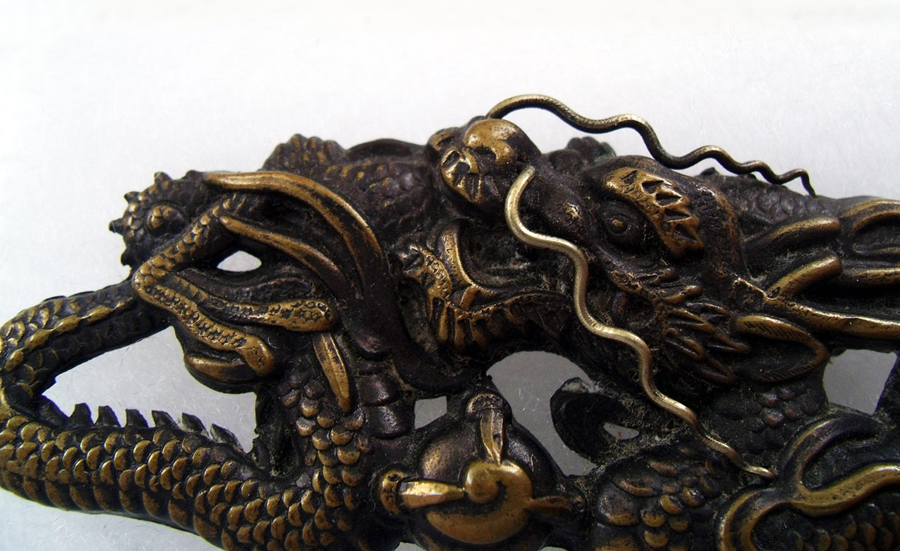
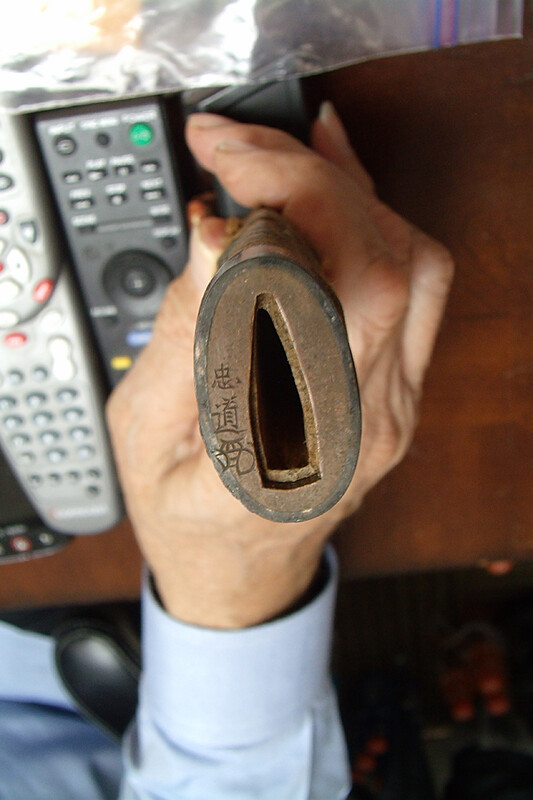
Hello all - I have recently gained access to a friend's collection - this mei is from a Wakizashi and I am having a tough time working it out. Also posted is a pic of the mei on it's fushi but thought I'd start with the Omote side of the nagasa. It also includes a very pretty kozuka with much engraving in Kanji, which I'll post next. Sorry in advance for the blur, but the light in his office was not good, and I had only a short time to examine them. Then I'll be posting photos of the blade, kissaki, Tsuka, etc. under the Nihonto section.... Please forgive me if it seems I'm being a board-hog :D --- I think he has a couple of good ones, and am just trying to learn. Many thanks in advance, Curtis R.


-
Do you use your nihonto for tameshigiri?
CurtisR replied to Hans Kondor's topic in General Nihonto Related Discussion
In my Dojo, for Iaijutsu, only shinken are used. No old Nihonto for Tameshigiri of course. My first school used only Iaito...my Sensei now is a 6th Dan in MJER and also teaches Shinto Muso Ryu Jodo. He uses a Koto blade for practice and the students use shinken. He tells me that when he goes back to Japan, his Senseis joke about those who use non-sharp swords. However, his #1 concern is safety! Curt -
Sword construction in general vs. periods
CurtisR replied to CurtisR's topic in General Nihonto Related Discussion
No offense meant -my ancestors were right in there as well. You're right that weapon construction can be compared side-by-side w/ the Europeans, who (obviously) killed plenty with the weapons & style of combat for the time. Including (perhaps *especially) the Norsemen. I should have phrased it "metals smithing" although if one looks at the recent hoard discovered in the UK, many in Greece, China, etc. they obviously had a great grasp as well. I still think the Nihonto smiths of that era - removed from much of the common trade routs - were amazing in their craft. We in the U.S. see 250 years as a "long time", vs. literally thousands in Asia and Europe. Where most of us came from . Curt -
Sword construction in general vs. periods
CurtisR replied to CurtisR's topic in General Nihonto Related Discussion
Will do Chris - thank you. And to think, as the Japanese schools and smiths were discovering (and many times learning 'the hard way') all of these things Europe was still in the dark ages (and before). That though has always added to the beauty of Nihonto for me. And I still don't own one yet - taking advice from this Board in studying, and saving to buy one good blade vs. five that are so-so . Curt -
Sword construction in general vs. periods
CurtisR replied to CurtisR's topic in General Nihonto Related Discussion
Wow Thomas - you hit my question "on the head"! Thank you again...found this article to be very helpful when I googled - http://www.bugei.com/niku.html And thought I'd share for others who may be curious as well. I suspect Sensei knows all of this but it's more fun to find out on my own :D . May I add.... ! Many thanks, Curt R. -
Sword construction in general vs. periods
CurtisR replied to CurtisR's topic in General Nihonto Related Discussion
Thank you Thomas - I appreciate the compass bearing! I suspected it had to do with specific schools/smiths... Best Regards, Curt R. -
Greetings all ~ I apologize in advance for the "basic" question, but in my research of the books I have, I have not been able to find an answer to this.... My Sensei uses a Koto period blade during practice (papered, of course), and it seems t have a fairly shallow sori and a thinner, yet still w/ bohi, blade construction. He does not use the Koto blade for Tameshigiri of course but in tests with NON Nihonto, I've found that the shallower sori as well as thinner blade @ the Mune cuts far better than one I have weighing about another 300 grams, and a thicker, "beefier" blade. I was given the explanation that it is, of course, simple physics...speed of the blade, resistance (sharpness of course), angle....all of which seem to benefit the lighter blade. In looking ay Bizen period blades, they appear to be very thick at the Mune. Is there a period when Nionto smiths began intentionally forging the lighter blades? I know that in combat against armor, a heavier blade would (usually if it's a good blade) stand up to the abuse but his Koto blade is perhaps 1-2mm thinner in Mune than others. Is there a period or time-frame for the lighter vs. heavier blade smithing, or is this just a matter of the smith himself and his technique? I'd also welcome input on which has been found to be more resilient in test-cutting from any perspective. Thanks in advance, Curtis
-
Evaluating the number of polishings a blade has had?
CurtisR replied to CurtisR's topic in General Nihonto Related Discussion
Wow - thank you Robert - I looked at his site and it is amazing. Depending on what I can 'wrangle' out of my friend, perhaps I have found "the" polisher. At least - thanks to those here - I know what to look for in a "tired" balde vs. one worth the investment. (P.S. - my friend doesn't really know WHAT he has...he is wealthy so perhaps a good deal will come my way!). Cheers for the Weekend!! Curtis R. -
Evaluating the number of polishings a blade has had?
CurtisR replied to CurtisR's topic in General Nihonto Related Discussion
To Mr. cabowen - I can imagine that a top-level polish on an old and expesive blade could run that price, easily. I suppose it's who does, it, blade quality *before* polish, etc. that sets the quote...and of course, the Shirasaya (Sayashi is the term I think?) has to get paid as well. I will be looking at some blades soon - many Gunto but also some old blades (Katana & Wakizashi / Nihonto) as well - owned by a friend of mine within the next week or so. Hoping to find a good blade in there somewhere :D. And also convince him how to store them properly (they are now standing upright in a box, with the Kissaki pointing down). More to follow and again, thank you for the knowledge and tips given! Curtis R. -
Evaluating the number of polishings a blade has had?
CurtisR replied to CurtisR's topic in General Nihonto Related Discussion
Thanks- Grey that make a bit more sense ! Curtis -
Evaluating the number of polishings a blade has had?
CurtisR replied to CurtisR's topic in General Nihonto Related Discussion
Excellent advice and hints - thank you all for your great (as always) information! It sounds as though experience and seeing many blades is the best way to tell or get a 'sense' of the number, and quality of the polisher. I *do* know that a quality polish is about $100.00 per cm, and on a good blade, can be money well-spent. Before I lay out 7k or so, I'm trying to learn as much as possible! Many thanks! Curtis R. -
I have been doing quite a bit of reading on Nihonto (as my Sensei describes it..."falling down the rabbit-hole" :D ) but am still unsure if there is a method or technique used to determine how many polishings a blade has had? Some are obvious of course, with much of the metal missing, etc. but is there a specific "way" to tell or estimate how many times a Nihonto has been polished? I'm sure that during a Shinsa the experts could tell, but as one thinking of buying a good blade(s) in the future, it would be helpful to know *before* the purchase, or at least have an idea what to look for. Thanks in advance, Curtis R.
-
The Kiseru and Tobacco in Japanese History
CurtisR replied to watsonmil's topic in General Nihonto Related Discussion
Hi Ron, Yes, I like them as well...the Hotei's bag is about 1.5 inches across is all...quite small but neat I enjoy it! Curtis -
The Kiseru and Tobacco in Japanese History
CurtisR replied to watsonmil's topic in General Nihonto Related Discussion
I have two that I enjoy very much, although I have no idea on age...The Ryu is my favorite and probably oldes, Curtis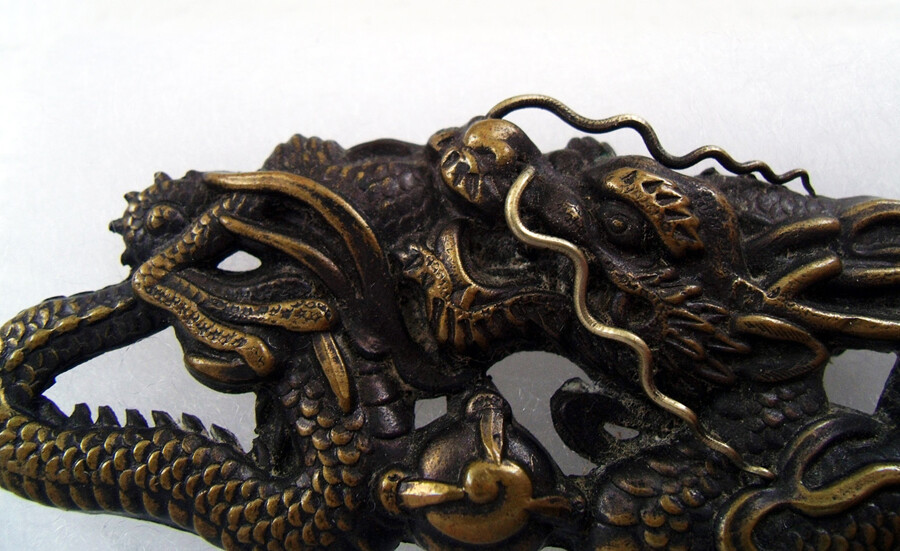


-
Ah Brian - see what a round-eye does when he triest to spell AND is dyslexic (not really) Thank you and yes, I meant the tang - NaKAgo- , not the ship or girl (although you're right....probably a good idea in all cases!) I'll get it right one day, I promise ! That's why I love this board!!! Curtis
-
May I also be allowed to add: "never clean the nagako!" (part the handle fittings go over). Curits
-
Yes, please take it up off of the grass! From what little I know, it looks like a well-made blade and fittings. Never risk moisture to rust it further, just in case. My $0.02 worth but will follow the thread! Curtis R.
-
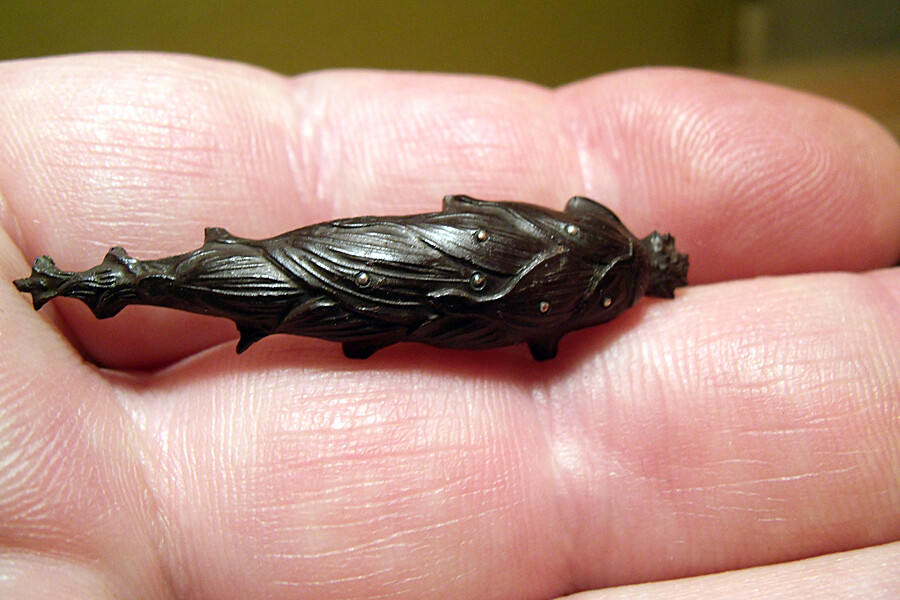
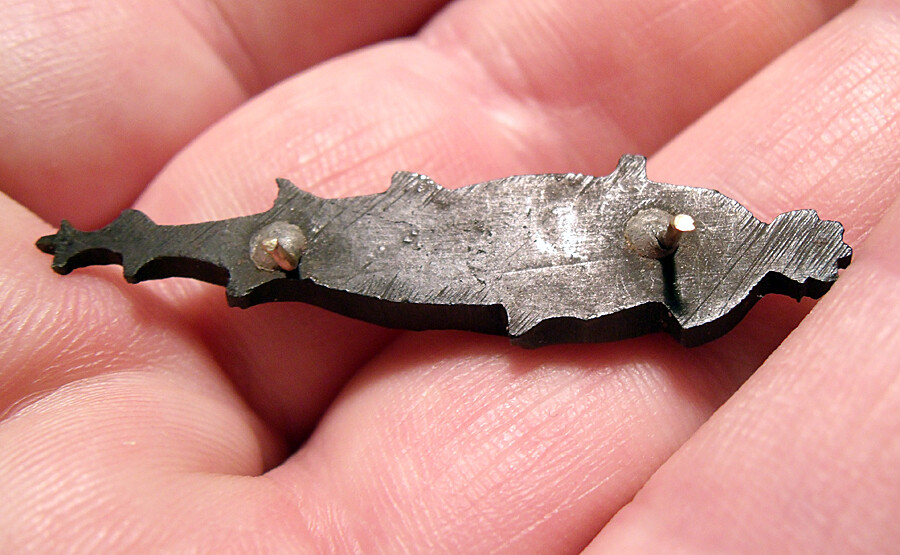
Yep, it's magnetic Tobias - and I sort of figured it was cast, but nicely. No patina on the back like the other old pieces I have....but I still like it and the price was in my budget . Curtis R.
-
Greetings all, I recently purchsed this "ear of corn" tobacco clasp for a very reasonable price...the metal-work seems very detailed and heavy (shakudo?) but the reveres tells me it was either well-kept of is Gendai. Any thoughts are appreciated. Regardless, for the small price paid, I like it . Thanks in advance, Curtis R.
-
Well, I think it was decided by those here w/ far more experience than I, that the pattern is a wagon-wheel (wagon turned upside down) in the river soaking to tighten the spokes, which I guess was how it was done "back then"? When you see ti from the "wagon is upside down" angle, it seems to make sense. Emphasis on the "I think" part . The one w/ the partial Sakura flower is very pretty, BTW! Regards, Curtis R.
-
Fist post didn't "take" so trying again.... I have a Sukashi Tsuba that is very similar - also an eBay purchase. I wonder if they were made by the same Tsubashi ? Probably unlikely but I really love the design. Congrat's on your find!! Best, Curtis R.

-
Smiths 'taking on other names'
CurtisR replied to CurtisR's topic in General Nihonto Related Discussion
Thanks for your reply Chris - these do make sense to me...I would imagine it is just by reading the sword forging (first, as suggested by my reading) one can narrow down the smith at least. I just could not figure this one out but you've clarified it well. Many thanks! Curtis R. -
Grettings all, I've been doing a good bit of reading but still can't figure out when or why a sword-smith would take on a "new name", thus changing the Mei? From what I can gather, once his apprenticeship ends he's allowed to take on a new name, but why would he do so, and how would it be picked? Perhaps my Gaijin brain can't wrap around it yet but any help understand this would be muck appreciated (or lnks). My books simply say "and he then took on the name................." Best Regards, Curtis R.
-
Awesome to all - and what an experience! Curtis R.
-
Ah well - at least I only paid $9.00 US for the set. Thanks! Curtis R.