watsonmil
-
Posts
1,406 -
Joined
-
Last visited
-
Days Won
4
Content Type
Profiles
Forums
Events
Store
Downloads
Gallery
Everything posted by watsonmil
-
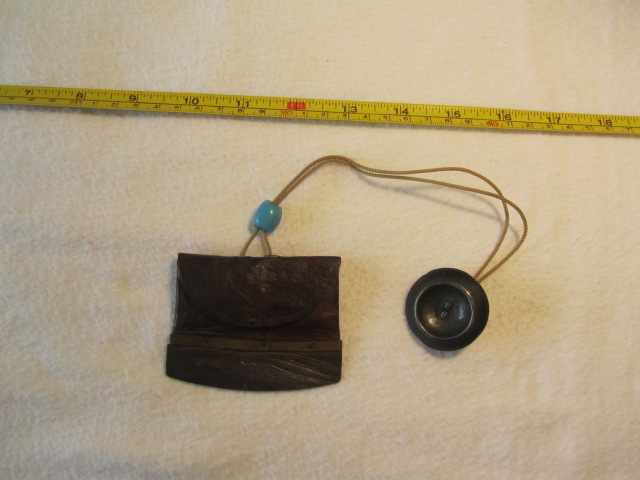
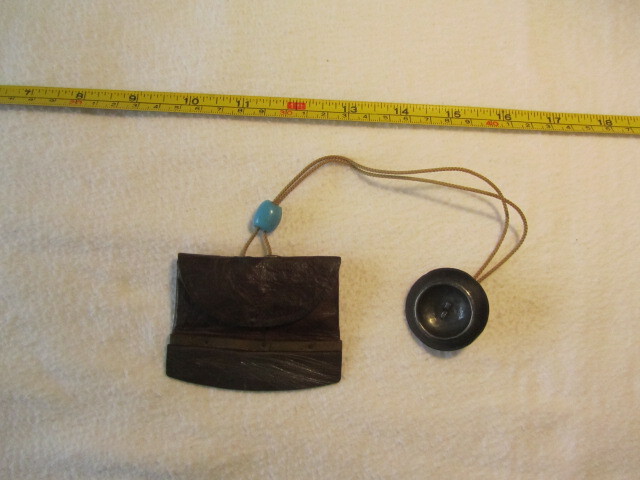
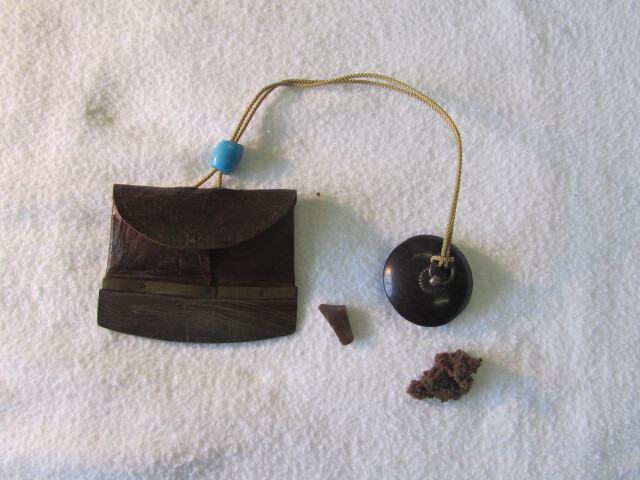
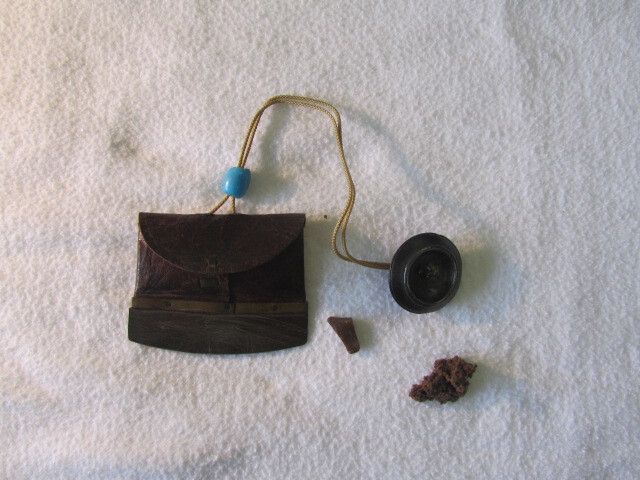
In my ever ongoing quest for items related to the Tanegashima ( Japanese Matchlock ), .... I was rather delighted to acquire a seldom seen accruement to the use of the Tanegashima. A prerequisite to firing the matchlock was a means of lighting the match. Given that the Tanegashima predates the advent of the Bic Lighter or for that matter the wooden strike anywhere match, ... the earlier version of a pocket lighter was the Strike-a-lite. This consisted of a piece of high carbon steel or iron, a piece of flint to strike against the steel, and tinder ( a bit of carbonized cloth or some other material which will take and hold a spark ). The combination was usually carried in a small leather purse or metal container. In the case of the metal container this would act to hold the tinder while sparks were directed onto the tinder. The Japanese being rather ingenious at improvement in technology, ... and just as likely because the Kimono has no pockets to carry your lighter, .... utilized a special netsuke ( tinder holder netsuke ) to do double duty in providing a means of carrying the Strike-a-lite contained in a leather bag to the Kimono or Armour Obi as well as providing a receptacle for holding the tinder. The example pictured is just such an artifact. The Netsuke is made of a hardwood having a metal bowl inset for the tinder. The netsuke measures 1 1/2 inches OA diameter while the metal bowl measures 1 inch and is quite deep. The leather bag holding the tinder and flint has a piece of steel riveted to the bottom of the bag. Width of the bag is 3 1/8 inches including the steel. A simple brass catch closes the bag to keep the contents within. Once the tinder took hold by smoldering, ... the match could be lit, ... and readied for shooting. Submitted for the interest of the NMB members .... Ron Watson
-
Dear Piers, I told you you could do it, ... Felix Beato, .... Kusakabe Kimbei eat your heart out ! ... Ron Watson
-
So it's Gimei? What do we do with it?
watsonmil replied to george trotter's topic in General Nihonto Related Discussion
Dear George, In response to your observations, .... I would respond by saying that the serious student of Nihonto should not / does not collect names. He may collect by School, by Era, by Type, by above all Quality. Far too much emphasis is and has been placed on the signature rather than the quality. There were many reasons for Gimei signatures NOT only deception. As an example I have in my collection a wonderful Katana bearing the signature: Izumi ( no ) Kami Kanesada ( Yes No Sada ) obviously Gimei. The signature is quite obviously incorrect, ... and the sword is Kanbun ! Ah, ... now here's the catch the URA reads : Seki San the owner of this blade presents to Matsudaira Hanjiro of Noshu in the town of Takasu this blade as a gift. It is a flawless high quality blade in full polish and free of any faults having a Nie based notare/midare mixed hamon with many workings within the hamon. It is known ( see John Yumoto ) that presentation blades can quite often be Gimei ( because that is all the town could afford but they wanted the blade to be considered important and worthy of the recipient ). The recipient quite often would realize the fact that the sword is Gimei, but in good taste would accept the sword with much adulation ( good manners ). This same sword might then be returned as a special gift to the town's headsman on the dignitaries next visit perhaps a year or two later, ... ALL IN GOOD TASTE. Now then I prize the sword not because of the signature NOR the dedication but rather the high quality. So called Gimei may also be seen where a student of a prominent swordsmith was allowed to sign the masters name because the sword met with the master's approval, ... conversely a sword which was deemed good enough might also be signed by the master himself even though it was a students work .... now we have a fake Kanesada with a genuine signature ! Far too much emphesis is placed on the correctness of signatures ( unless an outright FRAUD ). Who is to say, the swordsmith may well have had a friggin migraine when he signed, and one stroke is now reason to pronounce Gimei ! Variations in signature vary over a lifetime, ... I know mine has. Thank goodness the bank accepts my cheques, ... as if compared to a signature a week ago it might not just be 100% the identical ! I am sure that as a Smith grew older, ... signatures were often left to students to sign the Masters name, ..... Christ it was a business not a bloody ART SHOP ! It is this writer's opinion that far to much is made of SIGNATURES and too little attention is paid to quality. The NBTHK, ... and their rival the NTHK are somewhat to blame for this as let's face it both are somewhat Political, ... and often offer a Pink Slip where if a REAL service were to be provided an ATTRIBUTION would be forthcoming in many cases. It would be wonderful if there were no such thing as Gimei, ... but we live in the real world and there are of course forgers. What I hope to get across to the reader is that not ALL gimei are unworthy nor are they necessarily Gimei just because some so called expert Japanese or otherwise decides the signature is just not quite right. ... Ron Watson -
EDO PERIOD ABUMI ( SADDLE STIRRUPS )
watsonmil replied to watsonmil's topic in General Nihonto Related Discussion
Dear Piers, You just made my day, ... thank you. Between yourself and John I learned a good deal about the designs which I had not for whatever reason ( senility perhaps ) recognized. I must say I envy you in particular Piers ... living the history we all love ! ... Ron Watson -
EDO PERIOD ABUMI ( SADDLE STIRRUPS )
watsonmil replied to watsonmil's topic in General Nihonto Related Discussion
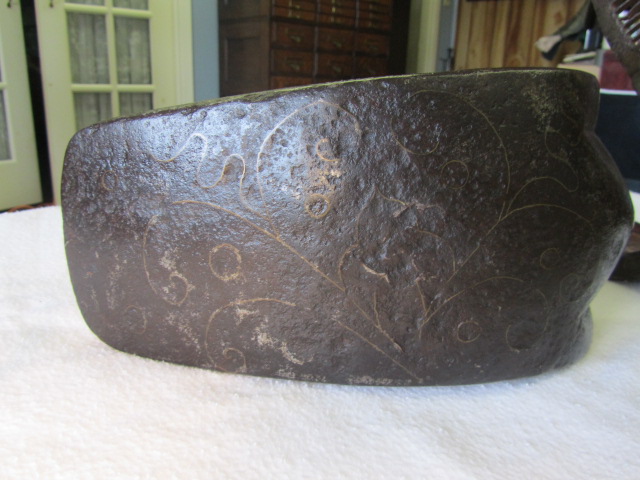
Dear John, You know when I was composing this little article, I could not think for the life of me where I had seen that pattern before ( shape ), ... but I do believe you've nailed it .... Turtle shell segments ! The design inside each is however a flower blossom alternating to a different flower blossom with I think either another different flower or an abstract leaf. Perhaps they represent different Mons ?? Flowers are not my forte as my wife will confirm. Regards, ... Ron Watson -
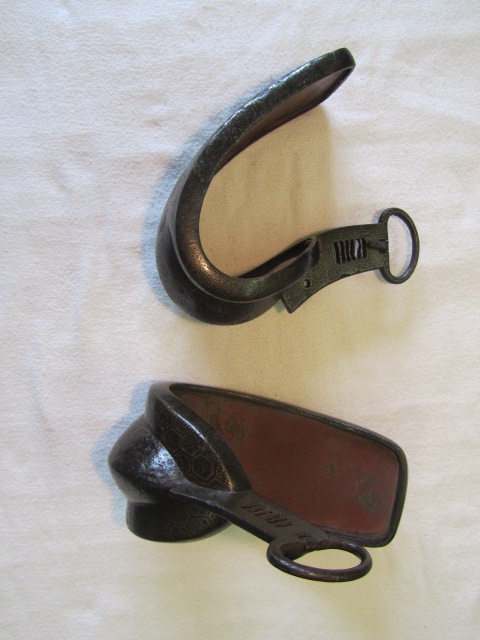
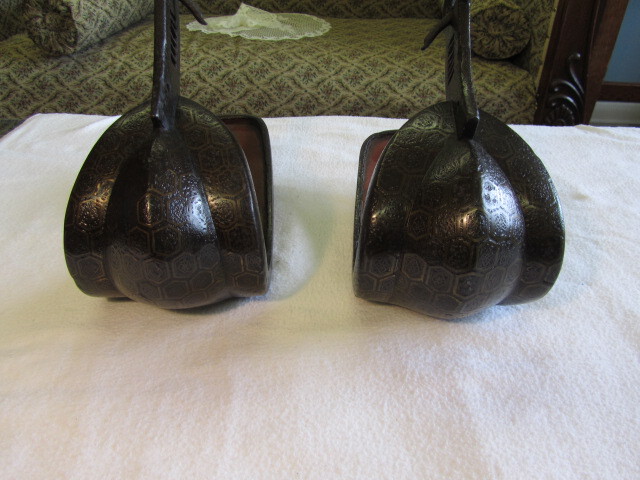
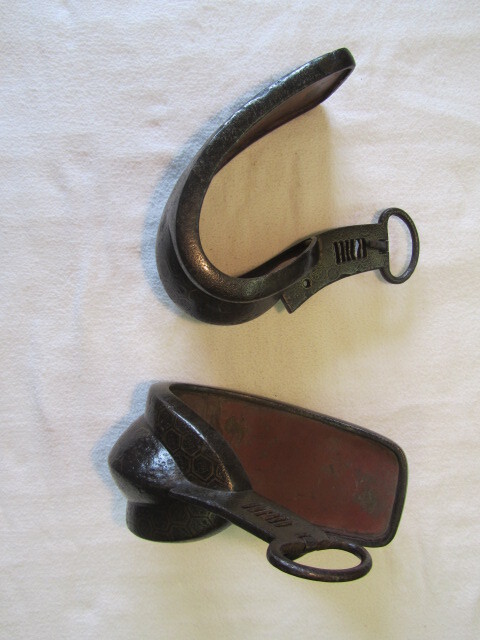
Piers et al, Piers' dilemma about mounting a horse ( sounds perverted when taken out of context ). Please see thread HOW TO MOUNT A HORSE .. authored by Piers brought to mind a pair of Abumi that I would like to share. They are made of iron with brass inlays in what I think might be referred to as a diaper pattern. The bottoms are inlaid in a sort of plant vine design. The section where the foot is placed is also iron, but with a covering of a woven fabric which in turn is lacquered over in red ( somewhat worn and faded ). The OA length is 10 1/2 inches, and height is 9 1/2 inches. Width is 5 1/4 inches. They appear to be quite old, and show wear, ... so they were definitely used rather than displayed or made for the tourist trade. They are surprisingly heavy. I should imagine the design of the stirrups allowed for the Samurai to stand while on horseback to give a more stable platform for the use of the Yumi ( long Japanese Bow ). Anyways I find them interesting and quite an attractive addition to a collection of Samurai equipment. One should I think not overlook these and other Samurai accoutrements in favour of a swords only collection, as displayed along with your swords they if anything compliment each other artistically. ... Ron Watson


-
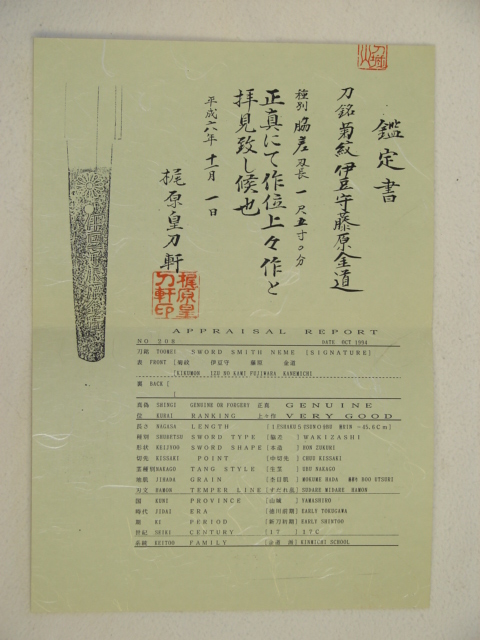
Dear John, Yes, Kajihara did use the words Boo Utsuri, ... and I upon making inquiry of others in this regard was advised that a better term would have been Tobiyaki in long straight pattern almost giving the appearance of utsuri. I should have made an inquiry directly to Mr. Kajihara but alas I did not. ... Ron Watson Dear Jacques, I note you have edited your original comments to remove the word " Gimei ", .... a word I note you use somewhat flippantly ( my opinion not that you would care ). I also note you have removed your translation of the Kanji for Izu being in reality Iga in your opinion. I also noted your statement that Mishina School never used utsuri, .... and I have answered this with : a better term would have been Tobiyaki in my resonse to John. Now then as far as the signature and authenticity go, ... I should like to quote a letter from the late Cary Condell ..... " In response to your inquiry, the oshigata that you sent to me is indeed ( Kikumon ) Izu no Kami Fujiwara Kinmichi. That is a rare specimen. According to the Meikan IZU no Kami is the brother of the nidai ( 2nd gen. ) IGA no Kami. The page you zeroxed from Fujishiros' Nihon Toko Jiten page 392 shows an example of a joint work ( gassaku ) of the two brothers with the IGA no KAMI mei ( senior brother) on the omote and the IZU no KAMI ( junior ) on the ura. Your oshigata shows a mei with slight differences with the one displayed in Fujishiro ( look carefully at the KIN & MICHI ). It is unlikely to be fake however. It looks to be closer in feeling to the way the shodai signed. Perhaps the sword you have was made earlier in his career. " Now, ... in addition I should like to quote a letter dated August 10, 1992 from the NBTHK : " As you are already aware, there is very little information on Izu-no-kami Kinmichi besides what is already known to you. He seems to have produced very few swords under his name. It is likely that there are few false works attributed to this smith. " The sword was subsequently examined by Kotoken Kajihara who issued the Shinsa paper in 1994 stating GENUINE work by : Kikumon IZU no Kami Fujiwara Kinmichi. In personal communication he felt the work in this case surpassed that of the nidai. I do not mind constructive criticism, .... but I bloody do mind your elitist tone ( attitude ) , and rash statements which you then edit out after a goodly number of our readers have read your original without so much as : " I may have erred ! " I think given the evidence that I have presented, ... that the sword is not only genuine but a worthy study piece. ... Ron Watson
-
Or OVER you ! ...Anonumous Ron Watson
-
Yep, .... it should work . Video tape if possible please ! ... Ron Watson
-
Hmmm, Having seen your physical stature, .... let us pray that these are not the small asian horses of old ! . In all seriousness the Armour as worn by the Samurai should be quite flexible in the lower extremeties to allow for mounting a horse. ... Ron Watson
-
A FEW MORE PHOTOS :
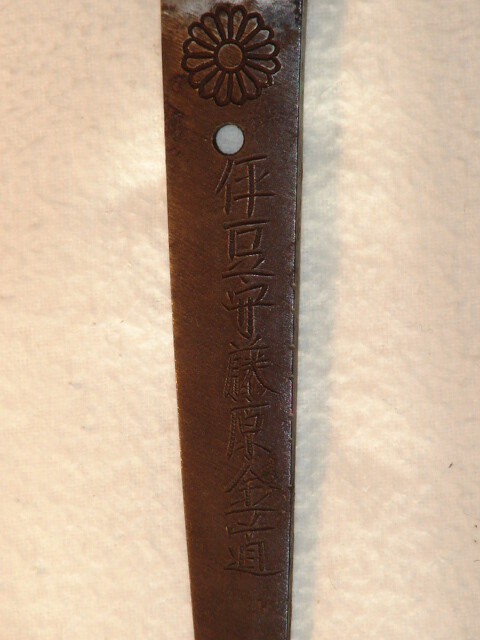
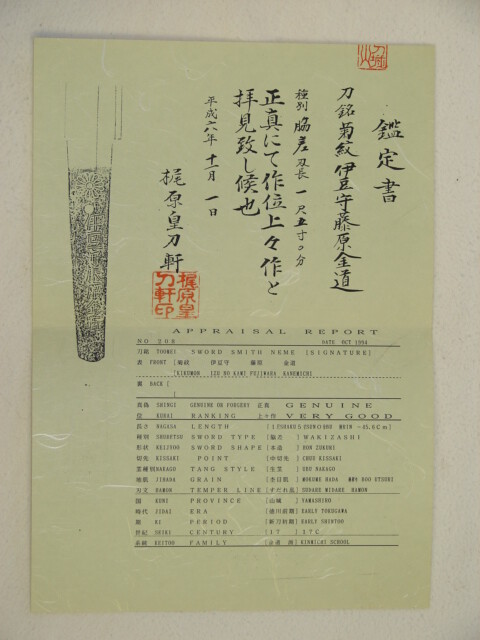
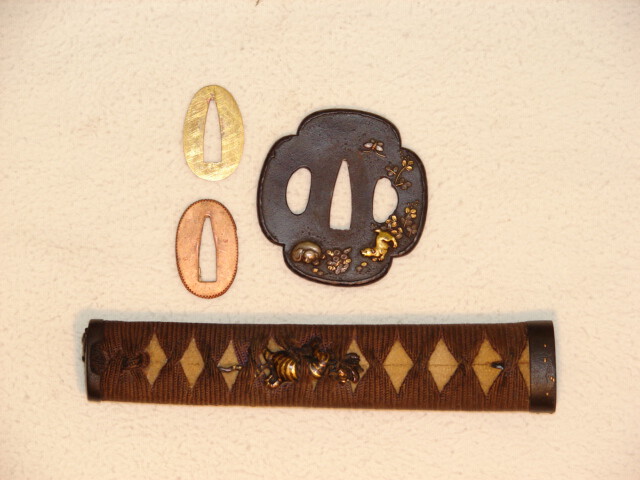
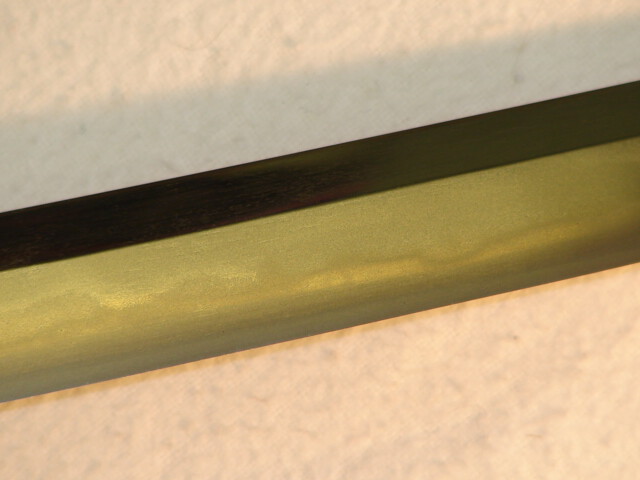
-
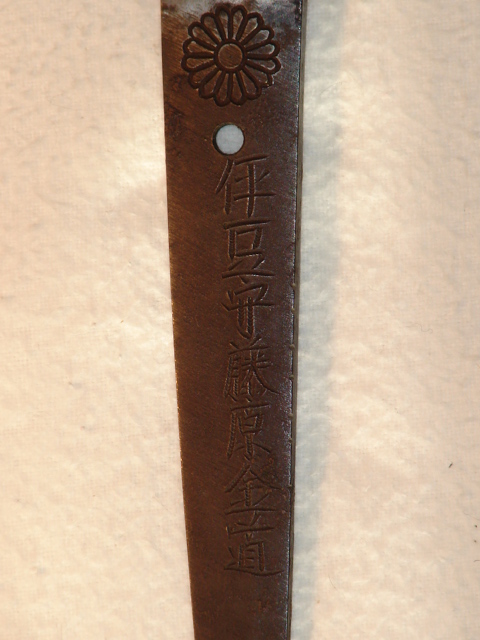
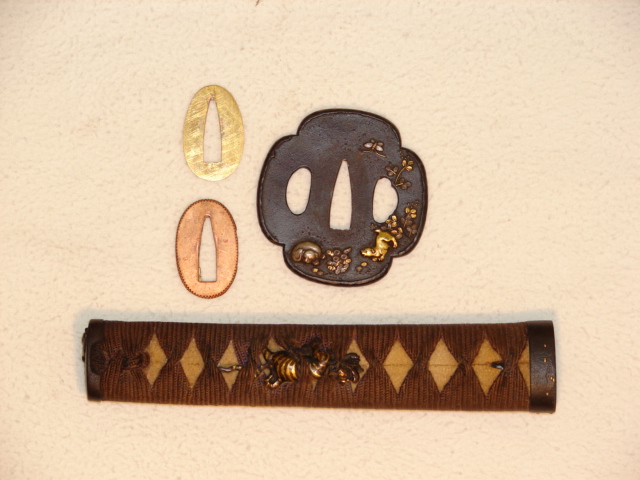
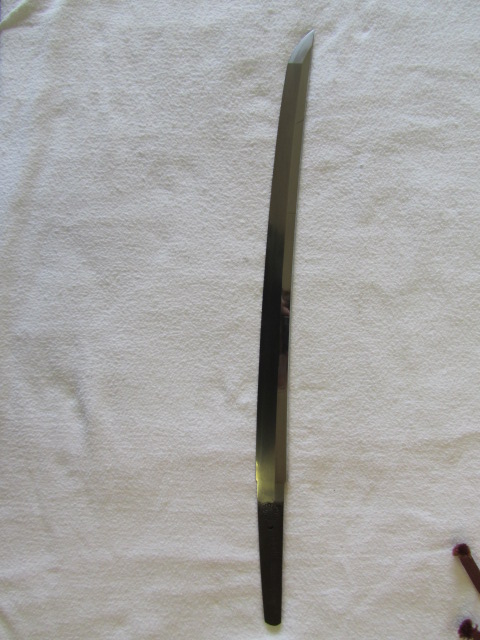
Dear Members, I particularly like the Mishina School Smiths, ... and since I had this one out for a cleaning and decided it might be of interest to our membership as a study piece I had a few photos taken ( I apologize for some which are just not the best ), .... never the less I think it is a nice example illustrating some kanti points to look for in the Mishina School. You will note the polish is sashikomi which I think best illustrates the workings to be found in this school ( or any school for that matter ). The sword is Wakizashi, the Nagasa being 45.6 cm. Shape is Hon Zukuri. Kissaki is chu kissaki and the boshi exhibits the Mishina School kaeri. Jihada is a tight Mokume grain with boo utsuri. Hamon would be classed as sudare midare. Hamon has large nie, and occassional kinsuji is present. The Nakago is ubu and the file marks are suji-chigai ( slanting left ). Mei reads : ( Kikumon ) Izu ( no ) Kami Fujiwara Kinmichi. Koshira is if not the original certainly very old ( excepting the kodzuka which I bought from a NMB member ). The blade is very healthy with no flaws, ... and by personal communication with Kotoken Kajihara who did the Shinsa paper, .... probably the best Izu ( rare anyway ) that he had seen, and fully the equal of his elder brother 2nd Generation Iga ( no ) Kami Fujiwara Kinmichi. This sword was made by the younger brother of second generation Iga ( no ) Kami who was active between 1661 - 1680. Respectfully sbmitted for the study and enjoyment of the NMB members ... Ron Watson

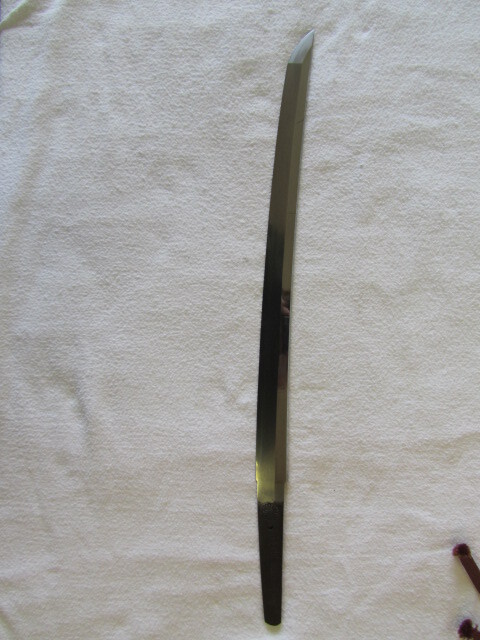
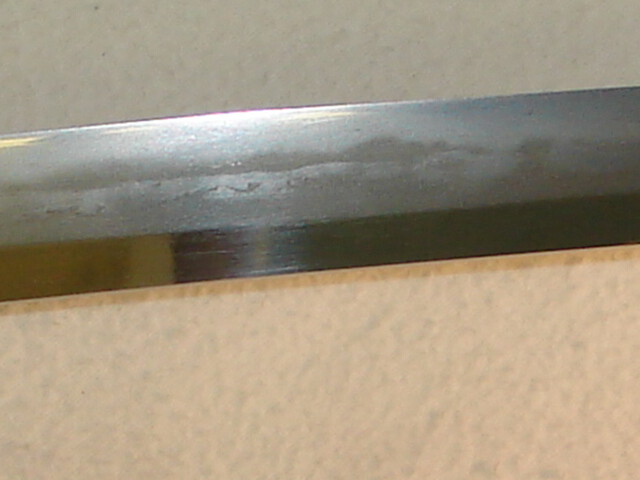
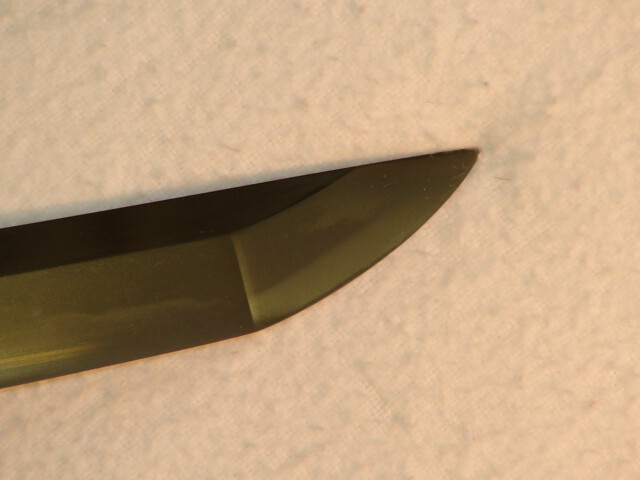
-
Hmmph, Being now in my 60's I no longer wield my sword with the proficiency I did as a younger man, nor nearly as often If given the chance to forge one, .... I would undoubtably have gone for forging a No-dachi rather than a tanto ... Ron Watson
-
This Week's Edo Period Corner
watsonmil replied to Bugyotsuji's topic in General Nihonto Related Discussion
Dear Ian, There you go, ... not only have we in North America, but also by Ian's little slip ... the UK ... been using the words brass and bronze interchangeably. It would appear that our learned colleague in the Netherlands is more on the ball ( although not bronze nor brass ) with the correction that gun barrels were never made of brass but rather bronze ! Quite correct Sir, and I am in total embarrassment to admit my own guilt in the misnomer. In defence of Piers, ... one of course would be pushed to total desperation to load nails into a blunderbuss, .... small bits of nails and other bits of metal, or stone to be sure, but not 5 inch spikes. I'm sure with Piers' expertise in the use of firearms he did not intend the reader to equate desperation with the loading nails in the sense that you fear :D . Perhaps this thread ( whatever the hell it is ... I've long since lost track ) .... ah yes it's coming back now Piers' non ferrous ball/balls may yet bear some scholarly fruit. Here's a bit of knowledge that will be an education to many of the readers since we now have blunderbusses intermingled with cannon, ... I might as well dispel the belief held by many that the flared muzzle of the blunderbuss was intended to disperse the shot be they pellets, nails, stones, or threepence coins over a wider area than the standard say 12 bore shotgun. Rather the flared ( funnel like muzzle ) was intended as just that a funnel to ease the loading of the gun while riding horseback at a gallop, or as a passenger riding within a bouncing horse drawn coach bouncing along at high speed in hopes of out running the English Highwaymen ( robbers ) of the Georgian/early Victorian period. The fact that the huge flared muzzle acted as a psychological deterrent is of little doubt, ... but actual experimentation has shown that the flared muzzle does not disperse the shot in the least. It was simply easier to load during a bumpy ride. The blunderbuss was devised as a direct result of the number of highwaymen working the King's roads during the 18th and early 19th centuries in the UK and Continental Europe. ... Ron -
This Week's Edo Period Corner
watsonmil replied to Bugyotsuji's topic in General Nihonto Related Discussion
Dear All, If I might make a few corrections to the thread : PIERS said, .... " Ship's cannon were often made of bronze so as not to throw out the compass. I wonder if they had special non-magnetic ball stored nearby ? " Sorry Piers, ... but this is not quite correct. Bronze cannon had little if anything to do with avoidance of compass deviation, and everything to do with the fact that Iron Cannon were for quite sometime totally unreliable and much heavier than their brass counterpart up until the late sixteenth century. It was also previous to this time that Galley type ship, ... firing cannon from the bow was the fighting ship of the day. Not until 1501 did the French cut gunports in the hull of a ship allowing for the side mounted cannon of the Men-of-War or Round Ship. In the late sixteenth century the development by the English of cheap cast iron cannon which could now be produced in large numbers sealed the fate of the Galley as a viable gun platform, to be replaced by the Man-of-War Sailing Ship armed all round with IRON cannon instead of bow mounted expensive Bronze cannon. It was pure economics that led to the demise of the bronze cannon and the adoption of the iron cannon. One must remember that in order to have an effect on compass deviation the iron cannon would have to be quite near the compass, and as such were not allowed near the compass. Compass deviation was always a concern however and I quote : " Magnetic Deviation,” or the difference between Compass North and Magnetic North, was known but not understood. “Deviation” was caused by the natural magnetic fields of the often several hundred tons of ships’ iron ballast, cannons, shot, anchors, fixtures and fittings, etc. Since seamen of that time knew about but did not understand this form of compass variation, they just included “deviation” in “variation.” However, the officer of the watch knew that when the ship was under way he was never to wear his sword or his pistols near the compass binnacle. The above information from: Navigation and Logbooks in the Age of Sail by Peter Reaveley. ERIC : I am waiting on a call from the Curator of the Alamo Museum regarding the brass balls. To date he has not returned my telephone message. KM : A wonderful photo and link to a Japanese Cannon of high quality. JUSTIN : Balls are Balls, ... whether they be Japanese, European or North American. Only difference I have noted is a very slight difference in the spur, ... Japanese musket balls have a square spur whereas the others have a round spur. ... Ron Watson EDIT: As one of our members KM pointed out to me by PM .. in Europe .. Bronze was the more prevalent in Cannon construction, ... whereas I and others have been using the word Brass to the exclusion of Bronze. I'm pretty sure both were in use however. -
This Week's Edo Period Corner
watsonmil replied to Bugyotsuji's topic in General Nihonto Related Discussion
Eric, Now that is interesting, .... that is the first I have read of Bronze being used as grape/cannister/case shot. Well there you go, ... as so often happens there are always exceptions. By the way, ... for those with inquisitive minds ( avid readers of the Enquirer no doubt ), ... as though it matters ... the technical difference between grape and cannister is the size of your balls, and the packaging. Grape shot is considered somewhat smaller than cannister but NOT necessarily musket ball size, .... in reality both are a load of shall we say Metal Balls ( normally iron ), .... the packaging is also somewhat different grape shot generally ( but not always ) contained in a bag, .... whereas cannister generally ( but not always ) contained in a thin metal can for ease of loading ( sometimes in lieu of the can, the balls are held together between thin sheets of wood of the correct barrel diameter ). Without going into a long drawn out treatise on ammunition it is generally accepted that anti-personel ( land use ) is most often called GRAPE, .... while anti-personel CARRIER or BUILDING ... eg. a SHIP ( Naval USE ) is called CASE or CANNISTER. Now to be more specific all this during the Black Powder era, .... as I am sure to be corrected that there exists today anti personel cannister as well. The bottom line is they are all balls and the difference in nomenclature is semantics. Piers, Although anything is possible, ... the chances of your metal ball being a cannon ball is not likely. For those who wish to delve into the NON Nihonto subject of Ammunition may I suggest : The Illustrated Encyclopedia of Ammunition by Ian V. Hogg. For those who wish to make this a MUST in their repitoir of knowledge may I suggest : The Technical Manual of Artillery Ammunition Guns, Howitzers, Mortars, Recoilless Rifles, Grenade Launchers, and Artillery Fuses : TM43-0001-28 Headquarters, Department of the Army Washington DC. ... Ron Watson PS. Just to satisfy my own curiosity I am trying to contact the Curator of the Alamo Museum to confirm the existence of the brass cannister or whether this is an error, ... as I am also quite confident that the idea of copper grape shot is in all likelyhood an error. -
This Week's Edo Period Corner
watsonmil replied to Bugyotsuji's topic in General Nihonto Related Discussion
Dear Bob, Please PM the real difference, .... there is no point in arguing packaging on the NMB. I too have a little experience with artillery. ... Ron Watson -
This Week's Edo Period Corner
watsonmil replied to Bugyotsuji's topic in General Nihonto Related Discussion
Guys, Grape Shot, Cannister, Case Shot are all synonums, .... and all are either iron or lead. On rare occassions, .... a mixture of nails, stones, misc. metal fragments of whatever was available was muzzle loaded into cannon. This was usually a last resort when all other projectiles were used up and anti-personel at close range was in order. No one ever used exotic metals. Sorry to disappoint you, ... but if it isn't iron or lead it is not a cannon ball. ... Ron Watson -
This Week's Edo Period Corner
watsonmil replied to Bugyotsuji's topic in General Nihonto Related Discussion
Dear Piers, Possibly Kryptonite, .... The only two materials that cannon balls to the best of my knowledge have been made of were 1stly Stone, ...... 2ndly Iron. All other materials were considered too expensive to be tossing about. I do know that bronze can take on quite a black patina, .... but I don't believe bronze was ever used as cannon fodder. ... Ron Watson -
Tekkan or tetsuken with kurikata
watsonmil replied to estcrh's topic in General Nihonto Related Discussion
Guys, Lets say the feathers I hope to have ruffled are " Japanese Feathers ", .... the fakers and dealers who have taken very rare artifacts and turned a mockery into profit to the damage of many a collection. The proliferation of this kind of activity can and will diminish not only the value of our collections, ... but the serious study of the historical artifacts of the Samurai era to the very real detriment of Japan and her history in the eyes of the world. It is too easy to blame the Chinese for the creation of fake Nihonto as an example when we see some Japanese dealers offering those very items as being genuine as well as creating like objects themselves. ... Ron Watson -
Tekkan or tetsuken with kurikata
watsonmil replied to estcrh's topic in General Nihonto Related Discussion
Dear Keith G and Eric, The majority of these newly discovered bashing weapons coming out of Japan are just that ... NEW ... . Although one can find the occassional iron or wooden club ... eg. Arms and Armour of the Samurai by Bottomley & Hopson, .... page 82 , ... they are VERY RARE and tend to be iron bars or wooden bats. They certainly DO NOT show up in Western collections formed in the late 19th century with the regularity they have been showing up post eBay in Western collections. There is and always will be a market for the exotic, ... and it is my considered opinion that that market is being well supplied from Japan. Having said that ... there were jitte or jutte or whatever multitude of names the Japanese tend to assign to everything, .... but even MOST jitte are now suspect due to this rampant forgery. It was easier years ago to have confidence in the integrity of dealers. I am happy the majority of my collection was formed pre - eBay, and certainly pre-Japanese Auction Houses ( sites ). I knew I would ruffle feathers, ... and for that I am truly sorry, ... but I tell it the way I see it. ... Ron Watson -
Tekkan or tetsuken with kurikata
watsonmil replied to estcrh's topic in General Nihonto Related Discussion
Dear ALL, I have read this most interesting thread and have up till now stayed away from contributing thought, as I am sure to be branded " Politically Incorrect ". Unlike John Stuart who is being most generous in his Politically correct terminology when he states that he has trepidations ( I think he used the word wary ) whenever he reads the words Hidden or Secret in the title of books on Japanese weapons. Anyways I have never been known to be Politically correct so here goes : 1. The Dirk type Hachiwara was clearly designed as a blocking and parrying weapon used in the left hand with a hook like protusion on the underside ... there being the hope of the opportune that it might by chance catch and thereby allow the user to hold the opponent's sword. This type of weapon was well known in Europe as a Main Gauche, ... see Stone's ... " A Glossary of the Construction Decoration and the Use of Arms and Armor " ... page 431. Please also note that many Main Gauche had notches in the blade to catch and hold an opponents sword ( Stone's does show only one, ... but I assure the reader these notches are quite commonly found ). The Japanese being good at improving upon a design but rarely of inventing , .... took the idea of a parrying weapon one step forward by also making it a Misericord ( Mercy Dagger ) ... see Stone's ... page 451. The Miseicord ( again in Europe ) was used once an opponent was down but not dead to drive thru armour into a vital spot of your opponent and thus dispatch him. The curve of the hachiwara is also an improvement in that it is curved in such a way that it follows the natural curve of the arc of the thrust ( once the opponent is prostrate ), rather than the straight vetrtical European thrust required of the straight European design. In addition to this the curvature of the hachiwara allows in parrying to strike a blow with the least amount of contact between the area being struck ( say a wrist ) and the weapon thus directing a much STRONGER blow to a given area than a flat blade which spreads the force of the blow over a larger area but with more disapation of force. As far as the argument of hook above or hook under while in use, ... one need only look at examples of mounted hachiwara pictured to see that they were employed hook under .. Stone's ... page 273. 2. The Cast Iron Hachiwara of sword shape I would suggest is nothing more than a fantasy weapon dreamed up by some enterprising faker, ... this somewhat borne out by the number I see being offered on various antique weapon sites of late. I must have over the past year seen at least 6 or 7 of these being offered .... all cast iron. Who in their right mind would go into battle with that heavy clumbsy contraption slung thru the Obi ??? I think it was Keith G. that said : " In many instances we are guessing at both of these and also forgetting that some of these things may also have been made as nothing more than export items to satisfy the demands and appetites of a European market that during the Post Edo period, was insatiably fond of the exotic items of the orient." I would go much further and say " nothing more than to satisfy the appetites of modern Western Collectors " by Japanese fakers who have more interest in Currency than Culture. This I back up by pointing to the penchant for the Japanese to fake Sword Signatures with out regard for the historic nor cultural value of the swords both in the past and in the present times. 3. The picture posted by Eric of the Jutte having the hidden dagger .... Please note if you will the heated areas of both the shaft, and the handle ( sorry tsuka ), ........ a method of softening for the ease of drilling ??? Also note the threaded blade base ( fine thread at that ), ... something unheard of during Edo times. Again my opinion ( for what it is worth ) of this item is that it is relatively modern and designed for the unwary Western Collector. Eric said : " Not the old ''export tourist item" explanation of objects that we just do not understand again.....If they were export items I guess they did not sell very well as they are rarely seen for sale outside of Japan, almost all the ones I see are coming from Japan. " ..... The reason I believe that many of these weapons ( I use the term with a grain of salt ) are more often found in Japan than in the west as should be the case if they were made for export is that they did not even exist for the most part during even the Meiji era, .... but are an recent industry of the Japanese faker for the sole purpose of satisfying the interest in the exotic by MODERN WESTERN collectors. This short, ... but somewhat unkind look at exotic weapons is NOT meant to hurt the feelings of any member nor slight any member. It is intented however to be a warning to those who would be taken in by many of the exotic weapons on offer in today's world of un-gentlemanly business. ... Ron Watson _________________ -
Acquiring a Tanegashima (Japanese matchlock)
watsonmil replied to estcrh's topic in Tanegashima / Teppo / Hinawajū
Dear Carlo, I noticed it as well, ... and since there is nothing to screw to or conversley screw on at that point of the lock plate and since what appears to look like a screw is also brass ( in lieu of steel ) , ... I assume it may be some type of mark put there by the lock maker. Perhaps Eric will confirm. ... Ron Watson -
Acquiring a Tanegashima (Japanese matchlock)
watsonmil replied to estcrh's topic in Tanegashima / Teppo / Hinawajū
The shooting of Antique Firearms is entirely dependant on the overall condition of the firearm in question. The possibility of damage to the firearm as well as yourself ( and others around you ) is something of a concern. My recommendation is that unless being handled by someone with a great deal of experience, ... that ALL antique firearms remain in the gun cabinet or displayed and NOT fired. There are too many variables to take into considertion, ... metal fatigue of all moving parts let alone the barrel, ... the intergrity of the wood is another. I simply cannot recommend the shooting antique firearms by anyone other than an expert in the firearms field. Now having said that, ... your friends shooting their replicas are using a simple detergent mixed into the water to help in cleaning the black powder residue from the barrel. In the case of most antique firearms the inside of the barrel is too rusted and pitted and NO black powder residue remains .... Only a very few antique black powder firearms that were cleaned and cared for after they were last fired which may be 200 years ago will have an internal barrel condition that can be suffciently cleaned of the light surface rust caused by normal atmospheric conditions to ever be shootable again. The exercise here is to preserve the firearm inside and out, .... to make it look and be the best it can be for the enjoyment of its artistic, and historic merits, .... and to preserve it for future generations. Generally speaking leave the actual firing of black powder weapons to the use of REPLICAS and NOT antiques. ... Ron Watson