Iaido dude
-
Posts
493 -
Joined
-
Last visited
-
Days Won
2
Content Type
Profiles
Forums
Events
Store
Downloads
Gallery
Everything posted by Iaido dude
-

RE: Which tsuba schools incorporate rectangular/square hitsu-ana?
Iaido dude replied to Iaido dude's topic in Tosogu
I think you are quite right, David. That reference to shrine was from an American Buddhist website. Definitely not shinto. I will correct the wording in my writeup for my own records. -
RE: Which tsuba schools incorporate rectangular/square hitsu-ana?
Iaido dude replied to Iaido dude's topic in Tosogu
Very nice composition on your Owari, Florian. Is that a rounded square mimi? -
RE: Which tsuba schools incorporate rectangular/square hitsu-ana?
Iaido dude replied to Iaido dude's topic in Tosogu
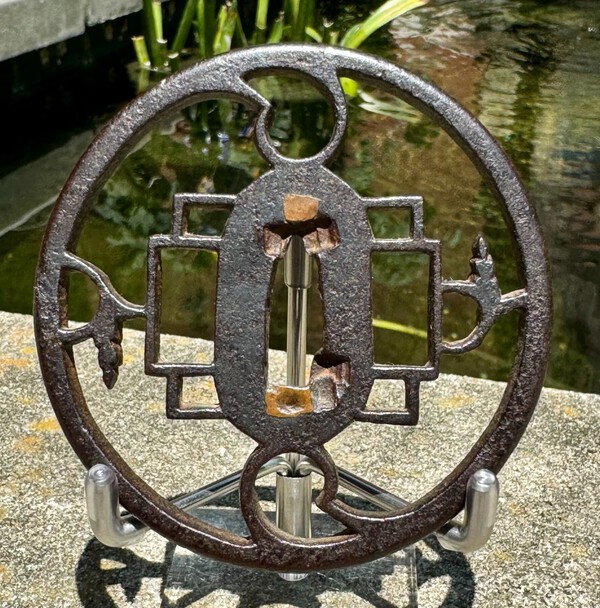
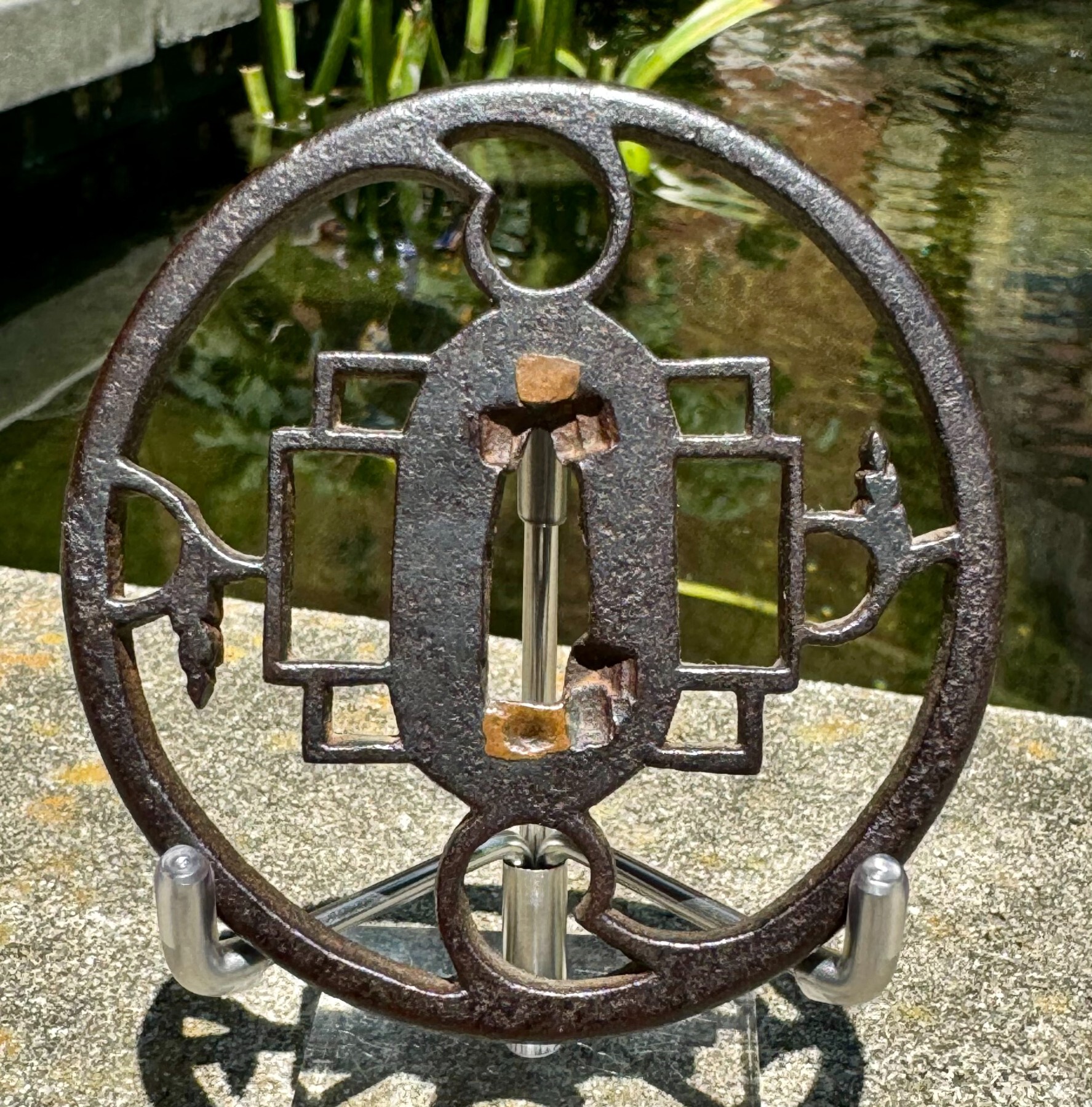
Here is a Kanayama in my collection with the motif of a water well 9rather than a window0, which may be a Buddhist symbol. I posted on this nearly a year ago, but not in relation to the shape of the hitsu-ana per se. The composition includes both the square hitsua-ana (buckets?) and a rectangular section above and below (the frame of the well with crank?).

-
RE: Which tsuba schools incorporate rectangular/square hitsu-ana?
Iaido dude replied to Iaido dude's topic in Tosogu
Thank you, David. This tsuba looks very familiar. I think I’ve seen it or another with the identical composition previously. -
RE: Which tsuba schools incorporate rectangular/square hitsu-ana?
Iaido dude replied to Iaido dude's topic in Tosogu
Here is a Kanayama (Holbrook)/Ko-Shoami (Haynes) attributed tsuba.
-
RE: Which tsuba schools incorporate rectangular/square hitsu-ana?
Iaido dude replied to Iaido dude's topic in Tosogu
Thanks, David. I'm looking more intently at early sukashi tsuba. -
RE: Which tsuba schools incorporate rectangular/square hitsu-ana?
Iaido dude replied to Iaido dude's topic in Tosogu
Some more Kanayama from various seller's sites (all items sold).

-
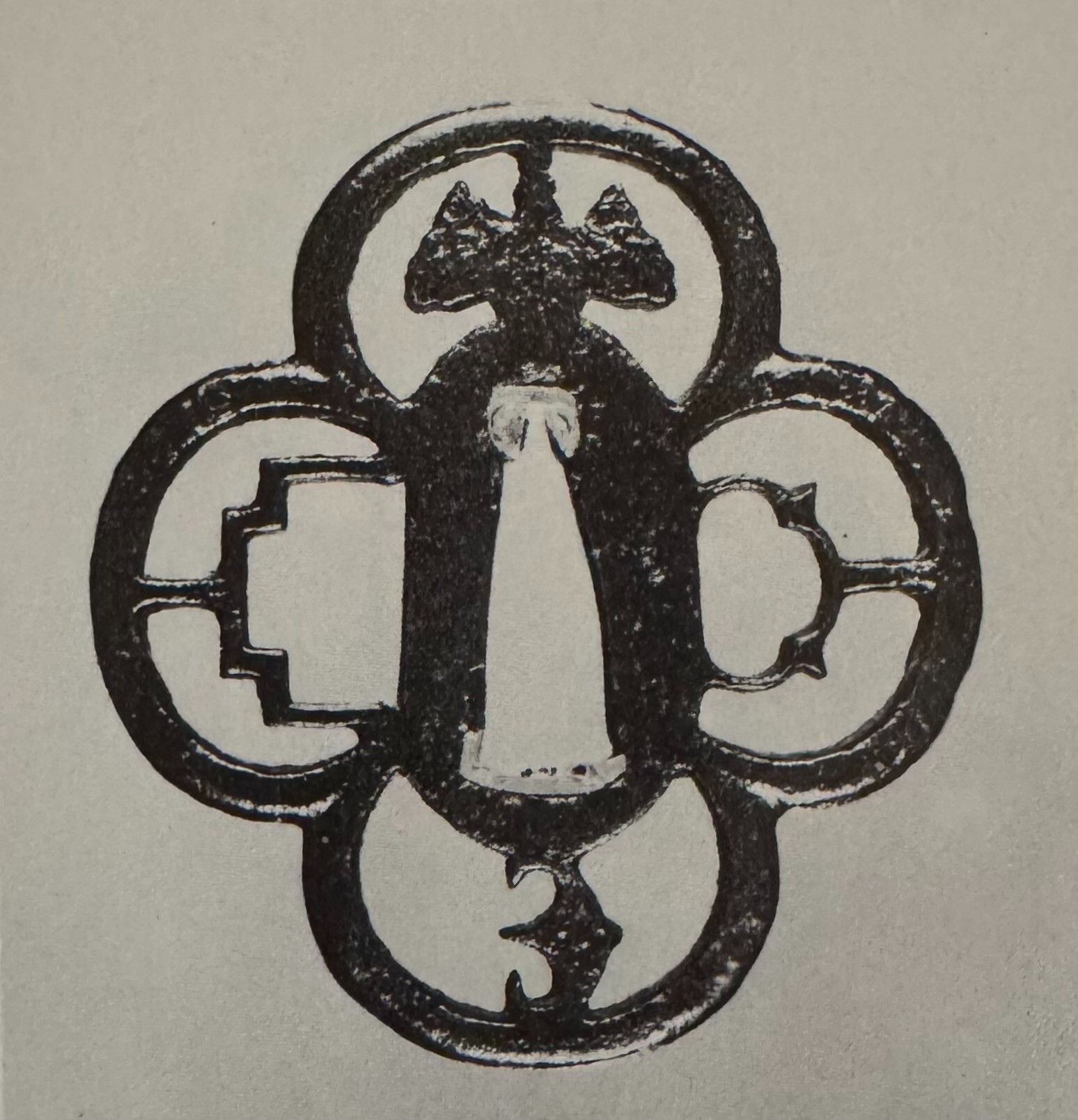
I have two sukashi tsuba (I have attributed to later Shoami and later Owari) with multi-tiered rectangular hitsu-ana. I have begun to wonder when and where this design element was first incorporated and subsequently used. I am including a few pics from Owari To Mikawa No Tanko of a rare mokko-shaped Kanayama with multi-tiered rectangular kogai hitsu-ana and an Owari with double rectangle hitsu-ana. Shoami double tomoe and myoga (mid-late Edo) Owari matsukawa bishi (mid-late Edo). My koi (Sonny and Cher). Kanayama Owari hyotan


-
The tsuba arrived. It is round-cornered, slightly dished, and actually has a well-preserved patina with a really impressive seppa-dai. The quality of the forging is quite good. The image by seller on Jauce is overexposed. If I were to give this tsuba a single attribution it would be Shoami because of the seppa-dai and it's more generic Edo period production and sensibility that incorporates numerous influences. The only issue is that in order to fit it on my iaito, I would have to significantly alter the sekigane. Somehow, now faced with the prospect of altering anything on this tsuba to suit the original intent for use, I hesitate to "defile" it even though it was purchased for $65. It's not about monetary value. It's just a respect for antiques and the history they hold. Thinking about the tradition of repairing tea bowl cracks with kintsugi, and how these flaws simply add another chapter to the intended Wabi Tea aesthetic like the scars and bruises we all experience through a human life, perhaps I shouldn't hesitate to file down the sekagane (pretty non-invasive). Does anyone have any basic tips for doing this? I include a pic of a Kanayama that I picked up on Jauce for $320 (posted separately earlier), mounted now on a custom-made folded tamagahane katana forged in the kobuse style that I use for tameshigiri practice. The tsuba could be mounted snugly without alteration of any kind. Dimensions: 65.7 x 62.2 mm, 6.0 mm at mimi, 5.4-5.5 mm at seppai-dai Wt: 71 g


-
This must be a Komorebi tsuba, which Dale posted before. It is Akasaka with some residual gold colored coating (lacquer?), which would be weird for Akasaka. Perhaps just a feature of the crumbly mimi surface patina. Condition is not great, but a nice example. https://www.aoijapan...nbthk-hozon-paper-2/
.thumb.png.1137ccbc76bf9278a04d86c8aa31eb3a.png)
-
Kirikomi on Tsuba from Sword Strike vs. Non-Combat Damage
Iaido dude replied to Iaido dude's topic in Tosogu
Ah, yes. I have seen this tsuba before. Very convincing because the extent of battle scars is linear across a large area and there are also multiple scars as one might expect from a fierce battle. Thanks for pointing me to the 2020 thread on tsuba battle scars. It's less credible when there is just a single small kirikomi on the mimi. -
Kirikomi on Tsuba from Sword Strike vs. Non-Combat Damage
Iaido dude replied to Iaido dude's topic in Tosogu
Thanks, Patrice. The diamond-shaped motifs that connect the inner disk to the mimi are points of relative weakness, I'm guessing. I'm not experienced enough to discern whether there is delamination. Any such delamination in the nakago-ana doesn't appear to be as clear as with the sanmei construction of Akasaka tsuba that I have seen. The high asking price for this piece is what you might expect for Kanayama, but I don't think this particular Shakoh composition is as lively and dynamic as the the "1st style" that corresponds to the earliest Jesuit image of the rays of light at the time Christianity was introduced to Japan by the Portugeuse. And there is this damage/defect. This one is from the Varshavsky Collection, attributed to 4th Gen Akasaka. This is presumably a later copy of the 1st style. I'm still looking for a good example...
-
Kirikomi on Tsuba from Sword Strike vs. Non-Combat Damage
Iaido dude replied to Iaido dude's topic in Tosogu
Here is another example from the Varshavsky Collection that is identical in motif and compositional elements--also attributed to Kanayama of the Momoyama Period. Sergei describes the rim as round-cornered, so the mimi is not quite as square..thumb.png.1d25e9652289444ed8a3c5691519ca26.png)
-
I would like to solicit the community's expertise on differentiating between kirikomi (I think that is the right term) present on the mimi of a tsuba that represent battle scars from sword strikes likely suffered during battle, as opposed to damage that is due to other causes NOT involving a blade making contact with the tsuba. It's in a location that is not on the mimi. Here is a shakoh tsuba that is attributed to Kanayama by NBTHK certificate. On the small section at 12 'oclock that attaches the central rays of light disc to the mimi, there appears to be a horizontal linear break in the surface. It is seen from multiple angles (see magnification of the same area rotated 180 degrees) and seems not to affect the full thickness of the tsuba because it does not appear on the ura. On the magnified pic there appear to be at least one globular/linear tekkotsu at 5 'oclock, which along with the wide squared rim and the shape of the hitsu-ana is a Kanayama feature. This looks like Momoyama/Early Edo work. This tsuba has the "2nd" style of the Jesuit rays of light (shakoh) motif in which the rays are equal in length rather than alternating long/short. Soon, the ban on Christians and Christianity would come into full swing. In the subsequent syles, the motif will soften and then become partially disguised to avoid persecution. https://world.seiyud...m/product/tu-010225/
.thumb.png.9d2f3b630c440f3d63138bb73966f58f.png)

-
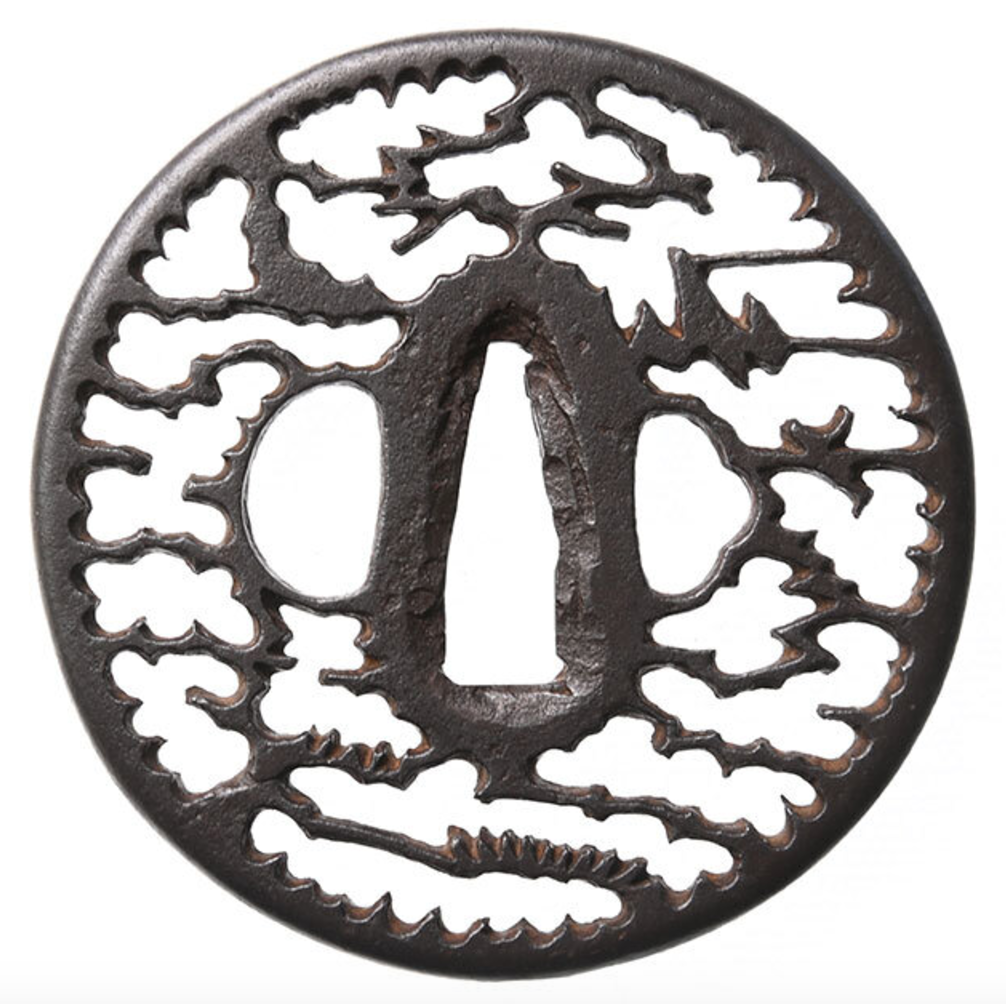
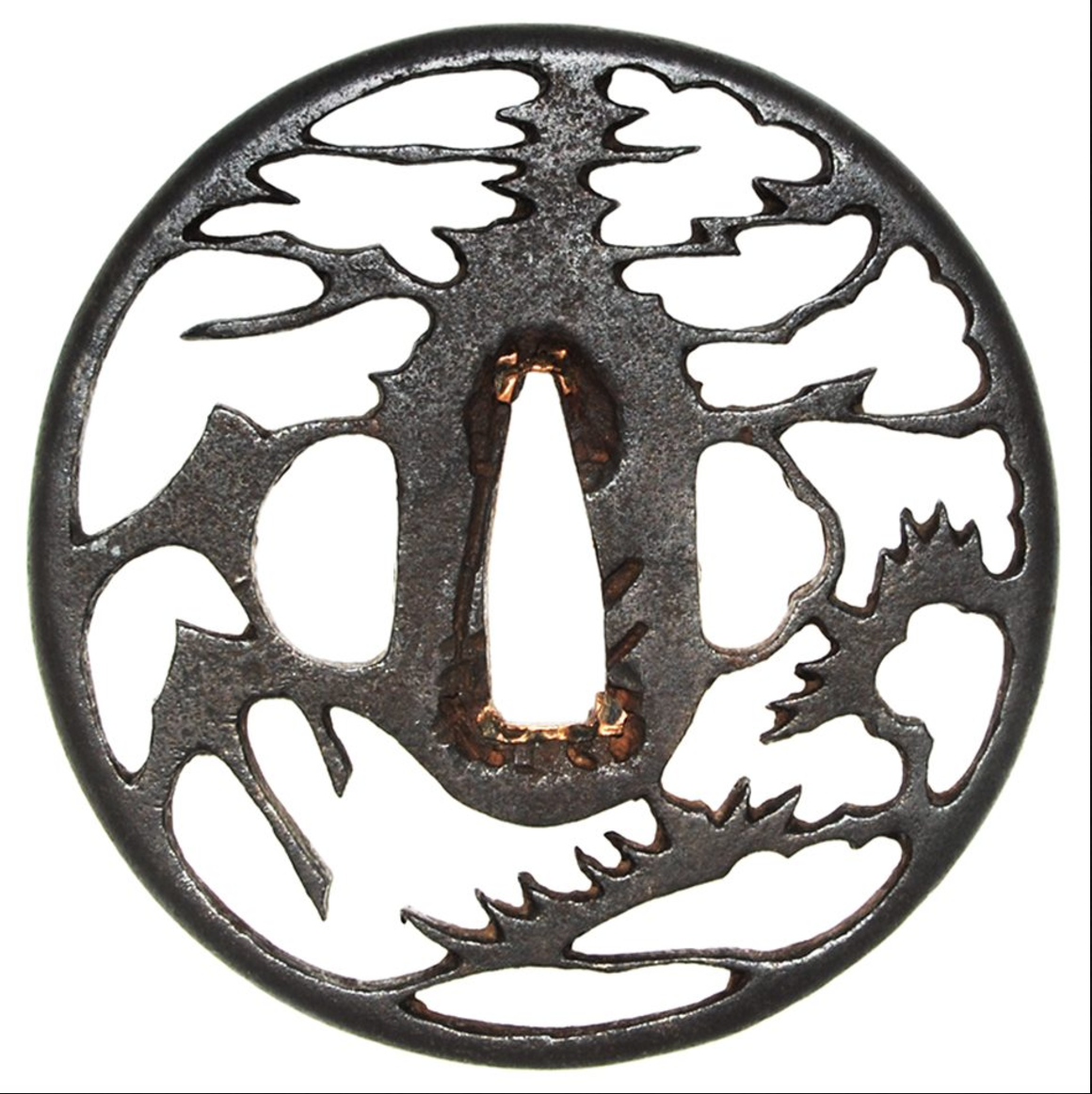
Very nice. I see that now. The reason I thought it might be Komorebi is because of the elements of the branches AND what looked like birds in the example on the left that Glen showed at two and three 'oclock.
-
I came upon this tsuba with composition that is described as rokugan (descending geese or geese alighting). Apparently there is a traditional Japanese hard candy with this name because it resembles descending geese. I think that it has some of the elements of komorebi. https://world.seiyud...m/product/tu-010415/


-
Itomaki-No-Tachi Koshirae (How do I match a tachi blade?)
Iaido dude replied to Iaido dude's topic in Nihonto
Thanks, Dee. I think that if I were inclined to invest in a sword for this koshirae, I would have a gengaito made to fit it. -
Itomaki-No-Tachi Koshirae (How do I match a tachi blade?)
Iaido dude replied to Iaido dude's topic in Nihonto
Here's another Jauce auction item with more historical significance and elaborate ceremonial grandeur. https://www.jauce.com/auction/1160871811 -
I started by calling it “generic Edo” for all of the reasons that you discussed. The size might suggest that it was made for wakizashi. The size and weight make it ideal for my practice iaito because I use a 30” blade that handles best with a smaller, but heavier tsuba mounted to shift the balance point closer to the tsuba. I can’t see putting a piece of high end art on my iaito, but the motif has to be meaningful. For $65 it was a good buy for my specific needs.
-
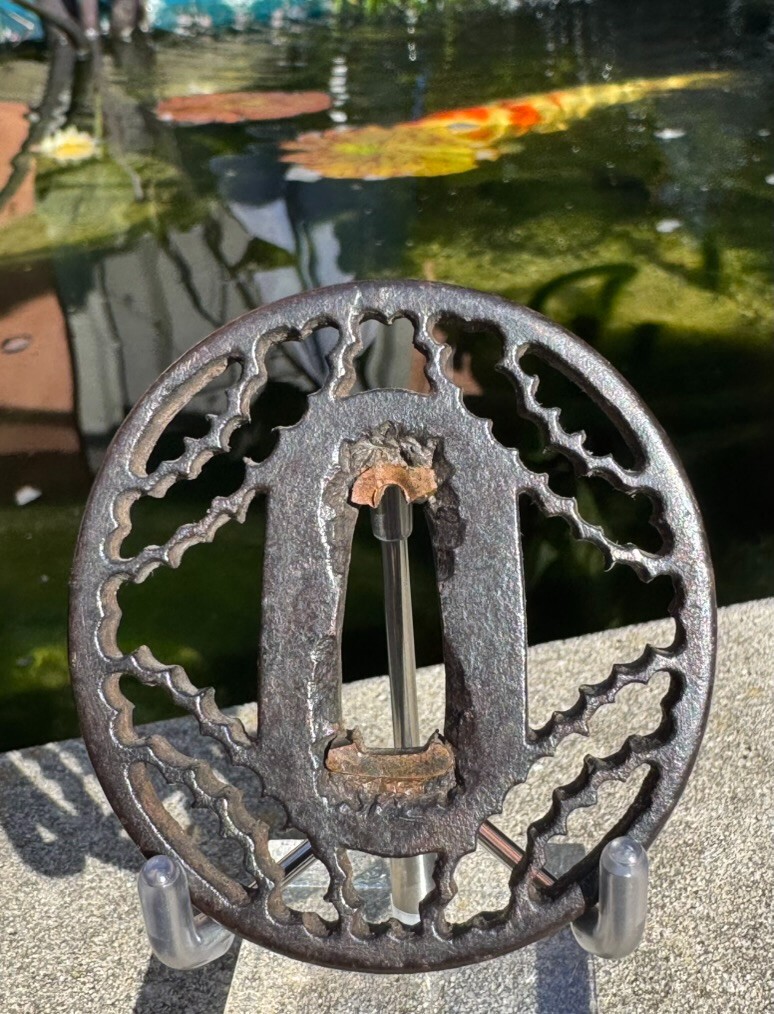
Very nice, Glen. I now "see the light" shining through the leaves. I hope that you and Bruce produce that paper on what is a sublime motif. What are your thoughts, though, on the guard I originally posed for this post? It is small and relatively thick, endowed with a large seppa-dai, and without tekkotsu it would appear. If not Akasaka, then which category does it resemble the most--fully acknowledging that it may have features of a number of styles? The "komorebi" 木漏れ日 appear not to follow rules of symmetry, which imbues them with a wonderful sense of organic movement, dynamism, and the beauty of the natural world.
-
Itomaki-No-Tachi Koshirae (How do I match a tachi blade?)
Iaido dude replied to Iaido dude's topic in Nihonto
Thanks, gentlemen. Mine is thought to be Showa era. It is a family heirloom. I just happened to stumble on that Aoi Art tachi kosirae while looking at tsuba. -
Itomaki-No-Tachi Koshirae (How do I match a tachi blade?)
Iaido dude replied to Iaido dude's topic in Nihonto
Yes, I agree with you Colin. It appears modern and with the same construction material and style as mine. I was surprised that the starting bid was so high. Could this really be the going rate? -
Itomaki-No-Tachi Koshirae (How do I match a tachi blade?)
Iaido dude replied to Iaido dude's topic in Nihonto
This tachi koshirae on Aoi Art auction is very similar to mine: https://sword-auctio...4270-tachi-koshirae/ -
Itomaki-No-Tachi Koshirae (How do I match a tachi blade?)
Iaido dude replied to Iaido dude's topic in Nihonto
Having a blade made to fit the koshirae seems to be quite doable, but I will sit tight for now. For $7K, I would sooner buy an excellent Nihonto katana or an important tsuba masterpiece from the Momoyama or Early Edo periods. I have seen this website before. Thanks for your help. -
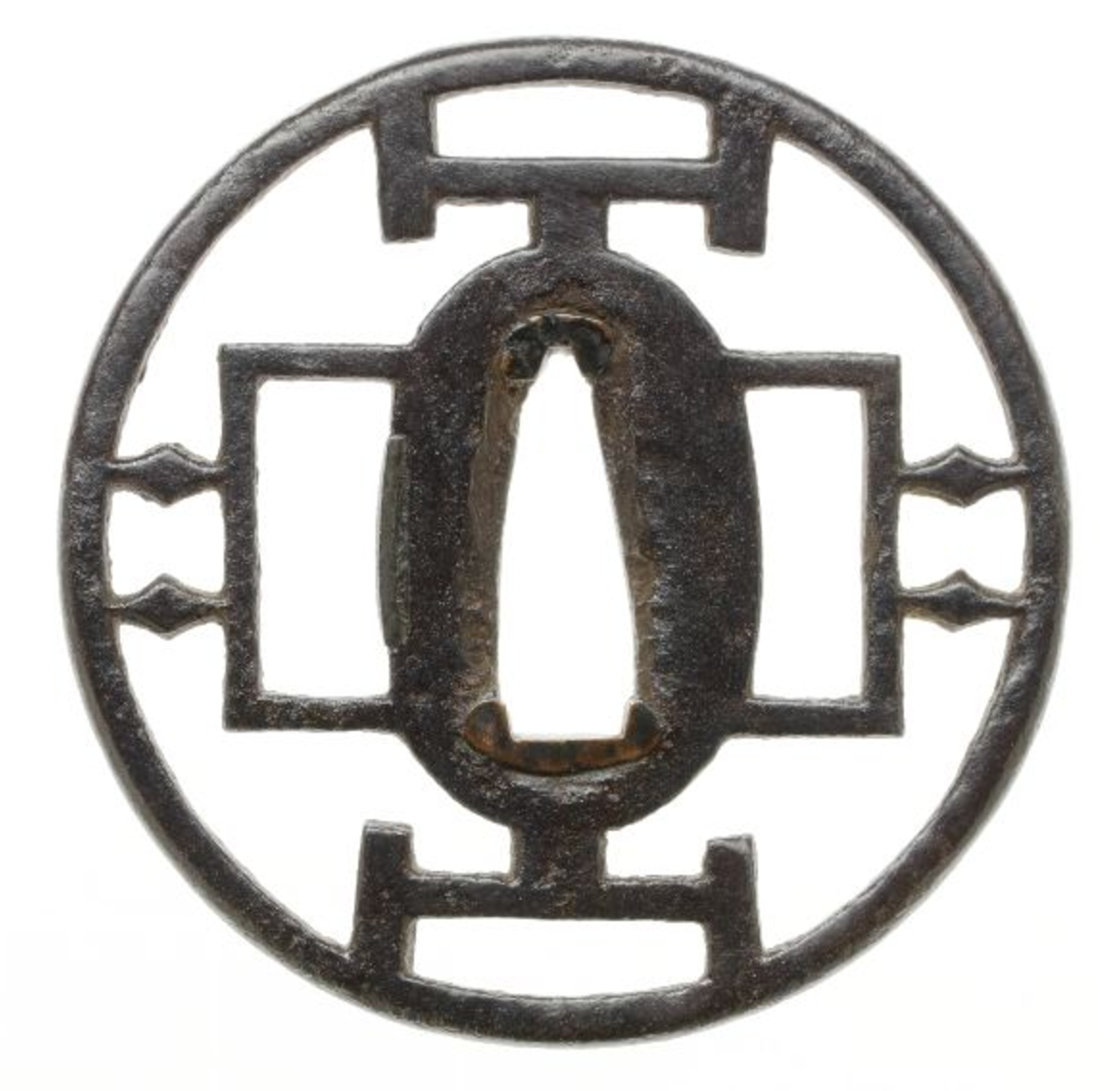
This style shows up quite frequently. I just never really understood the symbolism. My narrow collecting interest is tsuba with religious iconography. So, the shippo motif is definitely something to add.








.png.f0606ccc0b86718d8bcebfcc1ba47ad9.png)

.png.4e20283aee69c902cf8ca4b1084448ad.png)
.png.7d663df3f81afc09851ea93beeea3537.png)