George KN
-
Posts
256 -
Joined
-
Last visited
Content Type
Profiles
Forums
Events
Store
Downloads
Gallery
Everything posted by George KN
-
Need some expertise on blade.
George KN replied to Nazar's topic in General Nihonto Related Discussion
Unfortunately I agree with Chris and Lewis - the acid treatment is a big giveaway that it isn't genuine (you can even see it on the tang). Don't be disheartened though, quite a few of us began collecting properly after first buying a fake (including me!). You can't know what you don't yet know, and it's hard to find info on nihonto. Best of luck learning more, and never be afraid of asking us questions about a sword before buying Also, thank you for your service - while I'm nice and safe in the UK so it's easy for me to say, but what's happening in Ukraine both saddens and angers me deeply. Stay strong. -
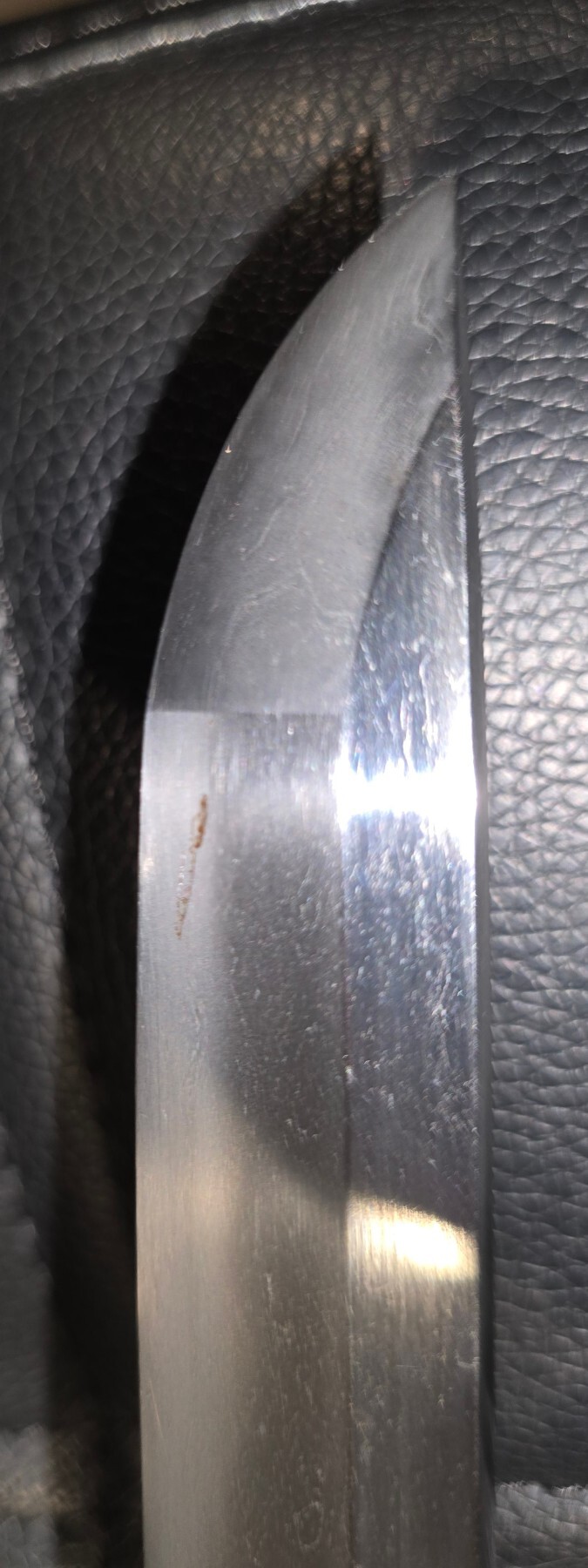
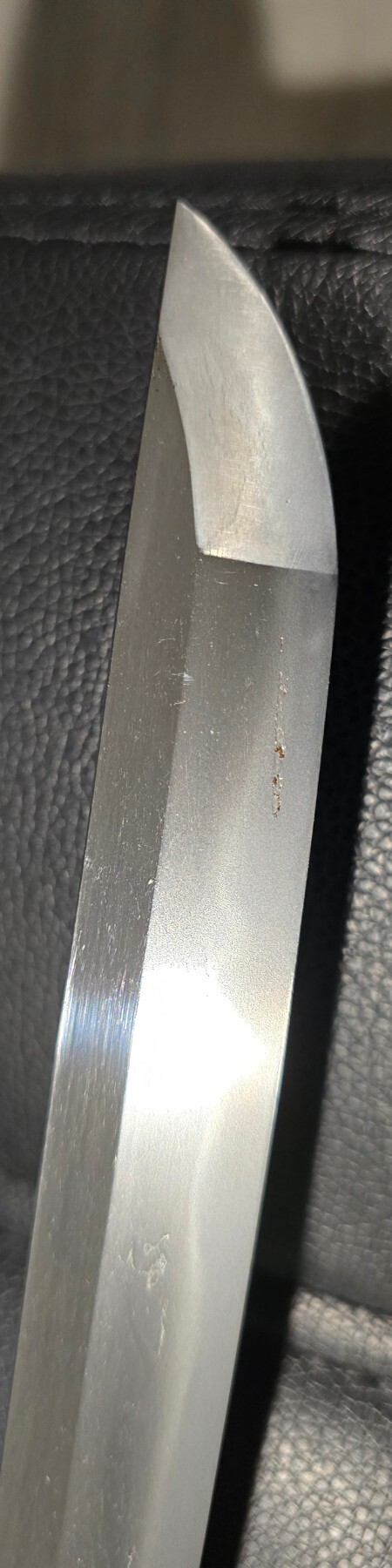
Dude, I've made my fair share of mistakes when trying to treat rust, but what on earth possessed you to clean the copper 😅... Do you just really not like patina? Fair play with the leather work though - as Bruce has said the same sorts of rules that apply to the metals don't to this, because it degrades so quickly. Similarly replacing the wooden mekugi peg if needed is also fine. And as for the steel, people have mentioned that what you've done is bad, but haven't explained why too well beyond you halving the value. I now have at least three blades which have been mucked about with, and learnt the hard way about it all. 1. Japanese swords last hundreds of years. They get past from owner to owner, generation to generation. If someone in that chain doesn't look after it well, and rust builds up, it will need to be polished. Polishing is a destructive action - it always removes steel from the blade, never adds it. Yes, you have removed the rust, but in doing so have likely removed more material than a traditional polish would, shortening the swords lifespan. The nakago (tang) is never traditionally polished, or else the mei (signature) would quickly disappear. As others have mentioned, removing the rust from the nakago also removes one of the easiest ways to help date a blade. 2. The other problem with using sandpaper and stones without knowing enough about Japanese swords is you'll likely have changed the geometry of the blade, rounding edges and divisions that shouldn't be. For example most nihonto aren't shaped like a knife with a razor edge, and instead have a rounded niku/profile like the below (A.) example (https://japaneseswordindex.com/niku.htm): This profile can be easily altered unknowingly with stones and belt sanders. Similarly, the yokote (the vertical dividing line between the kissaki (tip of the blade)) and the rest of it should be a sharp transition, as should the shinogi (ridge line) - these again will likely have been rounded more than normal (https://www.Japanese...dex.com/glossary.htm). They are possible for a professional to fix if there is enough meat on the blade, but doing so will mean even more of the steel will need to be removed than in a normal polish to do so, shortening the blades life further. 3. Using the wrong tools (sandpaper / non-traditional stones) can cause issues in the polish, even when it looks half decent. With the help of others on this forum, it turns out these white lines on my blade are likely from this: Similarly, an uneven polish can cause other issues, like possibly exposing darker core steel (which is what I think maybe happening in other places on this sword): So hopefully that explains a bit more? I'm hoping to explain not just to you @2FixandRepair but also all the people that may come and find this post on the forum through the in-built search or through Google in the future. I genuinely don't mean to come down hard on you, as I've done a whole bunch of mistakes on my journey, and information on the topic is genuinely quite hard to find outside this forum. You are now the guardian of that sword, and while the recent changes aren't ideal, I hope you'll look after it so it can continue its journey and keep writing its history. In the meantime, if you have the slightest interest in learning more, please stick around! There's so much to learn and if you've got the right mindset, it's really rewarding!
.thumb.jpg.0402434523d68f00091f750a2956a35f.jpg)

-
Always had good interactions with both @Scogg and @Bruce Pennington - two of the very few people I've actually directly messaged for help, and never seen a bad word from either - great recommendations
-
Thanks Jean and John, and I'm happy with even 2/3 right, that's awesome! Unfortunately I don't have better photos yet, hopefully the seller will get back to me with some.
-
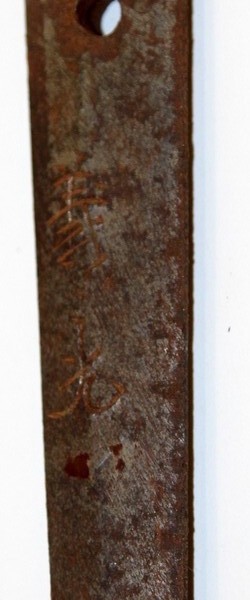
Finally got around to trying my hand at translating some mei using Sesko's Swordsmiths on some gunto. It's safe to say I now have a much greater appreciation of the mastery some of you guys have, it takes so long to do!! Any chance you could check my best guesses are correct please? 秀 Hide, Shu 宣 Nobu, Nori HIDENOBU (秀宣) Found a similar mei here: https://www.militaria.co.za/nmb/topic/4562-hidenobu/#comment-40614 (義) Yoshi (光) Mitsu, Hikari YOSHIMITSU (義光) Found a similar mei here: https://www.militaria.co.za/nmb/topic/50162-please-help-translate-this-one-got-me-stumped/#comment-522414 (一) Ichi (則) Nori - this took me *ages* to work out! Feels like its missing far too many vertical lines KAZUNORI (一則) Found another example here which helped confirm it: https://www.militaria.co.za/nmb/topic/47434-my-introduction-help-with-an-officer-sword-please/#comment-492709 Bonus question if anyone happens to know - I noticed the last sword, the Kazunori, is signed with a katana mei, but has a large seki stamp on it. It is also fitted in traditional nihonto (non-military) fittings but has a brown tassel which I read somewhere was for civilians, and a leather covered saya. Are these showato signed with a katana mei rarer? Thanks, George


-
Thought of new idea, electroforming of swords and knives
George KN replied to Mustafa Umut Sarac's topic in Nihonto
Ok, ignoring the way you just treated the administrator of the forum - Mustafa, yes, the idea of using electroforming to make a sword with the most efficient and or best combination of layers is pretty cool, and probably quite possible. But as Brian said, being a good cutter or an indestructible blade isn't what make nihonto special. It's not like we regularly use the swords for combat or regularly test them to destruction to see how well they perform. I think almost everyone here appreciates them for their art and/or for their history. Making the perfect sword, with the perfect hamon, in a way that can be repeated hundreds of thousands of times using an automated process goes against the whole point of artistic intent... -
Thought of new idea, electroforming of swords and knives
George KN replied to Mustafa Umut Sarac's topic in Nihonto
Wow - it's rare I see a comment on here that is just so offensive it becomes hilarious, but I think I've seen one today! -
I think you've probably hit the nail on the head Sam with them seemingly being easier pieces to collect. Still, commercially it seems odd - like I can see a future where as Gendaito/Shinsakuto are increasingly using modern tools and methods that WW2 Showato are once again accepted into Japan on mass, increasing their global value, but I can never see that happening with the type 95's due to their factory construction... Because of that too, it seems to be much harder to spot good fakes, and they do seem fairly prevalent. Don't get me wrong, the genuine articles are really cool pieces of history, and I want one for my own collection, it's just interesting that the market is developing in this way. Makes me wonder if some of the type 95 collectors will begin branching out into Nihonto more in the near future. That all being said, I do like Ray's example in the OP of this thread
-
^ Completely agree with this, it's bizarre! I also haven't been able to fathom it. Can anyone else?
-
Would you knowingly buy a gimei blade?
George KN replied to a topic in General Nihonto Related Discussion
Sorry Stephen, but I am going to chip in here, because I think it is important other voices are heard on this topic. I agree with @Hokke and @Natichu. The internet (and wider world) is a rather different place than it was 20 years ago - does it even matter if someone uses a different name, gender, or profile picture? Suppose for a brief moment that Dee is indeed Dee, what on earth does this make us all look like? This thread seems to have strayed from the normally friendly and educational environment I really like about this forum (Not to say that fraudulent selling isn't a big problem - it is, but such scrutiny shouldn't apply to people just being regular members of this forum IMHO) -
Giving a nihonto some use ?
George KN replied to Nicolas Maestre's topic in General Nihonto Related Discussion
These sorts of questions always remind me of this scene: https://youtube.com/shorts/NmwMwlhkmRY (but with nihonto instead 😄) -
Nice story about the return of a Katana
George KN replied to Brian's topic in General Nihonto Related Discussion
Thanks for sharing, great read -
Stolen sword : Your help is required ! (FOUND)
George KN replied to Tohagi's topic in General Nihonto Related Discussion
Sorry you had to go through all this, but at least the tanto has finally made it to its new home. I'd also still be livid - hope you can get some money back for the damage. -
Thanks Sean for the pics and measurements! It is then a wakizashi based on it's size, but also looks like the tsuba/guard (I'm still not sure what's most appropriate in this case!) has been there for a long while judging from the staining from the seppa. So I'm leaning towards that now being original to the rest of the koshirae. The sword is still a puzzle though. I can't see anything quite like this in my copy of Military Swords of Japan 1868-1945 - the fittings are halfway between a traditional nihonto and a police saber... But the nakago really does set the cat amongst the pigeons. It doesn't look like a recent fake or reproduction, but the start of the bo-hi (groove) is really odd. It almost looks like the steel has been folded back on itself and filled it in further down. Also very odd is the mekugi ana (hole for the mekugi peg) - the bo-hi goes around it? Almost like the ana was punched through afterwards with some force. I'm now on the fence about whether this blade is machine-made, or an older cut down nihonto that was fitted in a hurry into new mounts (such as during wartime)... Is there any sign of a hamon on the blade? And are there any markings anywhere? (such as on the mune / spine of the blade)
-
I was hoping more people would chip in on this thread, since it's an interesting sword! It actually almost looks long enough to be a katana... Have you been able to take the tsuka (handle) off by removing the mekugi peg? Having some pictures of the nakago (tang) would be really helpful in dating the blade. If the sharp part of the blade (measured from the back) is more than ~60cm it would be a katana. I really like the style of the fittings on this though - no menuki or wrap, very utilitarian, and very genuine. The only thing I'm not sure about is the tsuba/guard though. It looks like it has age, but it's very unusual. If it is original, then my guess was from the 1850s-1930s where Japan was westernising somewhat (Meiji period+ as John mentioned). It's a shame the blade has so many chips and scratches - looks like an amateur has mistreated it badly 😞 (a professional polisher may be able to salvage it though) It could be that the blade is much older than the other fittings - but without seeing the nakago it's impossible to tell.
-
These are both from the same sword of mine, the saya has what I think is likely a type of swallow: And the menuki possibly pairs of Ho-o / Phoenix (I can't find another bird with such a long tail - similar to this: https://daytonart.em...orm-of-a-hoo-phoenix). Alternatively I suppose they could be pheasants? (but not sure the tails quite fit): Bonus question, how can you tell if a menuki is gold leaf, gold plated, or solid gold whilst still on the tsuka? I do believe these are likely gilt, but not sure how I can confirm that.


-
Can't quite tell if this is sarcasm, but very glad I said something if not! The rust levels of the nakago are one of the most important ways of verifying a blades age, and removing it can easily reduce the value of the blade by half or more. From the new pictures this does look to be a rather decent old wakizashi in a bit of a rough condition. It's always hard to be certain (and I'm very much a beginner myself), but I'm leaning towards it being a Koto blade (pre 1596) - which is odd because the smiths linked before seem to be Shinto (1596-1780)... Perhaps my gut is wrong? Either way it is definitely worth treating with respect! The red rust spots on the blade are a concern. I would get some oil (my personal preference is gun oil) on the blade asap, let it sit for a few minutes and then rub it in with a microfiber cloth (Avoid cleaning the tang though ). After many repeat cycles of applying oil and drying for a few days, some of the lighter rust should flake off, and the rest begin turning black (stable rust). Please no sandpaper, stones etc. https://www.Japanese...rdindex.com/care.htm
-
Yes, it would likely be if it was original - so it makes me think the groove was added after the first shortening (but also before the current position of the habaki, because it goes under it)
-
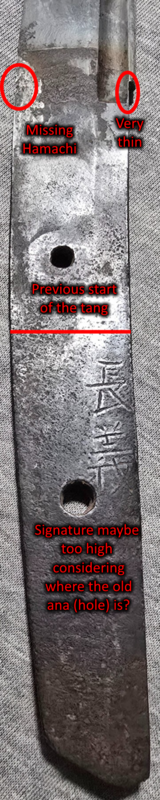
Thanks Nido for the extra pic! I think Jon said it best - this looks to be a rather tired old Wakizashi. It's probably not super valuable, but is very old, and has a lot to teach. I won't pass judgement on the signature/smith (that's beyond me) but here's my beginners thoughts on that latest image: I'm guessing somewhat here, but judging from the aging on the very bottom of the nakago, the general form of the blade, and it's thinness and current length, I would say this is from the Koto period or earlier: https://www.Japanese...index.com/period.htm (Please correct me guys if I'm obviously wrong, I'm still trying to learn myself!) The second ana/hole in the tang clearly shows it has been shortened (I have guesstimated where it used to start), and if you said the sharp part of the blade is currently 58.4 cm, this would have made it a katana back in the day. I'm thinking the current signature may well have been carved when the suriage/shortening happened - but whether it was copying an original signature I don't know. What is rather odd about this tang is the lack of the notch on the sharp part of the blade, the hamachi, as well as the fact that there is so little metal between the bohi/groove and the mune/back. This makes me think it has since been shortened again in a non-traditional manner fairly recently, but without creating a new ana. I'm wondering whether it was first shortened for something like the satsuma rebellion or ww2, and then the hamachi and mune ground down badly to fit the more modern koshirae or perhaps removed during a bad modern/non-traditional polish (hard to tell from just this image).
-
Hi Nido, welcome to the forum! Since nobody has replied on this thread yet, I think it's safe to say we need some better photos... To fit them within the forum's size limit you do often have to crop the excess space, and even then sometimes also reduce the quality a bit, but it is doable (I use paint dot net for this on my laptop). Better pictures of the nakago (tang) would in particular be super helpful. I'm not sure the spotlight is doing much good here - it can be a good technique for looking at micro-details like the hamon and hada of a blade, but it's made the rest of it so dark I can't really make anything out! I would say that it initially looks to be a genuine antique Japanese blade that was made before the war (probably a very long time before ) - although it does look in a bit of a rough shape.
-
I'm also fairly new to the Nihonto world, so can't pass much judgement on the finer points of the blade, but I would say it looks to me like a really nice mumei katana. I would also agree that the general form looks to be Shinto, and the rust levels on the nakago reinforce this - but I can't quite shake the feeling this could be o-suriage, where the entire original tang has been removed? It having been o-suriage would also explain the kiri cut (flat end to the tang - https://japaneseswor...com/terms/terms2.htm)... How long is the sharp part of the blade?
-
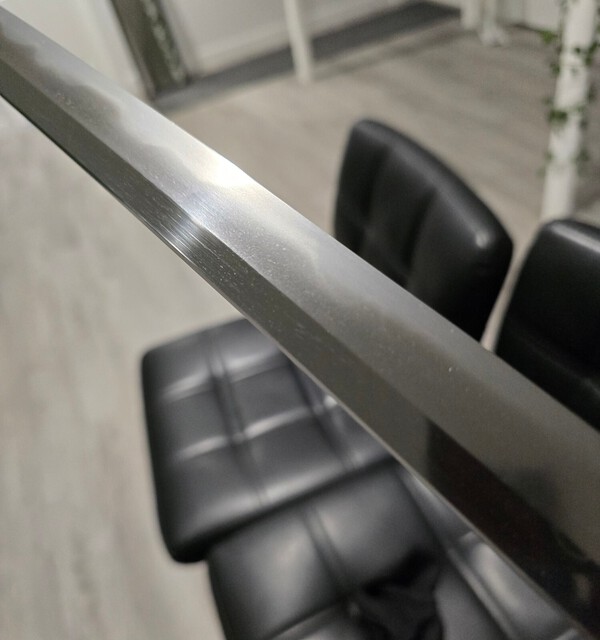
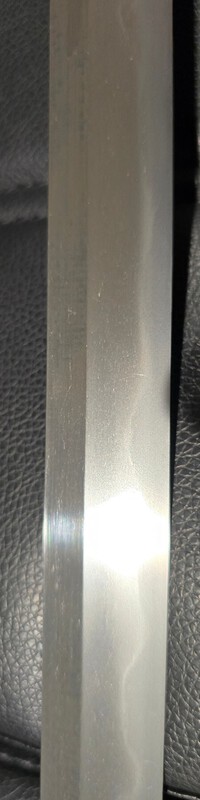
Hi Nick, welcome to the forum! I've taken the liberty of downloading and resizing your images - people never seem too keen on opening things up on external sites. Also as a bonus, when they're uploaded here they stay forever, making it much easier to do research in the future (the forum search is a wealth of information!):






-
If it is by Nobutaka there's a whole bunch of information from Stephen on this thread:
-
I'm not the person to say whether the signature is gimei or not, but it's not a case of whether it's the "real deal" or not - gimei signatures were added for a whole bunch of reasons, and not just on bad swords etc - you can get some really nice gimei blades! They also don't tend to negatively affect value - from my experience a gimei blade is generally worth as much as one that is mumei (unsigned). The important thing is that from the little we can see of the nakago (tang) it does look to be a genuine antique Japanese sword, and possibly with some very decent age It would be great to have more pictures of the blade and fittings though - having a few of the entire thing would be particularly helpful and might help us give a general date. (Removing the habaki (the copper collar) for this would also be useful) In the meantime please don't try removing any rust or cleaning the blade (especially not the tang!) And here's a site I found super useful when trying to learn more on the topic: https://www.Japanese...ndex.com/nihonto.htm
-
I like it! Reminds me of thorns. It's definitely been fitted to quite a few different swords judging by the nakago ana. It almost looks like there's two sekigane on the bottom of the ana too.

.jpg.43c899c97033baad9ca880ce1beaf999.jpg)