Mikaveli
-
Posts
358 -
Joined
-
Last visited
Content Type
Profiles
Forums
Events
Store
Downloads
Gallery
Everything posted by Mikaveli
-
Is sword collecting over?
Mikaveli replied to Peter Bleed's topic in General Nihonto Related Discussion
Lots of general negativity, which I don't think is entirely justified. People tend to assume any period of contraction or decline means something is dying... Also remember we're in somewhat of a cost of living crisis, and when younger people are struggling to afford homes, cars and life's necessities, swords (as with other hobbies) lose out - as they should. One indicator, is prices of swords - if there were no collectors, they'd get cheaper - much cheaper. Like any field of collecting, if people aren't buying, objects lose their value very quickly. Is that happening? -
This brings me back to the Naginata naoshi debate. It's not (always) clear whether a Naginata had to be reshaped, so I wonder if we're somewhat over interpreting 直し (なおし). Which literally translates to correction, mending, repair or rectification - Japanese has specific words for reshaping. So (only speculation) is it more accurate to think of Naoshi as meaning repurposing? After all, some of the Tachi that we regard as osuriage also had some reshaping work, but naoshi isn't used to describe it (hence my theory that it hasn't been repurposed).
-
So, after buying a few books to learn about Naginata and Naginata-naoshi, the Knutsen book on Japanese polearms mentions that at one point, repurposing yari (especially hira-zukuri) into tanto was fairly common. Now, I've seen plenty of Naginata-naoshi and Naginata-naoshi-zukuri, but don't recall ever seeing a Tanto being described in a similar way (former yari with shortened nakago etc). Does such a thing exist, or are they just described as suriage etc. (with or without mention of previously being a yari)?
-
Learn about condition/flaws, how to spot fakes (and common targets), and understand appraisal certificates/kanteisho and how much weight they carry would be a minimum foundation. Next, find some reputable dealers. Then, you just need to know your budget and what you like.
-
The gov site says: Checking the "if you need to make a customs declaration" site, it says "maybe" for both freight forwards and when travelling with the goods. 🤷
-
So, at least in the UK, the government allows individuals - I've just done my application, and will let you know the results: https://www.gov.uk/eori Previously, when dealing with Parcelforce and customs, their reference included an EORI number (I'm assuming Parcelforce's) - so it's not entirely new. Some Japanese sellers using private forwarders are saying I need one for the forwarder to be able to deliver. I don't know if that changes if I fly back with a purchase by myself, but I'm getting plugged in, in any case. 🙂
-
This link from the Southern California Naginata Federation states: Doesn't cite a reference or source, but makes another thread of inquiry.
-
Good luck 💪 I'm very confident that the signature is genuine, so hopefully no condition issues that would prevent getting it papered.
-
Thanks - any time. 🙂 Is this a sword you've purchased (or one you're considering)?
-
Notice on the Facebook
Mikaveli replied to yurie's topic in Sword Shows, Events, Community News and Legislation Issues
Thanks for the notice. I'll do my best to attend next week. -
Ura mentions made in Kuwana, I believe (but I don't recognise all the Kanji). Ah, 善定 (Zenjo) 作 (saku - made/work of)
-
Mei is Tanba no Kami Fujiwara Terukado
-
Transition from koto to shinto periods
Mikaveli replied to Mikaveli's topic in General Nihonto Related Discussion
There's been nothing wrong with any of your contributions - all interesting, with several points to consider. Yes, across that period is definitely in scope for this thread. Especially examples, dates events etc. For example, when someone mentions Kanbun, I have a fairly clear image - but I just kinda take the dates for granted. 😅 It's all small details, but an example of "here's one of the earliest examples of Kanbun" (or whatever feature, style, etc.) to plot the transition into the period where some of the generalisations hold more true. -
I found a few blogs etc. that say late Edo onwards - but not why (or any sources). Others said post Meiji sword ban, but likewise. Interesting question, as it's certainly something I just took for granted 😅
-
Transition from koto to shinto periods
Mikaveli replied to Mikaveli's topic in General Nihonto Related Discussion
Who was it that said, if you don't understand something well enough to explain it simply... Instead it's just the parroting of conventional opinion, not backed up with substance. Just an appeal to tradition and some mystical quality that just isn't measurable. You often encounter the same attitudes in martial arts, each convinced that their style holds the most effective technique, just never proven and somehow imperceptible to anyone who hasn't spent 60 years practicing their "2000 year old" art. -
Interesting reading. In Sesko's index, all three of the Kado 門... smiths are listed as also being quoted as Hiro... Mon is obviously the most common reading (in general Japanese), followed by Kado then To. I've also encountered Men and Ne as irregular/ one off readings. Would be very interested in learning anything of the original of the Hiro reading?
-
Transition from koto to shinto periods
Mikaveli replied to Mikaveli's topic in General Nihonto Related Discussion
Welcome to the forum. 🙂 It's a little off topic for this thread, but your best bet is to create a new topic, along with a picture of the blade / kizu (as how it's been described, verses how it might be evaluated may differ). -
Transition from koto to shinto periods
Mikaveli replied to Mikaveli's topic in General Nihonto Related Discussion
Proof by meme, must be true then... 😂 It's fine to have an opinion, but there should be some basis in verifiable facts (especially when asserted as a statement). Anyone can have a favourite den, school or smith - that's personal choice, but getting into the "better" classification, you need to cite how. Are Italian cars best? Fastest, most reliable, best overall value, quietest, least polluting, most innovative, successful in racing etc. At least with Iaido guys, there's some objective testing with verifiable results. But it still becomes subjective - the light sword is quicker, easier to handle, stout swords more robust, thin sword better for slicing soft objects etc. What's the criteria being judged? Like the car example, are we judging American cars against the Fiat or Ferrari? Shinto is what, 180-200 years at most. Shinshinto 100 years. Then factoring demand, and surviving works along side the available time periods, are we comparing average works, the tenth percentile, best ever? Still comes back to agreeing the criteria by which quality is judged, which again, is subjective... -
Transition from koto to shinto periods
Mikaveli replied to Mikaveli's topic in General Nihonto Related Discussion
I think in Sesko's history of the Shito era, he suggests a later start date (from c. 1624) before what he cited as a noticeable change in the jigane and sugata. There's lots of talk about whether the koto/shinto dividing line was chosen to align to political eras. Whatever the original thinking, I think it's healthier to think of the transition as less Boolean. -
Transition from koto to shinto periods
Mikaveli replied to Mikaveli's topic in General Nihonto Related Discussion
Shots fired... 😂 No, we don't know that. Lacking in prestige, perhaps - but there are several factors that influence the perception on Mino-to. Being newest, association with mass production etc. along with general focus on practical use, rather than decoration. Is there any objective data, showing which den produced "better" swords? Sharper, more resilient edges, less prone to breaking etc. Very little that I've seen. Conversely, the availability of quality steel improved, as did the knowledge and technology of forging (as this thread began with) and construction techniques. The presence of certain hataraki doesn't necessarily denote quality (which effects were intended versus consequentially etc.). The lense of the modern art sword collector is but one, very subjective lense (with a great deal owing to tradition and bias). -
Transition from koto to shinto periods
Mikaveli replied to Mikaveli's topic in General Nihonto Related Discussion
So, from what I've read, by the 18th / 19th century, the Chugoku region (a big chunk of western Japan) eventually peaked at around 80% of domestic steel production. But, that's at its peak. Regional decline in steelmaking started around the 11th century. And at least by the start of the Edo period, there were still several hundred furnaces spread across Japan (with more than 100 from the Chugoku region). So, more centralised, yes - but there were still at least a dozen steel making prefectures spanning the entirety on Honshu. You'd imagine swordsmiths had some degree of choice in materials - as much of the steel was transported. In any case, the picture it paints, is a progressive reduction in steelmaking distribution, over the course of half a millennia - and whilst by the end of the Edo period, one region was dominating - this wasn't the case at the start - and there had been a similar progression towards centralisation starting centuries before that.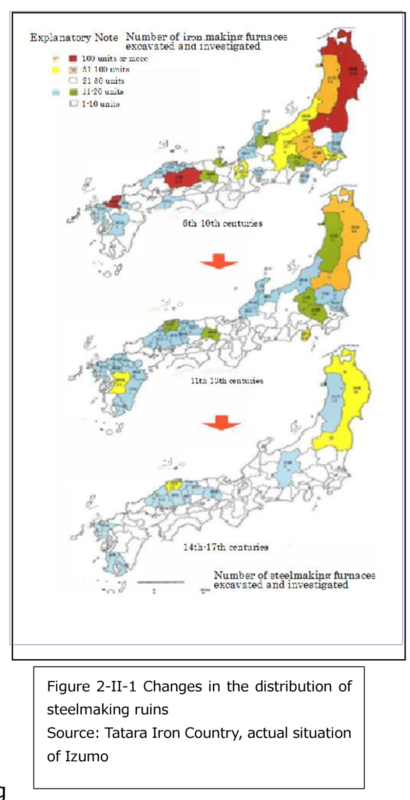
-
Transition from koto to shinto periods
Mikaveli replied to Mikaveli's topic in General Nihonto Related Discussion
I wondered this too - things like construction (kobuse, sanmai etc.) together with folding/hada style, selection of materials and carbon content and impurities retained in the process. Likewise, when people talk about steel production being centralised - how centralised? I'm assuming all production wouldn't have all come from a single source, and even if at one point, a smith managed the whole life cycle, there should be a progression towards more centralisation? Smiths, then schools, then cities, then regions, before national. Was there ever a period where steel cam from a single source in Japan? -
I don't think this is a case of confusion, just that people place too much emphasis on the koto / Shinto grouping (labels). It's not like sword making changed over night - it's more of a 50-150 year range before the groups become more distinct, but even then...
-
Transition from koto to shinto periods
Mikaveli replied to Mikaveli's topic in General Nihonto Related Discussion
The article cites Ohashi Iron Mine in Kamaishi as the source for that blast furnace - https://d-arch.ide.go.jp/je_archive/english/society/wp_je_unu8.html Assuming that's not sand iron (and would be suitable)? -
Transition from koto to shinto periods
Mikaveli replied to Mikaveli's topic in General Nihonto Related Discussion
Just to start to build a timeline (more to add later) I'd really like any more examples and events between 1543 and 1691. --- 1543 - Portuguese ship in Tanegashima, foreign influence on gun / steel making begins. 1607 - Teppo-ki (Accounts on guns) written, widening influence. 1691 - Tembin fuigo (balance bellows) believed to be invented, halving manpower requirement. 1858 - first western style blast furnace built in Japan (end of Tatara iron making). 1901 - state run Yawata Steel Works opens, importing of coal and iron ore begins.