Veli
-
Posts
497 -
Joined
-
Last visited
-
Days Won
1
Content Type
Profiles
Forums
Events
Store
Downloads
Gallery
Everything posted by Veli
-

OK Very Nice Blade at a bargain price?
Veli replied to Stegel's topic in Auctions and Online Sales or Sellers
Just a wild guess, but to my unexperienced eye this looks like a shinshinto utsushi of a Yamato Hosho tanto, with a deliberately aged nakago. Still a better deal than many other Ebay blades... Veli -
An interesting Waki to discuss
Veli replied to KORSH's topic in Auctions and Online Sales or Sellers
The NBTHK paper attributes it to Uda school. Thus I think it is sue-koto. Veli -
Great! We are looking forward to seeing the new pictures of the blade! There is another method you could try for removing the habaki, but it is somewhat time-consuming: http://www.militaria.co.za/nmb/viewtopic.php?f=1&t=6651&p=52429&hilit=stuck+habaki#p52429 It sounds, however, that the habaki is really badly stuck, so letting the polisher take it off is not a bad idea... Veli
-
It would be safest not to soak the patinated part of the nakago in oils containing unknown chemicals that prevent/passivate rust. Veli
-
I just started reading "The Art of the Japanese Sword" by Yoshihara and Kapp. I liked the inertia-based method they proposed for stuck habaki removal: This should work well for a heavy solid silver habaki. Veli

-
...and the papers arrived in Finland on Thursday! Thank you! Veli
-
Please correct me if I made some kind of a mistake, but I just wanted to state a fact that seemed obvious to me: a blade attributed to Gassan Sadayoshi school cannot be from the 18th century (=1701-1800) if the attribution is correct, and I would be inclined to trust Fujishiro papers... BR, Veli
-
Christian, Most certainly the Gassan school was active during koto period, but if I have understood correctly, during the 18th century it did not exist until revived by Gassan Sadayoshi in the early 19th century... BR, Veli
-
Steve, Your blade was attributed to Gassan Sadayoshi "family" (school), thus it originates from the first half of the 19th century. Veli
-
Nice sword indeed! But if I have understood correctly, it cannot be from the 18th century if it is Gassan school... BR, Veli
-
Hello Dimitri! I would call that shobu zukuri, but then I am no expert... could be a shortened nagamaki. http://www.ksky.ne.jp/~sumie99/Shikkake.html Very nice wakizashi! The hamon looks almost hitatsura to me. The polish appears a little mirror-like in the pictures, and hada is not visible in the photos, as you said, but that's probably just the photograph effect. What is the hada like? Any masame? BR, Veli
-
That specific Yoshi-kanji in "Muneyoshi" was only used by Harima province Muneyoshi lineage of smiths. Shinto to Shinshinto. Veli
-
Hi Max! Looks like Muneyoshi 宗榮 BR, Veli
-
Christian, I agree with you that I think this is not signed by the shodai. But, without seeing the references for nidai and sandai, I would greatly hesitate to call this gimei; the mei is has some similar characteristics and has correct placement in respect to mekugiana; nakago jiri, maybe even yakiba seem right. Do you have any examples of nidai/sandai signatures? They would greatly benefit this discussion. BR, Veli
-
And your analysis is based on...? Veli
-
Hello Brian! Nice wakizashi! Do you have a sword maintenance kit with an uchiko ball? There seems not to be any deep rust, so cleaning the blade repeatedly but gently with uchiko might make the hamon a bit more visible. Please be careful with your fingers, it is easy to cut oneself when wiping the uchiko off. There are subtle but significant differences in the signature when compared to the 1st generation Yasuhiro (all the links given are examples of the 1st. gen.), but there were also 2nd and 3rd generations, so I wonder if this could be a blade by either of them. Unfortunately I cannot find oshigata for the later generations. BR, Veli

-
I do not think the elongated iron object in the pictures has any kind of hamon. It looks like having a chemical surface treatment to generate an undulating discoloration, aiming at deception. The shape is all wrong, the steel looks all wrong, there's no real hamon that I can see, I do not even think its Japanese... Please keep studying good blades, as adviced... BR, Veli
-
Jag, Although it is advisable to learn first and buy afterwards, I think you should be credited for proposing a nice quality blade from a reputable dealer as your first purchase. Veli
-
If you check here http://www.aoi-art.com/sword/katana/12148-4.jpg and scroll down, you should see what I mean. Nothing to do with maintenance nor Hamon. I would not say the blade is tired, this is just the effect of the thin kawagane in Hizen blades. It is still an admirable blade! Please correct me if I am wrong... BR, Veli
-
I guess you are considering this blade: http://www.aoi-art.com/sword/katana/12148.html 1) NBTHK Hozon papers for a signed blade are very, very reliable. 2) £4k for an unshortened Hizen Yukihiro Katana in koshirae sounds like a bargain. Please note, however, that there is shintetsu (core steel) showing, which is typical for Hizen blades that have been polished several times. This, I guess, explains the lower price. 3) Any investment is risky. Normally I estimate getting 75% of the investment back if I have to sell, provided I did well when purchasing. 4) You need to prove the age of the blade to the customs; AOI Art estimation paper might do the job. UK members know more. 5) I have only positive experience with Tsuruta-san. Martin: "Not a Scoobie m8!" ??? I am not that good in English, please explain... Veli
-
Yes, Ishido Mitsunobu (kao)... http://home.earthlink.net/~steinrl/teruhide.htm Veli
-
1) If you someday can supply more photos, we'd be delighted! Maybe doing the recommended gentle blade maintenance with oil and uchiko will remove some accumulated dirt from the surface and allow us to see some of the hamon... Anyway, this discussion has been a pleasure after several threads where people tried to find the ugliest possible Chinese fakes on Ebay 2) So you would not be happy with the shirasaya alone (that is made as a part of the polishing project) ? Having a koshirae made for your blade will be very costly, and the saya would probably need remaking/cleaning after the blade has been polished. 3) You can find a list of recommended books in here: http://www.nihontomessageboard.com/faq.html 4) Some discussion about high-level polish: http://www.militaria.co.za/nmb/viewtopic.php?f=1&t=8324&p=68345&hilit=benson+bowhay+polish#p68345 6) There are some experts (like Bob Benson) in the U.S. capable of giving a much more reliable estimate about the authenticity of your blade, if they could see it in hand. But the NBTHK or NTHK or NTHK NPO shinsa is the only way that practically leaves no room for doubt or dispute whether your blade is shoshin or not. But if the blade will be sent to Japan for restoration, shinsa would not be a problem. There are also shinsas in the U.S. once or twice a year. I do not know if this has occurred to you, but the timespan of a high-level restoration project and consequent shinsa submittal is measured in years, not in months. So please take all the time you need to think about it! BR, Veli
-
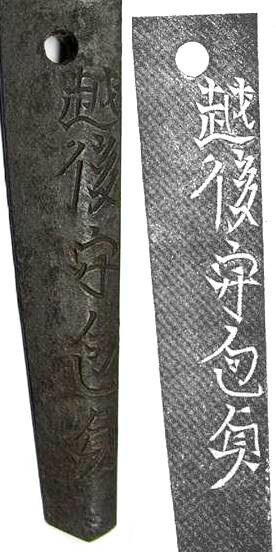
The mei (signature), mekugi-ana (peg hole) placement, nakago jiri (tang end) shape, overall shape, gunome midare hamon, none of them seem to significantly differ from the examples we can find for the 2nd generation Echigo no Kami Kanesada/Sakakura Gonnoshin Terukane. I am not an expert, and even experts cannot say anything definite from photos alone, but please treat this blade like it was an authentic Nidai Kanesada blade, until you get further proof. If it is genuine, it is an irreplaceable piece of art made by one of the great masters of the late 17th c. All the damage to the tip and cutting edge might well be restorable by a polisher who has received proper training in Japan. Here's what your blade might look like if would be genuine and in full polish http://www.choshuya.co.jp/1/0806/member_frame_sword.htm (Scroll down to number 12/page 20) http://www.sanmei.com/contents/media/A68500_W7000_PUP_E.htm Veli
-
This mei matches the nidai Kanesada/Terukane very closely. And that's a big name! More pictures of the blade, please!!! Veli