Mushin
-
Posts
214 -
Joined
-
Last visited
-
Days Won
5
Content Type
Profiles
Forums
Events
Store
Downloads
Gallery
Everything posted by Mushin
-
 Jacques, with all due respect, Darcy had access to the upper crust of the Honbu and was extremely close with Tanobe-sensei, who indeed has immense firsthand experience with shinsa, as well as all the quirks and inner workings of the organization. What Darcy was passing on to us in terms we could grasp is what he learned, what he saw and what he heard from reliable insiders. You don't have to believe it yourself, but unless you can disprove what he is saying with facts, which I have not seen from you on the subject, the observation seems logical if not perhaps a bit oversimplified. I appreciate your experience and many of your observations. They are often thought provoking and very right-brain observant. Any perspective that challenges me to question my own, I think, is a good thing. But denying a line of thinking just to deny it doesn't make you smart, it just makes you a contrarian.
 -
Coming back to the subject at hand, a work by Shikkake Norinaga: If I were you, Dennis, my goal would be to study the stuffing out of your blade, enjoy it for all it’s worth, and, if you really really love it, start thinking about an eventual upgrade — either to a longer blade, a signed example, or (my preference) a signed ubu piece of equal or better quality. Looking at Jussi’s database, there are enough zaimei Norinaga examples out there that, given time, you should be able to find one with workmanship as good as — if not better than — yours, with the added benefit of a mei. Whenever possible, I strive to collect signed pieces of the best quality that I can afford. Not that I have anything against mumei blades. On the contrary, two of my favorite pieces are unsigned works whose beauty is enough to bring me to tears. But there is something about a signed ubu work that moves and comforts me, and whenever possible I strive for these as long as the work is good. (Please don't just buy signatures or papers; the quality should be there!) Of course, sometimes it's simply not feasible to buy great swords with nice work and a signature — either because zaimei examples are rare, or because the ones available would require selling your house and several family members (which I do not recommend). But if you’re patient and vigilant, I’m confident you’ll eventually be able to trade up to a zaimei Norinaga — cashing out the blade you have and covering what will likely be a reasonable difference. The good thing about a smith like Norinaga is that while he’s very good and highly respected, he’s not on the level of a Mitsutada, Samonji, Norishige, one of the Awataguchi masters or other renowned famous makers. That makes upgrading a realistic and worthwhile goal IMHO. Ultimately, upgrading our collections when feasible is something we should all strive for, while being sure to fully enjoy what we already are looking after. It’s a noble balancing act.
-
I am not convinced there is a critical mass of top-class blades out "there" just waiting to be submitted to shinsa or make their way to the marketplace. No doubt there are likely some, but I think the number is small and for good reason. Over the last decade, an enormous number of swords by or attributed to top-ranked smiths have been vacuumed out of the marketplace and from private holdings by mega-collectors with extremely deep pockets—people like Sawaguchi and Touken Corp. One has to wonder what’s really left. A decade ago, you could log onto Japanese dealer sites—from the most exclusive to the most accessible—and see fresh, jaw-dropping pieces appear almost daily. Now? Many of those same dealers update their listings once a month, if that, and few of the swords they post have the same power to keep lustful collectors up at night. There have been other threads on this board commenting on how great swords too often seem only to get offered privately to top clients, leaving mere mortals like us in the dust. And yes, the very best swords have always bypassed the open market, going straight to well-heeled collectors. But there used to be enough great pieces circulating that a good number would make their way to dealers, giving at least the illusion of an egalitarian marketplace—where anyone with the funds had a shot at a top-tier sword. Today, that feels far less true. As an obsessive site-surfer, I see fewer outstanding blades being offered publicly. Sure, good swords still appear now and then, but they’re exceptions rather than the rule. You hear rumors of the occasional masterpiece turning up in a farmhouse rafters, but I have never seen one. So, what’s mostly left? As Darcy once called them, “commercial grade” swords: average-to-above-average late Muromachi, Shintō, and Shinshintō pieces. That's what I mostly see these days. I think when dealers do get good/great works today they hold them back for the DTI, and even then, a decade’s worth of DTI catalogues shows a noticeable decline in both quality and rarity. It's just the reality that I see. What I wonder is will it ever return to the way it was? For most of the 20th century, top blades moved through the market as collections turned over with each new generation. But some collector-dealer friends now fear that tradition is also gone. My friends think that the new mega-collectors who’ve vacuumed up the most coveted pieces may hold them for decades, locking them away from the market entirely. I am hopeful that this won't prove to be true, but the evidence does seem to suggest the days of milk and honey may be behind us.
-
Thanks for sharing. I get it as well. Sentimental value can't be discounted. There are some pieces in my collection that really don't fit anymore and logic dictates I should sell them to replenish the sword kitty. But I just can't bring myself to find them a new home because they carry memories.
-
On the edge of my seat, Alex: what was his answer?
-
Here you go. Interesting: from a quick analysis of the small data set of Norinaga tanto that Jussi compiled there is amazing consistency of dimensions and traits of Norinaga school tanto over a century. They seem to be slightly shorter at the end of the Kamakura, obviously extended a bit during the Nanbokucho and shrank some heading into the Muromachi. But the dimensional proportions and length to width ratios remained constant. They were also all muzori, which shows a consistency in the school that I thought was very interesting. However, this is a study of only 17 samples (mumei and zamei) and any conclusions from limited data analysis should be taken with a box of salt.

-
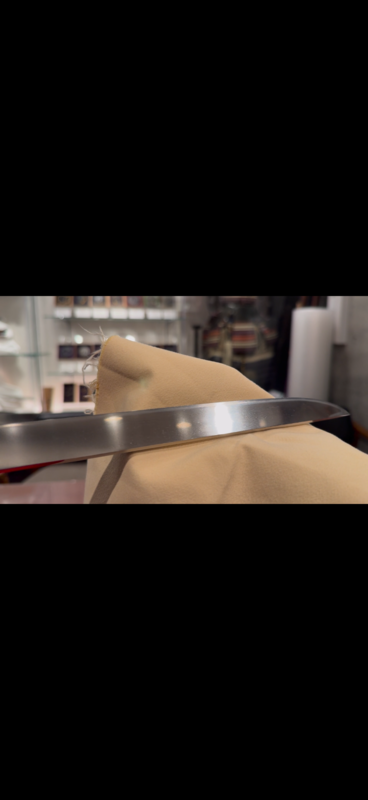
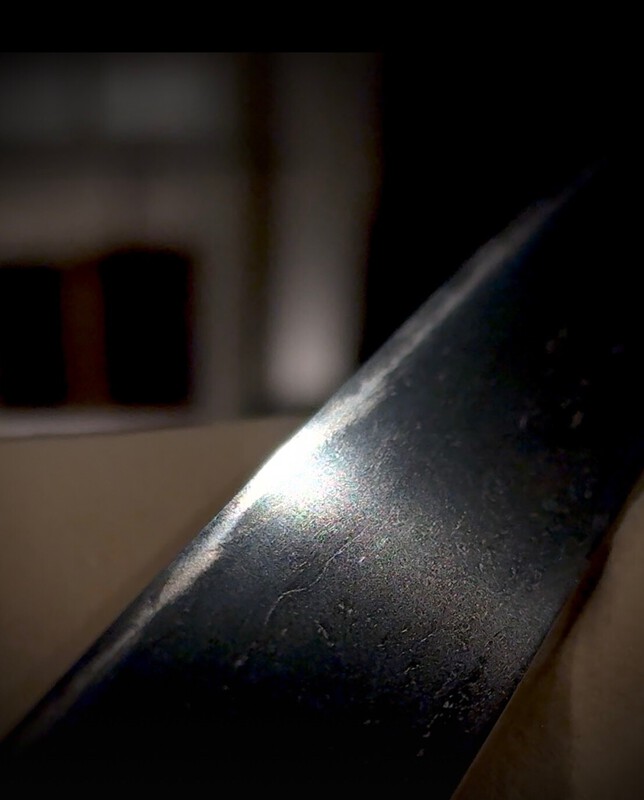
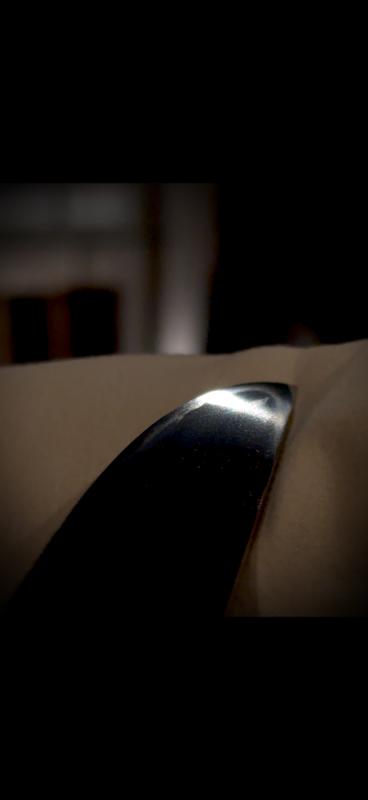
Dennis, I agree with those telling you not to get caught up in obsessing over generational differences. I often need to heed my own advice, but, as Hoshi has pointed out, it’s pointless to stress about such things. With mumei blades it’s easy to worry about the strength of the attribution or the subtle differences with signed pieces. And with zaimei works you can easily get lost wondering about which generation forged it. Case in point: Pictures below are of a zaimei Shikkake Norinaga tanto I recently purchased. It has Hozon papers, which in and of itself doesn’t necessarily mean much, and it was listed as Kodai Norinaga. Tanobe’s sayagaki gives the time of manufacture from the end of the Nanbokucho to Oei. Once upon a time it might have been attributed to the work of the Nidai or the Sandai. Indeed, the dealer who originally listed the sword said it was the work of the Nidai. But as recent scholarship started questioning the generations’ work periods, Tanobe and the NBTHK started assigning blades to likely time of manufacture, rather than generations of smiths. This is especially true when it’s not a slam dunk for a particular generation. You see this in Nobukuni and Hasebe attributions as well these days. I bought this piece is for serval reasons, including: 1) I am a tanto collector and zaimei Yamato tanto are not common, even Norinaga, which according to Jussi’s research, has 14 zaimei tanto (more than most Yamato smiths but still not many,) seven of which are Juyo from different era. 2) The sugata is lovely to my eye and the length at 29.2cm is sweet. 3) While there are some coarse areas on the ji from many polishes, the activity in the hamon is still wonderful and better than most Kodai blades I have seen, on a par with many of the Juyo examples. 4) It was relatively inexpensive with koshirae, always a nice extra. The key to all of this is that I liked the work. It’s better than most I have seen for sale over the years, and the price was right. And I got to study a new smith and school from a fascinating period of Japanese history. That is ultimately why most of us are in the hobby. The market does what the market does, and smiths fall in and out of favor. All that matters is that you like it. I think yours fits within the work of the Shodai, but even it is by another hand, it’s still lovely.





-
As my Shinto collecting days are behind me thanks to the evil influences of some friends and dealers who must have pegged me as Koto sword snob in the making, I'm selling some of my best books on Shinto smiths for those of you out there with better friends! (LOL!) Seriously, these are great books in great condition and not easy to find. So, if you're a Horikawa Kunihiro or Kotetsu fan these are for you. The Fujishiro book is also excellent and because of the photos, making it in some ways better then his Toko Jiten when it comes to identifying Shinto works. Please reach out to me here if any or all them hold any interest to you, or if you have any questions. Thanks! Bobby 1) Kotetsu Taikan by Homma & Sato, 1974. Clothbound w/slipcase, 10 ¼ x 14 ½”, 515 pages in Japanese. Photographs and oshigata of swords, tsuba, and armor. It’s a comprehensive examination of the work and signatures of one of Nihonto’s greatest masters. The book is in excellent condition. 9 pounds, 11 ounces. $175 plus shipping cost. 2) Kunihiro Taikan by Dr. Homma and the NBTHK, 1954. Clothbound w/ dust jacket and slipcase, 10 1/2 x 14 1/2″, about 40 pages, mostly text with some oshigata, followed by 106 pages of crisp photographic plates. It’s a 250 page book in Japanese. The importance of Kunihiro and his school cannot be understated and this is one of the canonical works on the Horikawa school by the greatest Japanese scholar of the 20th Century. This book is one of the earliest of the great taikans and is quite rare. The dust jacket is torn but well-taped. Otherwise it is in great condition. 4 pounds, 13 ounces. $725 plus shipping. 3) Shinto Shu by Fujishiro, 1971. Clothbound w/plastic dust jacket and slipcase, 7 1/2 x 10 1/2″, 223 pages in Japanese. Hundreds of wonderful phots and oshigata of important Shinto smiths. Great companion volume to Fujishiro’s Nihon Toko Jiten. $120 plus shipping.
-
Amen to that!
-
Impressive. Invaluable. Important. Incredible. Thank you.
-
Mandarin Mansion - experience to share?
Mushin replied to omgPirates's topic in Auctions and Online Sales or Sellers
Not wanting to further stray off topic here, but regarding dealers and Jacques' "mantra," it's not always possible to see a sword in hand. In places with no shows or local dealers, the internet is the only place for many to see and purchase swords. But Jacques is correct that a photo is often not enough. So, please be sure that when you buy online you have a minimum three-day inspection period to make sure that what you saw is what you got, and that it is what you wanted. If you don't you should be able to get a full refund, minus the postage to get the piece back. Most reputable dealers will do this. Yahoo and Ebay auction site holders as a general rule do not. So, as in all things, caveat emptor! -
Pierre, Thanks for sharing. Not a very Sue Soshu nakago shape for that period of time. Looking in Markus' A-Z of Japanese swordsmiths, there aren't many alternatives. There is one from Bizen from the same Tenbun time period, but again, that is not a Sue Bizen nakago either. The only other listed option is a Shinshinto smith, province unknown, from about 1818-1830. It's also possible that this is a smith that, in the words of Dr. Sato, fell out of the dictionary. Nice package though.
-
Anyone interested in a Honcho Kajiko PDF/Images?
Mushin replied to Takezo's topic in General Nihonto Related Discussion
I would be very interested! Thank you for considering such a labor intensive offer of love! -
Steve, you are 100% correct. My bad. Looking again, Bushu Kunimasa is apparently referring to the full signature of the Horikawa smith, "Bushu Edo Fujiwara Kunimasa." Work period would indeed be Kan'ei, and the paper does point to this being a Horikawa school blade. That said, I don't see it. While the photos are poor making it hard to see a definitive link to the school, the yasurimei of the Horikawa Kunimasa referred to here are supposed to be sujikai or o-sujikai. That's not what we see. Granted, the nakago could have been reworked, and it indeed looks to be have been repatinated by some chemical process, it all screams an extremely optimistic attribution to a smith with a small body of work. I stand by my advice to steer clear.
-
Jebediah, John is correct: the blade is papered to "den" Bushu Kunimasa. I see there is also a polisher listed on the origami who goes by the name Horikawa Akira. The blade is in decent condition, but as a general rule, stay away from unsigned Shinto works - even those by smiths from famous schools. They are easy to buy and extremely difficult to get rid of later. They also don't hold their value over time very well. I discovered this to my own detriment with (of all things!) a Horikawa Kunimasa katana I bought years ago. It was signed, and was a flawless masterwork, but it would never climb the ranks because it was slightly suriage. At the time, I brushed that aside. Why? In addition to being stunning, in amazing condition and 70 cm long, it also had great provenance that I could trace from the Lord of Himeji to one of his retainers in the late 1600s. But in the end, all that did not matter. The sword was not ubu and that made it mind blowingly difficult to sell when the time came to move on. I sold it at a significant loss. But like I said, that's a general rule. If you love the tanto, than that's a different story. Personally, I would pass.
-
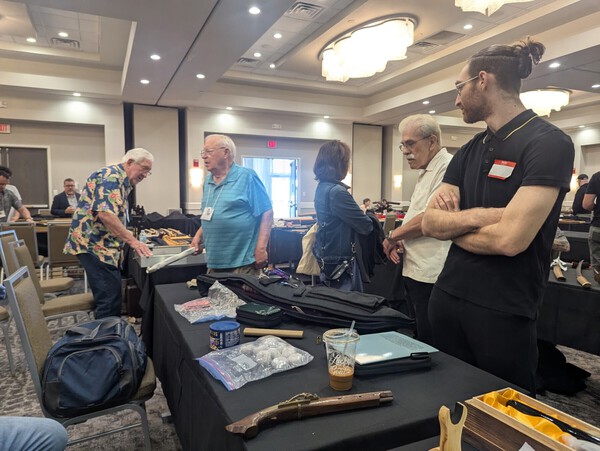
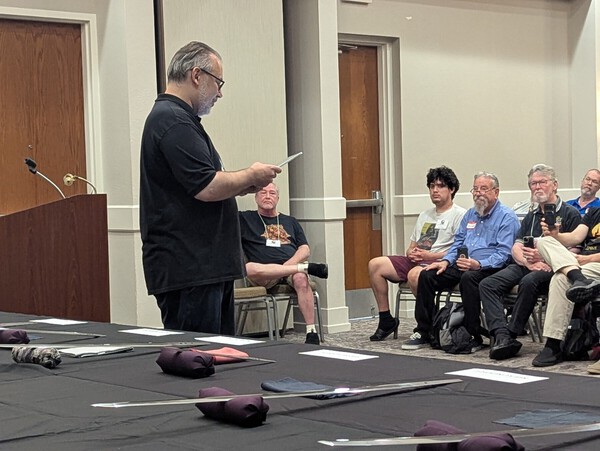
Well, another show has come and gone, and planning has already started for the next one in 2026. The show was a huge success thanks to Mark Ceskavich, Susan Ceskavich, Ray Singer, Joe Forcine and a cast of others who planned, executed, curated and lectured throughout the weekend. Special thanks to Markus Sesko for his presentation on Yamashiro blades which included a bevy of beauties from the early Kamakura through the Muromachi. Highlights included an Awataguchi, a Shintogo Kunimitsu, a Rai Kunimitsu, a Rai Tomokuni, an Enju, a Nobukuni and a Hasebe Kunishige. Tsuba show and tell and mei verification with Markus were also really popular. Sales were decent and deals were had. We look forward to seeing everybody in San Francisco and preparing for the show next year. We have some really cool ideas. Watch this space. Best, Bobby


- 1 reply
-
- 5
-

-

-
Exciting News! We’re thrilled to announce that Markus Sesko—one of the world’s leading Nihonto scholars and authors—will be offering mei assessments at the Orlando Japanese Sword Show on Saturday, June 21st! Got a sword or tsuba with a signature you're unsure about? Wondering if it’s worth submitting for shinsa? Don’t risk your hard-earned money—Markus will be on hand to help separate the genuine from the gimei. 📅 Show Dates: Friday, June 20 through Sunday, June 22 📍 Just minutes from Orlando International Airport, with easy access to Florida’s top theme parks. This year’s show features: 40+ vendors with swords, fittings, and antiques for sale Demonstrations and workshops, including an immersive session on Japanese calligraphy, oshigata-making, and tsuka-maki Bonsai and ikebana displays Tsuba show & tell And now, mei checks by Markus! Markus will also give a special talk during our Yamashiro sword exhibition and will be happy to sign exhibition catalogs and copies of his books. So, whether you're a seasoned collector or just starting your Nihonto journey, there’s something for everyone. For more information about attending, booking a room, or reserving a table, please contact organizer Mark Ceskavich at: 📧 orlandoswordshow@yahoo.com NO FOMO! Don’t miss this incredible weekend. We look forward to seeing you in Orlando!
-
- 10
-
-
-
Done, and thanks!
-
Specifically a catalogue from an NBTHK exhibition a decade or so ago called Iron Tsuba: The Works of the Exhibition “Kurogane no Hana”. If you have one and are willing to sell, please reach out here. Thanks! Bobby
-
recent shipping concerns
Mushin replied to chi fan wong's topic in General Nihonto Related Discussion
Chafan, USPS tracking and delivery issues with Nihonto have been a persistent problem for years, and things have only gotten worse since the pandemic. Even before COVID, packages were regularly misdelivered, marked as “delivered” when they weren’t, or left out in the rain without notification—just like what happened in your case. In every incident I’ve dealt with—either personally or on behalf of other collectors—the Postal Service has shown little willingness to take responsibility or resolve the problem. It often takes relentless pressure and formal complaints, even involving members of Congress, to get any movement—and even then, outcomes are hit or miss. There have also been cases of outright theft and unexplained disappearances, sometimes involving swords worth tens of thousands of dollars. Shockingly, some packages labeled “undeliverable” were routed to government auctions less than 40 days after disappearing from the USPS tracking system. This is a clear violation of USPS’s own 90-day waiting period before such items can be declared unclaimed and sold. I personally had a sword vanish, only to later discover it at a Georgia store called “Found Treasures.” They’d purchased a bulk lot of unclaimed items for pennies, less than a month after my package disappeared. Despite this, the USPS Postal Inspectors refused to investigate—citing insurance coverage as a reason there was “no victim.” Unfortunately, complaints to officials and influencers have only led to sporadic improvements. I got my sword back but I had to pay the insurance money to get it. My strongest recommendation: ask the dealer in Japan in the future to ship via UPS. Yes, it’s more expensive. And yes, they charge for things like Fish and Wildlife clearance and duties. But the peace of mind is worth it—you’re far more likely to get your sword delivered intact and on time. And by the way, Nihonto collectors aren’t the only ones dealing with this. Customs brokers tell me this is affecting antiques and art shipments across the board. So, be cautious. If you're forced to use USPS, start raising hell the moment your tracking goes dark. —Bobby -
Dear NMB friends, I wanted to personally invite you to this year’s Orlando Japanese Arts, Collectibles & Sword Show, happening June 21–23, 2025, just minutes from Orlando International Airport and not far from the theme parks if you're bringing family. Whether you're a seasoned collector or just beginning your journey into Nihonto, there will be something here for everyone. We have a few vendor tables still available, so if you’re thinking of displaying or selling, now’s the time to lock it in. Nothing to sell? Not to worry! We’re proud to be offering an experience that’s more than just tables—it’s a weekend steeped in Japanese art, tradition and craftsmanship. Here’s a quick look at what’s in store: Vendors and Displays - Some 40 vendors and collectors from around the country will be displaying and selling Nihonto, fittings and antiques on 60 tables full of treasures. Bijutsu Studio – A 90-minute hands-on workshop covering Shodo (calligraphy), Oshigata-making, and Tsuka-maki. You can learn, watch, and try your hand! Sword Etiquette Class – Essential for newcomers and a great refresher on how to handle and view authentic Samurai Swords. Tsuba Corner – Our show-and-tell for handguard lovers, from beginner to hardcore collector. Bring a favorite piece to share and learn from fellow collectors. Yamashiro Province Exhibit - .Markus Sesko will present an exhibit of important Japanese Swords from the Yamashiro (Kyoto) Tradition. A display and presentation will be followed by a “hands on” opportunity to study these treasured swords. A catalogue will also be available for purchase. Toyama Ryu & Kyudo demos, plus bonsai and ikebana displays with local club members available to chat. 📍Location: The host hotel is just 10 minutes from the Orlando airport, with easy access and great rates. It's also within driving distance of Disney, Universal, and other family-friendly destinations, so feel free to make it a sword-filled vacation! If you're interested in attending, booking a room or want a table, please comment here or reach out to organizer Mark Ceskavich at orlandoswordshow@yahoo.com. Would love to see lots of NMB members there in person. It's going to be a great weekend!

-
A katateuchi from the Muromachi generally refers to a sword with a nagasa between 53cm to 66cm. But the key feature was- like you said - a stubby nakago for one-handed fighting. That said, it’s not always easy to see at just a glance because the tangs were often reshaped (they were machi-okuri) in the Edo period to make the nakago longer and more secure for the two-handed fencing styles of the day. You have to look carefully to make sure it’s not a wakizashi or short katana. They were the iconic swords of the Sengoku period and are pretty cool, especially when you find them ubu with only one mekugiana. The one below has the marumune. (The oshigata shows an iori mune and is incorrect.)

-
I have a Sue Bizen katateuchi by Ukyo no Suke Katsumitsu that has a marumune. A good friend also has a Bizen blade by another smith from Meio that also has one. They seem to be the exception not the rule. The Katsumitsu is done in suguha with kanji for Kasuga Daimyojin on one side and Hachiman Daibosatsu on the other. Perhaps a special order that included a request for a marumune? I also believe that the Shinshinto smith Hayama Enshin always had a marumune.
-
Great work, Jussi. If I’m not mistaken, the past several Juyo shinsa pass rates have hovered well below 10%, with Session 70 ticking slightly higher than 69, but still yielding the fewest accepted swords in decades. That trend alone speaks volumes about how much more difficult the process seems now. But circling back to the Hirotsugu blade Rayhan so generously shared—while I fully agree that a polish can make or break a Shinsa decision, there’s another factor that deserves equal attention: the Shinsa teams themselves. Boards of judges rotate. Tastes shift. The standards—and even biases—of individual judges can vary from session to session. Add to that the overarching policies and guidance from the Honbu, and you have a landscape where the definition of “Juyo-worthy” is a seemingly ever movable feast. These dynamics can weigh just as heavily as polish on the final outcome. Politics, too—unfortunately the bane of all human endeavors—can sometimes color the process too. Case in point: I recently sent a mumei ko-wakizashi back to Japan for re-evaluation. It had received Tokubetsu Hozon papers, but the attribution was to a group that technically wasn’t even a formal school. Upon resubmission, the blade was again granted Tokubetsu Hozon—but this time with an attribution to one of the top-tier smiths in the history of Nihonto. It was an unbelievable dream result. At that point, I was happy to walk away with the win. I worried that submitting it to Juyo might risk a reversion to the weaker attribution. But I was told by a prominent Japanese dealer that once a Tokubetsu Hozon team makes a bold decision, the Juyo team that immediate follows will often support it because of the need to project consistency. I took the leap, and the sword passed Juyo with the improved attribution intact. I am still grinning over the result. But how much of that result was luck? How much was due to the quality of the new polish? How much was owed to the power and allure of the new attribution? Or to internal consistency within the NBTHK? I’ll never know. But I’m convinced that if I’d waited for a different session or team, the outcome could easily have changed. Timing, polish, attribution, and personnel—all of it matters. The sword has not changed. It's still the same piece. But I would lie if I said my perception of it hasn't.
-
What's the size, please, Curran?